
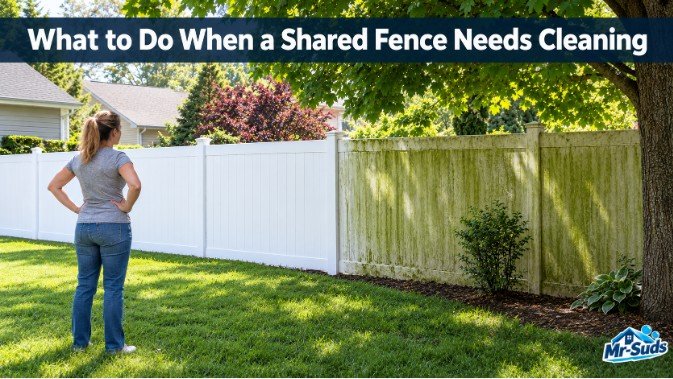
A back line in Newington, late spring. Six foot vinyl between two yards, and the customer had already scrubbed a few patches by hand on her side. The far side, under a big maple, was solid green top to bottom.
She wanted a quote for her side only. The first thing worth telling her was that it would not look finished.
That is the whole problem with a boundary fence. It has two faces, and usually only one owner who cares.
The short answer
A fence sitting on the property line is generally a shared responsibility in Connecticut, but state law addresses structural repair rather than cleaning. Treat a wash as a negotiation. Agree with your neighbour on cost and access before booking, and clean both sides in one visit so the fence does not look half finished.
The reason that last part matters is the mismatch. A fence cleaned on one side only shows the difference from every angle.
Who actually owns the fence
Three cases, and they are not always obvious from the yard.
A fence built entirely inside one property line belongs to that owner. Their fence, their decision, their bill.
A fence straddling the line is a division fence, and it is generally a shared responsibility between the adjoining owners.
A fence set back a foot or two from the line so the owner can mow behind it still belongs to whoever built it, even though it looks like a boundary fence to everyone including, often, the neighbour.
To find out for real: the deed, a survey if one exists, the town assessor and land records, and any fence permit on file. A contractor cannot determine your boundary and neither can a neighbour’s memory of what someone said in 2009.
What Connecticut law says about division fences
Connecticut fence law lives in Title 47, Chapter 823 of the General Statutes.
Section 47-43 sets out what counts as a sufficient fence and provides that adjoining proprietors each maintain half of a division fence. Section 47-49 covers the purchase of a division fence, Section 47-50 covers division of a fence by the selectmen, and Section 47-51 covers repair, including a process where town selectmen acting as fence viewers can allocate responsibility, and where a party who repairs after giving notice may recover costs from the other.
Now the part that matters for you, said plainly.
Those statutes are old, and they are written largely around enclosure and livestock. Their language is about securing fields and containing animals. They address structural sufficiency and repair, not appearance.
Nothing in them obliges a neighbour to pay for a wash.
So treat cleaning as a negotiation rather than an entitlement. For anything specific to your property, check with the Town of Newington, and for a real dispute talk to an attorney. This page is general information, not legal advice.
The “good side out” convention
The finished face of a wood or vinyl fence conventionally faces outward, toward the neighbour and the street, leaving the rails and posts facing the owner who paid for it.
That is a widely followed convention and some municipalities write it into their rules. Confirm whether anything of that sort applies locally rather than assuming it does.
Here is why it matters for cleaning. Good side out means your neighbour is usually looking at the smoother, better-looking face. That face is also the one that shows algae and dirt most clearly, and it is the face you cannot see from your own yard.
So the side you never look at is frequently the side that needs the work.
Why one side of a shared fence is always dirtier
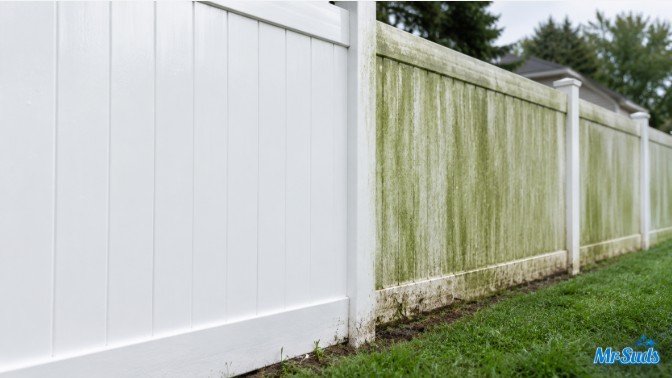
This is not bad luck. There are reasons, and they are worth knowing before you assume the neighbour has been neglecting something.
Orientation. A north facing face gets less direct sun, stays damp longer after rain and dew, and grows algae faster than a south facing one on the identical fence.
Shade and tree line. A fence under a maple or along a hedgerow stays wet, collects leaf tannin and organic debris, and greens up quickly.
Airflow. A face pressed against a hedge, a shed or a stacked woodpile never dries properly. No air movement, no drying, more growth.
Water sources. One sprinkler head aimed slightly wrong, a downspout outlet, or a low spot that holds water will do more damage to one bay of fence than a decade of ordinary weather.
Ground contact and splashback. The bottom twelve inches take mud splash and hold moisture, which is why the mismatch is always worst along the bottom rail.
Put those together and the neighbour’s side is often the dirty side through no fault of anybody’s. Which means cleaning your side alone leaves the fence looking half done from the street.
Why cleaning only your side looks worse than not cleaning at all
Fences are almost never seen straight on. They are seen at an angle, through the gaps, and from the road.
A clean face beside a green face does not read as an improvement. It reads as a stripe.
Post caps, top rails and the exposed ends of pickets are visible from both sides and cannot be half cleaned, so the boundary between done and not done sits right where the eye goes.
On wood it is worse, because cleaning lifts the grey and brings back colour. The contrast is not just dirt against clean, it is tone against tone.
Back to that vinyl fence in Newington. Her side would have come up bright white. The maple side would still have been green. From her own patio she would have seen exactly the strip she paid for and nothing else.
How to approach your neighbor and split the cost
Go in person, and go with a number rather than a concept. “Do you want to split a fence cleaning sometime” gets a vague answer. A price gets a decision.
Lead with how both properties look rather than with who is obliged to do what. Nobody responds well to being told what they owe over a fence.
Offer options, because different people say yes to different things:
- Split it evenly down the middle
- Each pays for their own side
- One pays for the cleaning and the other grants access and handles something else shared
A contractor can quote both sides separately, which removes the awkward part entirely. Nobody has to handle their neighbour’s money or chase them for half.
And use the real incentive. Doing both sides in one visit costs less per side than two separate trips, because the setup, the travel and the mobilisation happen once. That saving is the strongest argument you have, and it is honest.
What a written agreement should cover
Not a legal instrument. A short note both of you sign, so nobody misremembers.
- The fence and the specific section being cleaned
- The date and the contractor
- Who pays what, and when
- Permission to enter the neighbour’s property on that date, for that purpose
- What happens if weather moves the date
- The cleaning method, since one neighbour may object to a chlorine based mix near a vegetable bed
- What gets moved beforehand, and by whom
- Whether either of you intends to seal or stain afterwards
Anything genuinely contentious belongs with an attorney rather than a note on the kitchen table.
Access to the far side
You generally need permission to enter a neighbour’s property, and going in without it is a problem regardless of who owns the fence.
The practical obstacles are ordinary ones. Locked side gates. Dogs. A pool enclosure with a self-closing gate that cannot be propped. A narrow run between a shed and a hedge.
The way a crew handles it is to schedule the far side for a time the neighbour is home, and to confirm pets are secured before anyone opens a gate.
Some fences can be treated from a distance with a soft wash applicator and a long rinse. The far side of a solid board or panel fence usually cannot be done properly from your own yard, and pretending otherwise is how people end up paying for half a job twice.
What to do when the neighbour says no

The honest options, in order.
Clean your side anyway and accept the mismatch. Sometimes that is fine, especially on chain link or where the fence is mostly hidden.
Clean your side and offer to do theirs at your cost. This is often cheaper than the argument, and it changes the answer surprisingly often, because most refusals are about money rather than about the fence.
Wait and ask again. A no in April is frequently a yes in June, once the green is obvious from their own kitchen window.
Find out what the objection actually is. Money, chemicals near a garden, and access are three different problems with three different fixes. People rarely volunteer which one it is.
Escalate only for structural failure, never for appearance. Connecticut’s division fence provisions and the fence viewer process under Section 47-51 exist for repair disputes, not for cosmetic ones.
And keep the long view. Neighbours outlast fences.
Cleaning a shared fence by material
Vinyl
Non-porous, so the growth sits on the surface rather than in it. A soft wash mix and a low pressure rinse handles it well.
High pressure is usually unnecessary here and can drive water into post sleeves and rail pockets, where it sits. One honest limit: chalky oxidation on older vinyl will not wash off, because that is the surface breaking down rather than dirt on top of it.
Wood
The easiest material to damage and the one people most often wreck themselves.
Softwoods like cedar and pine fur and etch under too much pressure, and once the grain is raised it stays raised. Cleaning wood is a solution and dwell job, not a pressure job. Published guidance for softwood commonly sits in the 500 to 800 PSI range with a wide nozzle, and a soft wash approach uses less than that.
Expect tannin bleed on cedar. And a freshly cleaned wood fence is the moment to decide about sealing or staining, because it will never be cleaner or more ready for it than that week.
Chain link
The fabric itself is easy. The work is in what has grown through it: vines, hedge growth and packed leaf litter in the mesh.
Cleaning frequently reveals rust at the bottom rail and at the ties, which was always there and was simply hidden.
Overspray risk is highest on chain link, because there is no solid surface to stop anything. Plan for what is on the other side before anyone starts.
Composite
Behaves like composite decking. Surface mould and mildew settle into the embossed grain, and aggressive pressure can fuzz the cap layer permanently.
Manufacturer guidance often limits pressure and specifies which cleaners are acceptable, and that guidance governs. Getting it wrong can affect a warranty, which makes composite the one material where checking the paperwork first is genuinely worth the ten minutes.
At a glance
| Material | What causes the dirt | Method | Avoid | Realistic result |
|---|---|---|---|---|
| Vinyl | Surface algae and green film | Soft wash mix, low pressure rinse | High pressure into post sleeves | Uniform white, minus any oxidation |
| Wood | Algae, greying, tannin, ground splash | Solution and dwell, gentle rinse | Narrow nozzles, close passes, furring | Colour returns, ready to seal |
| Chain link | Vines, leaf litter, mesh debris | Clear growth, then wash through | Blind overspray to the far side | Clean mesh, rust now visible |
| Composite | Mould in the embossed grain | Low pressure, manufacturer approved cleaner | Aggressive pressure on the cap layer | Even finish, warranty intact |
Shared fences in Newington
Newington’s postwar neighbourhoods have back lines where three or four yards meet at a corner, so a single run of fence can touch several owners at once. That turns one conversation into three.
On the town’s regulations, residential fences are limited to four feet in the front yard and six feet in side or rear yards, with restrictions along both front sides on corner lots and a sight line limit near street intersections. Confirm current requirements, and any permit question, with the Town of Newington land use or building office, because regulations change and it is the deed and survey that control your boundary.
Connect that to cleaning and the pattern is obvious. The taller rear yard fences, under mature trees, on lots that were laid out tight, are exactly where the green side develops.
Wethersfield, Rocky Hill, Berlin and Hartford all have the same street geometry and the same problem.
Frequently asked questions
Who owns a fence on the property line? A fence straddling the line is generally a division fence and a shared responsibility. A fence built entirely inside one property belongs to that owner, even if it sits close to the boundary. The deed and a survey decide it, not appearance.
Does my neighbour have to pay half to clean a shared fence? Connecticut’s division fence statutes address structural sufficiency and repair rather than cleaning, so a wash is a negotiation rather than an obligation. Most neighbours agree once they see an actual number for their own side.
What is the good side out rule? The convention that the finished face of a fence points outward toward the neighbour and the street. It is a widely followed convention rather than a universal law, and some municipalities write it into their rules, so confirm what applies locally.
Why is one side of my fence dirtier than the other? Usually orientation, shade and airflow. A north facing or tree-shaded face stays damp longer and grows algae faster. A sprinkler head, a downspout or poor drying against a hedge will do the rest.
Can I go onto my neighbour’s property to clean my side of the fence? Not without permission. Ask first and agree a date, and confirm gates and pets. Entering without permission is a problem regardless of who owns the fence.
Can I clean only my side of a shared fence? You can, but it usually looks worse than leaving it. Fences are seen at an angle and from the street, so a clean face beside a green one reads as a stripe rather than an improvement.
What PSI should be used on a wood fence? Published guidance for softwood commonly sits in the 500 to 800 PSI range with a wide nozzle, and a soft wash approach uses less. Too much pressure raises the grain permanently, so wood is a dwell and solution job rather than a pressure job.
Can you pressure wash a vinyl fence without damaging it? Vinyl handles cleaning well, but high pressure is rarely needed and can push water into post sleeves and rail pockets. A soft wash mix with a low pressure rinse gives a better result with less risk.
How often should a fence be cleaned? Most fences here look right on a yearly or every other year cycle, and the shaded side sets the schedule. If the north face is greening while the sunny face still looks fine, that is the cue.
Getting both sides done in one visit
Back to the vinyl fence under the maple.
Her neighbour got his own quote, saw a smaller number than he expected because both sides were being done in one visit, and said yes. I have never once had a neighbour refuse after seeing a number. Only after being asked without one.
That is the offer, plainly. We will quote both sides separately so you and your neighbour can settle it however you like, and doing both in one visit costs less per side than two trips.
Mr-Suds Power Washing PROs is at 130 Dewey Ave in Newington and covers eighteen towns across central Connecticut including Wethersfield, Rocky Hill, Berlin, Hartford and Farmington. Licensed, bonded and insured, 5.0 across roughly 39 Google reviews.
Call (860) 263-9031 or email roman@mr-suds.com. First house cleaning service is 15 percent off.