
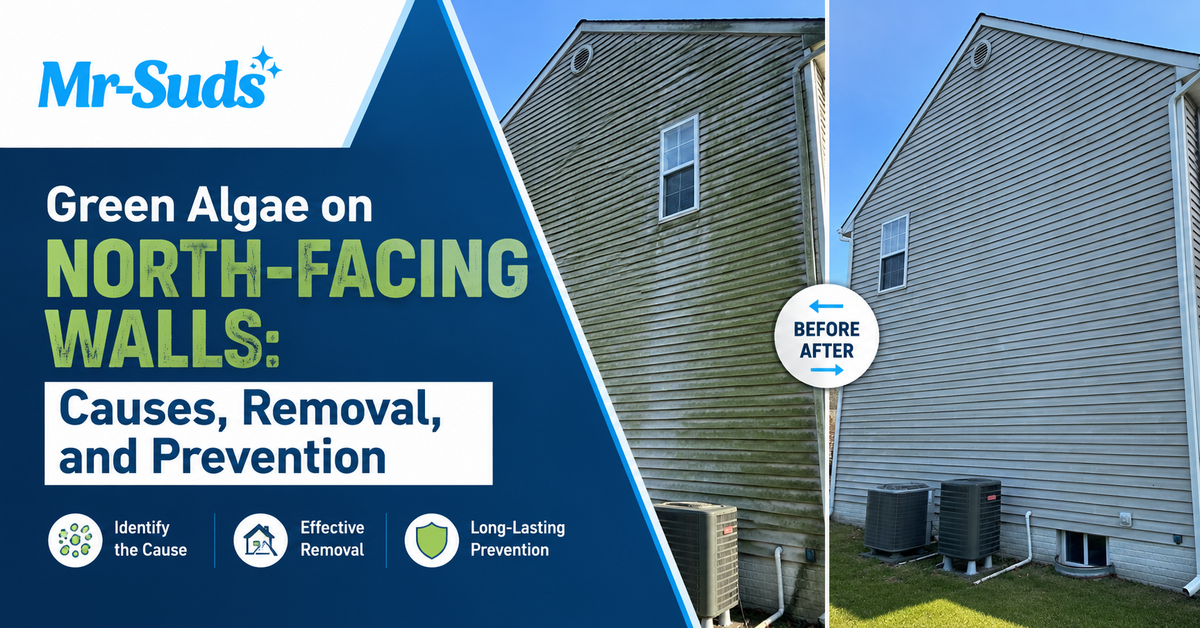
A homeowner in Glastonbury called us a few weeks ago and said, “The front of our house looks fine, but the back wall looks like it belongs in a swamp.” When I pulled up, I could see it immediately. The north-facing rear wall was covered in a green film from the foundation to halfway up the second story. The other three sides of the house were relatively clean.
This was not unusual. It is actually one of the most common calls we get at Mr-Suds across Hartford County. Almost every house we wash in Glastonbury, Avon, and Simsbury has the same pattern: the north wall is green, the other three sides are clean. It is not random. It is not a sign that something is wrong with your house. And it is not mold.
It is algae. And once you understand why it grows where it grows, the whole picture makes sense.
Green algae grows on north-facing walls because these walls receive the least direct sunlight throughout the year, keeping the surface cooler and damper than other sides of the house. In Connecticut’s humid climate, this persistent shade and moisture create ideal conditions for algae to colonize and spread. Professional soft washing is the safest and most effective removal method, and results typically last 12 to 18 months.
Why Does Algae Only Grow on One Side of Your House?
The Sun Angle Explanation Most Homeowners Have Never Heard
This is the part that clicks for every homeowner once I explain it on-site.
At Connecticut’s latitude, approximately 41 degrees north, the sun tracks across the southern sky year-round. Even on the longest day of the year in June, the sun rises in the northeast, arcs across the southern sky, and sets in the northwest. It never passes overhead in the north.
That means north-facing walls receive virtually zero direct sunlight. Not reduced sun. Not partial shade. Essentially no direct sun exposure, 365 days a year.
South-facing walls get direct sun for most of the day, which heats and dries the surface and kills algae before it can take hold. East-facing walls get morning sun. West-facing walls get afternoon sun. Both dry out during the day.
North-facing walls stay in permanent shade from sunrise to sunset, every single day. This creates a microclimate on one wall of your house that is consistently cooler, damper, and darker than the other three sides. That microclimate is exactly where algae thrives.
Moisture, Shade, and Organic Nutrients: The Three Ingredients Algae Needs
Algae is not complicated. It needs three things to grow, and Connecticut’s north-facing walls provide all three in abundance.
Moisture keeps the surface hospitable. Connecticut averages 118 precipitation days per year. Morning dew, rain, and gutter splash all contribute moisture to the siding surface. On south or east-facing walls, direct sun evaporates that moisture within hours. On a north-facing wall, it can sit all day.
Shade prevents UV light from killing algae spores. Ultraviolet radiation from sunlight is a natural algaecide. Surfaces that get regular sun exposure self-regulate biological growth to some degree. Surfaces in permanent shade do not get that benefit.
Nutrients come from airborne dust, pollen, road particulates, and organic debris from nearby trees. Connecticut’s heavy spring pollen season coats every exterior surface in a thin, nutrient-rich film. On a sunny wall, that film dries out and blows off. On a shaded, damp wall, it becomes food for algae.
Why Hartford County Homes Are Especially Vulnerable
Connecticut’s climate creates conditions that accelerate north-wall algae growth faster than many other regions.
Heavy tree canopy across suburban neighborhoods like Glastonbury, Avon, Simsbury, and Wethersfield adds shade beyond just the sun angle factor. A north-facing wall behind a row of mature oaks might get zero direct or indirect sunlight for months at a time.
Connecticut’s humid continental climate pushes humidity above 70% during summer months. That ambient moisture keeps shaded surfaces damp even between rain events.
Homes built close together in older neighborhoods like Newington, Rocky Hill, and Hartford can block airflow between houses. Reduced air circulation traps moisture against the shaded wall and extends drying time even further.
Vinyl siding, the most common siding material in Hartford County, has a textured surface with small grooves that trap moisture and give algae a physical foothold. Smooth surfaces shed water faster. Textured vinyl holds it.
What Is the Green Stuff on Your Siding? Algae vs. Mold vs. Mildew vs. Lichen
One of the first things homeowners ask when they see green on their siding is, “Is that mold?” Usually, it is not. But the distinction matters because each organism requires a different treatment approach.
Green Algae (Most Common on North-Facing Walls)
Green algae appears as a green or greenish-brown film that spreads uniformly across the siding surface, following the shade pattern. It feels smooth or slightly slimy when wet. It is a photosynthetic organism, similar to a plant, not a fungus. The most common species found on siding in Connecticut are green chlorophyte algae and, in some cases, Trentepohlia.
Algae is primarily a cosmetic issue. It does not eat the siding material the way mold does. But it does trap moisture against the surface, which can lead to secondary problems over time.
Mold (Black, Gray, or Dark Green Spots)
Mold appears as dark spots or patches, often in irregular patterns rather than a uniform film. It is a fungus that feeds on organic material in the surface, including paint, wood fibers, and accumulated dirt. Mold can penetrate into porous surfaces and cause actual material degradation.
Mold releases spores that can trigger allergic reactions and respiratory issues in sensitive individuals. It requires bleach-based or sodium hypochlorite treatment to kill, not just a rinse.
Mildew (Powdery White, Gray, or Light Green)
Mildew appears as a powdery or fluffy coating, usually lighter in color than mold. It typically stays on the surface and does not penetrate deeply. It is easier to clean than mold and common in damp, poorly ventilated areas like under eaves and behind downspouts.
Lichen (Crusty, Raised Patches)
Lichen appears as rough, crusty, raised growths, often gray-green or yellowish. It is a combination organism with algae and fungus living together in a symbiotic relationship. Lichen attaches firmly to surfaces and is very difficult to remove without professional chemical treatment.
Lichen on siding usually indicates long-term neglect, typically three or more years without cleaning. It can damage paint and shingle surfaces by rooting into the material. Roof cleaning for lichen is a separate and more intensive process.
A Simple Identification Test
You can narrow down the growth type from your phone while standing outside looking at the wall.
If the green growth wipes off easily with a damp cloth, it is likely early-stage algae. If it is dark-colored and does not wipe off, it is likely mold. If it is powdery and light, it is likely mildew. If it is raised, crusty, and firmly attached, it is likely lichen.
When in doubt, a professional can identify the growth type during a pre-wash inspection and recommend the right treatment for each.
Does Green Algae Actually Damage Your Siding?
Short-Term: Cosmetic Only
In the first few months, algae sits on the surface. It can be washed off without leaving any marks or residue. At this stage, the issue is purely about appearance. No structural risk to the siding.
If you catch it early, a DIY vinegar wash or a professional soft wash handles it quickly and completely.
Long-Term: Moisture Retention and Secondary Damage
Left in place for a year or more, algae starts creating real problems beyond appearance.
The algae layer acts as a moisture trap against the siding. It prevents the surface from drying out between rain events. On painted wood siding and trim, this constant moisture contact causes paint to blister, peel, and lose adhesion. On wood surfaces, prolonged moisture retention from algae can initiate early-stage rot.
More importantly, established algae creates conditions for mold and lichen to colonize the same surface. Once lichen takes hold, it roots into the material and is far more difficult and expensive to remove than algae alone.
In Connecticut, trapped moisture on north-facing walls going into winter also contributes to freeze-thaw damage on adjacent brick, concrete, and mortar surfaces. The connection between biological growth and winter damage is something most homeowners never consider.
The Cost of Waiting Too Long
Annual professional cleaning runs $250 to $500 for a full house wash. Repainting after algae-caused paint failure costs $1,000 to $5,000 or more depending on the extent. Wood trim and fascia replacement after moisture damage runs $500 to $3,000 or more.
The longer algae stays in place, the more expensive the eventual solution becomes.
How to Remove Green Algae Safely (Without Damaging Your Siding)
Why Soft Washing Is the Right Method (Not High-Pressure)
This is the mistake I see most often with DIY algae removal. The homeowner rents a pressure washer and blasts the siding to get the green off.
High-pressure water can force water behind vinyl siding panels, where it sits in the wall cavity and creates a moisture problem inside the house. It can strip paint from wood siding and trim. It can leave visible wand marks on vinyl that look almost as bad as the algae.
Soft washing is fundamentally different. It uses low-pressure application, similar to a garden hose, combined with a professional cleaning solution. The solution does the work, not the force of the water.
The cleaning mix, typically sodium hypochlorite with a surfactant blend, kills algae at the root level, not just on the surface. This is why soft wash results last 12 to 18 months. DIY rinsing without a root-killing solution allows regrowth in as little as 4 to 8 weeks because the root system is still alive under the surface.
When we soft wash a north-facing wall, we always tell the homeowner: this side will need attention sooner than the other three. It is simply the nature of the exposure. But 12 to 18 months of clean siding versus 4 to 8 weeks from a garden hose rinse is a significant difference.
The Professional Soft Wash Process (Step by Step)
Here is exactly what the process looks like when our crew arrives.
Pre-soak landscaping. All plants, grass, and flower beds around the work area are thoroughly watered before any cleaning solution is applied. This creates a protective water barrier in the soil and on the leaves.
Apply cleaning solution (bottom to top). The biodegradable sodium hypochlorite and surfactant mix is applied to the siding from the bottom up. Applying from the bottom prevents the solution from running down over dry siding, which can cause streaking.
Dwell time (5 to 10 minutes). The solution sits on the surface to penetrate the algae biofilm and kill the organism at its root. This dwell time is critical. Without it, you are just rinsing, not killing.
Rinse (top to bottom). Low-pressure rinse from the top down pushes all solution, dead algae, and debris downward and off the surface.
Post-rinse landscaping. A second rinse of all nearby plants and grass dilutes any residual solution that may have reached the ground.
Inspection. Walk the perimeter to check for missed spots, any remaining stains, or damage that was hidden under the algae. This step often reveals things the homeowner did not know about.
DIY Options for Light Algae Growth
For light, early-stage green film that has been visible for less than three months, DIY cleaning can work.
Mix 1 cup of white vinegar with 1 gallon of water. Apply with a soft-bristle brush, scrub gently in a circular motion, and rinse with a garden hose. For slightly more stubborn surface growth, mix 1/3 cup oxygen bleach (sodium percarbonate) with 1 gallon of water. This is stronger than vinegar but still safe for vinyl siding.
Two things to avoid. Do not use a pressure washer on siding for algae removal. And do not use undiluted chlorine bleach directly on vinyl siding. Full-strength bleach can discolor certain siding colors and weaken the material with prolonged contact.
If the algae has been growing for more than six months, covers a large area, or is on a second story, call a professional. At that point, the root system is established and DIY surface cleaning will not prevent rapid regrowth.
How to Prevent Green Algae From Growing Back
Cleaning removes the current growth. Prevention slows its return. Since you cannot move your house to change which wall faces north, the strategy is to reduce the moisture and nutrients that feed the next cycle.
Landscaping Adjustments
Trim trees and shrubs near the north-facing wall to improve whatever sunlight and airflow you can gain. Even indirect light helps dry the surface faster between rain events.
Maintain at least 12 inches of clearance between landscaping and the siding surface. Bushes and plants pressed against the wall trap moisture and block air circulation.
Remove any garden beds or mulch piles that sit directly against the siding. These hold moisture at the base of the wall and create a launching point for algae growth that climbs upward.
Gutter and Drainage Maintenance
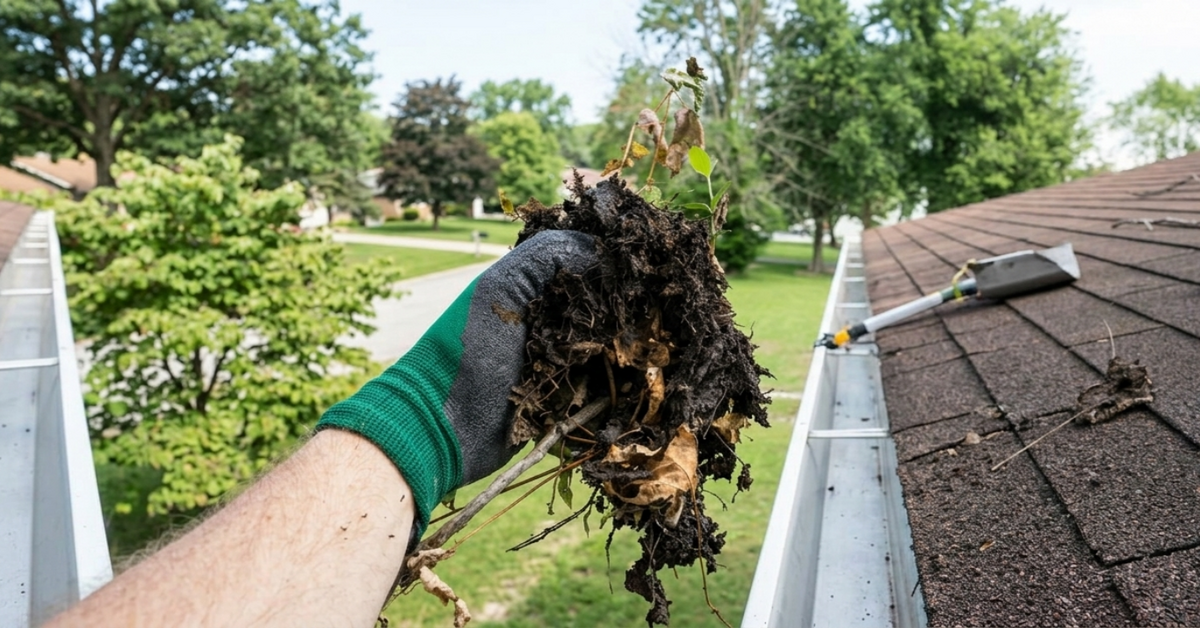
Clean gutters at least twice a year, spring and fall. Overflowing gutters are one of the biggest moisture sources for the wall directly below them. Fix any leaking, cracked, or poorly aligned gutter sections that allow water to run down the siding face.
Ensure downspouts direct water away from the foundation, not alongside the siding. A downspout that dumps water against the base of a north-facing wall feeds the moisture cycle that algae depends on.
Airflow Improvement
Avoid stacking firewood, storage bins, or equipment against the north-facing wall. Anything pressed against the siding blocks airflow and creates a damp, dark pocket that algae loves.
If possible, relocate structures like sheds, fences, or pergolas that block airflow to the shaded side. In dense neighborhoods, even small improvements in airflow make a measurable difference in how quickly the surface dries after rain.
Annual Professional Cleaning
The single most effective prevention measure is an annual soft wash. Professional-grade cleaning solutions include algaecides that slow regrowth for 12 to 18 months. That is significantly longer than any DIY rinse or consumer cleaning product.
Pairing annual house washing with gutter cleaning addresses the two biggest algae contributors, shade-driven moisture and overflow-driven moisture, in a single service visit. Many Hartford County homeowners schedule both together in spring or early fall.
Frequently Asked Questions
Why is only one side of my house turning green?
The north-facing wall receives virtually no direct sunlight at Connecticut’s latitude. The sun tracks across the southern sky year-round, which means the north wall stays in permanent shade from sunrise to sunset, every day of the year. This persistent shade keeps the surface cooler and damper, creating ideal conditions for algae growth that the other three sides simply do not provide.
Is green algae on siding harmful to my health?
Green algae itself is not typically harmful to humans. It is a photosynthetic organism, similar to a plant. However, if left untreated for an extended period, algae creates moisture conditions that allow mold to colonize the same surface. Mold spores can trigger allergic reactions and respiratory issues in sensitive individuals. The health concern is secondary, from mold that follows algae, rather than from the algae directly.
Can I pressure wash algae off my siding?
You can, but it is not recommended. High-pressure washing forces water behind vinyl siding panels, can strip paint from wood surfaces, and often leaves visible wand marks. Soft washing, which uses low-pressure water combined with a professional cleaning solution, is safer, more effective, and produces results that last 12 to 18 months because it kills the algae at the root rather than just rinsing the surface layer away.
How often should I clean algae off my north-facing wall?
In Hartford County, most north-facing walls need cleaning once a year. Walls with heavy tree coverage or poor airflow may need attention every 8 to 12 months. By comparison, south and east-facing walls with good sun exposure can often go 18 to 24 months between cleanings. Your north wall will always need cleaning more frequently than the rest of the house.
Will the algae come back after cleaning?
Yes. Algae will eventually return because the conditions that caused it, the shade, moisture, and nutrient supply, are still present. Professional soft washing slows regrowth significantly because the cleaning solution kills algae at the root and includes growth inhibitors. DIY rinsing without professional chemicals allows regrowth in as little as 4 to 8 weeks.
What does professional algae removal cost?
A full house soft wash in Hartford County, covering all four sides plus trim and soffits, costs approximately $250 to $500 depending on home size. If only the north-facing wall needs treatment, a targeted wash costs less. Many homeowners combine the wash with gutter cleaning for a bundled price through companies like Mr-Suds.
Keep Your North Wall as Clean as the Rest
Green algae on your north-facing wall is not a sign that something is wrong with your house. It is a completely normal biological response to the shade, moisture, and nutrients that every north-facing surface in Connecticut deals with. Your house is not failing. Your siding is not defective. The sun just does not reach that wall.
The solution is straightforward. Professional soft washing removes the growth safely and keeps it from coming back for 12 to 18 months. Combined with simple prevention steps like trimming vegetation, maintaining gutters, and improving airflow, you can keep your north wall looking as clean as the rest of your house year-round.
Ready to get rid of the green? Call Mr-Suds at (860) 263-9031 or request a free quote. One wash and you will see the difference.