
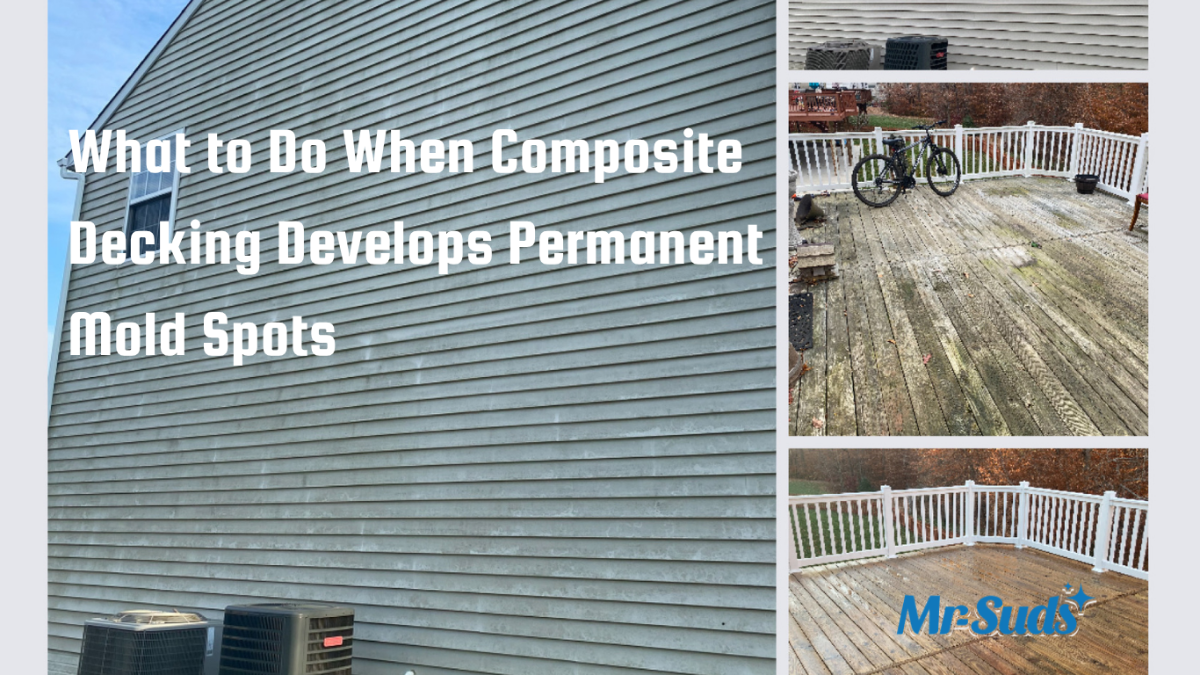
Most permanent looking mold spots on composite decking are one of three things: live mold on the surface film, tannin stains from wet leaves locked into the cap layer, or pitting in older uncapped board. The first two clean off with the right chemistry. Only the third is truly permanent.
Which one you have decides everything: the product, the method, the cost, and whether cleaning is even the answer. There is a five minute test further down that sorts it, and it is the reason our deck cleaning and restoration visits usually start with a diagnosis rather than a hose.
First, the Spots on Your Composite Deck Are Probably Not What You Think
Mold does not eat plastic. It does not eat the polyethylene or the PVC in your boards, and it has no interest in the wood flour once that flour is sealed inside a polymer matrix. According to the EPA’s guidance on mold and moisture, mold needs an organic food source and moisture to grow it does not consume synthetic building materials themselves.
What mold eats is what lands on top.
Pollen in May. Oak and maple tannin from every leaf that sits wet. Grill grease. Dust. Dead insects. Whatever the dog tracks up. All of that builds a thin organic film across the boards, and that film is the meal.
So the black spots are not your deck failing. In most cases they are growing on a layer of debris that is sitting on your deck, which is why they come back after you clean and why they concentrate exactly where debris collects.
Why “Maintenance Free” Was Never True
Somebody sold you this deck as maintenance free, and that is why you are annoyed. Fair enough.
What composite actually delivers is freedom from the maintenance wood needs. No sanding, no stripping, no staining every two or three years, no splinters, no rot.
What it does not deliver is freedom from washing. Nothing outdoors is free from washing. A glass table on the same deck gets dirty. A vinyl fence gets dirty. Composite is no different, it just does not need to be refinished afterward.
Low maintenance, not no maintenance. Once you accept that, the rest of this is straightforward.
The Three Things People Call Permanent Mold Spots
Here is the diagnostic core. Read all three, then run the test.
The reason this matters so much is that the wrong product on the right stain does absolutely nothing. Chlorine on a tannin stain is a wasted afternoon. Acid on live mold is a wasted afternoon. Most people who tell us “I already tried a cleaner and nothing happened” simply used the wrong category.
Type 1: Live Mold and Mildew on the Surface Film
This is what most people have, and it is the good news outcome.
What it looks like: blotchy or slightly fuzzy edges rather than sharp ones. Grey, green or black. It sits proudly on top of the board rather than looking like it is part of it.
Where it lives: the shaded third of the deck, the strip along the house wall where the siding blocks airflow, the north side, and anywhere under furniture that never moves.
How to confirm it: scrape gently with a fingernail or a plastic putty knife. Live growth on a surface film will smear or lift. You will get material on the knife.
Outcome: cleans off completely with the right chemistry and correct dwell time. No trace left. Our soft washing process is built specifically for this type of growth.
Type 2: Tannin and Leaf Stains Locked in the Cap Layer
This one fools almost everybody, including plenty of contractors.
What it looks like: sharp edges. Very often literally the shape of a leaf, sometimes with the vein pattern still readable. The color runs brown, purple, or a brownish black rather than the grey black of mildew.
Where it lives: wherever organic debris sat wet for a long time. Under a doormat that spent the winter out. Along the edge where leaves pile against the rail. In the corner where the gutter overflows.
How to confirm it: it will not scrape off, and it does not respond at all to a chlorinated cleaner. It is dead level with the surrounding board, and the board texture underneath is completely normal.
What it actually is: tannin is a natural chemical in oak, maple and pine. Wet leaves leach it, and it soaks into the polymer cap and bonds there. This is a chemical stain, not a living organism.
Outcome: chlorine does nothing to it. An oxalic acid based deck brightener will lift most or all of it. Different product, different mechanism.
Type 3: Pitting and Etching in Uncapped Board
This is the genuinely permanent one, and it is the reason this article exists.
What it looks like: dull, chalky and slightly sunken. Freckled rather than blotchy. The board has lost its sheen in that area, and crucially the discoloration appears to be inside the texture rather than sitting on it.
How to confirm it: run your palm across it. A pitted area feels noticeably rougher than an undamaged section of the same board. Look at it under raking light, meaning low angle sun early or late in the day. Pitting shows up as texture. A stain does not.
What happened: on uncapped composite, the smooth skin formed during manufacture wears off under traffic, weather and cleaning. Underneath is wood flour mixed with plastic. That exposed flour has none of the natural extractives real cedar or redwood has, so fungus grows in it and into it. The surface pits, and the discoloration is in the pit.
Outcome: cleaning improves the color and cannot restore the surface. This is the case where honest options are coating, board swapping or replacement, all covered below.
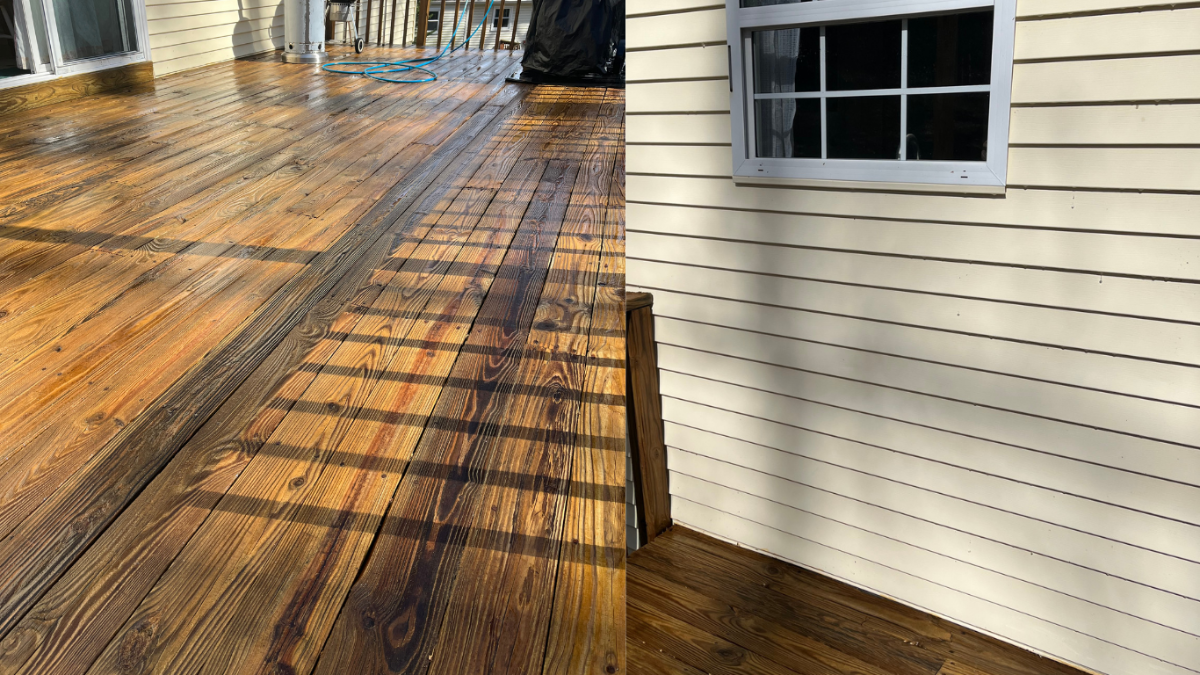
The Five Minute Test You Can Do This Afternoon
Pick your worst spot and work through these in order.
- Wet it and wipe it. Pour a little water on the spot and wipe firmly with a cloth. If it lightens noticeably, you have surface material, which points to Type 1.
- Scrape it. Use a fingernail or a plastic putty knife, not metal. Material coming off on the blade means Type 1. Nothing coming off means Type 2 or Type 3.
- Feel it. Run a bare palm across the spot, then across clean board nearby. If the spot is rougher, you are looking at Type 3.
- Check it under raking light. Crouch down and look across the board at a low angle in early morning or late afternoon sun. Texture change means Type 3. Flat discoloration means Type 2.
- Test one spot with an oxygen cleaner. Mix a small amount of an oxygenated deck cleaner, apply to one spot, let it sit the recommended time, then rinse. Significant improvement confirms Type 1. No change at all points at Type 2 or Type 3.
- Write down what you got. If the deck gives you different answers in different areas, that is normal and it is what we usually find.
Capped Versus Uncapped, and Why the Year Matters
This single fact explains more composite deck complaints than everything else combined, and no manufacturer is going to spell it out for you.
Uncapped composite, made from roughly the late 1990s through the 2000s, is wood flour and plastic mixed together and extruded. The wood is distributed all the way through the board, including at the surface. There is no protective shell.
Wood flour in a composite board has been processed. It has lost the natural extractives, the oils and tannins, that make cedar and redwood naturally fungus resistant. So it is arguably better fungal food than real wood.
While the factory skin is intact, it is fine. Once traffic, weather and cleaning wear that skin off, the flour is exposed and the trouble starts.
Capped composite, which became standard around 2010 and after, carries a polymer shell bonded over the core. That capstock is a genuine barrier. Mold can grow on the film sitting on top of it, but it cannot get into the material. Major manufacturers such as Trex publish their own deck care and cleaning guidance, which is worth checking against whatever brand you own before applying any cleaner.
The difference is not marketing. It is a different product. Mold and mildew problems on first generation composite were widespread enough to produce class action settlements, and the industry redesigned around it.
How to Tell Which One You Have
Four ways, easiest first.
- Look at an end cut or the underside of a board. Capped board shows a visibly different colored skin over a different colored core, like a crust on bread. Uncapped board is the same material all the way through.
- Look at the underside profile. Many capped products have a scalloped or ribbed underside for weight, and often only three sides are capped, so the underside may look and feel completely different from the top.
- Check the paperwork. The deck permit, the seller’s disclosure or the original invoice will date the install. Anything before roughly 2009 is very likely uncapped.
- Look at the fasteners. Face screwed with visible screw heads is more typical of the earlier era. Hidden fastener systems in a grooved edge became common later.
Worth knowing locally: a great many Hartford County decks went in between roughly 1999 and 2008, right in the middle of the uncapped era. If you bought a house here with an existing composite deck, there is a real chance you own first generation product without ever having been told.
Field Story: A North Facing Deck in Newington
A cape off a quiet street in Newington, deck built in the early 2000s, facing north and backing directly onto mature oaks.
The homeowner had been at it twice already with a big box deck cleaner and a stiff brush. Some spots faded. Most did not. By the time she called, she was mostly asking whether it was worth replacing the whole thing.
On site there were three separate problems on one deck, which is why nothing she tried had worked across the board.
Along the house wall, in the shaded strip where the siding blocks air movement, there was classic live growth. Grey blotches with soft edges that smeared under a putty knife. That section came off completely with soft wash chemistry in a single dwell, no scrubbing needed.
Near the slider, where a doormat and a pile of oak leaves had wintered over together, there were sharp edged brown black marks. Two of them were unmistakably leaf shaped. Chlorine had done nothing to them because there was nothing alive there. Those needed a separate oxalic acid brightener pass, and they came out to maybe ninety percent.
And then a two board stretch at the top of the stairs, the highest traffic spot on the deck. Dull, freckled, rough under your hand. That was worn through to the core, and it never came all the way back.
Same deck. Same afternoon. Three different answers.
Roman’s summary to her was straightforward: most of this is coming off today, a bit of it is coming off with a different product, and two boards are not coming back and we should talk about what to do with them.
She kept the deck. It is worth saying that plainly, because she called believing she was pricing a replacement.
The Right Way to Clean a Composite Deck Without Wrecking It
Composite punishes force and rewards patience. Nearly all of the genuinely damaged composite we see in Hartford County was damaged by someone trying to clean it.
Check the Manufacturer’s Limits Before You Touch It
This is the step everyone skips and it is the one with money attached.
Pressure limits are brand specific. Across the major manufacturers, published ceilings run roughly from 1,000 to 3,100 PSI. Several common lines cap around 1,500 PSI with a fan tip held well back from the surface. Some early generation products are not to be pressure washed at all, at any setting.
Chlorine permission is also brand specific. Some manufacturers explicitly permit diluted sodium hypochlorite. Others prohibit it outright and will treat its use as grounds to decline a warranty claim.
There is no universal answer, which is exactly why the internet’s confident advice is so unreliable here. Find your brand first. Look for a stamp on the underside of a board, check the permit, or ask the previous owner.
If you cannot identify the brand, treat the deck as restricted and use the gentlest approach. That is the same principle behind our pressure washing in Hartford CT approach generally: when in doubt, less pressure and more chemistry.
The Soft Wash Method We Use
This is what actually works, and none of it involves force.
- Clear the deck first, dry. Furniture off, dry sweep or blow the boards, and clear the gaps between boards. Debris packed in the gaps holds moisture against the board edges and it is the source of half the growth on most decks.
- Pre-wet everything below and around. Plantings, lawn, foundation beds, siding. Wet foliage dilutes anything that reaches it.
- Apply a low dilution sodium hypochlorite mix with a surfactant, on brands that permit it. The surfactant is not optional. It makes the solution cling to a horizontal surface long enough to work instead of running off into the gaps in thirty seconds.
- Let it dwell, and keep it wet. The chemistry does the work during the dwell. If it dries on the board it has stopped working and it can leave a residue mark. Mist as needed.
- Agitate gently with a soft bristle brush, working with the grain, board by board. Nylon or similar. Never a wire brush.
- Rinse thoroughly and completely. Boards, gaps, the underside of the deck, the joists, the siding behind it, and the ground below. Then rinse the plantings a second time for good measure.
Roman’s version of the philosophy: pressure is the fastest way to make a composite deck look better today and worse in three years. Chemistry and patience cost you an hour and cost the deck nothing.
That is soft washing, and composite is the surface it was invented for.
When Oxygenated Cleaner Is the Right Call Instead
Three situations call for an oxygenated product rather than a chlorinated one.
Your brand prohibits chlorine. The deck sits directly over sensitive plantings you would rather not risk. Or the soil is light and seasonal rather than heavy established growth.
Oxygenated cleaners, usually sodium percarbonate based, work by releasing oxygen. Two things they need that people rarely give them: warm or hot water to activate properly, and real dwell time.
Be realistic about what you get. Against light surface soil and mild mildew they work well. Against heavy established biological growth in a shaded north facing corner, they underperform a properly diluted chlorinated mix by a wide margin.
Tannin Stains Need Acid, Not Bleach
If your test said Type 2, put the bleach away.
Use an oxalic acid based deck brightener, the same category used on wood decks. Apply it to an already cleaned surface, because you want it working on the stain rather than on the grime above it.
Apply it across the full board, edge to edge, not just on the spot. Brighteners lighten. Spot treating a tannin stain in the middle of a board is how you trade a dark mark for a light patch, which reads just as obviously.
Let it dwell per the label, then neutralize and rinse thoroughly.
One caution that applies to both acid and chlorine products: either can lighten some composite formulations. Test on a hidden board, under the grill or behind a planter, before you commit to the whole deck.
What Never to Use on Composite Decking
Blunt list. Every one of these has come across a deck we were called to look at.
- No wire brush. It scratches the cap and, on uncapped board, opens the core directly.
- No rotary surface cleaner. Designed for concrete. It will scour composite and leave visible arc marks.
- No turbo nozzle or zero degree tip. Ever, on any brand, at any distance.
- No solvents. Acetone, mineral spirits, paint thinner, brake cleaner. These attack the polymer itself and the damage is instant and permanent.
- No sanding. People try this on uncapped board hoping to get under the stain. You are removing the last of the factory skin and exposing more wood flour. It always looks worse within a year.
- No pressure held close enough to fuzz the surface. Once you raise fuzz on a composite board, that texture holds dirt permanently and no amount of cleaning gets it back.
If the Damage Really Is Permanent, Here Are the Honest Options
If your test came back Type 3, cleaning will improve the color and will not restore the surface. Nobody can change that with a product.
Roman would rather say that on the estimate than have somebody find out after paying for a wash that was never going to fix it. So here are the three real paths.
Composite Rated Stain and Coating Products
They exist, they are made specifically for composite, and on a properly cleaned and prepped deck they work.
Understand the trade you are making, because it is permanent. You now own a coated deck. It has a recoat cycle, it can peel if it is applied over inadequate prep or trapped moisture, and it takes composite out of the low maintenance category you bought it for.
That is a legitimate choice on a deck with ten good years left in the structure and a surface nobody wants to look at. It is not a small decision, and it is not reversible in any practical sense.
Flipping and Swapping Boards
The most underused fix, and often the cheapest real one.
Grooved boards with hidden fasteners usually cannot be flipped, because the top and bottom profiles differ. But swapping is nearly always possible.
Take the worst boards out of your main sightline and move them to a low visibility run: along the rail behind the furniture, under the grill, the section around the corner nobody uses. Move the good boards to where you actually look.
A Wethersfield deck we could not fully save. Uncapped product with a row of planters that had lived in the same spot for years. The boards under them had gone chalky and freckled from constant trapped moisture, and no amount of chemistry brought that surface back.
Cleaning brought the rest of the deck to a color the owner was genuinely happy with. Then we swapped the four planter row boards with boards pulled from a screened section along the rail where nobody looks.
Cost a fraction of a replacement. From the kitchen window, the deck reads clean. The damaged boards still exist, they are just somewhere that does not matter, and the planters now sit on feet.
Partial or Full Replacement
Sometimes it is the answer, and we will tell you when we think it is.
The thing to know before you start pricing it: color matching across generations rarely works. A modern capped board next to a fifteen year old uncapped board will not match, no matter what the color name says, because the older board has weathered and the material is different. This Old House has a useful overview of composite decking options if you are weighing replacement versus resurfacing.
So partial replacement often means accepting a visible difference or replacing a whole run rather than a board.
Frame the decision as cost per remaining year of deck life. If the framing and joists are sound and you have a decade left, a resurface with new boards is reasonable. If the substructure is aging too, that changes the math.
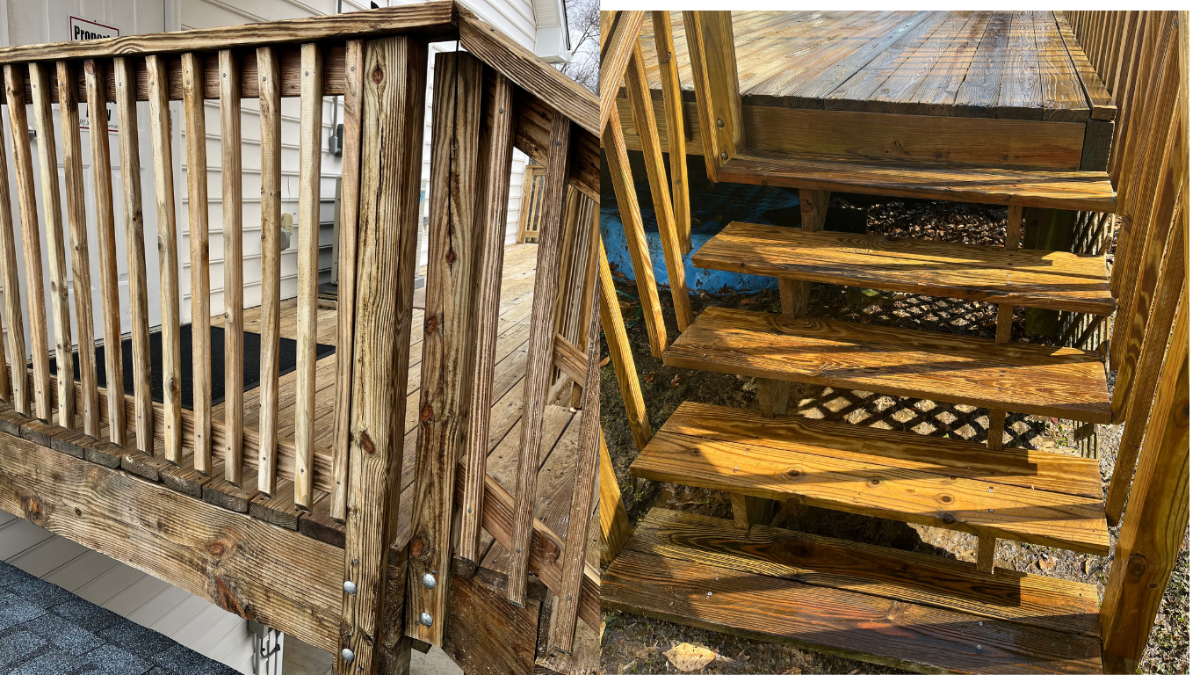
Keeping the Spots From Coming Back in a Connecticut Climate
The spots come back when the food film comes back. Everything below is about not feeding it.
The October and November Leaf Rule
Blow the deck weekly through leaf drop instead of once at the end of the season.
That is the whole rule and it does more than any product. Here is why it matters so much specifically in Hartford County.
Our canopy is oak and maple, both heavy tannin producers. Oaks around here hold their leaves well into December, so the drop is long. And a matted wet leaf left on a composite board for three weeks is not a chore you postponed, it is a tannin stain you are creating in real time.
Five minutes with a blower every weekend in November prevents the exact stains that make people search this topic in April.
Airflow, Gaps and Standing Water
- Clear the board gaps. Use a putty knife or a purpose made gap tool once or twice a year. Packed gaps hold moisture against the board edges permanently.
- Keep the space under the deck open. Stored lumber, bikes, bags of mulch and a tarp under there kill airflow and keep the underside damp. A deck that can breathe from below dries from below.
- Fix gutter overflow. An overflowing gutter dumping onto one section of deck creates a permanently wet strip, and that strip will be the first place growth appears every year. It is also usually a five minute fix, which is why gutter cleaning in Newington so often solves a deck problem nobody connected to the gutters.
- Get planters and mats off the boards. Rubber backed mats are the worst offenders, because they hold water against the surface and block all evaporation. Planters need feet under them.
Winter and Spring
Two seasonal things create most of the marks people find in April.
Snow sits on a deck here for weeks at a time, and anything left out sits under it. Furniture feet, a forgotten mat, a bag of ice melt. When the snow finally goes you find perfect rings and rectangles where nothing could dry for two months.
Then, right when you are ready to clean it, heavy oak and pine pollen lands in late April into May and reloads the organic film within days of a wash. Elevated indoor and outdoor mold exposure has also been linked to respiratory irritation, according to the CDC’s guidance on mold and health, which is one more reason not to let a damp, debris covered deck sit against the house all season.
That timing is the argument for washing after pollen drop rather than before it. Washing in mid April in central Connecticut means doing it twice.
The Annual Soft Wash
Once a year is the right cadence for most composite decks here.
Either in spring after pollen drop, roughly late May, or in fall after leaf drop, roughly late November. Spring is more popular. Fall is arguably better, because you go into winter with a clean surface and nothing feeding growth under the snow.
Note the season limit either way. Cleaners stop performing properly below roughly 40 to 45 degrees, so the working window in central Connecticut runs about April through early November.
The same annual cadence applies to any stained or painted structures nearby, which is why fence cleaning usually gets scheduled on the same visit.
Frequently Asked Questions
Why does composite decking get mold if it is supposed to be maintenance free? Because mold eats what lands on the deck, not the deck itself. Pollen, leaf tannin, grease and dust form an organic film across the boards, and that film is the food. Composite means no sanding or staining, not no washing. Nothing outdoors stays clean by itself.
Are black spots on composite decking permanent? Usually not. Live mold on the surface film cleans off completely, and tannin stains in the cap layer lift with an oxalic acid brightener. Only pitting in older uncapped board is genuinely permanent, and you can identify that by feeling a rougher texture where the discoloration is.
What is the difference between mold stains and tannin stains on a composite deck? Mold has soft blotchy edges, smears when scraped, and responds to chlorinated cleaners. Tannin stains have sharp edges, are often literally leaf shaped, sit flush with the surface, and do not respond to chlorine at all. Tannin needs an oxalic acid based deck brightener instead.
Can you pressure wash composite decking without voiding the warranty? It depends entirely on the brand. Published limits range roughly from 1,000 to 3,100 PSI, several lines cap around 1,500 PSI with a fan tip held well back, and some early generation products prohibit pressure washing completely. Identify your brand before you start, or soft wash instead.
Does bleach damage composite decking? It depends on the manufacturer. Several permit diluted sodium hypochlorite, several prohibit it outright and may decline warranty claims where it was used. Both chlorine and acid products can lighten some formulations, so test on a hidden board under the grill before treating the whole deck.
What PSI is safe for composite decking? There is no universal number, which is the problem with most advice online. Many common lines cap around 1,500 PSI with a wide fan tip held well back from the surface, but some allow more and some allow none. When you cannot identify the brand, use low pressure chemistry instead.
How do I know if my composite deck is capped or uncapped? Look at an end cut or the underside of a board. Capped board shows a distinct colored shell over a different colored core. Uncapped board is the same material throughout. Install date also helps: anything before roughly 2009 is very likely uncapped first generation product.
What removes leaf stains from composite decking? An oxalic acid based deck brightener, applied to an already cleaned surface. Chlorine will not touch tannin because there is nothing alive in the stain. Apply the brightener across the full board rather than spot treating, or you will replace a dark mark with a lighter patch.
Can you paint or stain composite decking? Yes, with products made specifically for composite and on a properly cleaned and prepped surface. Understand the trade first. You are converting a low maintenance deck into a coated one with a recoat cycle and a risk of peeling, and there is no practical way back.
How often should a composite deck be cleaned in Connecticut? Once a year for most decks. Either late May after pollen drop, or late November after the oaks finish. The working season here runs roughly April through early November, since cleaners underperform below about 40 to 45 degrees. Shaded north facing decks sometimes want twice.
Why do the spots come back every spring? Because the organic film comes back. Winter puts leaves, snow and debris on the boards for months with no drying, and heavy oak and pine pollen lands in late April. Weekly blowing during leaf drop and keeping the board gaps clear does more than any product.
Should I replace the whole deck or just the worst boards? Start with a proper cleaning, because most decks look dramatically better afterward and the decision changes. If specific boards are pitted, swapping them with boards from a low visibility run is usually far cheaper than replacement, and color matching across generations rarely works anyway.
Get a Straight Answer About Your Deck
If you have scrubbed those spots twice and they are still there, the useful next step is not a third cleaner. It is finding out which of the three problems you actually have.
We will come out, run the same tests described above, and tell you plainly: this comes off, this needs a different product, and this is not coming back. If the honest answer is that two boards are past saving and everything else will clean up fine, that is what you will hear before anything is quoted.
We serve Newington, Wethersfield, Rocky Hill, West Hartford, Glastonbury, Berlin and Farmington, Monday to Friday, 8am to 4pm. Deck season here runs roughly April through early November.
Book deck cleaning and restoration, or get a free quote and send a close up photo taken in low angle light so we can see whether the discoloration has texture.
Mr-Suds Washing, Newington, CT. Licensed, bonded and insured. Call (860) 263-9031.