
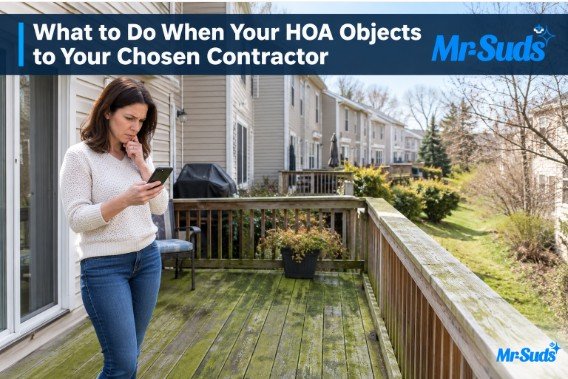
Early spring, a central Connecticut condominium development, attached units with a small assigned deck off the back slider. The deck had gone green and slick over the winter and there was a family gathering coming.
The owner booked the job. Then, two days later, forwarded an email from the management company: the contractor is not approved, work cannot proceed.
She read that as her contractor being rejected. It was not what it meant.
The short answer
Most HOA objections to a contractor come down to three things: no certificate of insurance on file, the contractor is not on the approved vendor list, or the surface belongs to the association rather than to you. Identify which one applies, supply the missing document, and appeal in writing if the objection stands.
Why associations object, and which reason yours is
Boards and managers are usually protecting the building and the other owners, not blocking you personally. Nine times out of ten they are not objecting to us, they are objecting to a blank space in a file.
There are five reasons, and the fix is different for each.
No certificate of insurance on file
This is the most common one by a wide margin.
A management company cannot let an unknown crew work on the property without proof of general liability coverage, and usually workers compensation as well. Many also ask to be named as an additional insured on the policy for the duration of the work.
That is not bureaucracy for its own sake. If something goes wrong on a shared building, the association is in the chain, and a certificate is the only thing that tells them who carries the risk.
It is also the easiest objection in the world to fix. An agent can usually issue a certificate the same day, with the association named exactly as the manager wants it written.

The contractor is not on the approved vendor list
Approved vendor status is an administrative process, not a verdict on the company.
Most associations will add a vendor who submits the right paperwork, and it is often a one-time thing. Once your contractor is on the list, they stay on it.
The surface is a common element, not yours to touch
This is the substantive objection, and it is the one worth taking seriously.
Siding, roofs and most of the building exterior are typically association property. An owner cannot unilaterally hire work on them, and no amount of paperwork changes that.
Association-wide cleaning is already contracted
The reason nobody writes about, and it comes up constantly.
Boards schedule building washing on a cycle. When they have already contracted it, a second crew on the property means a second insurance exposure, a second set of hoses across common walkways, and a finish that may not match the rest of the building.
The objection there is scheduling, not quality, and it is often solvable with a phone call about timing.
Worth asking two questions here. When does the cycle run, and does it include your deck or patio? Plenty of association contracts cover the building envelope and stop at the slider, which means the surface you care about was never going to be cleaned by anybody but you.
Rules about water use, noise, hours or access
The quieter category. Working hours and quiet hours. Whose hose bib and whose water. Where a truck and trailer can park. Staging near a common walkway that people need to get through.
None of these are refusals of your contractor. They are conditions, and most crews will work to them without blinking.
The mistake is treating a condition as a rejection. Forward it to your contractor and let them tell you whether it is a problem. Usually it is not.
Find out who actually maintains what
Before you argue about anything, work out whether the surface is yours.
The three documents that decide it
The declaration, the bylaws, and the rules and regulations, in that order of authority.
The declaration controls. Bylaws sit under it, and rules and regulations sit under those. Any rule of thumb you read online, including the table further down this page, is a pattern rather than an answer. Your declaration is the answer.
Common elements versus limited common elements
Two terms worth learning, because they decide most of these disputes.
A common element is shared property: the roof, the structure, the shared walkways, the grounds. A limited common element is part of the common property assigned for the exclusive use of one unit or a small group of them. A deck, a balcony, a patio, an assigned section of privacy fence.
In Connecticut condominium documents, the cost of maintaining a limited common element is frequently borne by the owner who has exclusive use of it. Frequently, not always.
What CIOA says and what it leaves to your documents
Connecticut common interest communities are governed by the Common Interest Ownership Act, at Chapter 828 of the General Statutes.
Under Section 47-249, the association is responsible for maintenance, repair and replacement of the common elements, and each unit owner for their own unit, except to the extent the declaration provides otherwise.
That last clause is doing enormous work. Most real answers live in the exception, which is exactly why the declaration matters more than any general statement about condominium living.
How to get a copy of your documents
Ask the management company or the board secretary in writing. CIOA gives unit owners the right to inspect association records, so this is a normal request rather than a confrontation.
Before you do, check your own files. The resale certificate package you received when you bought usually contains the declaration, the bylaws and the rules already.
The common pattern
| Surface | Usually | Who normally cleans it |
| Siding and building exterior | Common element | Association |
| Roof | Common element | Association |
| Deck or balcony assigned to one unit | Limited common element | Frequently the owner |
| Patio or fenced area assigned to one unit | Limited common element | Frequently the owner |
| Shared walkways, common pavers, pool deck | Common element | Association |
| Detached home exterior in many PUDs | The owner’s lot | Owner |
Read that as the common pattern, not as your situation. Your declaration is your situation.
The document pack that gets a contractor approved
This is what management companies actually ask us for. Forward it to your contractor in one email and most objections dissolve without an argument.
- Certificate of insurance, issued by the agent, naming the association as additional insured where requested
- General liability limits, stated on the certificate
- Workers compensation, where the contractor has employees
- Connecticut home improvement contractor registration number, verifiable free at elicense.ct.gov
- W-9
- Scope of work with dates, so the manager knows what is happening and when
- A short method statement: what pressure is used on what surface, and what solution
- A signed contract
That last one carries more weight than people expect. A Connecticut home improvement contract has to be in writing and signed by both parties, carry the contractor’s registration number, and include a start date and a completion date under Section 20-429. A compliant contract is therefore already most of what a manager is asking to see.
How to appeal an objection
Calm and in writing. Every step below is normal correspondence, not a fight.
- Ask for the objection in writing, along with the specific rule or document section it rests on. You cannot answer an objection you cannot read.
- Identify which of the five reasons it actually is. Most of the work is here.
- Supply the missing document. If it is insurance or vendor approval, this ends it.
- If it is a maintenance question, quote the declaration section back. Politely, with the section number.
- Ask to be placed on the next board meeting agenda. Managers can say no to an email. A board makes decisions.
- Attend, and bring the contractor’s paperwork with you. A folder on the table changes the temperature of a meeting.
- Ask for the decision in writing either way, so you have a record.
Tone does more work here than argument. A manager fielding a polite email with the right attachment moves it along. A manager fielding a complaint about the board forwards it to the board and waits.
One thing worth knowing. Under CIOA, an association may levy a fine only after notice and an opportunity to be heard. If you are facing enforcement rather than just a refusal, that hearing is a right, not a favour.
This is general information rather than legal advice. If you are in a real dispute, speak to a Connecticut community association attorney.
When the association is right and you should let it go
Sometimes the answer is that the surface is not yours, and the honest move is to accept it.
Hiring your own crew to clean a common element creates a liability exposure that lands on you, and it does not save you anything, because you are still paying for the association’s maintenance through your assessment.
The better move is to put the need in writing to the board. Photographs help, especially of a north elevation that has gone visibly green while the sunny side looks fine. Ask for the cleaning to be scheduled, or for it to go into the next maintenance budget.
That is a slower route and it is the one that actually works. It also puts the request on the record, which matters if the same surface is still dirty next spring.
How to avoid this next time
Ask before you schedule. One email to the manager saves the whole cycle.
Get your contractor pre-approved once, and they generally stay approved. Keep a copy of their current certificate of insurance, since certificates expire and a stale one is the same as none.
Learn the association’s cleaning cycle. And if you can, time your deck or patio cleaning near the association-wide wash, so the property looks consistent and nobody has a reason to object at all.
What this looks like from the truck
Before we quote a condo deck, we ask who owns it. Not to be difficult, but because the answer decides whether there is a job at all.
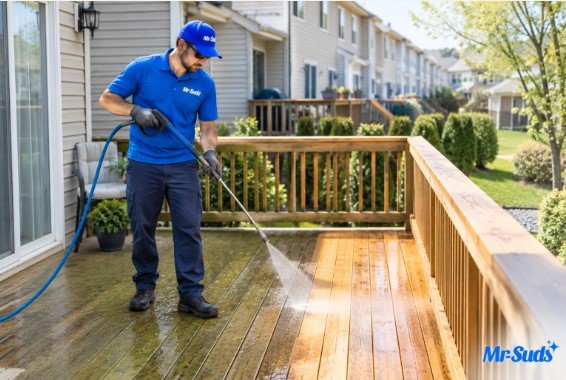
For the deck in the story, the fix took an afternoon. We sent the certificate of insurance with the association named as additional insured, the registration number and the W-9 straight to the management company. The manager confirmed approval the next morning and the job ran on the original date.
The other thing worth saying: when a scope starts on a deck and creeps onto the common siding above it, we stop and ask. That question belongs to the board, not to the homeowner or to us.
Frequently asked questions
Can an HOA stop me from hiring my own contractor? It can set conditions on who works on the property, and it controls work on common elements outright. For a limited common element like your deck, the objection is usually about missing paperwork or vendor approval rather than your choice of company.
Why does my HOA require a certificate of insurance from my contractor? Because an uninsured crew working on a shared building leaves the association exposed. The certificate shows general liability coverage and often workers compensation, and many managers also ask to be named as an additional insured for the job.
What is the difference between a common element and a limited common element? A common element is shared property such as the roof, structure and grounds. A limited common element is part of that shared property assigned for the exclusive use of one unit, such as a deck, balcony, patio or assigned fence section.
Who is responsible for cleaning a condo deck in Connecticut? Frequently the owner with exclusive use, because a deck is usually a limited common element. Under CIOA the association maintains the common elements except as the declaration provides otherwise, so your declaration is the deciding document.
Does my association have to give me a copy of the declaration and bylaws? CIOA gives unit owners the right to inspect association records, so requesting them in writing is a normal step. Check your own resale certificate package first, since it usually contains all three documents.
What documents does a contractor need to work in an HOA community? Typically a certificate of insurance with the association as additional insured, workers compensation where applicable, a Connecticut home improvement registration number, a W-9, a scope of work with dates and a signed contract.
What if the association already has a contract for association-wide cleaning? Then the objection is about scheduling and consistency rather than your contractor. Ask when the cycle runs and whether your limited common element is included in it, and time your own work accordingly.
Can an HOA restrict working hours or water use for exterior cleaning? Yes, and most do in some form. Quiet hours, truck parking, staging near shared walkways and whose water is used are all normal conditions. Pass them to your contractor and most will work around them without difficulty.
Do I need approval to clean my own fence? It depends on whether that fence section is a limited common element assigned to your unit or part of the common elements. The declaration will say, and asking the manager before you book takes a minute.
Get the paperwork out of the way and get the deck cleaned
The deck in the story was cleaned on schedule. The company also ended up on that community’s approved list, so the next owner in the same building will not hit the same wall.
That is usually how this ends. Not with a fight, with a PDF.
If you are in a condominium or planned community in Newington, Wethersfield, Rocky Hill, Berlin, Cromwell, Farmington or the towns around them, we can send the certificate of insurance, registration details and W-9 to your management company before we even quote the work.
Call (860) 263-9031 or email roman@mr-suds.com. Mr-Suds Power Washing PROs is at 130 Dewey Ave in Newington, licensed, bonded and insured, open Monday to Friday 8am to 4pm.