
What to Do When Wash Water Runs Into a Storm Drain
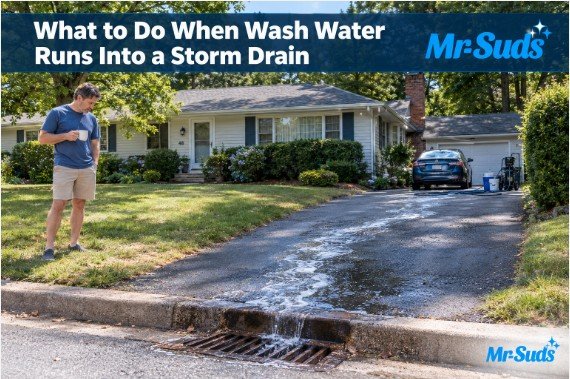
Late summer morning on a quiet Newington side street. A 1960s ranch with an asphalt driveway that slopes all the way down to a catch basin at the curb. The homeowner was standing at the end of it with a coffee, watching gray water find the grate.
He asked what a lot of people ask, and he asked it the way people do when they already half suspect the answer. That is fine to just go down there, right?
I gave him the short version that morning. This is the longer one.
The short answer
If wash water is heading for a storm drain, stop the rinse and redirect it to grass or a planting bed, then put a berm or drain mat between the flow and the grate. Storm drains are not connected to a treatment plant. In Newington, what enters them reaches Piper Brook and the Park River untreated.
A storm drain is not a sewer, and that is the whole problem
Two separate pipe systems under the same street
Almost every misunderstanding on this topic comes from one assumption: that everything underground ends up at the same place.
It does not. There are two systems and they are not connected.
The sanitary sewer takes what leaves your sinks, toilets and washing machine, and it goes to a treatment plant. The storm drain system takes rain off the streets and moves it, untreated, to the nearest waterway. That is its entire job.
The drain at the curb is not a sewer. It is a shortcut to the brook.
Where Newington’s storm drains actually go
This is the part that makes people put the hose down.
Newington’s storm drains discharge into Piper Brook, the South Branch Park River, Trout Brook and the Mattabesset system. From there the water moves to the Connecticut River, and then into Long Island Sound.
The town runs a small municipal separate storm sewer system, an MS4, under the Connecticut DEEP general permit. Part of that permit involves annual monitoring at six locations, and the parameters being measured are E. coli, total suspended solids, total nitrogen, total phosphorus and turbidity.
Look at that list again and think about what a house rinse carries. Suspended solids, nutrients, bacteria off a dirty surface, and enough cloudiness to move a turbidity reading. Those are not abstract categories. They are a description of wash water.
Nitrogen matters especially, because Long Island Sound has a nitrogen TMDL behind it, with stormwater sources carrying a 10 percent reduction target. Detergent nitrogen going down a grate works directly against that.
The illicit discharge rule in plain English
Connecticut towns prohibit anything but stormwater entering the storm drain system. That is the basic principle behind every local stormwater program in the state.
I am not going to quote you an ordinance number or a penalty, because that is not my business to interpret and the details differ by town. What I can tell you is that “only rain in the drain” is the standard everyone is working to.
What is actually in exterior wash water
The gray colour is not the interesting part. What matters is what is dissolved and suspended in it, and it varies a lot by surface.
House washing and soft washing
Surfactants, sodium hypochlorite residue, and a large amount of dead organic growth that used to be living on your siding.
The nutrient load and the oxygen demand are what matter in a brook, not the appearance. Water can look nearly clear and still be a poor thing to put in a stream.
Driveways, patios and pavers
Materially different, and worse.
Flatwork runoff carries heavy sediment, oil and fuel residue from where the cars sit, tire rubber, and whatever the winter left behind. That is a different discharge from a house rinse, and it deserves a different plan.
Roof washing
Shingle granules and heavy organic mass, and the twist is where they travel.
Roof runoff goes into the gutters and out the downspouts, and plenty of downspouts in Newington discharge straight onto a driveway that slopes to the curb. So a roof wash can reach the catch basin without anyone ever pointing a hose at it.
Why biodegradable is not a free pass
Biodegradable describes what eventually happens to a product, not what happens in the first hour in a brook.
The state’s own position on this is unambiguous in the car wash context: soaps cannot be discharged to a surface waterbody without treatment. That is true of the gentle ones too.
How a professional keeps the water out of the drain
Plan the water before you plan the wash
We plan the water before we plan the wash. That sounds like a slogan and it is actually just the order of operations.
Walk the property. Find the catch basin. Note the low point and which way the driveway pitches. Check where every downspout lets out. On a sloped drive like the one in the story, all of that is settled before anything comes off the trailer.
Berms, mats and covers
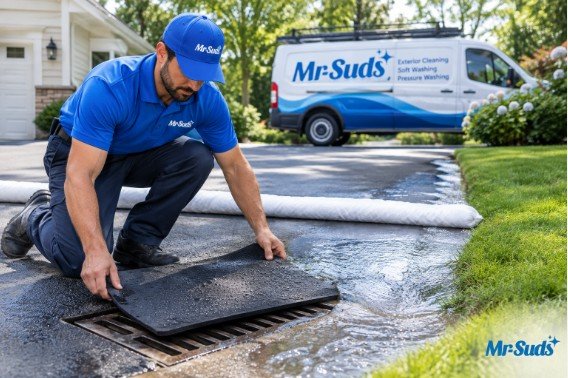
A berm across the driveway apron stops the flow before it reaches the grate. A mat or a fitted cover over the basin does the same thing at the last moment. Pipe plugs have their place on some sites.
One honest caveat: a cover only helps if the water has somewhere else to go. Blocking a drain and letting a pool build against it is not containment, it is a delay.
Directing rinse to a vegetated area
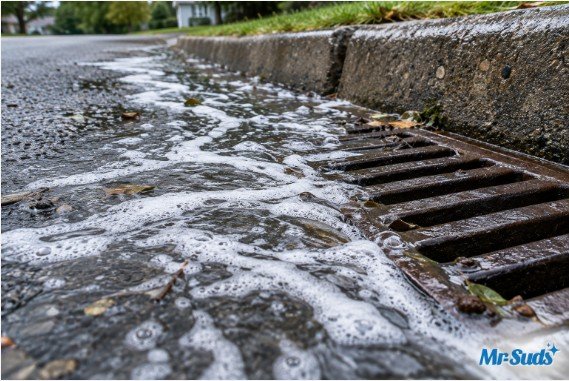
For most residential work this is the real answer.
A level grassed area or a planting bed large enough to absorb the volume does the filtering that a brook cannot. It is also exactly the route Connecticut DEEP names in its charitable car wash guidance.
The limits matter. Keep it away from wells. Do not use ground that is already saturated. And do not let it channelize, because a rinse that cuts a path across a lawn and out to the curb has just taken the long way to the same grate.
Vacuum recovery and reclaim
A wet vacuum recovers pooled water, which then has to be disposed of properly. Discharge to a sanitary sewer requires prior permission from the municipality, and that permission is a real step, not a formality.
I will be straight about the scale of this. Full capture and reclaim is common on commercial flatwork, parking structures and drive-throughs. It is rare on a residential house wash, and a company claiming to capture every drop off a two story colonial is describing something other than what happens.
Where soft washing changes the math
A house wash typically moves somewhere in the range of 100 to 300 gallons, and soft washing sits at the lower end of that, because the solution does the work and the rinse is low pressure rather than a sustained blast.
Less water is genuinely easier to control. Less water is not zero water, and it does not replace a containment plan.
Dry methods first
Sweep, blow and scrape before anything gets wet. Every bit of debris removed dry is debris that never becomes suspended solids in a brook.
Then test with plain water before reaching for chemistry. A surprising amount of what people assume needs a product does not.
What to do if it is happening on your job right now
- Stop the rinse, not the job. Nobody needs to pack up. The water just needs somewhere else to go.
- Redirect to grass or a planting bed. The nearest absorbent ground beats the nearest grate every time.
- Get something between the flow and the drain. A berm, a mat, a rolled towel, a sandbag. Whatever is to hand in the next thirty seconds.
- Let moving water spread rather than channel. A wide sheet across grass soaks in. A narrow stream travels.
- Ask the contractor what the plan was. Not as an accusation. The answer tells you whether there was one.
- Treat an actual chemical spill as a different situation entirely. That is the emergency number below, not a conversation.
One safety note. Do not step into moving water on a sloped driveway to place something. Wet asphalt on a grade with soap on it is exactly as slippery as it sounds.
Who carries the exposure, the homeowner or the contractor
How responsibility usually sits
This is general information rather than legal advice, and a specific situation belongs with your town or an attorney.
The broad shape is this. Illicit discharge ordinances generally reach the property, so hiring somebody does not automatically move the issue entirely off the owner. At the same time, the contractor is the one who controls the method, brings the equipment and decides where the water goes, and a competent contractor treats containment as part of the scope rather than as an extra.
In practice that means the homeowner’s real protection is upstream of the problem: hire someone who has a plan and can describe it before the truck arrives.
What to look for in a contractor’s answer
Three questions, and I tell homeowners to ask them of any company, mine included.
Where is the rinse water going to go on this property? What containment do you carry on the truck? What changes when you move from the siding to the driveway?
“It all evaporates” is not an answer. Neither is a blank look.
Registration, insurance and the paper side
While you are asking, check the paperwork too.
Connecticut home improvement contractors register with the Department of Consumer Protection under Chapter 400 of the General Statutes, Section 20-418 and following, and you can verify that free at elicense.ct.gov.
Residential house washing is normally taxable at 6.35 percent under state guidance, so an invoice with no sales tax line on it is worth one direct question.
Who to call in Newington
| Situation | Who to contact |
|---|---|
| Newington storm drain system or a local stormwater concern | Town of Newington Public Works and Engineering, which houses the stormwater program |
| Non-emergency water pollution concern in Connecticut | CT DEEP Report Water Pollution Concerns online form, general information 860-424-3000 |
| An actual spill or environmental emergency | CT DEEP Emergency Response, 866-DEP-SPIL (866-337-7745) or 860-424-3338, 24 hours |
| General guidance on wash water and detergents | CT DEEP Charitable Car Wash Guidance |
One thing worth saying plainly. If it is your own contractor and your own driveway, this is a conversation, not a report. Ask them to redirect the rinse. Most crews will fix it in a minute and think nothing of it.
The car wash comparison that makes it click
If the rules feel abstract, borrow the state’s own example.
Connecticut DEEP’s guidance for charitable car washes says washwater must not enter a catch basin, that no soaps can be discharged to a surface waterbody without treatment, and that the acceptable routes are a level grassed area large enough to absorb the water, or pumping to the sanitary sewer with prior municipal permission.
That is a fundraiser with buckets and a garden hose, in a parking lot, once a year.
A machine moving a few hundred gallons at a house is held to the same principle. Once you have seen it framed that way, the storm drain question stops being confusing.
What this looks like on our trucks
Back to that sloped driveway.
Before anything came off the trailer we put a berm across the apron, well above the basin. The rinse got sent to the lawn strip on the uphill side, where it had somewhere to soak in rather than somewhere to run to. The corner downspout got checked and dealt with before the roof rinse started, because that downspout emptied about six feet from the grate.
None of that took long. It is a walk-around and a decision, and it happens before the wash rather than during it.
We are at 130 Dewey Ave in Newington, licensed, bonded and insured, with a 5.0 rating across roughly 39 Google reviews, and I am on the trucks.
Frequently asked questions
Is it illegal to let pressure washing water go down a storm drain? Connecticut towns prohibit anything but stormwater entering the storm drain system, so wash water is not supposed to go there. Pressure washing itself is perfectly legal. Where the water ends up is the part that matters, and it is fixable with a berm and a redirect.
What is the difference between a storm drain and a sanitary sewer? Two separate systems. The sanitary sewer carries household wastewater to a treatment plant. The storm drain carries street runoff, untreated, to the nearest waterway. They are not connected.
Where do Newington storm drains actually go? Into Piper Brook, the South Branch Park River, Trout Brook and the Mattabesset system, then on to the Connecticut River and Long Island Sound. Nothing is treated on the way.
Does soft washing produce less runoff than pressure washing? Yes. A house wash generally moves somewhere between 100 and 300 gallons, and soft washing sits at the lower end because the solution does the work at low pressure. Less water is easier to control, but it still needs a plan.
Is driveway runoff different from house wash runoff? Materially. Flatwork carries sediment, oil and fuel residue and tire rubber from where vehicles sit. A house rinse carries surfactants, hypochlorite residue and organic growth. Both need managing, and the driveway usually needs more.
Can I rinse wash water onto my lawn instead? That is generally the right residential answer, and it matches the route DEEP names for car washes: a level grassed area big enough to absorb the volume. Keep it away from wells, avoid saturated ground, and do not let it channel into a stream that runs to the curb.
Am I responsible if my contractor’s wash water goes in the drain? Illicit discharge rules generally reach the property, so hiring someone does not automatically remove the owner from the picture. The contractor controls the method. The practical protection is asking about containment before you book.
Who do I call in Newington about a stormwater problem? The Town of Newington Public Works and Engineering department handles the local stormwater program. For a non-emergency pollution concern statewide, use CT DEEP’s online reporting form. For a spill, call DEEP Emergency Response at 866-337-7745.
Do I need a permit to pressure wash my house in Connecticut? Not for washing your own house. The obligations are about discharge rather than permission, which is why the containment plan matters more than paperwork on a residential job.
Talk to a company that plans the water first
The homeowner at the end of that driveway told me afterward that nobody had ever explained the two-pipe thing to him. Then he told his neighbour.
That is genuinely the whole reason this page exists. It is not a complicated rule, it is just one nobody gets told.
Mr-Suds Power Washing PROs covers eighteen towns across central Connecticut from Newington, including Wethersfield, Rocky Hill, Hartford, Berlin, Farmington and Plainville. Open Monday to Friday 8am to 4pm, weekends by appointment.
Call (860) 263-9031 or email roman@mr-suds.com for a free walk-through quote, and ask where the water is going while we are there. First house cleaning service is 15 percent off.