100% Customer Satisfaction!

Black streaks, moss and lichen taken off your shingles by soft washing, never pressure washing, by a company based here in Newington. We will also tell you honestly which of those three is actually worth worrying about. Free roof assessment, no obligation.
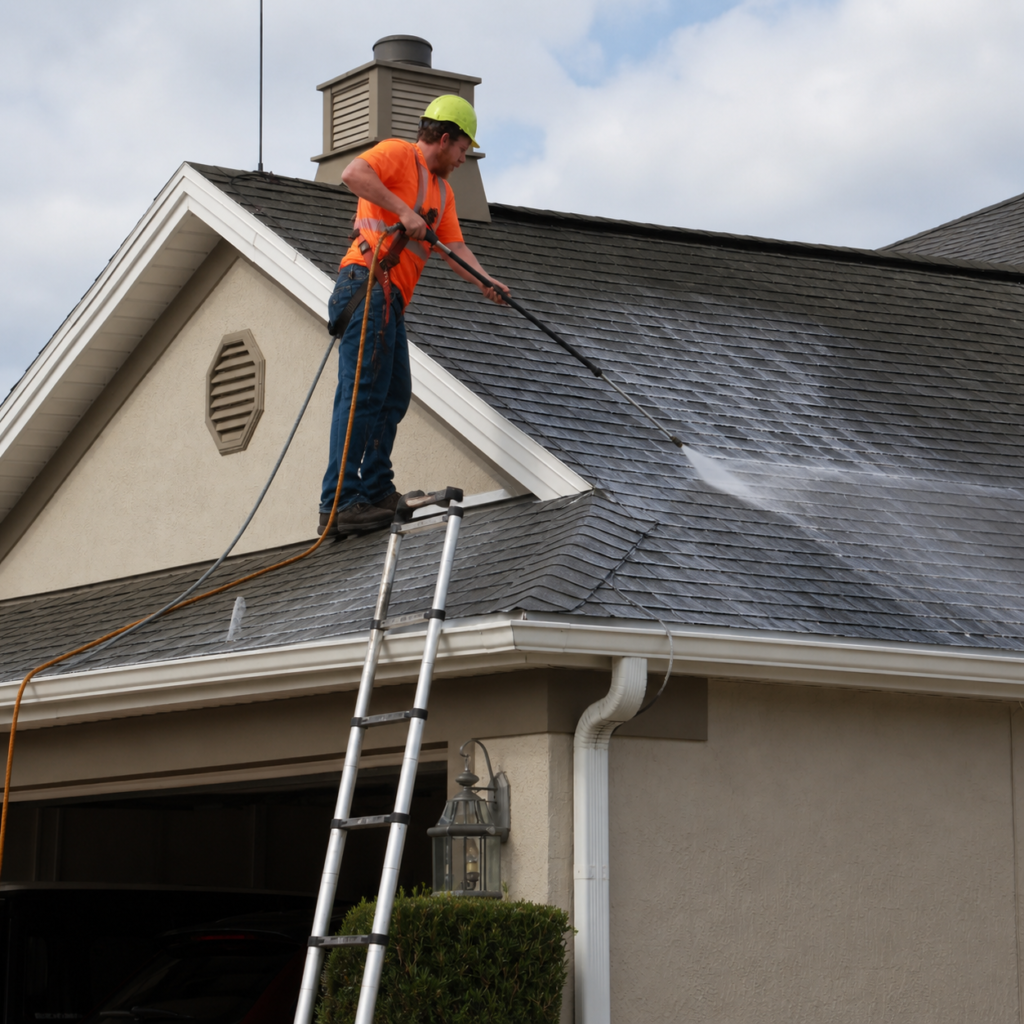
Three different things grow on a shingle roof around here, and they are not equally serious. Most of what you will read online treats them as one problem. They are not.
The dark streaks running down your slopes are algae, most often Gloeocapsa magma, and they are a cosmetic problem rather than a structural one. Industry guidance from the Asphalt Roofing Manufacturers Association reports no scientific evidence that algae damages asphalt shingles, though it clearly affects how the roof looks.
Why it is everywhere: modern shingles contain limestone filler, and the algae feeds on it. Spores travel on the wind, which is why you see one streaked roof and then the whole street.
So the honest position. Streaks cost you curb appeal and they cost you at resale, when a buyer looks up and mentally deducts the price of a new roof. What they are not doing is eating your shingles.
Moss is the one to act on. Unlike algae, it genuinely affects shingle performance. It holds moisture against the surface, and as it thickens it lifts and curls the leading edges of the shingles, which raises the risk of blow-off in a wind event. In bad cases it pushes water sideways under the courses instead of letting it run off.
Connecticut freeze-thaw makes all of that worse. Water held in moss expands when it freezes, right at the shingle edge.
It grows on the slopes that stay damp longest, which in this part of the country means the north-facing planes and anything shaded by overhanging limbs.
Lichen is the stubborn one. It bonds into the granule surface rather than sitting on top of it, so it does not simply rinse away once treated.
Being straight with you: substantial improvement is realistic. Complete erasure often is not. We will tell you what to expect from your roof before you commit to anything.
I get called out a lot by people who have been told their roof is failing and need to act now. Half the time I am standing in the driveway telling somebody their roof is fine and the problem is that it looks bad. That is still a legitimate reason to clean it. It is just a different reason from the one they were sold.
Not sure which one you have? Send us a photo and we will tell you.
Your shingles are protected by a layer of mineral granules bonded to the surface. That granule layer is the roof’s sunscreen, and it is what actually determines how long the roof lasts.
High pressure blasts granules off. Not a few, either. A pressure washer aimed at asphalt shingles strips the surface, exposes the mat underneath and takes years off the roof, which is exactly the damage people are trying to avoid when they call about staining.
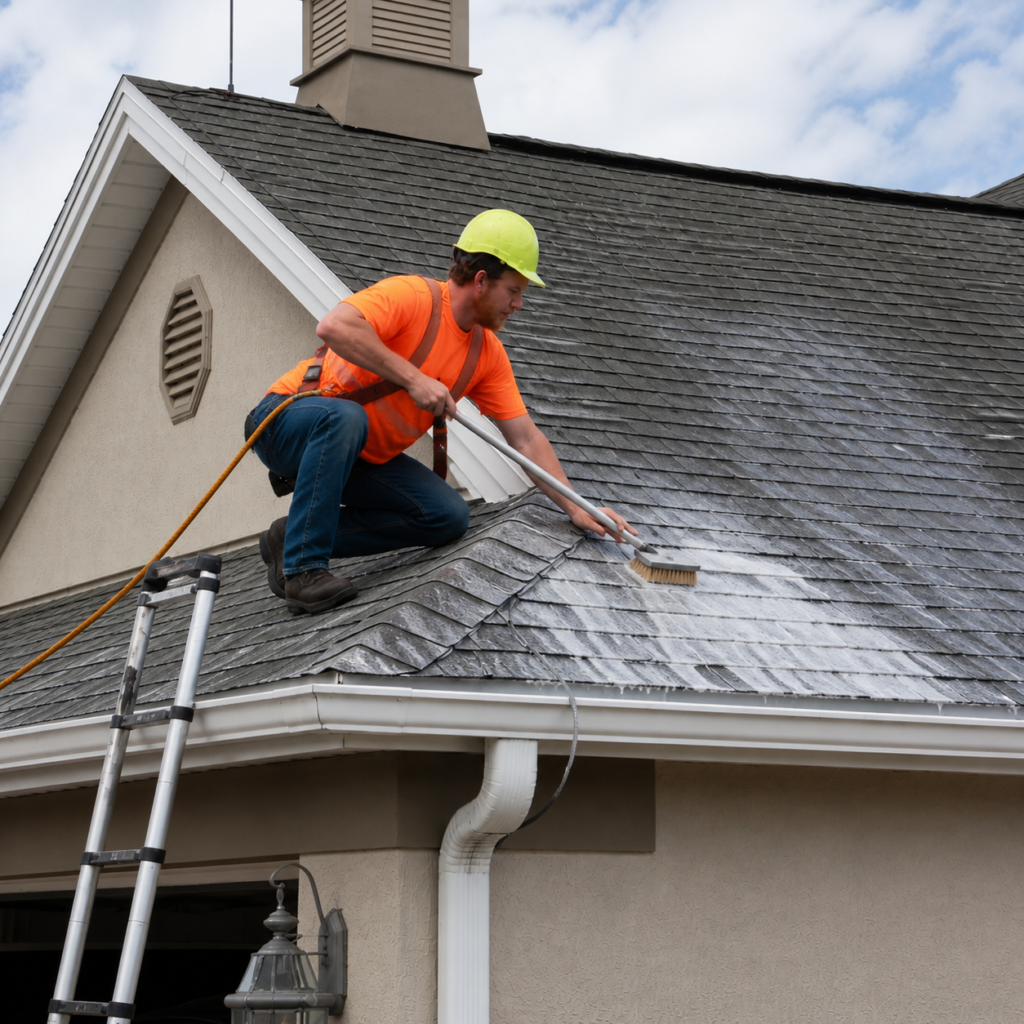
Soft washing works the other way round. Low pressure, a cleaning solution left to dwell so the growth is killed at the root rather than blasted off the top, then a gentle rinse. Slower, and the only method that makes sense on a roof.
This is also the method the shingle manufacturers point to. Their own guidance is explicit that high-pressure washing is likely to damage asphalt roofing and should not be used on it.
Not at a discount, not because a customer asks, not at any price.
Worth asking every company that quotes you, because most homeowners never think about it until something happens.
We are licensed, bonded and insured, and hold Connecticut Home Improvement Contractor registration with the Department of Consumer Protection.
The general principle: less foot traffic on a roof is better. Walking an older or sun-hot shingle scuffs granules loose, so we keep people off the surface wherever the job can be done without it.
We look at the slopes, work out whether you are dealing with algae, moss or lichen, and tell you honestly whether it is worth doing.
Planting, siding, drives and any water feature get pre-wetted and covered before anything is applied.
Because that is where runoff concentrates and where delicate planting suffers.
Across the affected slopes.
This is the step that matters. The solution kills the growth at the root instead of rinsing the surface layer off and leaving the rest to regrow by August.
And clear the gutter line of the debris that comes down with it.
Of landscaping, siding and hard surfaces.
So you can see the difference from where you actually look at the house.
Treated growth continues to break down and wash off over the following weeks, so a month later it usually looks better than it did on the day.
Not forever, and anybody telling you otherwise is promising something biology does not allow.
Algae and moss are living organisms, the spores travel on the wind from every other roof on your street, and Connecticut summers are humid. A cleaned roof typically holds up well for a few years before growth becomes visible again. North-facing and heavily shaded slopes come back faster than the sunny side. That is just how it works.
Which is why the useful thing to ask a contractor is not “will it come back” but “how long, roughly, for a roof like mine”. We will give you a straight answer at the assessment.
Our address is 130 Dewey Ave, 06111, and the number at the top of this page is a Connecticut number.
That is worth a look on any quote you collect. Some of the companies that appear for roof searches in this town are quoting from other states, and you will not know until something needs sorting out afterwards.
With Connecticut Home Improvement Contractor registration.
Earned on local properties.
Including an honest call on whether the job is worth doing at all.
And a satisfaction walkthrough before we leave.
We do not do roof repairs, flashing work or shingle replacement, and if what you actually need is a roofer, we will say so rather than washing a roof that needs replacing.
Two different jobs, two different prices. Algae staining is a straightforward soft wash. Moss is slower work.
| Service | Typical cost |
|---|---|
| Algae soft wash, black streaks only | $0.30 to $0.50 per square foot Most roofs here $350 to $800 |
| Soft wash with moss removal | $550 to $1,100 For most roofs here |
Moss costs more because it needs longer dwell time, careful work along the eave line where it sits thickest, and often a second pass. There is no way to rush it without leaving half of it behind.
What moves the number:
A single-storey ranch with a gentle pitch is usually the cheapest roof in town to clean, and this town has a lot of them.
Having the house washed or the gutters cleared too? One visit, quoted together, and it comes in below separate trips.
We cover 06111 and the surrounding towns, including the Cedar Mountain and Indian Hill areas where mature tree cover keeps the north-facing slopes damp for most of the year. Those are the roofs that streak first and hold moss longest.
If you have searched roof cleaning near me and found companies with out-of-state phone numbers, you are not imagining it. Comparing roof washing services near me is worth doing carefully on a job this size.
We also work in Wethersfield, Rocky Hill, New Britain, Berlin, West Hartford, Hartford and Farmington.
“Roman and his team did a fabulous job on our roof.”
on a roof job
“On time, professional, and incredibly thorough.”
after a whole-house visit
Rated 5.0 on Google.
Algae, usually a species called Gloeocapsa magma. It feeds on the limestone filler in modern asphalt shingles and spreads by airborne spores, which is why whole neighbourhoods streak at once. It shows first and worst on north-facing slopes that stay damp longer than the sunny side.
No. Industry guidance from the Asphalt Roofing Manufacturers Association states there is no scientific evidence that algae damages asphalt shingles, although it clearly affects appearance. Clean it because the staining bothers you or affects resale, not because somebody told you the roof is being eaten.
Yes, and this is where algae and moss differ. Moss holds moisture against the shingles and lifts the leading edges as it thickens, which raises blow-off risk in wind and can push water sideways under the courses. Worth dealing with rather than leaving.
Algae soft washing runs $0.30 to $0.50 per square foot, with most local roofs between $350 and $800. Add moss removal and most fall between $550 and $1,100, since moss needs longer dwell time and careful eave work. We quote flat after an assessment.
Not when it is soft washed. High-pressure washing is what strips granules and shortens roof life, and manufacturer guidance says plainly it should not be used on asphalt roofing. Low pressure with a cleaning solution is the method they point to instead.
Most roofs here need it every few years rather than annually. Shaded, north-facing slopes under tree cover come back sooner and some homes end up on a shorter cycle. The honest answer is to clean it when you can see it, not on a fixed schedule.
A few years for most roofs, depending on shade, tree cover and which way the slope faces. Growth returns eventually because spores blow in constantly and the climate here is humid. Any company promising a permanently clean roof is promising something that is not possible.
Not with the right routine. Beds, shrubs and lawn are pre-wetted and covered before anything is applied, with extra protection at the downspout outfalls where runoff concentrates and does the most harm. Everything gets rinsed down thoroughly once the slopes are finished.
Streaked shingles, moss along the eave, or just not sure whether what you are seeing is a problem? Book the free assessment and get a straight answer, including if the answer is that your roof does not need us yet.
Call (860) 263-9031, or send a photo of the worst slope and we will tell you what we are looking at.
Mr-Suds Power Washing PROs
130 Dewey Ave, Newington, CT 06111
Phone: (860) 263-9031
Also serving Wethersfield, Rocky Hill, New Britain, Berlin, West Hartford, Hartford and Farmington.