
One of the older Newington streets where the driveways nearly touch. A sedan parked on the neighbour’s side, maybe a dozen feet from the wall we were working on. The air was dead still when the trailer came off the road.
Partway up the second story, a breeze came through the gap between the houses.
Nothing dramatic happened after that, and the reason nothing happened is the next ten minutes. That is what this page is about.
The short answer
Rinse the affected surface immediately and heavily with clean water, and do not wipe dry residue. Photograph the damage before and after. Tell your neighbour and the contractor the same day. The contractor’s general liability insurance covers third party property damage, but fast rinsing usually resolves the problem before it becomes one.
Speed is the whole game here. Almost everything in this article is easier at minute five than at hour five.
First hour response, do this in order
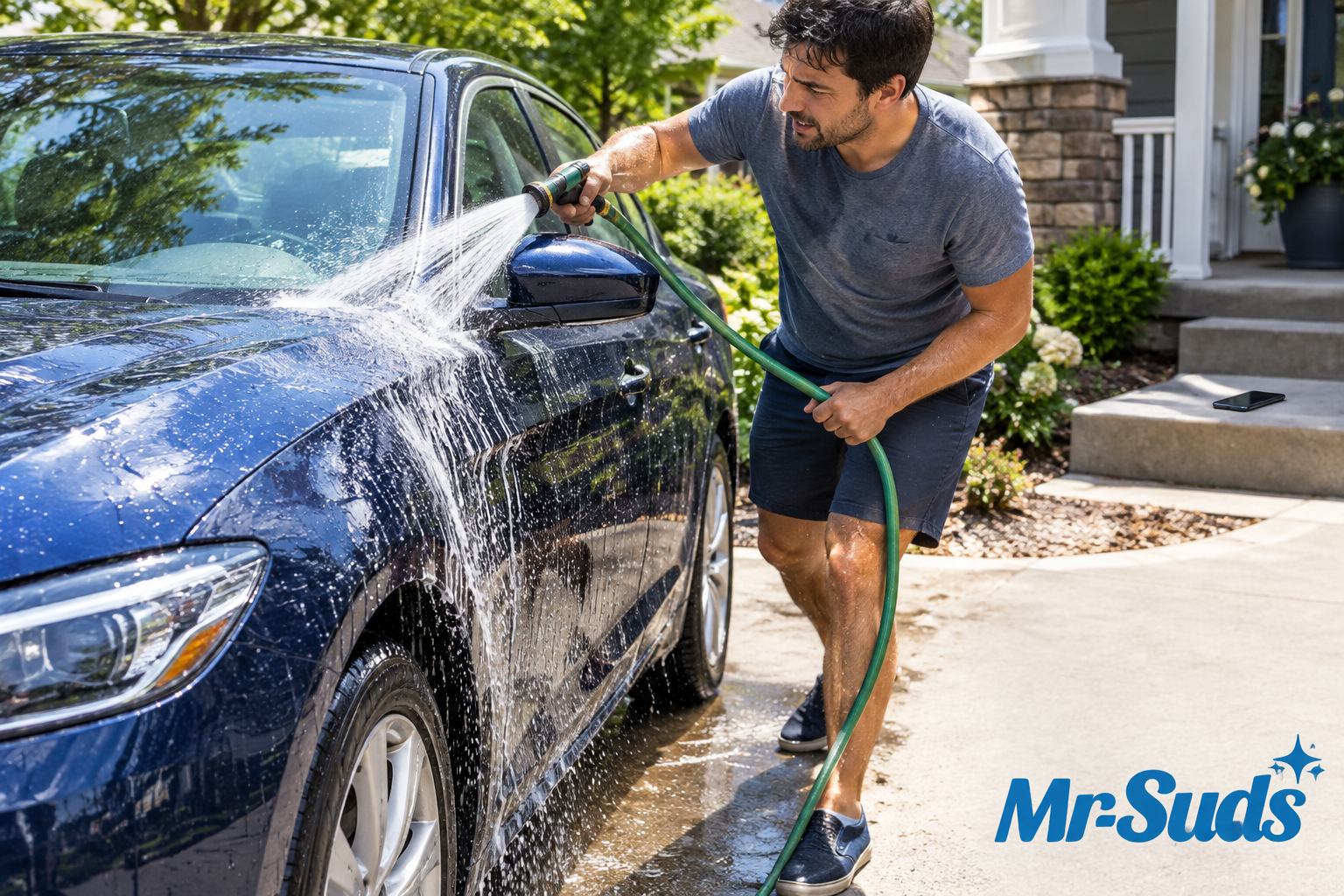
- Rinse the affected surface with clean water, heavily, from the top down. Do not wipe a car. Do not scrub dry residue into a panel.
- On plants, rinse the root zone as well as the leaves. Flushing the soil matters as much as washing the foliage, because runoff collects at the drip line.
- Photograph everything. Before, during and after, including one wide shot showing where the affected thing sits relative to the property line.
- Tell the crew straight away so they stop, reset the setup and do not finish the wall the same way they started it.
- Tell the neighbour the same day, in person if you can, before they find it themselves.
- Write down the time, the wind and exactly what was affected. Two lines in your phone is enough.
Do not promise a dollar figure, and do not tell the neighbour nothing happened. Both make the next conversation harder than it needs to be.
What soft wash solution actually is
Most people picture one of two things: dish soap, or bleach straight from the jug. It is neither.
A soft wash mix is water, a diluted sodium hypochlorite solution, and a surfactant. The hypochlorite kills the algae and biological growth on the surface. The surfactant makes the mix cling instead of sheeting straight off the wall, which is what gives it the dwell time it needs to work.
That clinging is also exactly why drift matters. A solution engineered to stay put on siding does not become harmless the moment it lands somewhere else.
Concentration varies. A roof mix and a siding mix are not the same thing, and the growth on the surface changes what is needed. Anyone quoting you one universal ratio is describing a shortcut rather than a method.
What it does to plants, paint and other surfaces
Plants
Damage is not instant, which is precisely why people miss it.
Leaf edge browning and yellowing usually appear within a few hours to a day or two. So the homeowner who checks the shrubs right after the crew leaves sees green leaves and concludes nothing happened. Then Thursday arrives.
Here is the mechanism worth understanding. A well hydrated plant absorbs less, because its cells are already full. That is the whole reason a crew pre-soaks vegetation before mixing anything, and the reason they keep it wet through the application rather than watering it once and moving on.
The root zone matters as much as the foliage. Concentrated runoff collects at the drip line and, worse, at downspout outlets, which is where whatever came off the wall ends up in one place.
Outcomes vary honestly. Foliage burn on an established shrub is usually recoverable and often grows out by the following season. Seedlings, annuals and anything shallow-rooted and small are much less forgiving.
Vehicle finishes
The realistic risk on a car is not destroyed paint. It is spotting and staining.
Solution or mineral-laden rinse water that dries on a warm panel in the sun leaves marks, and the enemy is dwell time and drying rather than the contact itself. A fast, heavy rinse before anything dries usually ends the problem entirely.
The harder case is dried residue on a dark colour or an older single stage finish, where the mark can sit in rather than on the surface.
Whatever you do, do not wipe dry residue off a panel. That grinds it in, and you turn a rinse into a polishing job.
Painted surfaces, decks, furniture and the things nobody thinks about
The list that causes the most awkward conversations is the cheap stuff.
Patio furniture cushions. An open window screen. Laundry on a line. A stained deck on the far side of a fence. A grill cover. A neighbour’s raised bed with lettuce in it in June.
None of that costs anything to prevent and all of it is uncomfortable to argue about afterwards.
What a competent crew does before mixing anything
This is the part you can use as a hiring test, because a company that has thought about it will describe it without being prompted.
We walk both sides of the property line before anything comes off the trailer. Not the customer’s side. Both.
Then we work out what is actually within reach: cars, plantings, a shared driveway, an open window, a neighbour’s deck, anything soft that cannot be hosed later.
All vegetation on both sides of the line gets pre-soaked, and it gets kept wet through the application rather than watered once at the start. What cannot be moved gets tarped or sheeted. Downspout outlets get bagged or bucketed so concentrated runoff does not pool at a root zone.
We ask the homeowner to move their vehicles, and to ask the neighbour to move theirs.
Wind gets checked before setup and again during. When it turns, we stop. A wall that waits an hour is cheaper than a repaint, and that arithmetic is not close.
And we knock on the neighbour’s door before the trailer is even unloaded. It takes thirty seconds and it changes every conversation that might follow.
At the end, everything gets post rinsed, including surfaces that were only near the work. Then we walk the line again before we leave.
Who is liable, and how the insurance responds
The contractor who caused the damage is the responsible party. This is not a dispute between neighbours, even though it feels like one.
The reason is a technical point worth knowing. Your neighbour is a third party to the contract between you and the contractor, and third party property damage arising out of the contractor’s operations is exactly what general liability insurance exists to cover.
That is also why hiring an insured company matters more than it seems when you are comparing quotes. If the company on your driveway has no policy behind it, the question of who pays gets a lot less clean, and the homeowner who hired them is not automatically outside the conversation.
Liability turns on the facts of the situation, and this is general information rather than legal advice. If you have a real dispute, speak to your own insurer or an attorney.
For scale, a claim like this in Connecticut is an ordinary property damage claim. Connecticut small claims handles most consumer money claims up to a limit you should verify with the Judicial Branch before relying on it.
A neighbourly fix or a claim, how to tell
Most of these are a hose, an apology and a Saturday. Some are a detail shop bill. A few are replacement plantings. Very few are a claim.
There is a practical reason a good contractor often offers to pay directly rather than filing. On a small amount, a claim can cost more in premium over the following years than the repair costs today. A direct offer is usually good business, not an admission that something worse happened.
| Situation | Typical fix | Who normally handles it | When it escalates |
|---|---|---|---|
| Light spotting on a car, rinsed within minutes | Rinse, then a wash | Nobody, it ends there | If it dried before anyone noticed |
| Dried residue on a panel | Detail or paint correction | Contractor pays directly | If refinishing is needed |
| Foliage burn on established shrubs | Water well, wait a season | Contractor checks back | If the plant does not recover |
| Annuals, seedlings or a vegetable bed | Replace the plants | Contractor pays directly | Rarely |
| Mature landscaping loss | Replacement and planting | General liability claim | Almost always a claim |
| Cushions, screens, laundry, grill cover | Clean or replace | Contractor pays directly | Rarely |
| Disagreement about what caused it | Photos and dates | Insurers | Immediately |
How to raise it with a neighbour without starting a feud
Go in person, and go before you text. A text about property damage reads colder than anything you would actually say out loud.
Lead with the facts and the offer, not with fault. Something like: “The crew was washing the north wall this morning and some spray carried over onto your car. I’ve rinsed it already and I’ve got photos from before and after. I want to get it sorted, so tell me what works for you.”
Bring the photos. Say what you already did. Do not say “it was just water,” and do not say “it will wash off.” Both are the sentences people remember for a decade.
Do not send the crew to explain it for you unless the neighbour asks to speak to them.
And if you are the neighbour reading this: rinse the car now, before you decide anything about who pays. A same-day rinse is in your own interest regardless of how the conversation goes afterwards, and it costs you five minutes of hose time.
Why this comes up so often in Newington
The housing stock explains most of it. Newington built out through the 1950s to the 1980s, so the streets are ranches, colonials and split-levels on lots with narrow side yards. Some streets have paired or nearly shared driveways. Mature trees sit right on the property lines.
Then there is the detail that catches everybody: on a lot like that, people park closer to the neighbour’s siding than to their own.
Season compresses the problem. The good washing window runs spring through fall, and June and July each average around ten days with precipitation. Work stacks up on the dry days, and a stacked schedule is exactly when a crew is tempted to push through a breeze it should have waited out.
There is a drainage point worth knowing too. Newington runs a small municipal separate storm sewer system under the Connecticut DEEP general permit, and storm drains here discharge to Piper Brook, the Park River system and the Mattabesset system without treatment first. So wash water should be directed onto vegetated areas rather than down a storm drain. That is a rule about the brook, not about your neighbour, but it shapes how a crew sets up on a tight lot.
Wethersfield, Rocky Hill, Hartford and Berlin all have versions of the same street geometry, so none of this is unique to one town.
Prevention checklist to hand your contractor
Ask these before you book. The answers take a minute and they tell you a lot.
- Will you walk both sides of the property line before setting up?
- Will vegetation be pre-soaked and kept wet through the application, on both sides?
- What gets tarped or covered, and who decides?
- Will downspout outlets be contained so runoff does not pool at the plantings?
- Do you want vehicles moved, and will you tell me which ones?
- What wind conditions make you stop, and who makes that call?
- Will you speak to the neighbour before you unload?
- Is everything post rinsed, including surfaces near the work rather than only on it?
- Where does the wash water go?
- Can you send a certificate of general liability insurance?
Frequently asked questions
What is soft wash solution made of? Water, a diluted sodium hypochlorite solution and a surfactant that helps it cling to the surface long enough to kill algae and biological growth. Concentration varies by surface and by how heavy the growth is, so a roof mix and a siding mix are not the same.
Will soft washing kill my plants or my neighbour’s plants? It can damage them if they are not protected, which is why crews pre-soak vegetation and keep it wet throughout. Established shrubs with foliage burn usually recover. Seedlings, annuals and shallow-rooted plants are much less forgiving.
Can soft wash solution damage car paint? The realistic risk is spotting and staining rather than destroyed paint, and it comes from the solution or rinse water drying on a warm panel. Rinse heavily and immediately, and never wipe dry residue, which grinds it into the finish.
How long before plant damage shows up? Usually a few hours to a couple of days. Leaf edge browning and yellowing appear first, which is why a homeowner who checks right after the crew leaves often sees nothing at all.
Does rinsing actually help, or is the damage already done? Rinsing early genuinely changes the outcome, because contact time is what causes most of the harm. Flush the foliage and the root zone on plants, and rinse a vehicle before anything dries on the panel.
Who is liable when a contractor’s overspray damages a neighbour’s property? The contractor who caused it. Your neighbour is a third party to your contract, which is what makes it a general liability matter rather than a neighbour dispute. Liability turns on the facts, so get advice on a real dispute.
Does a pressure washing company’s insurance cover damage to a neighbour? General liability insurance is designed to cover third party property damage arising out of the contractor’s operations. Ask for a certificate of insurance from the agent before you book, not after something happens.
Should I file a claim or just pay to fix it? Small amounts are usually settled directly, because a claim can cost more in premium than the repair costs. A claim makes sense for vehicle refinishing, mature landscaping loss, or any situation where the parties disagree about the cause.
Can I ask a crew to reschedule because of wind? Yes, and a good crew will already be watching it. Wind carries solution beyond the wall, and a job that waits a day costs far less than a repaint or a set of replacement shrubs.
How we handle the property line
Back to that car on the shared driveway.
It got rinsed within minutes, the neighbour was told before he noticed anything, and that was the end of it. The reason it stayed nothing is that somebody was watching the line and moved fast.
That is the standard here. The neighbour gets a knock before the trailer is unloaded, plants get soaked before anything is mixed, and the line gets walked twice, once at setup and once before we pull out.
Mr-Suds Power Washing PROs is based at 130 Dewey Ave in Newington and works across eighteen towns in central Connecticut including Wethersfield, Rocky Hill, Hartford, Berlin and Farmington. Licensed, bonded and insured, 5.0 across roughly 39 Google reviews.
Call (860) 263-9031 or email roman@mr-suds.com for a quote. First house cleaning service is 15 percent off.