
What to Do When a Tenant Refuses Access for Scheduled Washing
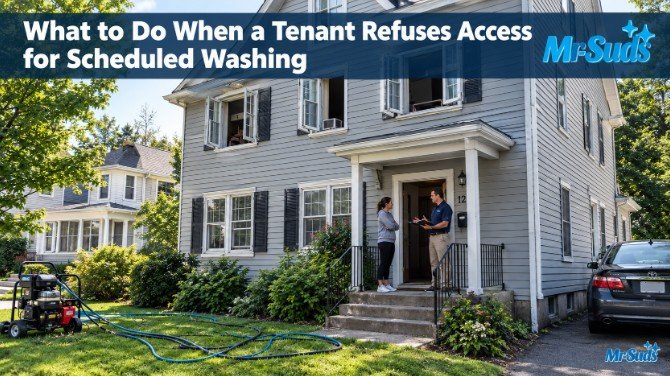
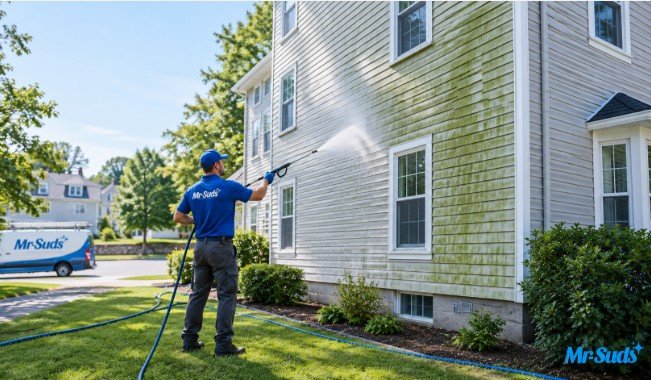
A weekday morning at a three-family on a side street. North wall green, crew set up, hoses run.
Two units were ready. The third was not. Second floor windows wide open, a car parked tight against the siding, and a tenant at the door saying, quite reasonably, that nobody had told them anything about this.
That sentence is the whole article. Most refusals we see are not refusals. They are surprises.
This is general information rather than legal advice, and anything that turns into a real dispute belongs with a Connecticut landlord-tenant attorney.
The short answer
Under Connecticut General Statutes Section 47a-16, a tenant may not unreasonably withhold consent for a landlord to make repairs or supply services, including work by contractors, and the landlord must give reasonable written or oral notice and enter at reasonable times. Exterior washing rarely needs interior entry, so most refusals are solved by better notice.
What Connecticut law actually says
Section 47a-16 in plain language
The statute provides that a tenant may not unreasonably withhold consent for the landlord to enter the dwelling unit in order to inspect the premises, make necessary or agreed repairs, alterations or improvements, supply necessary or agreed services, or exhibit the unit.
It expressly contemplates that this may involve workmen or contractors. So a contractor being on site to do agreed work is squarely inside what the statute is about.
Notice and reasonable times
The landlord must give the tenant reasonable written or oral notice of intent to enter, and may enter only at reasonable times, except in an emergency.
Notice what the statute does not do. It does not name a number of hours. It says reasonable. Twenty four hours in writing is the widely recommended practice rather than a figure written into the statute, so treat it as the sensible floor and give more where you can.
The harassment limit
The statute also bars abusing the right of access and using the right of entry to harass the tenant.
That is worth taking seriously even when your intentions are ordinary. Repeated visits, short notice, and arrivals outside normal hours are how a legitimate maintenance programme starts to look like something else on paper, particularly if the tenancy is already strained.
When consent is unreasonably withheld
The remedy path runs through the courts, not through the door.
Connecticut law gives both sides routes here. A landlord facing an unreasonable refusal can seek relief through a court, and a tenant facing unlawful entry has a corresponding remedy. This article is not going to state outcomes or figures as certainties, because they depend on facts.
The practical takeaway is simple. If you reach the point where the legal question actually matters, stop and call a Connecticut landlord-tenant attorney before you take any step that involves proceeding over an objection.
Exterior washing is not the same as entering the apartment
This is the part nobody writes down, and it defuses most of these disputes on its own.
What we almost never need
Interior entry.
For a house wash, a soft wash, a roof or a gutter clean, nobody needs to be inside the unit. Not to reach a valve, not to check a room, not for anything. Say that first when you talk to a tenant, because it is usually the thing they are actually worried about.
What we do need
Yard and perimeter access, all the way around the building. Water and power access depending on the setup. Room to stage a hose run and park a truck or trailer. And a safe working distance around the crew.
That is a different list from the one in the statute, and it is the list that decides whether the day works.
The cooperation list
- All windows and storm windows fully closed and latched, including the ones people forget on the second floor.
- Vehicles moved off the driveway and away from the siding, ideally to the street.
- Pets indoors for the duration, with gates kept shut.
- Patio furniture, grills, planters and door mats moved clear of the walls being washed.
- Bikes, toys and bins off the perimeter, so the crew is not stacking somebody’s belongings.
- Hose reels, holiday fixtures and satellite or AC equipment flagged so they get worked around rather than into.
- Any known window or screen defect reported in advance, because a frame that already leaks is far better known before the water starts than after.
Why this list is the actual dispute
Read that list again and it becomes obvious. Most refusals are refusals to do the list, not refusals of access.
A tenant who works nights and cannot move a car at 8am is not withholding consent. They are asleep. A tenant with a dog who is out of the house all day genuinely cannot bring it indoors at eleven in the morning.
Treat that generously and the problem usually solves itself with a different date.
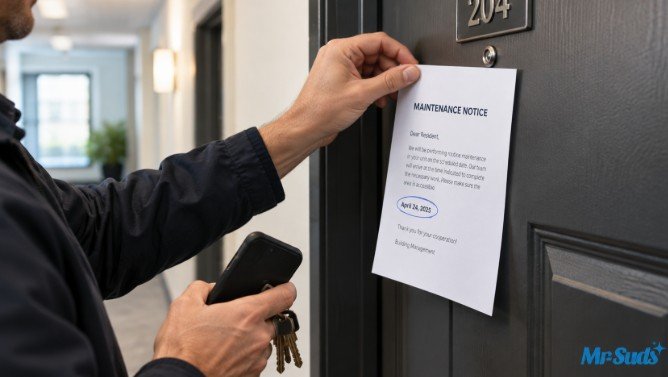
How to write the notice
The goal of the notice is not to assert your rights. It is to prevent the refusal.
A good one covers:
- The date and an arrival window, not a single time
- What work is being done
- That no interior entry is required, stated plainly
- The cooperation list
- A contact number for the day, ideally the contractor’s
- What happens if weather moves the date
- A request to confirm, so you know it was read
Connecticut allows written or oral notice, but written notice is the one you can show later. Send it twice: once about a week ahead, and again the day before.
The day-before reminder is what closes the gap between a notice that was delivered and a notice that was remembered.
When the tenant still refuses
- Ask why, and listen to the answer. The real reason is usually timing, a pet, a night shift or a day full of calls from home.
- Offer two alternative dates, rather than asking them to propose one.
- Offer to have the contractor call them directly to explain what happens and how long it takes. Hearing “nobody comes inside and it takes about two hours” from the person doing the work lands differently.
- Put the refusal and the alternatives in writing, calmly, so there is a record of what was offered.
- If the refusal continues with no reason given, stop. Get legal advice before you take any step that involves proceeding over an objection.
Nothing in this article tells a landlord to force access. That is not a route worth taking, and the law firms who write about this in Connecticut say the same thing: walk away and get advice rather than push the door.
Reschedule or proceed
Honest answer from the truck.
A crew can sometimes work the unaffected elevations and leave one wall for a return visit. That is often the right call on a multifamily, and it saves most of the day.
What a crew should not do is wash a wall with the bedroom windows open, or work around a car parked eighteen inches off the siding, or clean a deck loaded with somebody’s furniture and belongings.
The decision rule is uncomplicated. If the risk of damage or a complaint is higher than the cost of coming back, move the date. We would rather move a date than wash a house with the windows open.
The money and liability questions
Trip charges
A scheduled crew is a booked block of the day. When access fails, that block cannot be resold on the morning.
Most companies have some policy for this, whether a trip charge, a rescheduling fee or absorbing it. The important thing is to ask your contractor how they handle a failed access day before you book, not on the phone from the driveway afterwards.
Who is responsible if something is damaged
The usual scenarios: water through an open window, a torn screen, solution on a vehicle, plantings, or belongings left out on a deck.
Damage caused by the work is normally a matter for the contractor’s general liability insurance, which is exactly why “licensed, bonded and insured” stops being a slogan on this kind of job. Ask for a certificate of insurance from the agent before the first visit.
Where a tenant was asked in writing to close windows and did not, the picture is more complicated. Responsibility depends on the facts and on the lease, which is another reason the written notice matters.
The lease clause worth adding
For future tenancies, consider a maintenance cooperation clause: a short paragraph describing scheduled exterior maintenance, the notice practice, and what the tenant is asked to do to prepare.
Have a Connecticut attorney look at the wording. It costs very little and it turns an annual argument into a paragraph everyone already agreed to.
If you are the tenant reading this
Fair is fair, so here is the other side.
Exterior washing protects the building you live in, and usually your own comfort too. Green siding holds moisture. Blocked gutters back up into places nobody enjoys.
Nobody needs to come inside for it. What is actually being asked of you is a date that works, enough notice to move a car, and closed windows for a couple of hours.
If you are getting notice at 7am for the same morning, repeatedly, that is a legitimate concern and it is worth putting in writing to your landlord. A reasonable request in writing is treated very differently from a refusal at the door.
Scheduling around central Connecticut weather
Dates move here, and it is worth building that into the notice.
June and July each average around ten days with precipitation, which is exactly why summer jobs slide. October is the wettest month by volume even with fewer wet days.
At the other end, overnight lows fall below freezing December through March, and March and November nights sit in the low 30s, which limits late-season work involving rinse water on walkways.
A notice that says “if weather moves this, you will get a new date the same day” prevents the second surprise, which is often the one that turns a cooperative tenant into an uncooperative one.
How we handle it on scheduled multifamily work
We ask landlords to give notice about a week out and again the day before, with an arrival window rather than a time.
At the three-family in the story, the call went to the landlord from the driveway. We washed the rest of the house that morning and left the second floor elevation for a return visit, rather than putting water at an open window and hoping.
If a unit has not prepared, that is the process. Call, work what can be worked safely, and book the return. If a landlord wants me to speak to a tenant directly and explain what happens and how long it takes, that is a two minute phone call and it usually settles it.
We are at 130 Dewey Ave in Newington, licensed, bonded and insured, open Monday to Friday 8am to 4pm with weekends by appointment, which is genuinely useful when a tenant works weekdays.
Frequently asked questions
Can a tenant refuse to let a contractor onto the property in Connecticut? Under Section 47a-16 a tenant may not unreasonably withhold consent for the landlord to make repairs or supply services, including through contractors. Reasonable notice and reasonable timing are required, and refusals with a genuine reason are treated differently from refusals without one.
How much notice does a Connecticut landlord have to give before entry? The statute requires reasonable notice rather than naming a number of hours. Twenty four hours in writing is the widely recommended practice, and more notice is better where the tenant has to move a vehicle or arrange for a pet.
Does the notice have to be in writing? Connecticut allows written or oral notice. Written is what you can show later, so put it in writing and follow up with a reminder the day before.
Does exterior power washing require entry into the apartment? No. A house wash, soft wash, roof clean or gutter clean is done entirely from outside. What is needed is yard access, closed windows, moved vehicles and pets indoors.
Can a landlord enter the yard without the tenant’s permission? It depends on the lease and on what the tenant has exclusive use of, and a fenced rear yard leased with a unit is not the same as shared common ground. Give notice either way, and get advice if it is genuinely contested.
Who pays if the crew shows up and cannot work? That is between the landlord and the contractor, and policies differ. Some charge a trip or rescheduling fee, some absorb it. Ask before booking so nobody is surprised.
Can a landlord be accused of harassment for scheduling repeated work? The statute bars using the right of entry to harass a tenant. Repeated visits, very short notice and off-hours arrivals are the pattern that creates that risk, so keep notice generous and the schedule normal.
What if the tenant’s belongings are damaged during the wash? Damage arising from the work is normally a general liability matter for the contractor, which is why a certificate of insurance is worth having before the first visit. Where a written preparation request was not followed, responsibility depends on the facts and the lease.
Does a tenant have to move their car for the crew? It is a reasonable request rather than a legal demand, and it is far easier to obtain with a week of notice than with a knock at the door. Give the arrival window and most people move the car without being asked twice.
Book a wash that actually happens on the first visit
The return visit at that three-family went fine. Proper notice a week out, an arrival window, the preparation list on the sheet, and the windows were shut before we arrived.
That landlord now sends the same notice as standard, which means the crew shows up once instead of twice.
We send a pre-wash notice you can forward to tenants with every multifamily quote, so you are not writing one from scratch.
Mr-Suds Power Washing PROs covers eighteen towns across central Connecticut from Newington, including Hartford, Wethersfield, Rocky Hill, Berlin, Cromwell and Middletown. Licensed, bonded and insured, 5.0 across roughly 39 Google reviews, weekdays 8am to 4pm and weekends by appointment.