

A deck looks fuzzy after pressure washing because the wand cut the soft spring growth out of the boards and left the harder summer growth standing. That fuzz is torn wood fiber, not dirt, so washing again will not remove it. Let the deck dry, brighten it, then sand.
This is the single most common call we get in June, and it is fixable on nearly every deck. Most of what you need is on this page, and if you would rather hand it off, that is what deck cleaning and restoration covers.
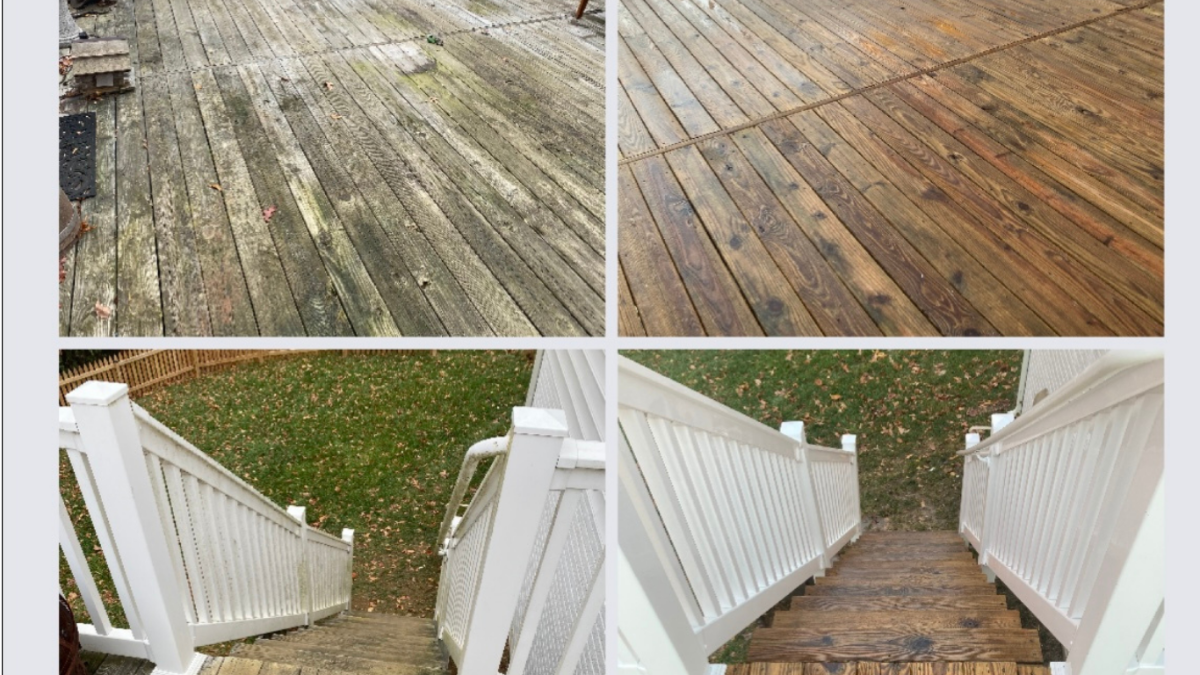
A Wethersfield Deck in Early June
A split level in Wethersfield with a pressure treated deck built in the late 1990s. Roughly 400 square feet, north facing, ringed by mature maples, so it carried a green film most of the spring.
The homeowner rented a 3,000 PSI machine on a Saturday. He started with the wider tip, decided it was too slow, and switched to the 15 degree. The green came off beautifully. He finished the whole deck in about three hours and it looked, wet, like a new deck.
By Sunday afternoon it had dried and every board had a fine standing nap on it, plus a set of parallel stripes running across the boards where the wand had lingered.
He called Monday morning to book a second wash. He was certain he had left something behind.
Two steps barefoot onto that deck and you stopped walking. Not painful yet, but you could feel the nap grabbing at your skin.
We ran the edge of a quarter across one of the boards and a continuous strand of wood fiber lifted up behind it. That is the moment the conversation changes, because you can see the fiber is coming off the board rather than off the surface.
The deck was not dirty. It was missing wood.
What it took: brightener, three days of drying, a floor buffer with a sanding screen, and two boards near the stairs replaced because the wand had cut down past the screw heads and there was nothing left to sand.
First, Understand What You Are Actually Looking At
The single most useful shift in this whole article is this one: you are not looking at residue. You are looking at your deck.
Every fiber standing up on those boards used to be part of the wood. The machine loosened it, tore it at one end, and left it attached at the other. Now it is dry and standing.
That is why the deck feels rough after it dries but felt fine while it was still wet. Wet fiber lies flat. Dry fiber stands.
This is specific to real wood. A composite or PVC deck cannot fuzz this way because there is no grain to tear; if that is what you have instead, see PVC deck cleaning.
Why Another Wash Makes It Worse
The instinct is to go back over it and blast the hair off. It is the wrong move and it is worth understanding why.
Another pass does not remove the fuzz. It removes more soft fiber from underneath and around it, which loosens more of the hard fiber, which then stands up when it dries.
You end up with deeper furring than you started with, and now you have also driven more water into the board, which pushes your drying time out by days.
You cannot wash off missing wood. Every pass costs you board thickness and buys you nothing.
The Mechanism: Soft Spring Wood, Hard Summer Wood
This is the part nobody explains, and once you see it you will never look at a deck board the same way.
How a Growth Ring Is Built
A tree grows in two speeds each year.
In spring, water is plentiful and growth is fast. The wood laid down then, called earlywood, is light, open and comparatively soft.
In summer, growth slows down. The wood laid down then, called latewood, is dense, dark and hard.
Cut a board out of that trunk and you get alternating bands of soft and hard running across the face. On a piece of southern yellow pine you can see them clearly: the pale wide stripes and the darker narrow ones.
Those two materials do not respond to water pressure the same way. Not remotely. The U.S. Forest Products Laboratory’s own finishing research documents this differential erosion directly, measuring how much faster earlywood wears away than latewood on a planed softwood surface.
What a 15 Degree Tip Does in One Second
A narrow fan concentrates the machine’s whole output into a thin, high energy line.
Point that at a pine board and it erodes the soft earlywood out from between the hard latewood bands. The soft material washes away. The hard bands stay.
What you are left with is a miniature ridged washboard, plus a fringe of fiber torn loose at the boundary between the two.
Held close and paused, a 15 degree tip cuts visible stripes into a pressure treated board in under a second. Not a minute of careless work. One second.
That is why wand marks so reliably appear at the ends of each sweep, where the wrist slows to change direction.
Why Pressure Treated Southern Yellow Pine Is the Worst Offender
Southern yellow pine has an unusually strong density contrast between its earlywood and latewood bands. That contrast is exactly what makes it fuzz so dramatically.
It is also what most Hartford County decks built in the 1990s and 2000s were framed and decked with, which is why this problem is close to universal around here.
Why Cedar and Redwood Fuzz Differently
Cedar and redwood are softer overall and much more uniform between bands. There is less contrast to exploit.
So instead of ridging into a washboard, they bruise. The wand crushes and dents the surface, and the fuzz that comes up is long and stringy rather than a short even nap.
That matters for diagnosis, because a damaged cedar deck can look milder from standing height while actually needing more sanding than a striped pine deck.
What Pressure Is Actually Safe on Wood
The Numbers
Here is the trio, and you need all three together. Any one of them alone will mislead you.
500 to 1200 PSI at the surface for softwood decking.
25 to 40 degree tip. The white 40 degree is the safe default. Green 25 degree is the aggressive end.
12 to 18 inches of standoff, with the fan always moving and always running with the grain, never across it.
And one rule that outranks all three numbers: never stop moving. A correct tip at correct pressure held still for two seconds will still cut a board.
| Nozzle | Degree | Typical use | Safe on a wood deck | What it does to PT pine |
|---|---|---|---|---|
| Red | 0 | Concentrated blasting | No | Cuts a groove instantly |
| Yellow | 15 | Heavy stripping | No | Erodes earlywood, ridges and furs the board in one pass |
| Green | 25 | General cleaning | With care, at the low end of the pressure range | Acceptable at distance and constant motion |
| White | 40 | Rinsing and delicate surfaces | Yes | The right default for decking |
| Black | Low pressure soaping | Chemical application | Yes | Applies cleaner, does no cutting |
Why Pressure Should Never Be the Cleaner
Here is the actual method, and it is the reason our results do not come with a sanding bill attached.
The gray on your deck is oxidized surface fiber, mildew and organic film. That comes off chemically. A sodium percarbonate deck cleaner, or a properly diluted sodium hypochlorite mix depending on what is growing, applied and given real dwell time, releases it.
Then a low pressure rinse carries it away.
The chemistry does the cleaning. The pressure is only the rinse. That distinction is the whole basis of soft washing, and it applies to wood more than to any other surface on your property.
Roman stopped treating pressure as the cleaning tool years ago, and he puts it simply: pressure is the fastest way to make a deck look clean today and cost you a weekend of sanding next week.
Everything in our approach to pressure washing in Hartford CT follows from that same idea, which is matching the method to the material rather than turning the machine up.
Worth noting: fences fuzz for exactly the same reason and take exactly the same treatment, which is why fence cleaning uses the same low pressure approach.
Honest Triage: Which Boards Can Be Saved
Not every board on a fuzzy deck needs the same thing. Walk it and sort it into three groups.
Light Fuzz
A fine surface hair with no ridging. Your fingertip catches slightly. Your fingernail does not.
If you are not staining this year, this will largely weather off in four to eight weeks of sun, rain and traffic.
If you are staining, sand it anyway. Loose fiber under stain is loose fiber under stain, and it will take the finish with it when it sheds.
Medium Fuzz
Visible standing grain. A ridged washboard feel when you run your palm across the board. Splinter risk if anyone walks it barefoot.
Sanding is required. This is the large majority of what we see.
The Coin Test and the Fingertip Test
Two ways to sort light from medium in about five seconds.
Fingertip: drag it across the board. Catching slightly is light. Feeling distinct ridges is medium.
Coin: drag the edge of a quarter across the grain. If it lifts a continuous strand of fiber rather than just a few loose hairs, you are at medium or worse.
Destroyed Boards
Deep wand marks. Scalloped stripes you can feel with a fingernail. Fiber cut away below the level of the fastener heads. Soft or punky spots.
Sanding will not bring these back. Sanding a board that is already cut below the screw heads just removes what little sound material is left.
These get replaced. On a deck with sound undersides, an alternative is to unscrew and flip the board, which gives you a fresh face and costs only labor.
It is normally a handful of boards, usually near the stairs and near the door where people work slowest. Rarely the whole deck.
A Newington cedar deck worth mentioning. We looked at one where the damage barely registered from standing height. No stripes, no obvious washboard. Up close, the boards were bruised and dented rather than ridged, and the fuzz came away in long strings instead of a short nap.
That deck needed more sanding than the striped pine deck in Wethersfield did. Cedar hides the damage better and holds more of it.
If you are not sure which tier your deck is in, we will tell you for free. Get a free quote or call (860) 263-9031.
The Recovery Process, Step by Step
Eight steps. The order is not optional.
Step 1: Let It Dry, 48 to 72 Hours Minimum
Longer here than the national blogs tell you, because central Connecticut humidity and canopy shade both slow it down. A north facing deck under maples can need four or five days after a real soaking.
Sanding damp softwood does not cut the fiber, it mashes it flat and clogs the abrasive. Then it dries and stands right back up, and you have wasted a screen and an afternoon.
Step 2: Apply a Wood Brightener
Oxalic acid, sold as a deck brightener. This step gets skipped constantly and it does four things at once.
It neutralizes the alkaline residue left behind by a percarbonate or hypochlorite cleaner, which matters because sanding into alkaline residue locks a gray tone into the board.
It restores the wood’s pH so stain absorbs evenly.
It pulls back the darkened, grayed tone and brings the natural color forward.
And it lifts tannin and iron stains, which are the black rings you see around fasteners.
Apply it to the deck while the surface is still damp from the previous step, following the product’s own directions, then rinse.
Step 3: Dry Again, Another 24 to 48 Hours
You just put water back on the deck. It needs to leave again before anything abrasive touches the boards.
Step 4: Sand With the Correct Grit
60 to 80 grit on badly furred boards to cut the standing fiber off cleanly.
80 to 100 grit to finish.
Why You Must Not Go Finer Than About 100
You will find advice online recommending 120 to 150 grit for light fuzz. Do not follow it on a softwood deck.
Fine grit does not cut softwood, it burnishes it. The abrasive polishes the surface and closes the grain, sealing the pores that the stain is supposed to soak into.
The result is a beautiful looking bare deck that rejects the stain. The finish sits on top instead of penetrating, dries blotchy, and starts shedding within a season.
Roman has seen enough burnished boards six months after staining to be blunt about it. They look patchy and streaked, the stain is peeling in flakes rather than fading, and there is no fix except stripping and starting over.
A deck is not furniture. You want the grain open.
Step 5: Pick the Right Tool for the Deck Size
Pole sander for a small deck, touch-ups and reaching without kneeling.
Random orbital sander for control, and for stair treads where a big machine cannot go.
Floor buffer with a sanding screen for anything over roughly 300 square feet. This is the only realistic tool for a full deck, and it is rentable. It also moves fast, so keep it moving and never let it sit.
By hand, always: rails, caps, balusters, stair noses and any edge. Machines round over edges and gouge corners.
Step 6: Vacuum and Tack
Shop vac the boards and, importantly, the gaps between them.
Blowing dust with a leaf blower pushes it down into the gaps, where the first breeze lifts it back out and drops it onto wet stain. Vacuum, then a dry tack pass over the boards.
Step 7: Check Moisture Before You Stain
Aim for roughly 12 to 15 percent moisture content or lower.
This is where a moisture meter earns its cost. A board can feel bone dry on the surface while the core is sitting at 20 percent, especially on a shaded deck after a wet week. Stain applied over that will not bond, and it will fail early no matter how well you sanded.
If you do not own a meter, the poor substitute is time plus a plastic sheet test: tape a square of clear plastic to the boards overnight and look for condensation underneath in the morning.
Step 8: Stain
Follow the product’s own window and coverage rate. Do not over-apply in an attempt to get more color, because excess stain that cannot penetrate stays on the surface and goes tacky.
Can I Just Stain Over the Fuzz?
No. Three reasons, all of them mechanical rather than cosmetic.
Fuzz drinks stain unevenly. Raised fiber has enormous surface area and soaks up far more product than the flat board next to it. You get dark blotches at every furred patch and a lighter field around them.
The fiber is barely attached. It is torn loose at one end. When it eventually sheds, and it will, it takes the stain sitting on it with it. You get bare patches within a season on a finish you just paid for.
It stays a splinter hazard. Stain does not glue the fiber down. It coats it. The deck is exactly as rough as it was, now with a color on it.
Staining a fuzzy deck is the most expensive way to skip a step, because you pay for the stain, then you pay to strip it, then you sand anyway. For a deck too far gone to save with sanding alone, that stripping and refinishing is exactly what our rejuvenation service is for.
The Splinter and Bare Foot Problem
This is the reason not to just wait it out, and it is worth taking seriously if you have kids or a dog.
A furred pressure treated board is a splinter factory. Every one of those standing fibers is a barb waiting for a bare foot, a hand on a rail, or a dog’s paw.
And they are splinters in treated wood, which people are understandably less relaxed about than a splinter from a cedar fence picket.
The problem peaks exactly when the deck gets used. June and July, barefoot season, kids running.
It is worse still around a pool, where everyone is barefoot and moving fast on a wet surface. If your deck is part of a pool surround, the same visit that handles the wood should look at the hard surfaces too, which is what pool deck cleaning covers.
Check Your Fasteners While You Are Down There
Do this before the sanding pad touches the boards.
A sanding screen finds every proud screw and every popped nail head on the deck. It will shred a screen instantly and gouge the board around the fastener while it does it.
Walk the deck, set or replace anything standing proud, and countersink where needed.
While you are looking, there is a Hartford County specific thing worth knowing. Plenty of decks around here were built in the 1990s and early 2000s with older galvanized fasteners. Modern ACQ treated replacement boards are considerably more corrosive to those fasteners than the older CCA lumber was.
So if you are replacing a few boards on an older deck, use fasteners rated for modern treated lumber. Mixing old hardware with new boards is how you get black staining and loose deck boards three years later.
Connecticut Timing: When to Do This Work
The Stain Window in Central Connecticut
Roughly late May through September.
The bigger issue here is not daytime temperature, it is overnight dew. In Hartford County a deck can be perfectly dry at six in the evening after a hot day and be visibly wet at five the next morning. Dew re-wets the surface and pushes your moisture content back up.
Plan your staining for mid morning once the dew has burned off, and finished by mid afternoon so the film has time to set before evening.
Pollen Will Ruin a Freshly Sanded Deck
Oak and pine drop heavily from late April into May here.
Do not sand a deck and then leave it open for a week waiting for a free weekend. You will come back to a yellow film bonded into freshly opened grain, and now you are sanding again.
Sand and stain in the same weather window, or do not sand yet.
Why Our Dry Windows Are Longer Than the Blogs Say
Three reasons stack up in this area.
Summer humidity in the Connecticut River valley slows evaporation considerably. Mature oak and maple canopy shades a lot of Newington and Wethersfield backyards. And north facing decks, which are common on this housing stock, may never get direct sun at all.
A national article saying “allow 24 to 48 hours” is written for somewhere else. Plan on 48 to 72 as your floor, and check rather than assume.
How We Clean a Wood Deck Without Fuzzing It
For what it is worth, here is the actual sequence, so you can either follow it or judge whoever you hire by it.
Pre-wet and protect the plantings and the lawn below first. Everything that comes off the deck lands there.
Apply the cleaner appropriate to what is actually growing, and let it dwell. This is where the work happens, and it takes patience rather than horsepower.
Agitate with a soft brush where the film is heavy, usually the shaded corners and under the rail.
Rinse at low pressure with a wide fan, moving with the grain.
Brighten while the surface is still damp, which is when oxalic acid works best, then rinse again.
Only then do we evaluate whether any sanding is needed at all. On a deck that was cleaned this way rather than blasted, frequently the answer is very little.
Frequently Asked Questions
Why is my deck fuzzy after pressure washing? The wand eroded the soft spring growth out of the boards and left the harder summer growth standing, tearing fiber loose at the boundary. The fuzz is wood, not dirt. It lies flat while wet and stands up once the deck dries, which is why it appears a day after you finished.
Will the fuzz on my deck go away on its own? Light surface fuzz largely weathers off in four to eight weeks of sun, rain and traffic. Medium and heavy furring does not. It stays a splinter hazard and it will ruin any stain applied over it, so if you plan to finish the deck this season you need to sand.
Can I just wash the fuzz off with another pass? No, and it will make things worse. Another pass removes more soft fiber, loosens more hard fiber, and deepens the furring while adding days to your drying time. You cannot wash away missing wood.
Can I stain over a fuzzy deck? No. Raised fiber absorbs stain unevenly so the finish goes blotchy, the fiber is barely attached so it sheds and takes the stain with it within a season, and the surface stays just as rough underneath. It is the most expensive way to skip a step.
What grit sandpaper do I use on a furred deck? Start at 60 to 80 grit on badly furred boards and finish at 80 to 100. Do not go finer than about 100 on softwood. Fine grit burnishes rather than cuts, closing the grain so the stain cannot penetrate and will dry blotchy.
How long should a deck dry before sanding? At least 48 to 72 hours, and longer in central Connecticut for shaded or north facing decks. Sanding damp softwood mashes the fiber flat and clogs the abrasive instead of cutting it, and the fiber stands right back up once it finally dries.
Do I need a deck brightener before I sand? Yes, if you used a percarbonate or bleach based cleaner. Oxalic acid brightener neutralizes the alkaline residue, restores the wood’s pH so stain absorbs evenly, brings back the natural color, and lifts tannin and iron staining around fasteners.
What PSI is safe for a wood deck? Generally 500 to 1200 PSI with a 25 to 40 degree tip held 12 to 18 inches back, always moving and always with the grain. Better still, let chemistry do the cleaning and use the machine only as a low pressure rinse.
How do I know if a board is too damaged to save? If there are deep wand marks you can catch with a fingernail, scalloped stripes, or fiber cut away below the level of the screw heads, sanding will not recover it. Those boards get replaced, or unscrewed and flipped if the underside is sound.
Does cedar fuzz the same way as pressure treated pine? Not quite. Pine has a strong density contrast between growth bands, so it ridges into a washboard. Cedar is softer and more uniform, so it bruises and dents and sheds long stringy fibers. Cedar damage often looks milder from standing height while needing more sanding.
Get It Looked At Before You Stain
If you are planning to stain in the next couple of weeks, the useful move is to have someone look at the boards first.
Roman would rather see a deck before it gets stained than after. Before, it is a brightening and a sanding pass and maybe a couple of boards. After, it is stripping somebody’s stain off a furred deck, and that is a much longer, more expensive day for everybody.
We will tell you which tier your deck is in, whether the brightener step is needed, and whether any boards are past saving. If it is light fuzz and you are handy, we will tell you that too.
We serve Newington, Wethersfield, Rocky Hill, Glastonbury, West Hartford, Berlin and the surrounding Hartford County towns, Monday to Friday, 8am to 4pm. Deck work runs from roughly late May through September here.
Book deck cleaning and restoration, or get a free quote and send a close up photo of a board taken in low angle light.
Mr-Suds Washing, Newington, CT. Licensed, bonded and insured. Call (860) 263-9031.