
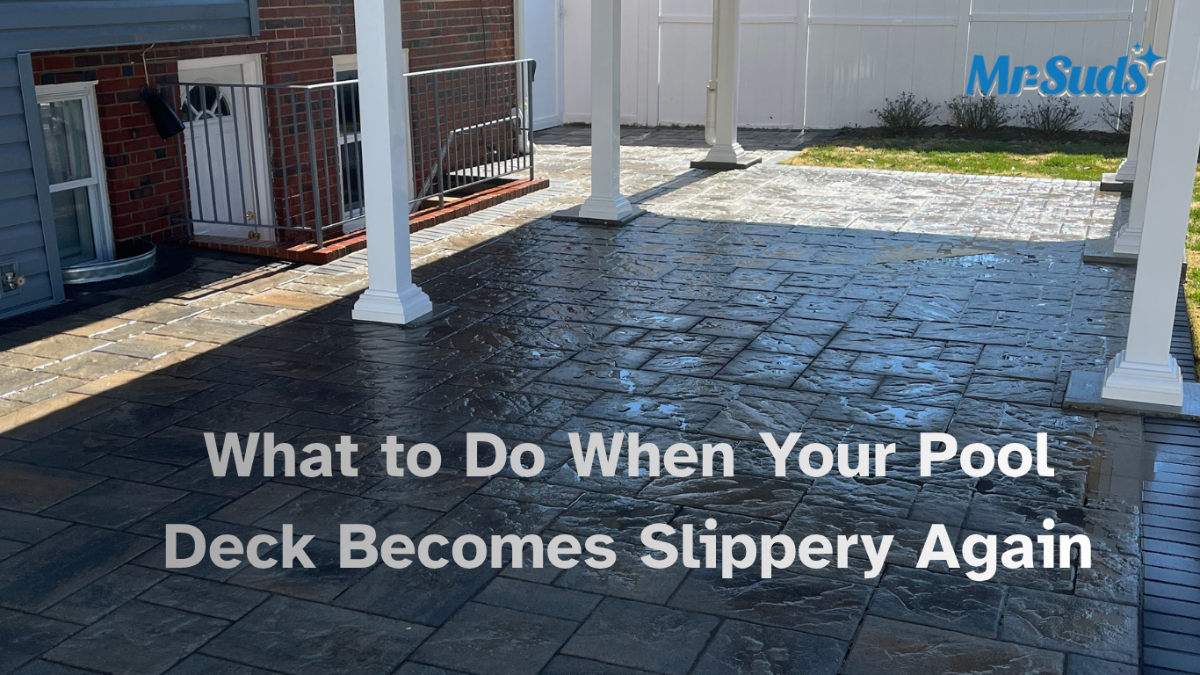
A pool deck that turns slippery again within weeks was cleaned, not treated. Chlorine bleach removes the color from algae but leaves the biofilm and spores inside the pore structure. Lasting traction takes a soft wash with proper dwell, a spore-targeting post-treatment, and restored surface texture.
That is the mechanism. The rest of this page does two things: helps you work out which of six causes you actually have, then matches the right fix to it. Skip the diagnosis and you will be back here in six weeks, which is probably how you found this page in the first place.
If you want it handled before the season, that is what pool deck cleaning is for. But read the diagnosis first, because it changes what you should be asking for.
The Short Answer: Cleaned Is Not the Same as Treated
Here is what bleach actually does on a pool deck.
Algae contains pigment. Sodium hypochlorite oxidizes that pigment and the color disappears. The surface goes from green or black to bright. It looks finished.
What has not happened is the colony being removed.
Algae does not sit on a surface as loose dirt. It builds a biofilm, a thin slick protective layer of secreted material that anchors the colony and shields it. That biofilm is largely transparent once the pigment is gone, and it is exactly the thing your bare foot is sliding on.
Below that, spores sit down inside the pore structure of the concrete or stone, well beyond where a surface rinse reaches. They are waiting for the next warm damp week.
So you get a deck that is visibly bright and still genuinely dangerous, and then a full re-bloom in three to six weeks because the anchor layer and the spore load never left.
Roman sees this often enough that it barely registers anymore. He shows up to a deck the homeowner scrubbed a month ago, it looks perfectly clean, and you can feel the slick under your shoe before you have walked six feet.
Why the Deck Feels Slicker After Washing Than Before
This part surprises people, and it is worth understanding before you reach for the machine again.
A consumer washer running 2,000 to 3,100 PSI does two things to a soft or coated pool surface. It removes whatever surface texture was left, and it opens the pore structure.
Both of those make the next algae bloom faster and better anchored than the last one, because you have given it more surface area to grip and a rougher pore network to hide in.
On travertine, Kool Deck and sealed stamped concrete it is worse still, because the material is soft enough that pressure takes profile off permanently. This is one of the main reasons our whole approach to pressure washing in Hartford CT is built around matching pressure to the surface rather than turning it up.
Nobody tells you this when you buy the washer. It is not a stupid mistake, it is a predictable one.
First, Diagnose It: Six Reasons a Pool Deck Turns Slippery
Every fix below depends on which of these you have. Each one has a test you can run barefoot in ten minutes.
1. Algae and Biofilm, Green or Black
Green algae takes the shaded north side. Black growth, the Gloeocapsa type you also see streaking roofs, sets into the wettest seams and the coping joints.
How to tell: wipe a small area with a wet white rag and look for a green or grey smear on the cloth. Or simpler, look at where the slick zone stops. If it tracks the shade line from a tree or the house, you are dealing with growth.
Fix pointer: soft wash plus post-treatment. Sections below.
2. A Slick Sealer, or a Half-Worn Wet-Look Sealer
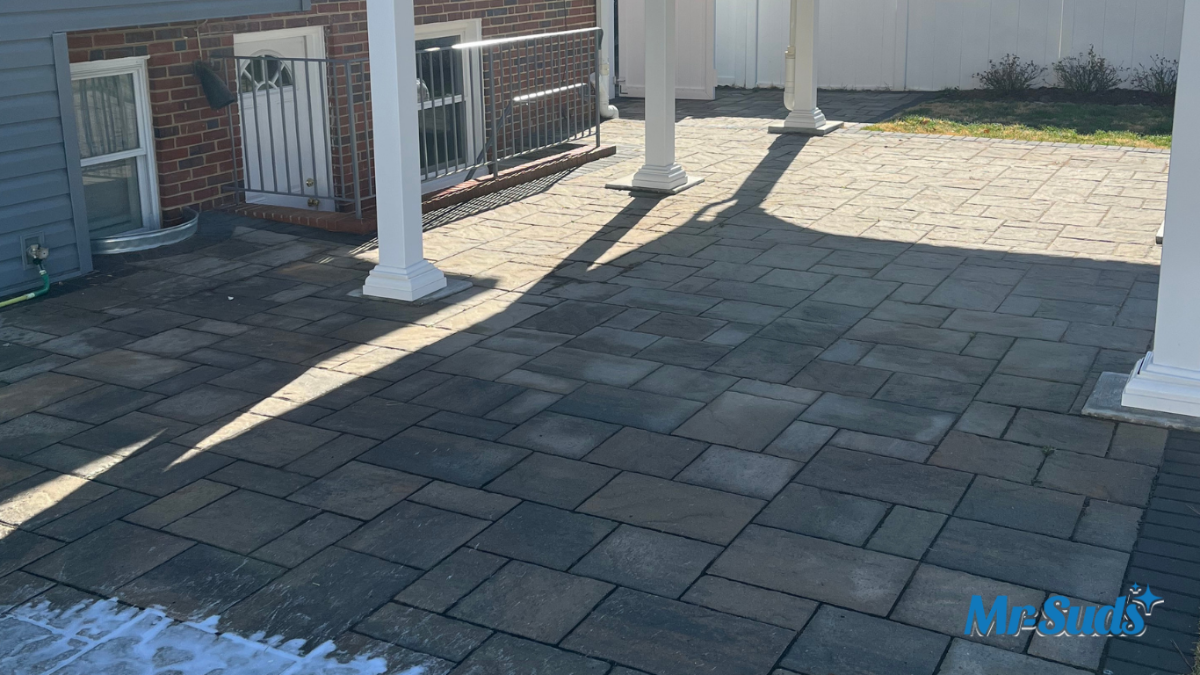
Glossy acrylic sealer with no anti-slip additive is slippery when wet by design. That is not a defect, it is what a smooth resin film does.
A half-worn wet-look sealer is worse, because now you have slick patches next to grippy patches and your foot cannot predict which is which.
How to tell: flick water onto the surface. If it beads up and sits, there is an intact film. Beading plus gloss plus slick means you have a sealer problem, not an algae problem, and no amount of cleaning will change it.
3. Polished or Worn-Smooth Surface With No Texture Left
Broom finish gets walked and washed flat over twenty years. Honed travertine never had barefoot-wet texture in the first place, because it was finished for looks.
How to tell: run a dry palm across a main traffic lane, then across a protected spot under a planter or behind a chair. If the traffic lane feels noticeably smoother, texture loss is at least part of your problem.
4. Mineral Scale and Calcium Film
Chlorinated splash-out and hard water evaporate and leave minerals behind. Over seasons that builds a chalky film that looks dull, feels slick wet, and ignores bleach completely.
How to tell: put a drop of household vinegar on a suspect area. A light fizz means carbonate scale.
5. Shade and Poor Drainage Keeping It Permanently Damp
A deck that never fully dries never stops growing. This is the underlying condition behind most of cause one. University extension horticulturists fielding the same complaint on concrete surfaces consistently point back to shade and standing moisture as the reason a spot keeps re-growing no matter what it was cleaned with.
How to tell: four hours after a rain, walk the deck and note where water is still sitting. Then compare that map to where it is slick. They usually match, and they usually also match the tree shadow at two in the afternoon.
6. Pollen and Organic Film in Spring
Late April into May, oak and pine pollen lands heavily across Newington and Wethersfield. It lays a yellow film that turns greasy with the first rain, then rots down and feeds the algae behind it.
How to tell: timing. If your deck goes slick in May before it has been used, and the cars in the driveway are yellow, that is your answer.
Field Story: A Rocky Hill Deck Cleaned Three Times in One Summer
Stamped concrete surround, in-ground pool, mature maples along the north side of the property in Rocky Hill.
The homeowner had bleached and pressure washed the deck himself in June. It came back by mid July. He did it again, harder. It came back by mid August, faster than the time before. When he called us he opened with a fair question: why is it getting worse every time I clean it.
Three things were happening at once.
The wet-look acrylic sealer was about half worn. Slick where it survived, dull and porous where it had gone. His foot was crossing between two different surfaces every step.
The biofilm was re-establishing within roughly three weeks because nothing had ever touched the spore load in the pore structure. He was removing color on a cycle, not removing the organism.
And there was a low spot near the deep end, maybe six feet across, that held water all day after rain. That corner was the slickest part of the deck every single time.
What we did: soft wash with the right chemistry and real dwell time, then a post-treatment aimed at the spores rather than the pigment. Once it dried out properly, the remaining sealer was stripped and the surface re-coated with grit broadcast into the wet coat. Then we had a conversation about the low spot, which is a grading issue and not a cleaning issue.
Honest outcome: the deck held through the following season with one pre-season visit instead of three panic washes. The low spot still holds water and always will until it is addressed properly, and we told him that rather than pretending the sealer solved it.
How Slip Resistance Actually Works, in Plain Language
Coefficient of friction is just a number for how much grip there is between your foot and the surface. Higher number, more grip.
Static friction is how hard it is to start sliding from standstill. Dynamic friction is how much grip you have once you are already moving. Around a pool, both matter, because people walk fast and change direction.
Here is the point that gets buried in every product spec sheet you will read.
Most published slip resistance numbers were measured using a hard rubber slider. A hard slider behaves nothing like a wet bare foot. Bare skin is soft, it deforms into surface texture, and it interacts with a water film completely differently.
That is why a deck surface can pass a published slip rating and still be genuinely dangerous around a pool full of barefoot kids.
Testing methods designed specifically for wet barefoot areas do exist. European DIN 51097 barefoot classification and the pendulum test value method with a soft slider are what safety specialists point to for this exact situation, with wet PTV benchmarks in the region of 40 for level deck areas and higher for steps and ramps.
You do not need a lab. What you need to take from this is simple: the thing that gives a wet bare foot grip is texture that survives water. Every fix in the next section is ultimately about restoring or protecting texture.
The Real Solution Stack
This is a sequence, not a menu. Doing step three without steps one and two is why grit additives sometimes disappoint people.
Step 1: A Proper Soft Wash With the Right Cleaner and the Right Dwell
Surface-appropriate chemistry at the correct dilution, applied and given time to work, then rinsed at low pressure.
Dwell is what does the work. Not pressure. A cleaner that sits for the right number of minutes and stays wet will out-clean any amount of PSI, and it will not cost you surface profile in the process. That is the entire premise of soft washing.
Step 2: A Post-Treatment That Attacks Spores, Not Just Color
This is the step nearly every DIY job and a lot of cheap contractor jobs skip, and it is the single reason a clean lasts a season instead of six weeks.
After the visible growth is gone, the surface gets a treatment aimed at the residual spore load sitting in the pore structure. You cannot see the difference on the day. You see it in July.
If somebody quotes you a pool deck clean and there is no post-treatment step in it, ask why. That is the difference between a wash and a result.
Step 3: Anti-Slip Additive Broadcast Into the Sealer
If you are sealing, this is where traction gets built in.
Two common materials. Aluminum oxide grit is hard, effective, inexpensive and available in colors. Polymer grit is softer underfoot and blends more invisibly.
Method matters more than material. Mixing grit into the sealer bucket suspends some of it below the surface where it does nothing. Broadcasting it into the wet coat puts it where feet actually contact, and it holds better.
The honest tradeoffs, which product pages never mention:
Coarse grit is rough on bare feet, and rougher still on a kid’s knees.
Textured surfaces hold dirt and are harder to sweep and rinse.
Grit wears out in traffic lanes and needs renewal every few seasons.
Roman talks people down from the most aggressive grade in lounging areas fairly often, because they will hate it by August. The right approach is graded placement: something more aggressive on the steps, the coping edge and any ramp, and something finer where people lie down and walk slowly.
Step 4: Texture Restoration When the Surface Is Genuinely Worn Flat
No cleaner restores texture that is gone. It is worth saying plainly because a lot of money gets spent pretending otherwise.
When the profile is genuinely worn out, the options are mechanical profiling, chemical etching where the material allows it, or an overlay or resurfacing. Those are concrete specialty jobs, not cleaning jobs, and we will tell you when you are in that territory.
Step 5: Drainage and Grading
A deck that dries within two hours of rain grows almost nothing.
Look at low spots that pond, deck drains that have silted up, and downspouts discharging onto or toward the deck. Fixing drainage is unglamorous and it does more for long term traction than any product on this page.
Step 6: Cut Back the Vegetation
Limb up the canopy. Pull shrubs and hedges back off the deck edge. Get sunlight and moving air onto the surface.
Cheapest permanent improvement on the entire list, and the one most people skip because it does not feel like a fix.
Surface by Surface: What Your Deck Can and Cannot Take
| Surface | Typical cause of slip | Chemical approach | Pressure | Do not do |
|---|---|---|---|---|
| Broom finished concrete | Worn texture plus algae | Standard soft wash with post-treatment. See concrete and driveway cleaning | Low, wide fan | Do not stripe it with a turbo nozzle |
| Stamped concrete | Slick or half-worn acrylic sealer | Soft wash, then strip and reseal with grit broadcast | Low | Do not reseal glossy without an additive |
| Pavers | Biofilm in the joints plus lost joint sand. See paver cleaning and re-sanding | Soft wash, re-sand, grit in the sealer if sealing | Low to moderate, controlled | Do not blast the joint sand out |
| Travertine | Polished surface plus mineral scale | pH-appropriate stone-safe cleaner, never straight bleach at strength | Very low | Do not use acid blindly, it etches permanently |
| Kool Deck or cool deck coating | Chalking topping plus embedded biofilm | Gentle soft wash, mild dilution, short dwell | Very low | Do not pressure wash it, the topping comes off in sheets |
| Composite or PVC surround | Slick organic film held in the grain. See deck cleaning and restoration | Manufacturer-approved cleaner, thorough rinse | Very low | Do not use a hot mix or high pressure, it hazes and voids warranties |
This is why a pool deck cannot be quoted at one price per square foot across the board. Six different materials, six different chemistries, six different pressure limits, and two of them can be permanently damaged by the approach that works fine on the other four. Anyone quoting your deck without asking what it is made of has not looked at it.
Why This Keeps Happening in Connecticut
Here is the local reality that the Florida and Texas articles on this topic cannot describe.
Your pool season is about three months. Roughly Memorial Day to Labor Day. Which means your deck is in active use for twelve weeks and sits wet, shaded, cold and completely untreated for the other eight or nine months.
That is the actual growing season for what is making you slip. It is not growing while you are using the pool. It is growing while you are not looking at it.
Freeze thaw opens the surface every winter. Central Connecticut delivers roughly 100 to 140 freeze thaw cycles a season on horizontal surfaces. Each one works the pore structure a little wider. That gives algae a slightly better anchor every spring than it had the year before.
May pollen loads the deck right before opening. Oak and pine drop heavily in late April and May here, which lands an organic film on the surface at exactly the wrong moment.
Canopy shade. Mature oak and maple over north facing decks in Newington, Wethersfield, Rocky Hill and Glastonbury means plenty of pool surrounds never see direct sun at all. Those decks are damp from October to June.
And there is a chemistry floor. Below roughly 40 to 45 degrees, most cleaners and sealers stop performing correctly. This is May work, not March work, no matter how much you want it done early.
The Right Time to Schedule It
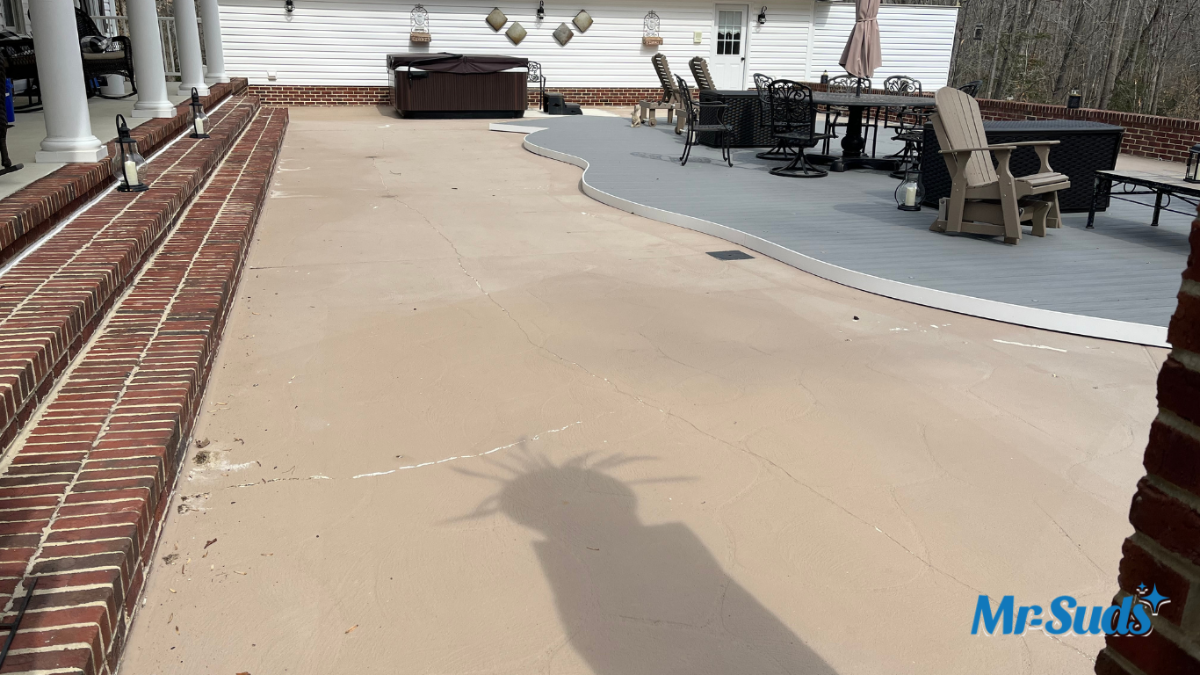
The pre-season window in May, before the furniture goes out and before the first guests arrive.
Doing it then means an empty deck, no cover to work around, and a surface that gets treated before the growth has its head start. Doing it in July means working around a full pool, moving your furniture, and losing a weekend of use.
Same job, half the inconvenience, and a better result because you got ahead of the season instead of chasing it.
Safety and Liability: The Part Homeowners Skip
A pool deck is the one surface on your property where people walk fast, wet and barefoot, often distracted, sometimes running, sometimes older and less steady than they used to be.
That combination is why this topic is different from a dirty driveway. A slick driveway is an appearance problem. A slick pool deck is a hazard with your name on the deed. Even the Consumer Product Safety Commission’s own pool safety guidance puts non-slip deck material on the same list as fencing and float lines, not as an afterthought.
On the insurance side, we are not insurance people and this is general orientation only, so talk to your agent about your specific policy.
What is worth understanding in general terms is that a known hazard that was never addressed tends to be a different conversation with an adjuster than an incident on a surface that was being properly maintained. Keeping a record of annual professional maintenance is part of demonstrating the second thing rather than the first.
That is the real argument for reframing this. The correct answer to a slippery pool deck is not an emergency clean after somebody goes down. It is an annual pre-season plan that gets scheduled in May and creates a maintenance record while it is at it.
If you want an assessment before the season, get a free quote and we will tell you which of the six causes you are dealing with.
Second Field Story: The Newington Travertine Deck
A honed travertine surround in Newington, installed by a previous owner.
The homeowner had been going after it with straight bleach every few weeks all summer and could not understand why the deck stayed slick when it clearly was not dirty anymore.
She was right that it was not dirty. By the time we got there, there was very little algae left to kill. The bleach had done that part.
The slip was two other things. A layer of mineral scale from years of splash-out, which bleach does nothing to, sitting on top of a stone that was honed smooth to begin with.
The scale came off properly with stone-safe chemistry at the right pH. The stone underneath came back to a nice even finish.
And it was still slick when wet, because honed travertine is slick when wet. That is not a fault in the cleaning, it is a property of the material.
Roman said the thing most contractors will not say on a job like that: some surfaces cannot be made barefoot-safe by cleaning alone. The honest answer is not a stronger chemical, it is placement and expectation.
So the real fix was a matte penetrating treatment across the field, grit only on the steps and the coping edge where people transition and where falls actually happen, and mats in the two lounging zones. Less satisfying than a miracle product. Considerably safer.
Frequently Asked Questions
Why is my pool deck slippery even after I pressure washed it? Because pressure removes visible growth but not the biofilm anchor layer or the spores in the pore structure. It also strips surface texture and opens the pores, which makes the next bloom faster and better anchored. You need chemistry with dwell time plus a post-treatment, not more pressure.
Does bleach actually kill algae on a concrete pool deck? It removes the pigment, which makes the deck look clean, but it does not reach the spores held in the pore structure and it leaves much of the biofilm behind. That is why a bleached deck typically re-blooms within three to six weeks and still feels slick while it looks bright.
Can a sealer make a pool deck more slippery? Yes. A glossy acrylic sealer with no anti-slip additive is slick when wet by design, and a half-worn wet-look sealer is worse because grip changes from step to step. Test by flicking water on it. Beading plus gloss plus slick points at the sealer, not algae.
What is an anti-slip additive and is it rough on bare feet? It is grit, usually aluminum oxide or polymer, broadcast into wet sealer so it sits where feet contact the surface. Coarse grades are genuinely rough on bare feet and knees. The right approach is graded placement: more aggressive on steps and the pool edge, finer where people lounge.
How often should a pool deck be cleaned in Connecticut? Once a year as a pre-season visit in May, before furniture goes out. Our decks sit damp, shaded and untreated for eight or nine months, so the growth establishes over winter and spring. Sealer and grit renewal typically runs every few seasons depending on traffic and exposure.
Can pressure washing damage a pool deck and make it slipperier? Yes, particularly on travertine, Kool Deck and sealed stamped concrete. High pressure removes surface profile permanently and opens the pore structure, giving algae more surface area to grip. Several of the slickest decks we see were made that way by a well intentioned homeowner with a rented machine.
Why is only the shaded side of my pool deck slippery? Because that side never dries. Algae and biofilm need moisture, and a north facing section under mature canopy can stay damp for most of the year in Hartford County. Cleaning it helps for a while, but the lasting fix involves drainage, airflow and cutting back the vegetation above it.
Why does my Kool Deck feel slick and chalky at the same time? The topping is breaking down, which produces the chalk, and biofilm has established in the porous surface underneath, which produces the slick. Kool Deck style coatings need very gentle treatment. Pressure washing takes the topping off in sheets and turns a maintenance job into a resurfacing job.
Getting It Handled Before the Season
If your deck went slippery again this summer, the useful move is not another round of bleach. It is finding out which of the six causes you have, because two of them do not respond to cleaning at all.
We will look at the surface, tell you whether you are dealing with biofilm, a failing sealer, lost texture, mineral scale, drainage or simply spring pollen, and give you a straight answer about what will hold and what will need doing again next year. If your deck needs resurfacing rather than cleaning, we will say so.
Book the pre-season window in May, before the furniture goes out. Same job, far less disruption, and the surface gets treated before the growth has its head start.
We serve Newington, Wethersfield, Rocky Hill, Glastonbury, West Hartford and the surrounding Hartford County towns, Monday to Friday, 8am to 4pm.
Get a free quote or call (860) 263-9031.
Mr-Suds Washing, Newington, CT. Licensed, bonded and insured.