
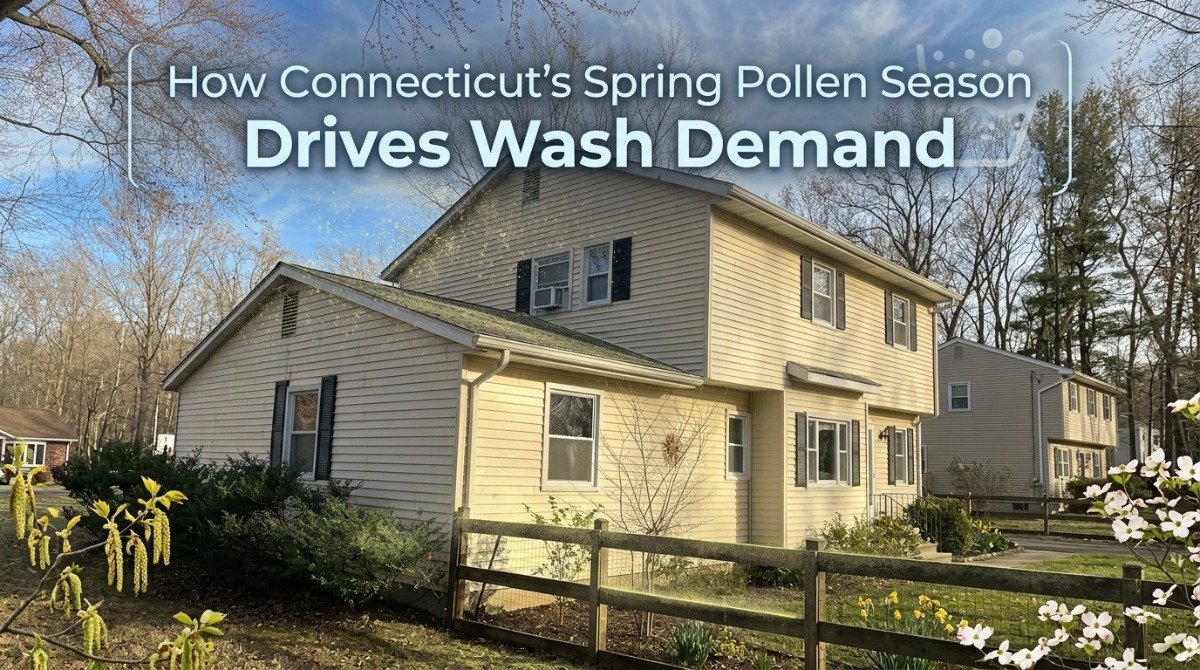
Most years I can tell you the week the yellow shows up without checking a calendar. I walk out to the truck in the morning, and the hood has a fine coat of it. The wiper blades have little yellow lines in the creases.
That is when the phone changes. The question becomes “Can you come after the pollen?” But the calls about Connecticut pollen season and house washing started long before that, on the first warm days of March.
I’m Roman, and I run Mr-Suds Power Washing PROs out of Newington. The spring pollen season decides a big part of our schedule, so I watch the trees about as closely as I watch the forecast.
This guide covers which trees shed when around Hartford County, when the yellow phase usually lands, and why spring fills every washing calendar at once. It also covers how to time your own wash so it lasts.
The Short Answer: When to Wash Around Connecticut Pollen
Connecticut tree pollen runs from about March into early June, peaking in May with oak and birch. The visible yellow pine pollen usually lands from late May into June.
For the longest lasting clean, wash after the pine shed, or in September and early October. Plan early, because spring calendars fill fast.
Here is the short version, month by month:
- March to April: maple, birch and other early tree pollen. First warm days. Calls start.
- May: oak and birch peak. This is the tree allergy peak.
- Late May to June: yellow pine pollen on everything.
- June: the best spring window opens once the pine shed slows.
- September to early October: the second best window, before the first frost.
Which Trees Make Connecticut’s Spring Pollen Season, and When?
Some pollen makes you sneeze and never shows up on siding. Some of it turns the porch yellow. Knowing which is which matters.
Why Connecticut gets so much tree pollen
The short answer is that we live in a forest. According to the USDA Forest Service’s inventory of Connecticut forests, forest covers about 57.8 percent of the state’s land. The oak and hickory group makes up about 69.9 percent of that forest land.
Red maple is the most common tree in the state, with about 24.5 percent of all tree stems. By volume, the leaders are red maple, northern red oak, black oak and eastern white pine. Every one of those puts pollen in the air each spring.
Newington and the Hartford suburbs sit right in this mix. Most streets we work on have mature oaks and maples, and a stand of pines somewhere nearby.
Early season: red maple, elm, birch and aspen (March into April)
The first trees to flower are the red maples, along with elms, birches and aspens. Back in 2014, after a cold winter, Jeff Ward of the Connecticut Agricultural Experiment Station described those trees flowering in mid April, as reported by Connecticut Public.
Timing moves around. Dr. Philip Hemmers of St. Vincent’s Medical Center told WFSB in 2025 that tree pollen has historically started around mid March in Connecticut and has been arriving earlier lately.
This year was a good example. NBC Connecticut reported the Hartford allergy index reaching medium on March 9, 2026, on a day near 70 degrees.
For washing, this early pollen barely matters. It is fine, mostly invisible dust. Early spring washes are about winter grime and algae.
Peak season: oak and birch in May
Connecticut’s spring allergy season runs roughly two months, from early April to early June. UConn Health allergists, quoted in the Hartford Courant back in 2007, put peak tree pollination in May and said birch and oak account for much of the state’s tree pollen.
Oaks also drop their catkins in May. Those are the stringy brown tassels that pile up on driveways, decks and patios, and they fill gutters fast. Wet catkins can leave brown marks on light concrete if they sit.
In late May, tree pollen and grass pollen overlap, which pushes counts higher, according to NBC Connecticut. On a house, oak pollen shows up as a faint greenish dust at most. The catkins are the bigger mess, and they are a big reason we often pair spring work with gutter cleaning in Newington.
The yellow phase: pine pollen, late May into June
The thick yellow dust on cars, decks and siding is almost always pine pollen. Pine grains are large, which is exactly why you can see them. They settle on surfaces instead of floating around as fine dust.
Pines also pollinate later than the hardwoods. The University of Maine Extension notes that eastern white pine releases pollen typically between May and June. Reports from Maine and eastern Massachusetts describe the same thing: a late May start and a June peak.
For Hartford County, late May into early June is a fair expectation in a typical year. On our job sites around Newington, the yellow tends to appear toward the end of May and hang around into June.
It is short and intense. A good rain knocks it down, but more falls until the shed is over.
If pine pollen lands on your house right after a wash, it is loose dust sitting on a clean surface, not grime worked into the siding. A rain or a gentle garden hose rinse usually takes most of it off once the shed ends.
After the trees: grass in summer, ragweed in fall
Grass pollen follows the trees into summer. Ragweed starts in late July or August and runs until the first killing frost, usually with a peak in September.
Neither one coats a house the way pine does. So they do not really drive washing timing. A wash done in September tends to stay clean.
Connecticut pollen and washing calendar
This table joins the pollen calendar to what it means for your house.
| Month | What is shedding | What homeowners see | Washing and booking note |
| March | Early tree pollen begins, maple | Winter grime, salt film, algae streaks in early sun | Calls start; good time to plan spring and early summer dates |
| April | Red maple, birch, elm, aspen; oak starting | Algae on north walls, dark roof streaks | Good for clearing algae and mildew if a date matters; expect pollen later |
| May | Oak and birch peak; tree and grass overlap late in the month | Catkins on drives and in gutters | Popular but risky for a long lasting clean; gutters fill with catkins |
| Late May to June | Pine, the yellow phase | Yellow film on everything | Wait out the shed; aim for the window right after it |
| June | Pine tapering, grasses | Pollen fading | Best spring window for a lasting clean |
| July to August | Grasses, ragweed starts | Humidity, algae regrowth on shaded walls | Fine for washing; avoid midday heat |
| September to early October | Ragweed, then frost | Clean surfaces stay clean | Second best window; finish before the first frost around October 20 |
| Late October to February | Little pollen | Cold, freezing risk | Most exterior washing pauses |
Is Connecticut Pollen Season Getting Longer?
It looks that way. FOX61, using Climate Central data, has reported that Connecticut’s allergy season is about 20 days longer on average than it was in the 1970s. The same reporting says the Hartford area growing season has stretched by more than 20 days over five decades.
Climate Central’s March 2026 analysis found the freeze free season got longer in 173 of 198 U.S. cities, by an average of 21 days since 1970. For the Northeast, the average gain was about 17 days from 1970 to 2025.
Local allergists see it too. Dr. Hemmers described pollen starting earlier and lasting longer in recent years.
What does that mean for washing? Mostly that the first warm week can arrive earlier than people expect. When it does, the phone starts ringing earlier, and the spring calendar starts filling earlier too.
Why Spring Is the Busiest House Washing Season in Hartford County
Back to that truck covered in yellow. By the time the pine phase shows up, our spring has already been running for weeks. Here is how the calendar fills, one layer at a time.
Winter leaves a mess that shows up in the first sun
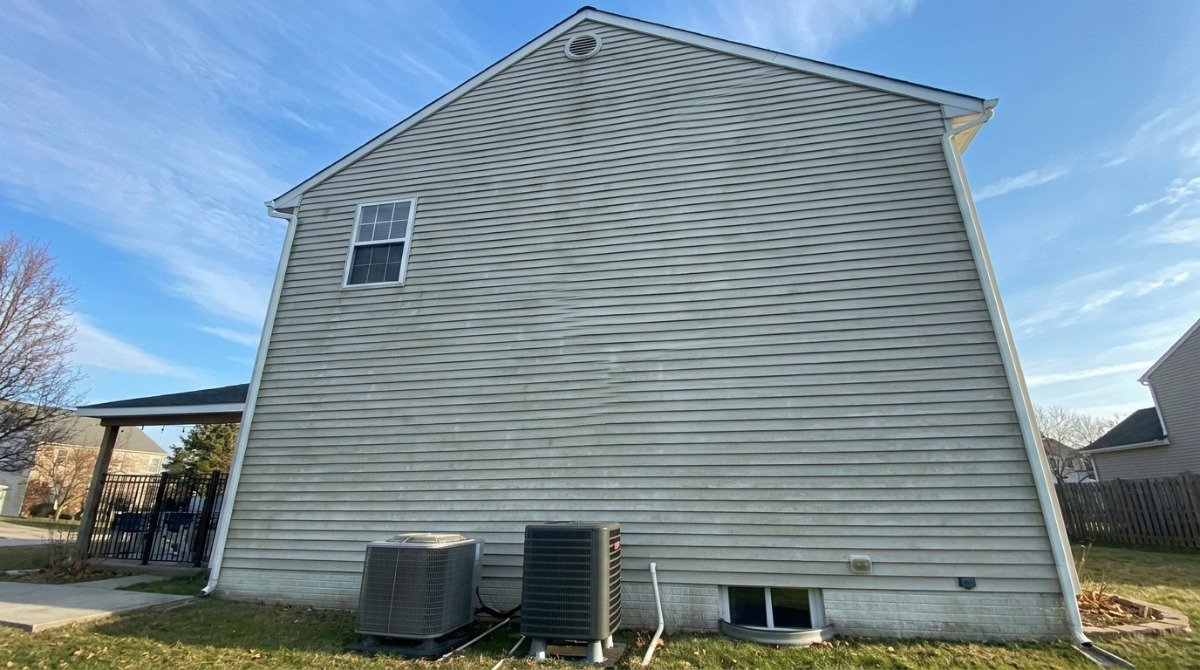
In March and April the leaves are not out yet. Everything winter left behind is suddenly obvious. Gray film near busy roads, splash marks along the foundation, green algae on the shady side.
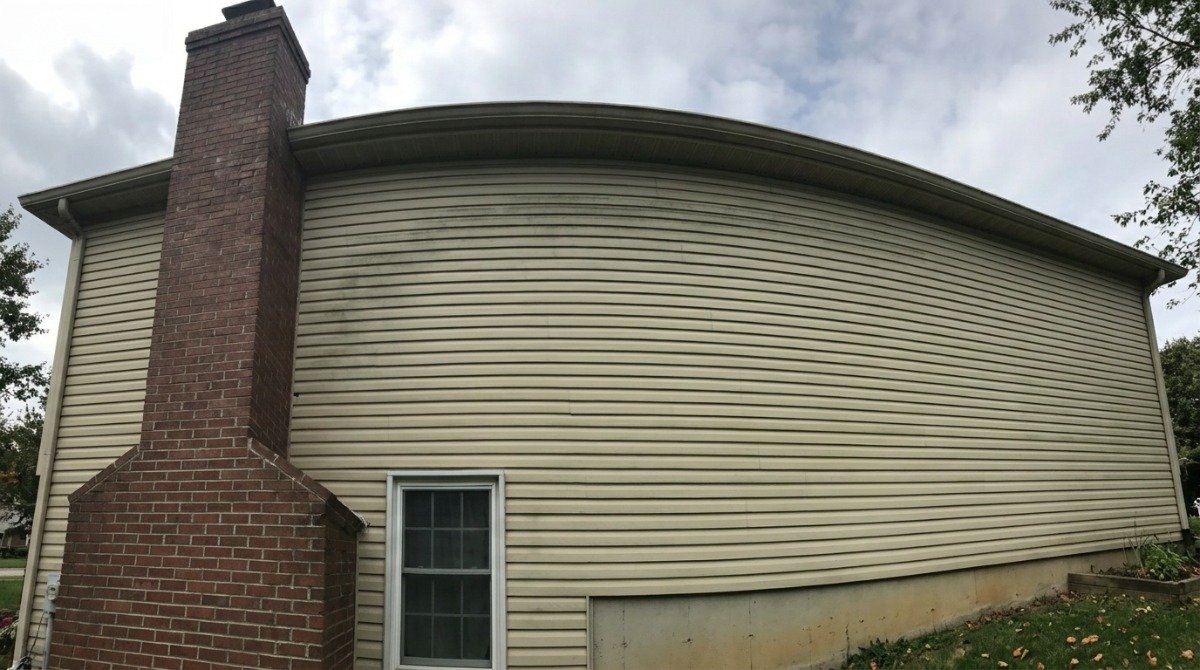
On the capes and ranches around Newington, I see the same pattern every spring. North walls go green, and roofs show dark streaks that were easy to ignore in December.
If that sounds familiar, our piece on green algae on north facing walls explains why it grows where it does. Heavier roof growth is a job for roof cleaning in Newington, done with low pressure.
The weather finally allows it
Most exterior cleaners wait until temperatures stay above about 50 degrees, so water does not freeze in siding joints or masonry. Some guides put the comfortable range at roughly 50 to 85 degrees.
Hartford’s average highs, based on NOAA’s 1991 to 2020 normals, tell the story. March averages about 47 degrees.
April climbs to about 61, May to about 72, and June to about 80. The average last spring frost near Hartford falls around April 23.
So in Hartford County, steady washing weather usually arrives in April. And everyone who waited all winter calls in the same few weeks.
Pollen stacks on top of everything else
Then the pollen phases add two things at once. They give people a visible reason to call, and they give people a reason to wait.
Exterior cleaners in other states describe the same pattern. Many homeowners hold off until the pollen is gone, and some condo complexes will not allow washing until late May.
Here, I hear “after the yellow” more than anything else in May. That pushes a lot of demand into the weeks right after the pine shed.
Outdoor season, events and listings all land at once
By late May, people want the yard back. Decks and patios get cleaned before Memorial Day, and so do pool decks before the cover comes off. We get a lot of calls for deck and patio cleaning and pool deck cleaning in the same stretch.
Fixed dates pile on too. Graduations, family parties and spring listing photos all need a clean house by a certain day.
Rain and wind cut the number of working days
Spring here is also wet. Hartford averages close to 4 inches of precipitation in each of April, May and June. Rainy days push jobs back, and those jobs have to land somewhere.
Wind matters as well. Many washers skip days with sustained wind over about 15 mph, because the cleaning solution drifts. We keep an eye on the gusty days for the same reason, and our post on storm season exterior care covers the wet weather side of things.
Fewer workable days plus more calls equals a full calendar. That is the whole reason spring dates go quickly. If the week you want is taken, the simple fix is to ask for the next open date and stay flexible by a few days, or to look at the fall window instead.
If you already know you want a clean house after the yellow pollen, tell us now. We will help you pick a week that fits the trees on your street and your plans. Mr-Suds Power Washing PROs, 130 Dewey Ave, Newington, (860) 263-9031.
How to Time Your House Wash Around Connecticut Pollen
There is no single right date. Here are the situations I hear about every spring.
If you want the longest lasting clean
Aim for the window right after the pine shed, which is June in a typical year. The other good option is September to early October.
The catch with June is that everyone else wants it too. Reaching out in March or April gives you the best choice of dates. Our house washing service page explains what a full wash includes.
If you have a fixed date (listing, graduation, event)
Wash when you need it. Two to five days before the date usually works well for curb appeal and photos.
If the yellow phase lands after your wash, plan on a quick garden hose rinse the day before. Do not hold a listing or a party hostage to the trees.
If algae or mildew is heavy
Do not wait for the pollen to end if the roof or north walls have heavy growth, or if walkways are getting slippery. Algae keeps growing while you wait, and slick steps are a real safety issue.
A spring soft wash removes the growth, and a light rinse later handles any pollen. As I like to put it, “Low pressure paired with eco friendly solutions removes mold and algae at the source.” Our soft washing in Hartford page covers how that works.
If you manage a condo or townhouse association
Plan building washes for June or September, and get on the calendar in winter if you can. Think about the order too. Start with the buildings that sit farthest from the pines, and save the most pine heavy sides for last.
We handle this kind of work through our commercial exterior cleaning service.
Spring vs fall at a glance
| Factor | Late spring (June) | Early fall (September to early October) |
| Pollen | Pine shed just ending | Little that coats houses |
| Weather in Hartford | Average high about 80 degrees in June | Average high about 76 degrees in September, 64 in October |
| Demand | Very high, plan early | Lower, easier scheduling |
| Best for | Summer curb appeal, outdoor season | Clearing summer algae before winter, a clean house through the holidays |
| Watch out for | Midday heat, thunderstorms | First frost around October 20 |
Practical Example: A Homeowner Who Timed It Around the Pine Shed
Here is one ordinary job that shows how the timing works. It is the kind of call we get every spring.
A homeowner in Wethersfield called us in early April. The house was a vinyl sided cape, built around the middle of the last century, with a row of white pines along the back lot line and a big oak out front. Winter had left the usual gray film, and the north side had a green tint along the lower courses.
They wanted the house to look good for the summer. Nothing urgent, no listing, no party.
They had been through it before. The year prior, they had the house washed in early May, and a few weeks later the back deck and the siding facing the pines were yellow.
So we talked through the calendar. The algae on the north wall was light, not the slippery kind, so waiting a few weeks would not hurt anything.
With those pines right behind the house, I suggested holding off until the yellow had mostly finished, and we put them down for June.
When the pine shed slowed, the crew came out and soft washed the siding, top to bottom, with a little more dwell time on the north side for the algae.
We rinsed the deck and cleaned out the gutters, which were full of oak catkins and pine needles. The whole job took part of a day.
The house stayed clean through the summer. There was some light dust on the deck rail by August, the way there always is, but nothing like the yellow coat from the year before.
No special trick. Just knowing the pines would shed late, and letting the calendar do the work. For more on how we handle different materials, our siding cleaning page goes through vinyl, aluminum, cedar and stucco.
Pollen Season in Hartford, Newington and Central Connecticut
Pollen intensity changes a lot from year to year.
In the Asthma and Allergy Foundation of America’s 2026 Allergy Capitals report, Hartford ranked 60th of 100 metro areas. New Haven ranked 40th and Bridgeport 78th. Back in 2022, FOX61 reported Hartford at 7th on the same list.
If you follow the local allergy reports, watching the tree pollen fall off in late spring is a decent sign the washing window is getting close.
Mr-Suds works out of 130 Dewey Ave in Newington. We serve Hartford, Newington, Wethersfield, Rocky Hill, Middletown, Southington, Cheshire, Glastonbury, Bloomfield, Avon, Berlin, Cromwell, East Berlin, Farmington, Plainville, Portland, Simsbury and Wallingford. That covers most of Central Connecticut, and the timing above holds across it, give or take a few days depending on how many pines are near your house.
Much of the housing here is mid century capes, ranches and colonials with vinyl or aluminum siding, and cedar on some older homes. As I’ve said before, “Newington homes cover a wide range of ages and building materials, and each surface calls for a slightly different approach.”
For homes in the city itself, our pressure washing services in Hartford page covers the full list. If you are closer to home base, see house washing in Newington.
We are licensed, bonded and insured, and we hold a 5.0 rating on Google. You can read what neighbors have said on our reviews page.
Frequently Asked Questions
When is pollen season in Connecticut?
Tree pollen runs from about mid March to early June, peaking in May with oak and birch. Grass pollen follows in summer, and ragweed runs from about August to late October. The visible yellow pine pollen that coats houses and cars usually lands from late May into June.
What trees cause the yellow pollen in Connecticut?
Mostly pines, including eastern white pine. Pine grains are large, so they settle on surfaces where you can see them. Oak and birch pollen drive most allergy symptoms, but they are not what turns your porch yellow.
When does tree pollen season end in Connecticut?
Usually by early June. In a late year, the pine phase can run into mid June before it tapers off.
What is the best time to power wash a house in Connecticut?
For the longest lasting clean, right after the pine shed, which is June in a typical year, or September to early October. Wash earlier if algae is heavy, walkways are slippery, or you have a fixed date like a listing or a party.
Why are pressure washing companies so busy in spring?
Several things land in the same few weeks. Winter grime and algae become obvious in the first sun, reliable weather above 50 degrees finally arrives, and the pollen phases give people a reason to call and a reason to wait. Outdoor season and events add more, while rain and wind cut the number of working days.
How early should I book a spring house wash in Hartford County?
The earlier you reach out, the better your choice of dates. Calling when the first warm days come in March or April is a good habit if you want a June slot. If your first choice is taken, staying flexible by a few days or choosing the fall window usually solves it.
Is fall a good time to wash a house in Connecticut?
Yes. Average highs near Hartford are in the mid 70s in September and the low 60s in October.
Pollen is not coating houses, and you clear summer algae before winter sets in. Just plan to finish before the first frost, which usually comes around October 20.
Is Connecticut pollen season getting longer?
It appears so. Climate Central data reported by FOX61 shows Connecticut’s allergy season about 20 days longer than in the 1970s, and local allergists describe earlier starts.
Planning Your Spring or Fall Wash?
There is no perfect date, honestly. Every Connecticut spring runs a little differently. But knowing the trees helps a lot, and picking your week before the calendar fills is the easiest way to get the timing you want.
Call Mr-Suds Power Washing PROs at (860) 263-9031 or request a quote online. We will help you choose between a June slot after the pine pollen and a September or early October wash.
First time customers in Hartford and the surrounding towns get 15 percent off their first house cleaning service. We are locally owned in Newington, licensed, bonded and insured, with a 5.0 rating on Google.