
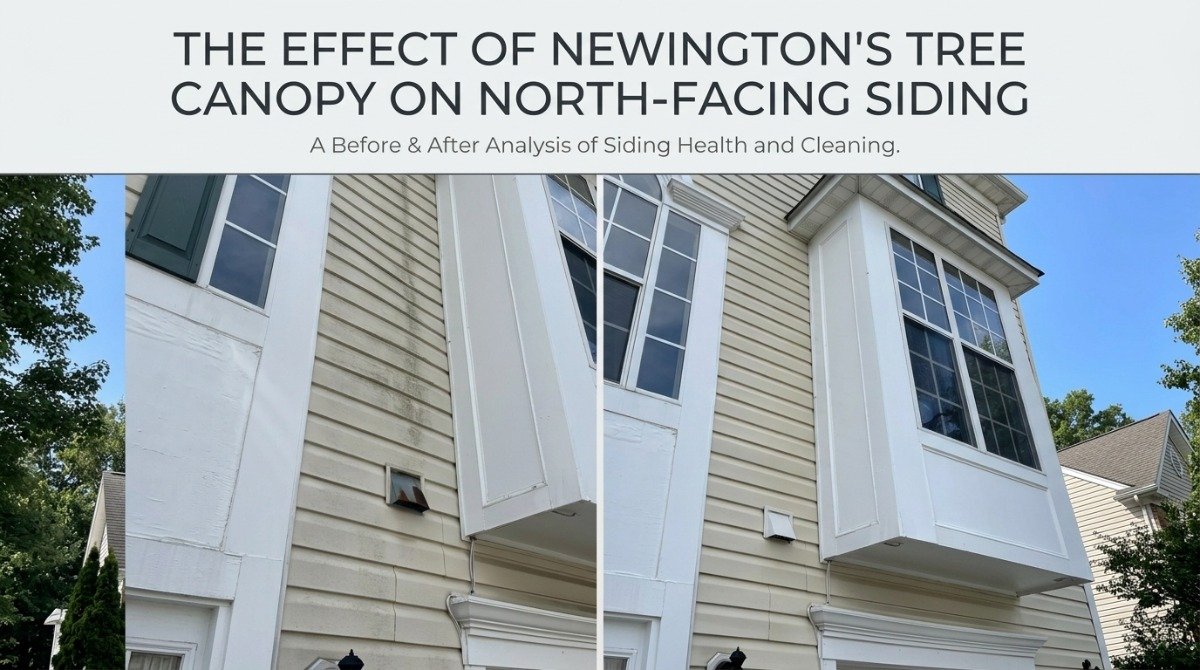
North-facing siding under a big tree is the wall we get asked about most in Newington. A while back I walked one with the homeowner before a wash. The front looked fine, and the south side looked almost new.
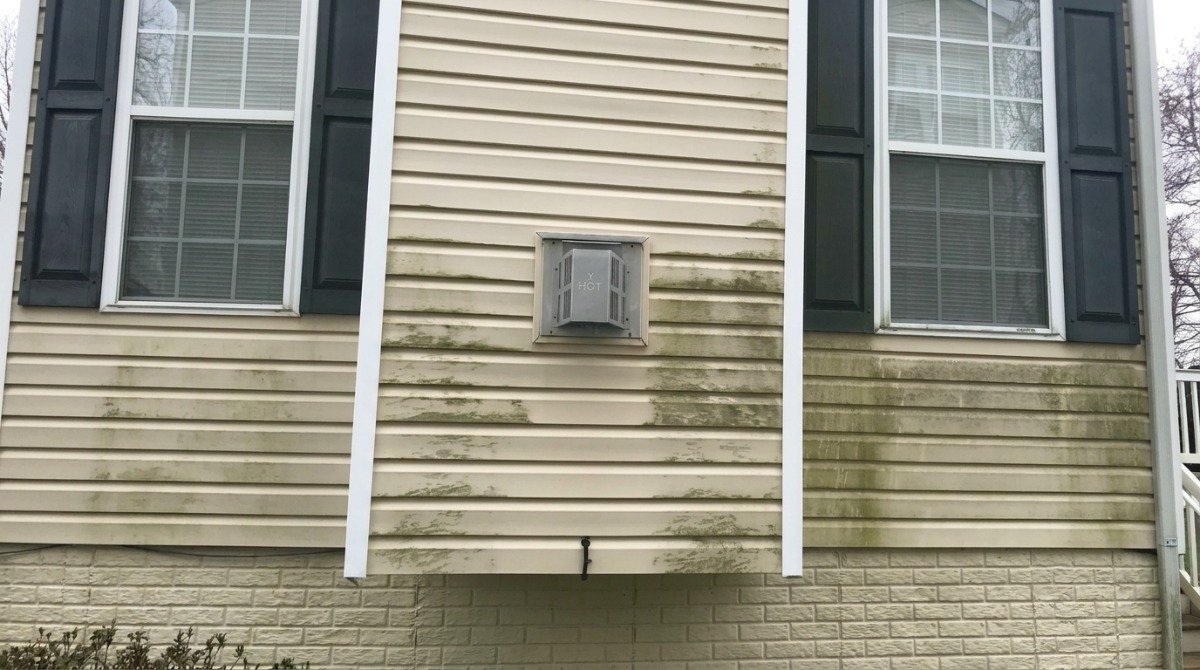
Then we turned the corner. The north side sat under a large shade tree, and the vinyl had gone green. The bottom courses behind the shrubs were darker, and there was a sticky, speckled patch under one low limb.
The homeowner asked two things. Did the tree have to go? And would a rented pressure washer handle it? Neither, as it turned out. Here is why that wall behaves the way it does, and when trimming, washing or both make sense.
Why does north-facing siding under trees turn green?
North-facing siding gets little or no direct sun in Connecticut, so dew and rain sit on it for hours. Add a canopy that blocks airflow and drops pollen, sap and leaves, and the wall stays damp and fed. Green algae and mildew grow there first and come back fastest.
- Little direct sun, especially from fall through early spring
- Dew and rain dry slowly
- Trees block the breeze that would dry the wall
- Pollen, honeydew, sap and leaves feed the growth
- Shrubs and gutter overflow keep the lowest courses wet
Why does the north side of a Connecticut house stay wet the longest?
Where the sun actually goes over Newington
Newington sits at roughly 41.7 degrees north latitude. At that latitude the sun crosses the southern sky, so the south wall gets direct light most of the day and the north wall barely sees it.
In summer the sun rises a little north of east and sets a little north of west. The north wall gets some glancing light very early and very late, when it is weakest. From fall to spring it gets no direct sun at all.
Sun angle at noon in Newington
| Date | Approx noon sun height | What the north wall gets |
| June 21 | About 72 degrees | Glancing light early and late only |
| March 20 and September 22 | About 48 degrees | Essentially none |
| December 21 | About 25 degrees | None, plus long shadows |
These are rounded figures worked out from the latitude. The NOAA Solar Calculator shows the sun’s height, sunrise and sunset for your own address on any date.
Morning dew is the daily soak
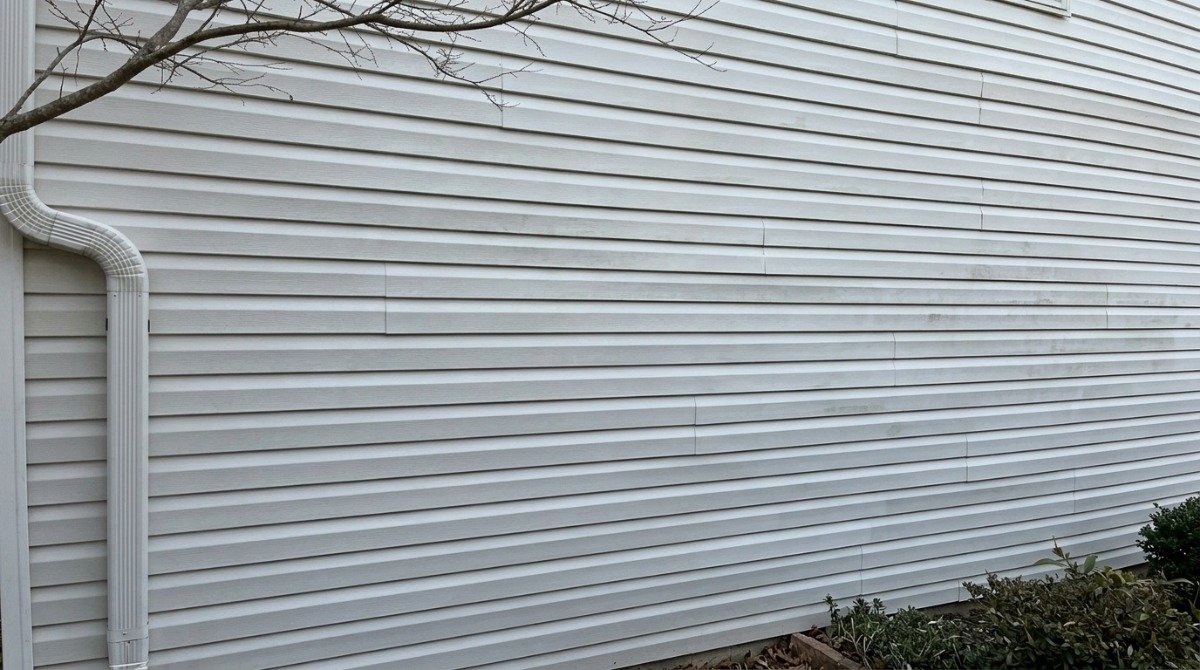
Summer and early fall mornings here are humid, and siding collects dew overnight. The east and south walls get morning sun that burns it off. The north wall waits for the air to do the job.
I see this on early jobs all the time. We pull up, the south side is dry, and the north side is still beaded with water.
Houses close together make it worse
Many postwar lots in Newington and Wethersfield have narrow side yards. A wall facing the neighbor’s house gets shade from that house on top of any trees, so it often looks a lot like the north wall.
What does a tree canopy add on top of the shade?
Shade where the light was already thin
A tree south or west of the house can shade walls that would otherwise get sun. A tree on the north side deepens shade that is already there. A cooler wall dries more slowly.
Blocked airflow
Moving air carries moisture off a wall. A dense canopy and shrubs packed against the foundation slow that air down, so the siding stays damp long after the rain stops.
Pollen in spring
Every spring a yellow green film coats siding, windows and patio furniture across Greater Hartford. Rain rinses most of it off a sunny wall. On a damp shaded wall it sticks and gives algae an organic layer to start on.
Honeydew, sap and the black specks
Aphids and scale insects feed on tree sap and drop a sugary liquid called honeydew onto whatever sits below. A dark fungus called sooty mold grows on it. That is usually what the black specks under one overhanging limb are.
If a spot under a single branch feels sticky, it is almost always honeydew, not failing paint. Sap can also leave small amber drips in summer.
Leaf litter, seeds and the bottom three courses
Leaves and seeds pile into the gutters on the tree side, and overflow leaves dark drip lines down the siding. If that happens even after a cleaning, this piece on gutters that overflow right after cleaning covers the usual causes.
Leaves also pile against the foundation and hold moisture. Rain splashing off soil and mulch adds dirt to the lowest courses, which is why the bottom of the wall is usually the darkest.
What the tree drops on your siding
| What falls or happens | When | What you see | Usual fix |
| Shade | Year round, worst fall to spring | Slow drying, green film | Washing, maybe raising lower limbs |
| Blocked airflow | While in leaf | Damp wall after rain | Thin shrubs, open space at the wall |
| Pollen | Spring | Yellow film that turns gray | Wash after pollen season |
| Honeydew and sooty mold | Summer | Sticky spots, black specks | Soft wash, arborist if heavy |
| Sap | Summer | Small amber drips | Spot treatment during the wash |
| Leaves and seeds | Spring and fall | Gutter streaks, wet lower courses | Gutter cleaning, clearing beds |
Back at that Newington house, nearly every row showed up on one wall. Green film, dark courses behind the shrubs, the sticky patch, and drip lines under a gutter packed with seeds.
Is that green on your siding algae, mildew or something else?
- Green film that wipes off green on a cloth is usually algae.
- Gray or black speckles under eaves or on trim are usually mildew.
- Black specks only under a limb, sometimes sticky, are sooty mold on honeydew.
- Crusty gray green rosettes on wood trim or a fence are lichen.
- A dark band along the bottom is splashback dirt mixed with growth.
A damp white cloth on a small spot is the easiest test. I’d leave anything involving chemicals to a crew.
On vinyl and aluminum the growth is mostly cosmetic. On painted wood and cedar, years of it hold moisture against the finish and can shorten the life of paint and stain. Green steps on that side can also get slippery.
Each material needs its own approach, which is how we handle siding cleaning. Our guide to green algae on north facing walls goes deeper on removal and prevention.
Should you trim the tree, wash the wall, or both?
When trimming helps
Lifting the lowest limbs, often called crown raising, or thinning branches near the house lets more light and air reach the wall. Keeping branches off the roof helps too, since a roof under the same canopy holds debris and may need roof cleaning of its own.
Trimming reduces growth on a north wall without stopping it, because the sun angle stays the same. For anything beyond small branches, talk to a licensed arborist.
Is the tree yours or the town’s?
Under Connecticut General Statutes Chapter 451, each town appoints a tree warden. The tree warden has care and control of trees and shrubs in public roads and grounds, including limbs that overhang them.
Anyone else who prunes or removes a public shade tree without permission can be ordered to pay restoration costs. A court may also award damages of up to five times that cost, or statutory damages of up to $5,000.
So if a street tree shades your wall, call the Town of Newington and ask for the tree warden first. If it is a neighbor’s tree, talk with your neighbor and an arborist.
When washing is the right call
Most of the time the tree stays, and that is a good thing. The wall will grow again, and regular soft washing keeps it from building up and staining. “Soft washing is where many older Newington roofs and painted surfaces benefit most.” That is why soft washing is our default for shaded walls.
A pressure washer can drive water up behind the laps of vinyl and gouge soft cedar siding. If that has already happened, here is what to do when water gets behind your siding.
Trim vs wash decision table
| Situation | Trim | Wash | Both |
| Limbs touching roof or siding | Yes | After trimming | Yes |
| Street tree shading the wall | Ask the tree warden | Yes | If approved |
| Healthy tree, no contact, wall green | Usually not needed | Yes | No |
| Sticky honeydew every summer | Arborist check for insects | Yes | Often |
| Shrubs tight against the wall | Thin the shrubs | Yes | Yes |
| Gutters overflowing on tree side | Trim overhanging limbs | Gutters plus wash | Yes |
Practical Example: The north wall we washed in Newington
Reading the wall before we sprayed anything
Back at that house, we walked the north side slowly with the homeowner. I pointed out the darker band behind the shrubs, the sticky area under the limb and the drip lines below the gutter. We also checked the vinyl for loose or cracked panels before anything got wet.
“Newington homes cover a wide range of ages and building materials, and each surface calls for a slightly different approach.” A sticky patch and a gutter streak need different fixes, so we look first.
Protecting the tree and the beds
We soaked the shrubs and beds with plain water before any solution went on. We kept the solution off the trunk and the ground around the tree as much as we could, then rinsed the plants again at the end.
The wash and the gutter cleanout
We did the gutter cleaning on that side first, so the next rain would not push seeds and dirty water over the edge onto a clean wall.
Then came the soft wash: low pressure, time for the solution to work, and a rinse from the top down. The green came off, the patch under the limb cleaned up, and that side finally matched the rest of the house.
What I told the homeowner about the tree
Keep it. It shades the house in summer and is part of what makes the street feel like home.
An arborist could lift that low limb, and giving the shrubs more room would help. I was also honest that this wall will need attention before the rest of the house, which is why the north side alone tends to come back first.
If one side of your house has gone green under a tree, we can wash that side or do full house washing in Newington, with the gutters on the same visit. We are on Dewey Ave in Newington and serve Hartford and the surrounding towns. First time house cleaning customers get 15 percent off. Call (860) 263-9031.
Newington’s trees and the houses under them
A town that grew up with its trees
Newington’s population nearly doubled in ten years, from 9,110 in 1950 to 17,664 in 1960. That boom built many of the capes and ranches we wash today. Trees planted with those neighborhoods are now roughly 65 to 75 years old, and many stand taller than the houses.
So a wall that got some light in 1960 may sit in full shade now.
How much canopy is there around Hartford?
US Forest Service research cited by the state puts Connecticut’s tree canopy at about 64.5 percent of all land and 49.3 percent of urban land.
A canopy assessment for Hartford based on 2008 aerial imagery measured 26 percent, with residential and public property zones holding the most. West Hartford’s recent study found its canopy fell from 46 percent in 2010 to 37 percent in 2023. Even so, the residential streets around Hartford still carry a lot of mature trees.
Where we see it most in our service area
I notice it most on older tree lined streets in Newington and Wethersfield, on wooded lots in Glastonbury, Avon, Farmington and Simsbury, and on condo back walls that face woods. We see the same walls in Hartford, Rocky Hill, Berlin, Cromwell, Middletown and the rest of our area.
The same shade often greens the deck on that side and the fence along the shady property line too.
FAQ
Why is only the north side of my house green?
At Newington’s latitude the sun crosses the southern sky, so a north wall gets little or no direct sun much of the year. Dew and rain sit on it while the other sides dry. Shade from trees or a neighbor’s house makes it worse.
Do trees cause mold and algae on siding?
Trees do not plant it, but they set the table. They add shade, slow the air that would dry the wall, and drop food in the form of pollen, honeydew, sap and leaves.
What is the sticky black film on my siding under a tree?
Usually honeydew dropped by aphids or scale insects feeding on the tree, with sooty mold growing on it. A soft wash removes it. If it comes back heavy every summer, ask an arborist to look at the tree.
Will trimming my tree stop the algae?
It helps by letting in light and air, but a north wall will still grow some because the sun angle stays the same. Sensible trimming plus a periodic wash of that side is the realistic plan.
Can I trim a street tree that shades my house in Connecticut?
Not on your own. Trees in public roads and grounds are under the town tree warden’s care, and unauthorized pruning can bring restoration costs and damages under state law. Call your town and ask for the tree warden first.
Can I pressure wash green algae off vinyl siding?
High pressure can force water behind the laps and only strips the surface, so the growth returns quickly. A low pressure soft wash kills it and rinses it away. Our vinyl siding cleaning page explains how we handle it.
Will the cleaning solution hurt my tree or shrubs?
It should not when the work is done with care. We wet plants with plain water first, keep solution off the trunk and the ground around the tree as much as we can, and rinse everything at the end.
How often should a shaded north wall be washed?
More often than the sunny sides. A heavily shaded wall often shows green again before the rest of the house, so many homeowners wash that side between full house washes. We can look at your whole house during a visit.
You do not have to choose between your trees and a clean house. If your north-facing siding or a shaded wall in Newington, Hartford or a nearby town is turning green, call Mr-Suds Power Washing PROs at (860) 263-9031 or reach us through our contact page. We are licensed, bonded and insured, rated 5.0 on Google, and I or one of the crew will walk the house with you before we wash anything. First time house cleaning customers save 15 percent.