
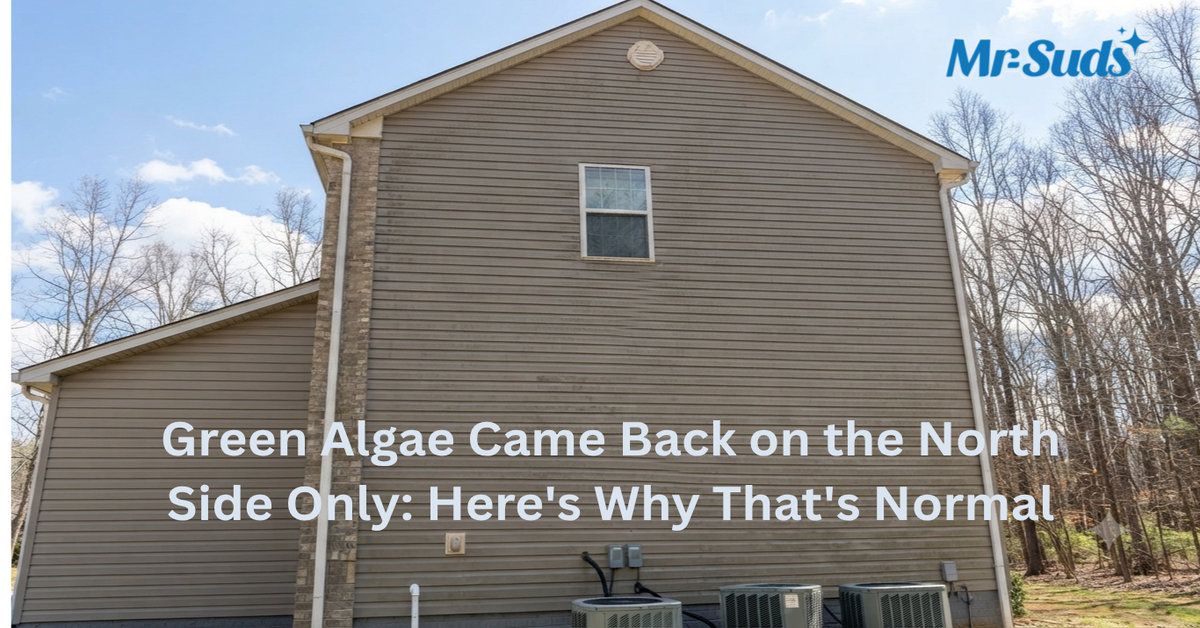
If three walls of your house still look clean and the north wall is green again, the most likely explanation is not that the north wall got a worse cleaning. It is that the north wall is a different environment.
At Connecticut’s latitude, a north-facing elevation receives little or no direct sun for much of the year. It warms up later, cools down sooner, and stays wet for hours longer after every rain, every morning dew and every snowmelt.
Green algae does not need much. Moisture, shade, and a surface to sit on. Your north wall provides all three every single day, while the south wall bakes dry by mid-morning.
Same house. Same wash. Entirely different conditions.
Why the North Side Grows Algae and the South Side Doesn’t
North-facing walls get almost no direct sunlight in Connecticut from autumn through spring. Without UV, growth goes unsuppressed. The surface also dries far more slowly after rain, sits cooler so condensation lingers, and often has restricted airflow. Duration of surface wetness is the single biggest driver of algae growth on siding.
Four mechanisms, all working in the same direction:
Direct sunlight. A north wall in Connecticut gets essentially no direct sun for most of the year, and only brief low-angle sun near midsummer. UV is a natural biocide. Take it away and nothing suppresses growth.
Surface drying time. A south wall dries within an hour of the rain stopping. A north wall can stay damp all day, and in the cool months for days at a time.
Surface temperature. Cooler surfaces hold condensation longer. On cool nights, the north wall drops below the dew point earliest and stays there longest. It gets wet even when it has not rained.
Airflow. North elevations are very often the tight side of the house. Close to a property line, a fence, a hedge, a garage or the neighbour’s wall. Restricted airflow means slower drying all over again.
Put those together and an uneven result over time is expected, not a defect.
Is It Algae, Mildew, Mould or Lichen?
Most people use these interchangeably. They are not the same thing.
| What it looks like | Where it shows up | Removal | |
|---|---|---|---|
| Green algae | Classic green film | Shaded siding, fences, north walls | Comes off readily with correct treatment |
| Mildew | Darker, grey-black to brown, blotchy or spotted | Painted surfaces, shaded trim | Treatable, may leave staining on old paint |
| Mould | Usually a question about what is behind the wall | Interior, musty odour | Different problem entirely |
| Lichen | Crusty grey-green patches, tightly bonded | Masonry, fences, north-facing trim | Hardest to remove, may leave a mark |
Quick test: a green film that wipes to a smear with a wet cloth is almost certainly algae. Crusty and firmly attached is lichen.
One important separation. If you are smelling musty odours indoors on that elevation, that is not a siding problem, and it is worth reading up on what to do when water gets behind siding.
The Six Things Making Your North Wall Worse Than It Needs to Be
The physics you cannot change. These six you can.
1. Foundation plantings pressed against the wall
Shrubs, hedges and ornamental grasses grown right up against the siding block airflow completely and hold humidity against the wall.
The fix: maintain roughly two to three feet of clearance between planting and siding.
Of everything on this list, this one change usually produces the biggest single improvement. We have gone back to houses in Newington a year after a wash where the owner cut the yews back, and the difference on that wall is obvious from the street.
2. Tree canopy and drip line
Newington’s mature oak and maple canopy is genuinely beautiful and it is also why so many local north elevations stay permanently damp. Overhanging limbs drip for hours after the rain stops and block what little light the wall would otherwise get.
Opening the canopy helps a great deal. Use a licensed arborist, since arboriculture in Connecticut requires a state licence through CT DEEP.
3. Sprinklers and irrigation hitting the siding
Extremely common, and almost always unnoticed. An irrigation head throwing onto a north wall three times a week guarantees green.
Do this: run the system and stand there watching it. Adjust every head so nothing touches the building. It takes fifteen minutes and it is free.
4. Gutter overflow and downspout discharge
Blocked gutters overflowing down a north wall keep it saturated. Downspouts discharging right at the foundation splash the lower courses constantly.
Extend the downspouts away from the wall and keep the gutters clear. That is covered further in why gutters overflow right after cleaning and our gutter cleaning service.
5. Grade and drainage against the wall
Soil sloping toward the house, mulch piled up against the siding, or a low spot that holds water all keep the base of the wall wet.
Notice that the green almost always starts at the bottom and works upward. That pattern is a drainage clue, and it is worth acting on.
6. AC condensate, dryer vents and exhaust
Warm moist air discharged against a cool shaded wall is a reliable algae generator. Check where your dryer vent and bathroom exhausts actually terminate. On plenty of older Central Connecticut homes, they terminate somewhere nobody has looked at in twenty years.
Did the Contractor Actually Skip That Wall?
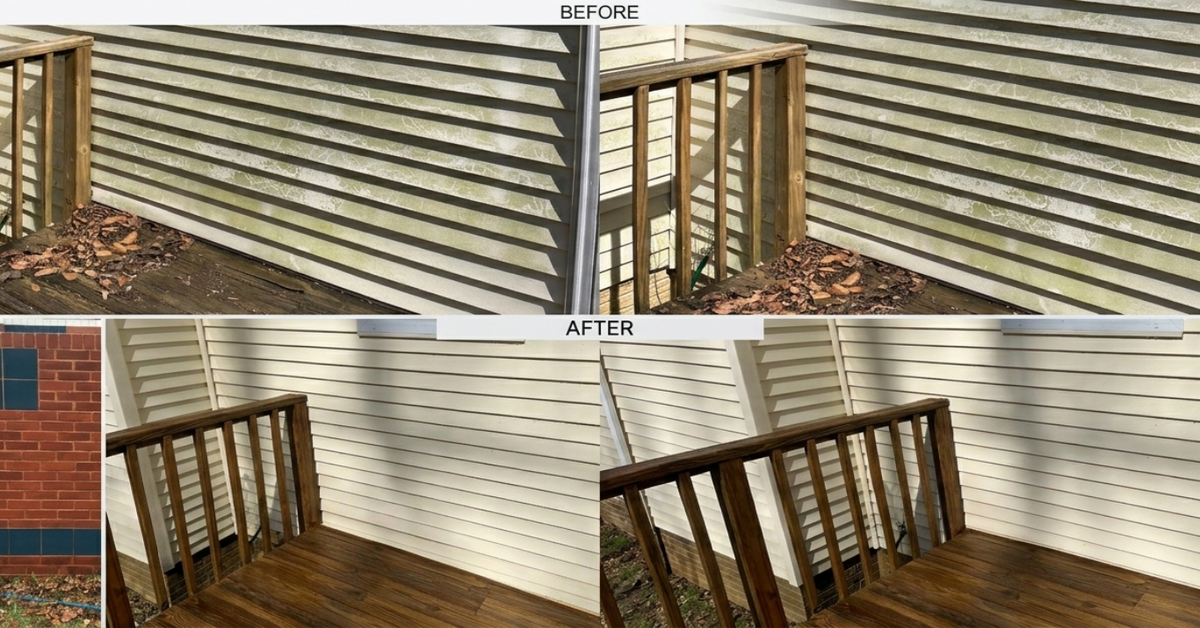
Fair question, and it deserves a fair test rather than a defensive answer.
Signs the elevation was genuinely missed or under-treated:
- The wall was still visibly dirty on the day the crew left, not weeks later
- Sharp boundaries: a clean band and a dirty band with a hard line between them
- Missed areas behind downspouts, under soffits, above the reach of the equipment used, or behind shrubs
- Regrowth within days rather than months
Signs it is ordinary microclimate regrowth:
- The wall was genuinely clean at completion and photos confirm it
- The green returned gradually over weeks or months
- It is uniform across the elevation rather than patchy
- It is worst at the bottom, in the corners, behind plantings and under the eaves
If you believe it was genuinely missed: reach out to the contractor with dated photos and ask them to come look. Any reputable operator will. If they will not, verify their HIC registration at eLicense.ct.gov and follow the standard Connecticut process.
And here is the part I will own on behalf of my whole trade:
A professional should have told you at the estimate that the north wall would need attention sooner than the rest. If nobody set that expectation, that is a communication failure, not necessarily a cleaning failure.
We put it in the quote now. We learned to.
How Long Should a House Wash Last in Central Connecticut?
These are field-experience ranges from our own work across Newington, Wethersfield, Rocky Hill and Glastonbury. They are not published statistics, and any contractor quoting you precise data on this is making it up.
| Elevation | Typical time before noticeable regrowth |
|---|---|
| South and west | 2 to 3 years |
| East | 18 months to 2 years |
| North, open and reasonably bright | 12 to 18 months |
| North, heavily shaded, tight to a boundary, under canopy | 6 to 12 months |
Read that table again and take the point that matters: it is entirely normal for one elevation to need washing twice as often as another. Nothing is broken. It is just a wall that lives in a different climate from the wall on the other side of the same house.
Most of our Newington customers on shaded lots do a full house wash every two to three years and a north-elevation touch-up in between. It costs a fraction of a full wash. Call Roman at (860) 263-9031.
What Actually Keeps It Off Longer
- A correct soft wash with proper dwell time and a surfactant. Chemistry does this work, not pressure. See what soft washing actually is
- Clearance. Plantings cut back, canopy opened, airflow restored
- Irrigation redirected so nothing sprays the building
- Gutters cleared and downspouts extended away from the wall
- Grade corrected so water moves away from the foundation
- North-elevation-only maintenance washes between full-house cleans. Cheaper, faster, and exactly matched to the problem
- Set the schedule to the elevation, not the house. Full house every two to three years, north wall annually
- Time it right. Late spring through early autumn in Connecticut, when surfaces dry quickly
One honest limit. No treatment permanently prevents regrowth on a shaded, damp wall in a humid New England climate. Anyone promising that is selling something. The realistic goal is longer intervals, not permanence.
The Vinyl Siding Institute’s cleaning and maintenance guidance makes a similar point: regular gentle cleaning slows visible buildup, but it does not change the underlying conditions driving it.
And a note about your fences. North-facing fence panels have exactly the same problem for exactly the same reasons, which is why we usually quote fence cleaning alongside a north-elevation wash.
FAQs
Why does only the north side of my house get green? Shade, longer surface wetness, cooler surface temperature and less airflow. It is a different microclimate on the same building.
Is green algae on siding harmful? It is a surface organism sitting on the cladding. The concerns are appearance and, over years, staining. Musty odours indoors are a separate issue worth investigating properly.
Did my contractor skip that wall? Use the test above. Sharp boundaries and dirt visible on the day point to a missed area. Gradual, uniform regrowth over months points to microclimate.
How often should the north side be washed? In Central Connecticut, often annually. Other elevations typically hold for two to three years.
Will the cleaning solution damage my plants? A correct job pre-wets and covers landscaping and rinses thoroughly. Ask any contractor exactly how they protect plantings before you book.
Can I just pressure wash the green off? No. High pressure on siding drives water behind the laps and can damage the material. Chemistry at low pressure is the correct method.
Do zinc strips help on siding? Zinc is primarily a roof measure. On siding, airflow and drainage do far more for you.
What time of year is best to wash in Connecticut? Late spring through early autumn, on a dry mild day.
Put the North Wall on Its Own Schedule
Full House Every Two to Three Years, North Wall Annually
We book it ahead so it never gets forgotten, and we price the north-elevation maintenance wash separately because it is a smaller job than a full house and should cost like one.
If your lot is shaded, this is the arrangement that actually keeps the house looking right, rather than washing everything every three years and being annoyed at one wall for the last eighteen months of that cycle.
See our house washing service and real before and after results.
Get a Free Quote or call (860) 263-9031
Veteran owned. Licensed, bonded and insured. Owner-supervised on every job. Serving Newington, Hartford, Wethersfield, Rocky Hill, Glastonbury and Central Connecticut.