
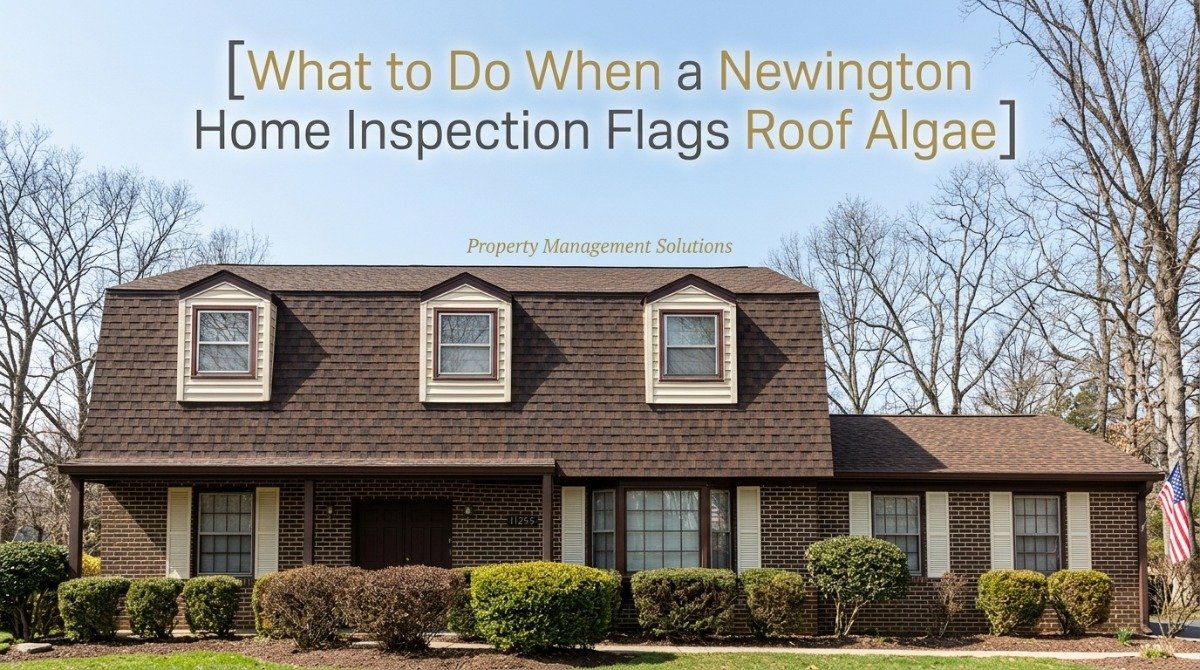
The call came in on a weekday morning. A seller had just received the buyer’s repair request after a Newington home inspection, and one line in the report mentioned algae staining on the north slope of the roof. The inspector recommended cleaning and a look from a roofing contractor.
The first question was the one I hear most often: “Does this mean the roof is going?”
A home inspection roof algae note looks alarming on paper. In most Newington houses I see, though, it turns out to be a cleaning question, not a roofing emergency. It is still worth confirming before closing, and the buyer deserves the same honest picture as the seller.
Below is what the note usually means, whether it touches the sale, mortgage or insurance, who tends to pay, how a soft wash fits before closing, and when to call a roofer instead.
The Short Answer: Roof Algae Is Usually Cosmetic, but Confirm It Before Closing
Black streaks flagged as roof algae are usually Gloeocapsa magma, a cosmetic growth on asphalt shingles. It rarely means the roof needs replacing. Confirm there is no shingle damage or leak, then decide with the other party whether the seller soft washes the roof before closing or offers a credit.
Here is how I sort what I see in a report:
| What the report shows | What it usually means | Typical next step |
| Algae or black streaks only | Cosmetic staining | Soft wash before closing or a small credit |
| Algae plus moss clumps | Moisture holding growth | Soft wash; check under clumps for lifted shingles |
| Algae plus granule loss, curling, lifted tabs | Possibly an aging roof | Roofer evaluation first; clean only if the roof stays |
| Active leak or ceiling stain | Not an algae issue | Roofer repair; negotiate separately |
What Is That Black Streaking on the Roof, Exactly?
According to the Asphalt Roofing Manufacturers Association, Gloeocapsa magma is probably the most prevalent of several algae species behind roof discoloration. It travels through the air, settles on the shingles and slowly darkens a light roof to brown or black.
Technically it is a cyanobacterium, often called blue green algae. What matters more is how it behaves.
It grows where the roof stays damp the longest. That is why it shows up as streaks running down the slope, following the water.
Shade is the biggest factor. North facing slopes and roofs under big trees stay wet longer after rain and dew, and grow algae first.
Connecticut gives it plenty to work with. We have a humid continental climate, with roughly 47 inches of precipitation a year measured at Bradley. ARMA lists the Eastern Seaboard among the regions where this discoloration is most widespread.
On older Newington capes and ranches with tall maples or oaks nearby, the shaded slope is almost always the one named in the report. Our piece on algae that comes back on the north side only covers the same pattern on siding.
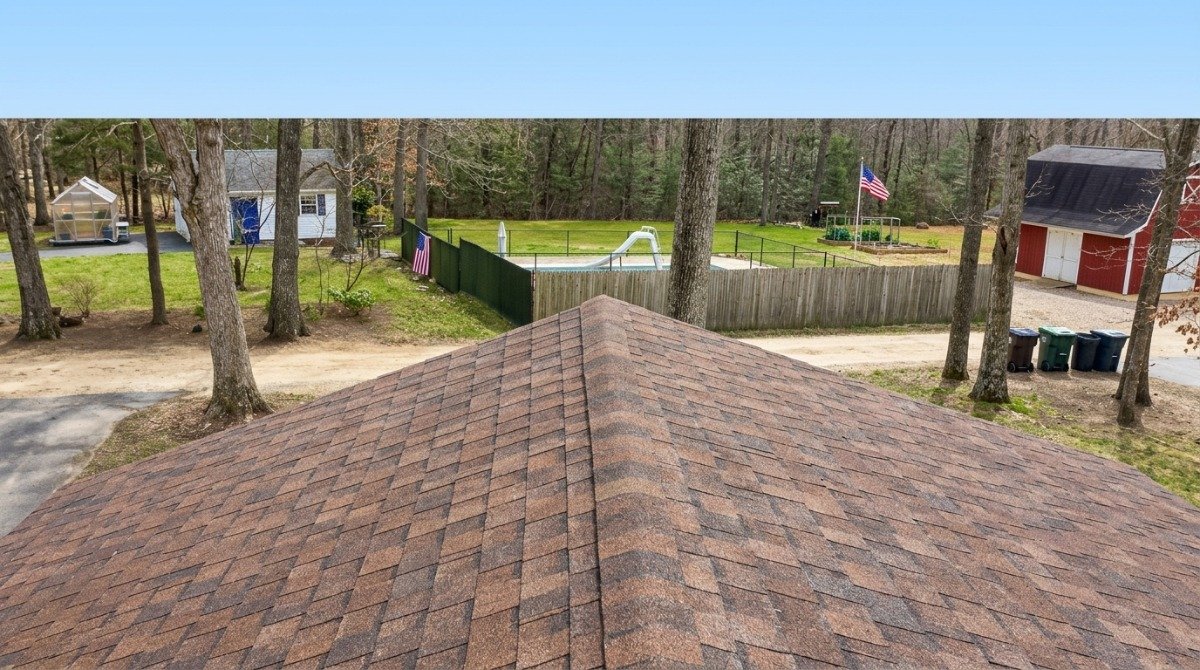
Algae, moss, lichen or dirt: how do you tell them apart?
Inspectors often lump these together as “organic growth.” The difference matters.
- Algae: flat dark streaks with no texture.
- Moss: green, raised, cushiony growth. It holds water and can work its way under shingle edges.
- Lichen: crusty gray green spots, often round, that grip the surface tightly.
- Soot or tree drip: patchy staining under branches or near a chimney.
- Granule loss: the opposite of growth. Bare or shiny spots where the protective granules have worn away.
Algae is easy to mistake for soot, dirt or tree droppings. A clear zoomed photo from the ground usually settles it.
Does roof algae damage shingles?
Algae staining by itself is generally considered a cosmetic problem. The common reference view is that it is not believed to damage asphalt shingles, although it can look objectionable. That matches what I see on Central Connecticut roofs.
Moss is different. It holds moisture against the shingles and, left long enough, can lift edges and let water creep in. Our article on moss that has lifted the shingles explains what that looks like and what it means.
The bigger risk to the shingles is usually the cleaning, not the algae. ARMA warns that high pressure washing is likely to damage asphalt roofing and that scrubbing can loosen and remove granules. A rushed wash before closing can create the very problem the buyer was worried about.
What Does the Roof Algae Note in Your Newington Home Inspection Report Actually Mean?
Under the InterNACHI Standards of Practice, an inspector checks the roof covering, gutters, downspouts, flashing and roof penetrations, and may do it from ground level or the eaves. The inspector is not required to walk on the roof, predict its service life or warrant or certify it.
So when a report notes streaks and adds “recommend further evaluation by a qualified roofing contractor,” that is usually standard protective wording. It does not mean the inspector found the roof failing.
In Connecticut, home inspectors are licensed through the Department of Consumer Protection under Chapter 400f of the General Statutes. A licensed inspection covers at least two major components, such as the roof, exterior and structure.
Here is how I read the phrases that come up most:
- “Organic growth” or “biological growth”: algae, moss or lichen is present. Look at the photo to see which.
- “Staining” or “discoloration”: a color change only. Usually algae or debris.
- “Moss present”: moisture holding growth. Worth checking underneath for lifted edges.
- “Granule loss” or “nearing end of service life”: an aging roof. This is separate from algae and deserves a roofer.
- “Recommend evaluation by a licensed roofer”: the inspector’s standard referral when something is outside a visual inspection.
If your report pairs algae with granule loss, read them as two separate items: a cleaning question and a roof age question.
What should you check for besides the algae?
Before I call a roof a cleaning job, I look for signs it is really a roofing job:
- Granule loss, bare spots or a lot of granule grit collecting in the gutters
- Curling, cupping or cracked tabs
- Lifted or missing shingles near the ridge, rakes or eaves
- Flashing around chimneys, vents and skylights that looks loose or open
- Ceiling stains inside, or staining on the attic sheathing
- The roof age the seller listed on the Connecticut condition report, which asks for roof type and age
Some grit in the gutters is normal. Our guide to granules in your gutters after a roof cleaning explains where normal ends and a warning begins.
On the roof from that morning call, the tabs lay flat, the chimney and vent flashing looked sealed and the gutters held only a light dusting of granules. With no history of leaks, it was a cleaning job, not a roofing one.
When to bring in a roofer before cleaning
If the inspector noted damage beyond staining, get a roofer’s opinion first. The same goes for a roof near the end of its expected life. As a rough guide, three tab shingles typically last about 15 to 18 years and dimensional or architectural shingles about 24 to 30.
Cleaning a roof that is about to be replaced is money spent for nothing. When that is the situation, I say so.
Does Roof Algae Affect the Sale, the Mortgage or Insurance?
This is where most of the worry sits. I am a roof and exterior cleaner, not an agent, lender, insurer or attorney, so treat this as general information. For your contract, loan or policy, your own professionals have the final word.
Will it hurt the sale?
On its own, usually not. Roof algae tends to become one line item in the repair negotiation, not a reason to walk away.
What hurts is uncertainty. Buyers who think a roof needs real work tend to ask for a bigger price reduction. A clear cleaning plan, or a modest credit based on a real estimate, keeps the streaks from being treated like a roof replacement.
When homes around Greater Hartford are moving quickly, most sellers I talk to would rather settle it fast. Sellers who handle the roof before listing simply fold it into prep before photos.
Will the lender or appraiser care?
Cosmetic staining is not usually treated as a repair condition. Active leaks or visible damage are different.
Roof issues can slow down FHA, VA and conventional loans, and sometimes lead to an escrow holdback until work is done. If the appraisal mentions the roof at all, ask your loan officer right away what, if anything, the lender needs to see.
Will homeowners insurance cover roof algae?
I keep this one careful because policies vary. Homeowners insurance is generally written for sudden damage, and routine cleaning and maintenance are generally the owner’s responsibility. Do not count on a policy to pay for an algae wash.
Some insurers do look at roof condition and age when they write or renew a policy. A buyer can ask their insurance agent early in the contingency period whether the roof’s age or appearance will matter for coverage. For anything specific, read your own policy and ask your agent.
Does the seller have to disclose roof algae in Connecticut?
Connecticut sellers generally give buyers a Residential Property Condition Report before the buyer signs a binder or contract. The roof section asks for the roof type, its age and whether there have been any leaks.
If that report is not provided, Connecticut law requires the purchase agreement to give the buyer a $500 credit at closing. Sellers still have to disclose known defects either way.
Answer the form honestly and talk with your attorney or agent about anything you are unsure of. This is not legal advice.
Should You Soft Wash the Roof or Replace It?
If the shingles are sound, a soft wash is the right fix for algae. Replacement is for an aging or damaged roof, not for stains.
A soft wash means applying a cleaning solution at low pressure, letting it work on the growth and then rinsing gently. ARMA describes a similar approach with diluted sodium hypochlorite, a dwell of roughly 15 to 20 minutes and a gentle rinse. It specifically says not to use a power washer, brush or broom.
Pressure washing shingles can strip granules and drive water under the tabs. If it has already happened on your roof, our article on what to do after a roof cleaner used high pressure walks through the next steps.
As I tell homeowners, “Low pressure paired with eco friendly solutions removes mold and algae at the source.” That is how we approach roof cleaning on every house. “Soft washing is where many older Newington roofs and painted surfaces benefit most.”
When a roof does need replacing, ask about algae resistant shingles with copper treated granules.
| Option | What it fixes | Risk to shingles | Fits before closing? |
| Soft wash | Algae, light moss, staining | Low when done correctly | Usually, weather permitting |
| Pressure wash | Removes stains fast | High: granule loss, water intrusion | Not recommended on asphalt shingles |
| Replacement | Aging or damaged roof | None to old shingles; they are gone | Often hard inside a contingency window |
What does roof soft washing involve on the day?
We start on the ground, noting plants below each roofline and where the downspouts empty.
We wet down plants and foundation beds before any solution goes on, and keep pets indoors. We apply the solution at low pressure from the ground or the roof edge, wherever it is safe, then give it time to work. A gentle rinse follows, and we rinse the siding and plants again at the end.
Time on site depends on roof size, pitch and access.
Why do the streaks sometimes fade over days instead of instantly?
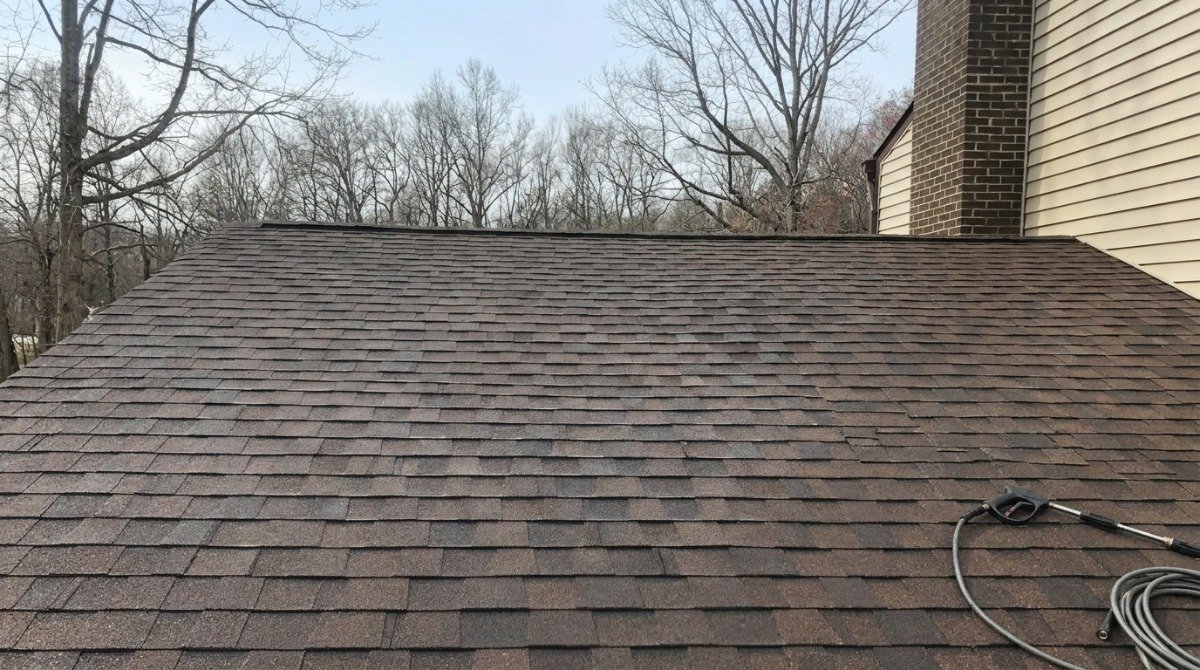
On some roofs, most of the staining lifts the same day. On others, a shadow of darkening stays and fades over the following days or after the next rain or two.
If the final walk through is close, I would rather the parties know ahead of time that the roof may keep lightening after the wash.
What does roof cleaning cost?
As general context only, national cost guides put typical roof cleaning at about $250 to $600, with one guide listing a national average around $440. Published soft wash rates run roughly $0.15 to $0.75 per square foot, depending on the guide.
Those are national figures, not our prices. We look at the roof first, then give you a written estimate you can share with the other side.
Got a report that mentions roof algae? Reach out through our contact page with the report page and a couple of roof photos. I will tell you honestly whether it looks like a cleaning job or something a roofer should see first, and if it is ours, we will find a date that works before your closing.
Who Pays for Roof Algae Cleaning After an Inspection?
Nothing here is automatic. No repairs are mandatory after a home inspection; findings become part of a negotiation between buyer and seller, usually handled by the agents.
These are the outcomes I see most:
| Option | How it works | When it fits |
| Seller has the roof soft washed before closing | Seller books and pays; shares invoice and photos | Enough time before closing; seller wants a clean handoff |
| Seller gives a credit | Amount agreed at closing; buyer cleans after | Tight timeline; buyer wants to choose the contractor |
| Price adjustment | Folded into the sale price | Algae is one of several items |
| As is | No change | Buyer sees it as cosmetic; competitive market |
| Buyer handles after closing | Buyer plans the cleaning once moved in | Buyer prefers control; small issue |
A tip for sellers: get a written estimate quickly. A credit conversation goes better when it starts from a real number instead of a guess.
A tip for buyers: if you accept a credit, book the cleaning soon after you move in. Another wet season gives the algae more time to spread.
If the roof is under a manufacturer warranty, keep records from day one. Our article on roof warranties that require documented cleaning explains what to keep.
The wording of any repair addendum or credit belongs with your agents and attorneys. I can supply the estimate, invoice and photos.
How Much Time Do You Need Before Closing?
Inspection windows are short. Many due diligence periods run around 10 to 14 days, but your own contract sets the real dates, so check it.
A simple timeline that works for most sales:
- Report received. Pull out the page and photos that mention the roof.
- Quick assessment. Send the report page and a few roof photos to a cleaning company, or have a roofer look first if there are signs of wear.
- Written estimate. Get it in hand before the response to the repair request is due.
- Agreement. Buyer and seller settle on cleaning, a credit or another option.
- Booking. Pick a dry day with a spare day behind it.
- Wash day. The roof is soft washed and rinsed.
- Fading period. Leave time for any remaining staining to lighten.
- Final walk through. The buyer sees the result.
For sellers, the deliverables matter almost as much as the wash. Keep the invoice, before and after photos and a short note on the method used.
How Do You Keep Roof Algae From Coming Back?
Algae usually returns over time. Prevention slows it down.
Zinc or copper strips. The usual approach is zinc or copper strips or wire at the ridge, with more spaced every four to six feet down the roof on larger slopes. National guides list zinc strips at roughly $30 to $60 per 50 foot roll, and they need replacing every few years.
Strips work slowly and best near the ridge. They do not clean an existing stain.
Skip zinc sulfate powder. Cost guides warn it can run off in rainwater and harm the landscaping below.
Let in sun and air. Trimming overhanging branches is one of the most effective things you can do on a shaded slope.
Keep the gutters clear. Packed gutters hold wet debris along the roof edge. Regular gutter cleaning helps the lower courses of shingles dry out.
Choose algae resistant shingles at the next replacement. That is the long term answer.
Plan maintenance cleanings. One roofing expert suggests every three to five years where shade cannot be fixed. If streaks came back much faster than expected, our article on black streaks that returned within a year looks at what usually went wrong.
Should the new owner install zinc strips right away?
It is a reasonable step after a cleaning if the roof still has years left. It is also roof work at height, so use a roofer, or ask whoever you hire whether they install strips and how they fasten them.
A Roof Algae Note We Handled Before a Newington Closing
Back to that morning call. The buyer’s repair request asked for the roof to be addressed, and there were only a few days to respond.
The house was a mid century ranch with asphalt shingles and a stand of tall maples along the north side. The report described algae staining on the north slope and recommended cleaning and evaluation by a roofing contractor.
I looked from the ground first, then up close at the edges where it was safe. Gutters, tabs and flashing all pointed to staining, not wear.
I told the seller that plainly, and also that I could not speak for the roof’s remaining life; that belonged to a roofer if the buyer wanted it. The seller passed my estimate to the listing agent.
The two sides agreed the seller would have the roof soft washed before closing and share the invoice and photos. We booked a dry, still morning and kept the following day open in case the weather turned.
On the day, we wet down the foundation beds, checked each downspout outlet, applied the solution at low pressure and rinsed gently. Then we rinsed the siding and plants again.
Most of the streaking lifted that day. A faint shadow stayed on the lower part of the north slope and faded over the next few days and a rain. By the walk through, the north slope looked like the south one.
We sent the seller the invoice and before and after photos, which went to the buyer’s agent. As far as I heard, the sale moved on to closing without the roof coming up again.
Why Roof Algae Shows Up So Often on Newington and Greater Hartford Homes
Newington grew fast after the war. The town went from about 5,449 people in 1940 to 9,110 in 1950 and 17,664 in 1960. A lot of the houses from that boom are capes and ranches on lots that now have mature trees.
Those trees leave one slope of many roofs in shade most of the day, and that is where the algae starts.
The climate does the rest. Central Connecticut is humid continental, with roughly 47 inches of precipitation and about 52 inches of snow a year at Bradley. Long damp springs and humid summers keep shaded shingles wet for hours after every rain.
We see the same pattern in Newington, Wethersfield, the West Hartford area and older Hartford neighborhoods. On many of these homes the siding on the same side greens up too, which is where soft washing in Newington usually comes in alongside the roof.
“Newington homes cover a wide range of ages and building materials, and each surface calls for a slightly different approach.” That is why we look before we spray.
Mr-Suds is based at 130 Dewey Ave in Newington and serves Hartford and 17 nearby towns. Being local helps when the inspection window is short. See more about our roof cleaning in Newington, CT on its own page.
Frequently Asked Questions About Roof Algae and Home Inspections
Is roof algae a deal breaker when buying a house?
Usually not. If the shingles are sound, roof algae is cosmetic staining that a soft wash can remove. Confirm there is no granule loss, lifted shingles or leak, and get a roofer’s opinion if the inspector noted more than staining.
Does black algae mean the roof needs replacing?
No. Replacement depends on the roof’s age and condition, not on the stains. A heavily streaked roof can still have years of life left if the shingles are sound.
Who usually pays to clean roof algae after an inspection?
It is negotiated. The seller may soft wash before closing, give a credit or adjust the price, or the buyer may accept it as is. Your agents handle the terms.
Can you pressure wash roof algae off?
Not on asphalt shingles. ARMA warns that high pressure washing is likely to damage asphalt roofing. A soft wash uses low pressure and a cleaning solution, followed by a gentle rinse.
How soon before closing should the roof be cleaned?
As soon as both sides agree, on a dry day with a spare day behind it. Leave time before the walk through, since leftover staining can keep fading for a few days.
Will the algae come back after cleaning?
Usually, over time, especially on shaded north facing slopes. Trimming branches, clear gutters and zinc or copper strips near the ridge can slow it down.
Do home inspectors walk on the roof?
They are not required to. Under the InterNACHI Standards of Practice, inspectors may check the roof from the ground or the eaves. That is why reports often refer roof questions to a roofer.
Is roof soft washing safe for plants and pets?
We wet down plants first, keep pets indoors, work at low pressure with eco friendly solutions and rinse plants and siding afterward. Ask any company how they protect the landscaping.
Have a Roof Algae Note in Your Report? Here Is the Simple Next Step
For that seller, the roof stopped being a worry within a few days, and everyone could focus on the rest of the move.
My one piece of advice for the next buyer or seller in the same spot: get it looked at early, and do not let anyone pressure wash it.
Mr-Suds is owner run and based right here in Newington. We are licensed, bonded and insured, and we hold a 5.0 rating on Google. You can read what neighbors say on our reviews page.
If your inspection report mentions roof algae, call us at (860) 263-9031 or send the report page and a few roof photos through the site. I will give you a straight answer on whether it is a cleaning job, and if it is, we will soft wash it carefully and get you the invoice and photos your agents need before closing.