

Some granule shedding after roof work is normal, and on most roofs it means nothing at all.
Asphalt shingles are surfaced with ceramic-coated granules, and a certain number of them are always loose, held in place by nothing more than dirt, moss and time. Clean that debris off and the loose ones come down with it.
So the question is not whether you found granules. It is how many, from where, and how old your roof is. Those three answers separate “completely normal” from “your roof was already finished and you just found out.”
Here is how to tell which one you are looking at. We run this exact sequence on the phone with homeowners most weeks between April and October.
What Granules Are and Why Roofs Shed Them
Granules are ceramic-coated mineral particles embedded into the asphalt surface of the shingle. They do three jobs: they block UV, they contribute to the fire rating, and they give the shingle its colour.
Underneath them sits the asphalt mat. Once that mat is exposed, UV starts degrading it and the shingle ages quickly from that point on.
Every asphalt roof sheds granules from the day it is installed until the day it comes off. That is normal and continuous. What changes over the life of the roof is the rate.
How Much Granule Loss Is Actually Normal?
After roof work, expect a light scattering: enough to notice, not enough to scoop. A dusting in the gutter trough and a small deposit at the downspout outlet is ordinary. A continuous sediment layer you could rake, or granules arriving from one downspout only, is not. Age of the roof decides how to read it.
Two tests we give homeowners, because vague reassurance helps nobody.
The tablespoon vs the cup test
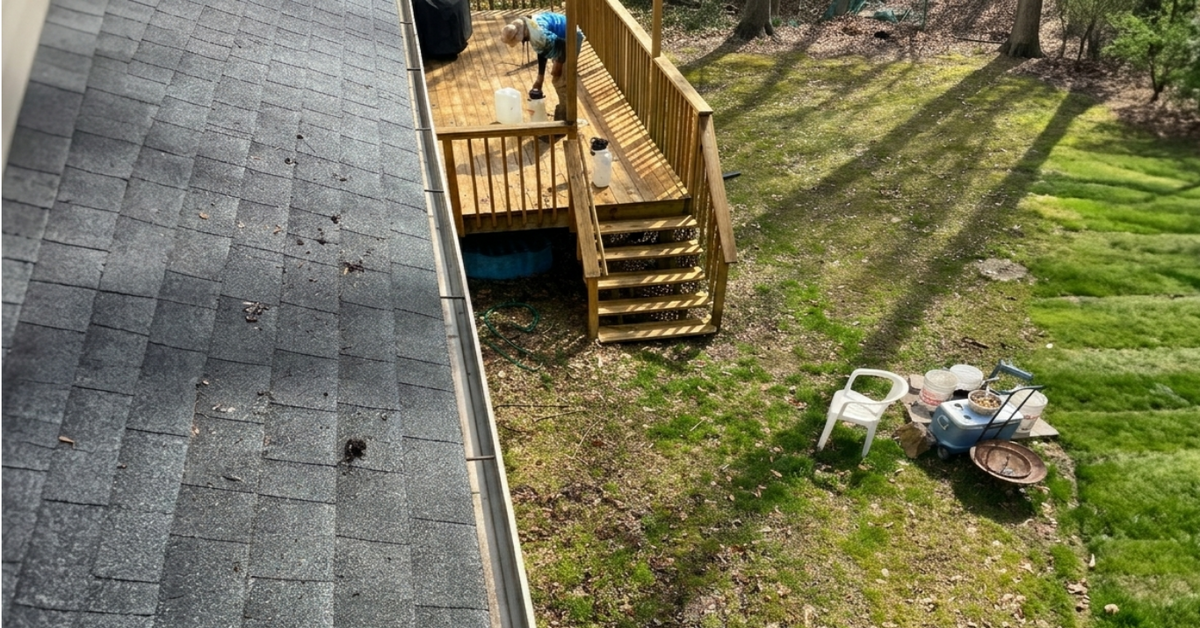
Sweep up the deposit at the splash block. If it fills roughly a tablespoon, that is ordinary shedding. If you are filling a cup, or the gutter trough has a continuous layer of sediment sitting in it, that is a different conversation.
The four-week test
This is more reliable than any single measurement.
- Clear the splash block and downspout outlet completely.
- Write down the date.
- Check again after four weeks and two or three good rains.
Ongoing accumulation at that rate is the real signal. A one-time deposit that stops is not.
Where it comes from matters more than volume
This is the part most people miss. Granules arriving evenly from every downspout on an older roof is normal end-of-life shedding. Granules arriving from one downspout serving one slope means something happened to that slope.
The Six Reasons You’re Seeing Granules Right Now
1. Your roof is new (0 to 2 years)
Manufacturers apply excess granules during production, and that loose surplus sheds heavily through the first year or two. Completely normal, entirely expected, harmless.
If your roof is this new and you are seeing grit at the downspout, you can stop worrying now.
2. The debris was holding them in place
Moss, lichen, leaf mulch and years of accumulated grit trap already-detached granules on the roof surface. Take that layer off and the granules underneath finally wash down.
This is the single most common cause of what you are looking at. The cleaning did not create the loss. It revealed loss that had already happened, sometimes years earlier.
I explain this on site at least a dozen times a season, usually to a homeowner standing over their splash block looking worried. Nine times out of ten it is this.
3. Your roof is at end of life (18 to 25-plus years)
Shedding accelerates sharply in the final few years of a shingle’s service life. If your roof is in this bracket, the granules are the roof telling you its remaining life is short. That is true regardless of what any contractor did or did not do.
4. Moss removal took granules with it
Moss anchors itself with rhizoids that grip into the granule layer. When a thick mat finally releases, some granules come with it.
This is unavoidable to a degree, and it is the strongest practical argument for treating moss early, before the mat gets thick. We cover the timing in what to do when moss has lifted your shingles.
5. The method was wrong
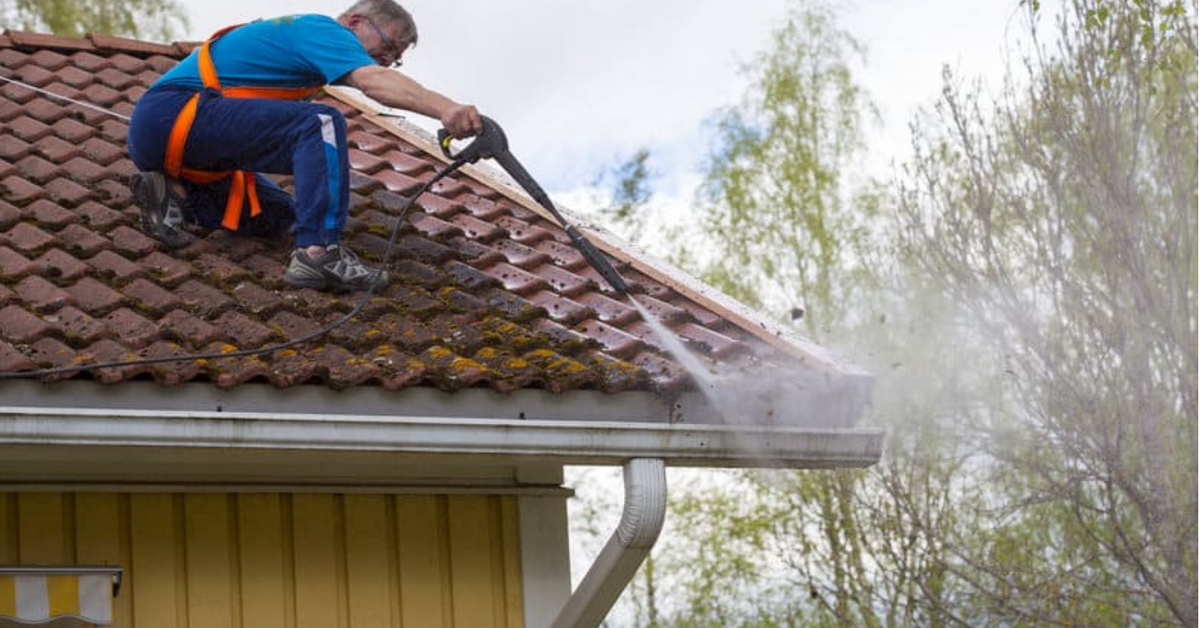
High pressure strips granules mechanically. The signs are specific: wand-arc striping across the slope, granules concentrated below particular slopes, and a sediment layer rather than a dusting.
If that matches what you are seeing, the diagnosis and the recourse path are both covered in what to do when a roof cleaner used high pressure on your shingles.
6. It is not from the roof at all
Worth ruling out before you spiral. Gutter guard mesh sheds its own debris. Ridge vent filter material breaks down over time. A neighbouring roof or nearby construction contributes. And on plenty of older Newington homes, deteriorating roll roofing on a porch or shed roof sheds heavily while the main roof is perfectly fine.
Check the Roof Itself: What to Look For From the Ground
Binoculars or a phone zoom. Please do not go up there.
- Bald spots. Patches where the surface looks shiny, smooth and darker than the shingle around it. That is exposed asphalt mat, and it is genuine granule loss. This is the single most decisive check on the list.
- Colour unevenness across a slope. Worn areas read lighter or duller in raking light, so look early morning or late afternoon.
- Wear tracks. Loss concentrated below roof-mounted equipment, in valleys, or along a path where someone walked. That pattern tells you the cause was mechanical rather than age.
- Curled or cupped edges. Granule loss plus curling almost always means end of life, not cleaning damage.
- Consistency. Uniform wear across the whole roof points to age. Wear isolated to one slope points to an event.
Send us a photo of your gutter and one of the roof slope above it. We will tell you what we are looking at. No visit required, no obligation. Text or email Roman at (860) 263-9031 or roman@mr-suds.com.
How Old Is Your Roof, Really? (And How to Find Out in Newington)
Most homeowners guess wrong by five to eight years. Almost always in the optimistic direction.
Getting the real number matters more than any other single fact in this article. A 22-year-old roof shedding granules is a roof at end of life. An 8-year-old roof shedding the same volume is a problem worth investigating. Identical symptom, opposite conclusion.
Check the permit record. Re-roofing requires a building permit, and the Town of Newington Building Department holds permit history by address. A phone call or a records request usually gets you the install date and often the contractor’s name.
Other sources worth checking:
- The home inspection report from when you bought the house
- Your closing file
- The previous owner’s disclosure
- A leftover shingle bundle wrapper in the garage or attic (more common than you would think)
There is a local pattern worth knowing here. A large share of Newington’s housing stock is post-war ranches, capes and colonials that have been re-roofed once or twice. Many of the current roofs date to the 2000s and early 2010s, which puts a lot of homes in this town squarely in the 15 to 25 year window where shedding naturally accelerates.
If your neighbours are getting quotes for new roofs, that is not a coincidence. Whole streets around here went up at the same time and get re-roofed at the same time.
What to Do Right Now, Step by Step
- Collect a sample. Sweep the splash block deposit into a sealed bag and label it with the date and downspout location. Costs nothing, and it is evidence if you end up needing any.
- Photograph the gutter trough and splash block before you clean anything out.
- Clear it completely and start the four-week test.
- Determine the roof’s real age through permit records.
- Look for bald spots with binoculars or a phone zoom. This is the decisive visual check.
- Check the attic on a bright day with the lights off. Daylight, staining, damp sheathing.
- Ask the contractor what method they used, in writing. A soft wash company answers specifically and without hesitation. Vagueness is itself information.
- Get an independent roofing inspection if there are bald spots, curling, or the roof is 18 years or older. Not from the cleaner, and not from whoever is trying to sell you a roof. From a third party.
- Clean the gutters properly. Granule sediment settles, hardens, blocks outlets and adds real weight to the trough. Whatever the cause turns out to be, the gutters need clearing. That is a good reason to book annual gutter cleaning while you are sorting this out.
- Do not panic-replace. Granules in the gutter alone is not a reason to re-roof. Granules plus bald spots plus curling plus twenty years is.
If the Roof Is Genuinely Near End of Life
Cleaning an end-of-life roof buys appearance, not lifespan. Worth being clear about that.
There is a second issue too. On a roof with widespread granule loss, the cleaning results will look patchy, because the surface underneath is already uneven. You cannot make a worn roof look uniform by washing it.
The sensible sequence looks like this:
- Get roofing quotes and plan the replacement on your own timeline, not in a panic
- Clean the new roof preventively from around year three onward, so you never end up back here
- Keep the gutters clear throughout, because that is what protects the fascia and foundation regardless of roof age
One more thing if you are thinking about selling. Connecticut sellers of one-to-four-unit residential property are generally required to provide a Residential Property Condition Disclosure Report covering known conditions, including the roof. Knowing the roof’s actual state before you list is a much better position than discovering it during the buyer’s inspection. Check current requirements with CT DCP, since the details and the associated buyer credit can change.
And the part I say out loud on driveways in Newington and Wethersfield every year: if your roof is finished, we will tell you, and we will not sell you a cleaning. Come back to us when the new one goes on.
Preventing Avoidable Granule Loss
| Practice | Why it helps |
|---|---|
| Treat moss early, before mats thicken | Thin growth releases without pulling granules with it |
| Soft wash only, never pressure on shingles | Removes growth chemically instead of mechanically |
| Keep foot traffic off the roof | Nobody should walk the shingle field who does not have to |
| Trim overhanging limbs | Less debris means less trapped moisture and less growth |
| Annual gutter cleaning | Stops the bottom courses staying permanently damp |
| Clean on a 3 to 4 year cycle | Waiting a decade means fighting a thick mat instead of a thin film |
FAQs
Is it normal to find granules in the gutter after roof cleaning? Usually yes. Debris on the roof holds loose granules in place, and removing that debris releases them. The loss had already happened.
How much granule loss means I need a new roof? Gutter volume alone does not answer that. Bald spots plus curling edges plus a roof age of 18 years or more is what points to replacement.
Do granules in gutters mean the cleaner damaged my roof? Not by itself. Look for wand-arc striping, loss concentrated below one slope, and a sediment layer rather than a dusting. Those markers point to method damage.
Does a new roof shed granules? Yes, quite heavily through the first year or two. Manufacturers apply excess granules and the surplus washes off. Normal.
Can granules be replaced or repaired? No. There is no product that puts granules back on a shingle. Affected shingles can only be replaced.
Do granules clog gutters and downspouts? Yes. They settle, harden into the trough, and are a very common cause of slow drainage and overflow at the outlet.
How do I find out how old my roof is? Newington Building Department permit records, your home inspection report, or the closing file from when you bought the house.
Should I stop having my roof cleaned to avoid granule loss? No. Skipping cleaning lets moss and lichen do far more granule damage over time than a correct soft wash ever will.
Want Someone to Tell You Straight?
Get an Honest Read, Including “You Don’t Need Us”
Send a photo, or have us come look. We will tell you whether you are looking at normal shedding, a method problem, or a roof at the end of its run. If it is the last one, you will hear that clearly, and we will not quote you a cleaning.
Either way, the gutters probably need clearing. That part we are happy to handle.
See our roof soft washing service, our gutter cleaning service, and real before and after results.
Get a Free Quote or call (860) 263-9031
Veteran owned. Licensed, bonded and insured. Owner-supervised on every job. Serving Newington, Hartford, Wethersfield, Rocky Hill, Glastonbury and Central Connecticut.