
Shingle warranties are not automatic. Nearly all of them contain two things homeowners skip past: a list of exclusions, and an expectation that the roof has been reasonably maintained.
When a claim is filed, the manufacturer’s first request is usually documentation. Proof of what was done to the roof, when, by whom, and how. Most homeowners have none, because nobody ever told them to keep it.
The good news is that a compliant maintenance file takes about twenty minutes to set up and five minutes a year to keep current. Here is exactly what goes in it, how to get it from your contractor, and what to do if you are already being asked for records you do not have.
A quick note on why we care about this. We started issuing formal service records years ago after a customer in Wethersfield called us in a panic, mid-claim, asking whether we could confirm in writing what we had done to his roof three years earlier. We could, because we keep files. He got his answer in an hour. That call changed how we run every job. You can read more homeowner-facing breakdowns like this one on our blog.
You Probably Have Three Different Warranties: Know Which Is Which
Most warranty confusion comes from treating these as one thing. They are not.
| Who issues it | What it covers | Typical term | Does maintenance matter? | How it’s lost | |
|---|---|---|---|---|---|
| Manufacturer’s limited warranty | GAF, CertainTeed, Owens Corning, IKO, Atlas, TAMKO | Manufacturing defects in the shingles | Often non-prorated for a period, then prorated | Yes, heavily | Improper maintenance, neglect, mechanical damage |
| Workmanship warranty | Your roofing contractor | Installation error | Usually much shorter | Sometimes | Contractor goes out of business |
| Algae-resistance warranty | Manufacturer, separately | Blue-green algae staining on AR shingles | Own term, often shorter than the main warranty | Yes | Its own conditions and exclusions |
| Enhanced / system warranty | Manufacturer, via certified installer | Full system, sometimes including workmanship | Varies widely | Yes | Missing the registration window |
Two of these deserve extra attention.
The workmanship warranty is worth exactly as much as the contractor’s continued existence. If they closed, it is gone. Worth checking whether your installer is still an active registered HIC at eLicense.ct.gov, because that tells you something about whether that piece of paper still means anything.
The algae-resistance warranty is separate. This is why a homeowner can have “a lifetime warranty” on their roof and no coverage at all for black streaks. Different document, different term, different conditions.
Enhanced warranties are the most commonly forfeited coverage of all, because they typically require registration within a set window after installation and nobody remembers to do it. You can review a manufacturer’s own tiers and requirements, such as GAF’s warranty resources, directly before assuming what yours covers.
Read your own documents. Terms vary by product line and by year, and they change without notice.
Does Cleaning Your Roof Void the Warranty?
Cleaning by the correct method does not void a warranty. Cleaning by the wrong method commonly does. Manufacturers and ARMA direct that asphalt shingles be cleaned with low-pressure chemical methods rather than pressure washing, and mechanical damage from improper cleaning falls under exclusions in virtually every limited warranty.
Now the part almost nobody knows.
Failing to clean can also cost you coverage. Warranties commonly exclude damage attributable to neglect, failure to remove debris, or failure to maintain. Moss that lifts your tabs and lets water run under the courses is not a manufacturing defect, and the manufacturer will tell you so in writing.
So the honest summary is this: the warranty does not ask you to leave the roof alone. It asks you to maintain it correctly and be able to prove it.
If your roof already has moss under the tabs, read what moss lifting your shingles actually means before you file anything. And if you want a sense of how much damage accumulates when exterior maintenance is skipped altogether, our piece on 5 years without exterior cleaning walks through what that actually looks like on a real property.
What “Documented Cleaning” Actually Means
This is the section worth printing.
A compliant service record should contain every one of the following:
- Date of service, plus the dates of any prior services on the same property
- Full property address
- Contractor’s business name, address, phone and Connecticut HIC registration number
- Proof of insurance, with a certificate of insurance on file
- Method used, stated explicitly. For example: “low-pressure soft wash application; no pressure washing performed on shingle surfaces.” That sentence, in that plain form, is what a warranty adjuster is actually looking for
- Product type applied, meaning the category and its purpose. A contractor’s specific formulation is proprietary, but the class of product and what it was for belongs on the record
- Areas treated: which slopes, plus gutters, valleys and ridge
- Condition notes. Anything observed on the day: lifted tabs, granule wear, damaged flashing, prior repairs. A contractor who documents defects is doing you a favour, not creating a problem for you
- Before and after photographs, dated
- Itemised invoice showing payment, including the 6.35% Connecticut sales tax line
That last point matters more than it looks. Housewashing and maintenance services on residential property are taxable in Connecticut per CT DRS. A properly taxed invoice from a registered business is far stronger documentation than a handwritten cash receipt with no paper trail behind it. Adjusters notice.
Ask your contractor for this at booking, not afterwards. Retrofitting documentation a year later is a much harder conversation than requesting it at the quote stage.
Every Mr-Suds roof service comes with a dated, photographed service record stating the method used. That is the document your warranty department will actually ask for. Call Roman at (860) 263-9031.
Build Your Roof File: A 20-Minute Setup
One digital folder, one physical envelope. Here is what goes in both.
- ☐ Original roofing contract and invoice
- ☐ Shingle brand, product line, colour and lot information (photograph the bundle wrapper if one is still in the garage)
- ☐ The actual warranty document, not a marketing summary
- ☐ Proof of warranty registration, if your coverage required it
- ☐ Building permit and final inspection sign-off, obtainable by address from the Town of Newington Building Department if you never had a copy
- ☐ Installer’s HIC number, plus a screenshot of their eLicense.ct.gov record as of the install date
- ☐ Every maintenance service record from then on
- ☐ Dated photographs, at least annually
- ☐ Storm event dates and any insurance correspondence
- ☐ Gutter cleaning records, since debris-related damage is a common exclusion
Two habits that make the file genuinely usable ten years from now:
Name files by date. For example, 2026-05-14-roof-softwash-invoice.pdf. Sounds trivial. It is the difference between finding a document in thirty seconds and giving up.
Back it up to cloud storage. Paper in a basement filing cabinet in Connecticut has a way of not surviving a decade.
What to Do If You’re Being Asked for Records You Don’t Have
General information about the process, not legal advice. Warranty terms vary by manufacturer and product, so read your own document and contact the manufacturer directly.
- Do not guess or reconstruct from memory in writing. Never send an adjuster an estimated date. Send what you can actually prove and say clearly what you cannot.
- Reconstruct from bank and card statements. Payments to a roofing or cleaning contractor establish dates and amounts, and those are often enough to anchor a timeline.
- Contact previous contractors and request copies. Most keep records for several years. Ask specifically for the invoice and any job photos. Photos are more common than people expect, because half this industry photographs everything for marketing.
- Pull permit records from the Newington Building Department for the installation date and the installer’s name.
- Retrieve your home inspection report from when you purchased. It documents roof condition at a fixed date, which is very often exactly what is in dispute.
- Search your email archive by contractor name and by the word “roof.” Quotes and confirmations count.
- Get a current professional condition assessment, dated and photographed. It will not fill the gap retroactively, but it establishes present condition and can support a partial claim.
- Respond to the manufacturer in writing, provide everything you have, and ask them to state specifically which requirement they consider unmet. Getting the objection in writing narrows the argument to something you can actually address.
- If the dispute is with the installer rather than the manufacturer, Connecticut has a defined recourse path through CT DCP, the Home Improvement Guaranty Fund and Small Claims. We walk through it fully in what to do when a roof cleaner used high pressure on your shingles.
Transferring the Warranty When You Sell Your Newington Home
Almost nobody handles this correctly, and it is free money left on the table.
Many shingle warranties are transferable once, and only within a defined window after the sale. That window is often measured in weeks or months, not years. Miss it and coverage typically drops to a reduced level or ends entirely.
Transfer usually requires written notice to the manufacturer with the property address, the original owner’s details, the new owner’s details, and sometimes a fee.
Put it on the closing checklist. Closing swallows small tasks whole, and this is exactly the kind of thing that gets remembered in November about a sale that completed in August.
There is a Connecticut angle worth knowing. Sellers of one-to-four-unit residential property are generally required to provide a Residential Property Condition Disclosure Report covering known conditions, including the roof. A documented maintenance file lets you answer roof questions with records instead of guesses, and it holds up at the buyer’s inspection. Confirm current requirements and any associated buyer credit with CT DCP, since these details change.
If you are buying in Newington: ask for the roof file and the warranty document during due diligence. Most buyers never think to. The sellers who have one are usually the sellers who maintained the house.
How Often Should a Connecticut Roof Be Cleaned to Stay Compliant?
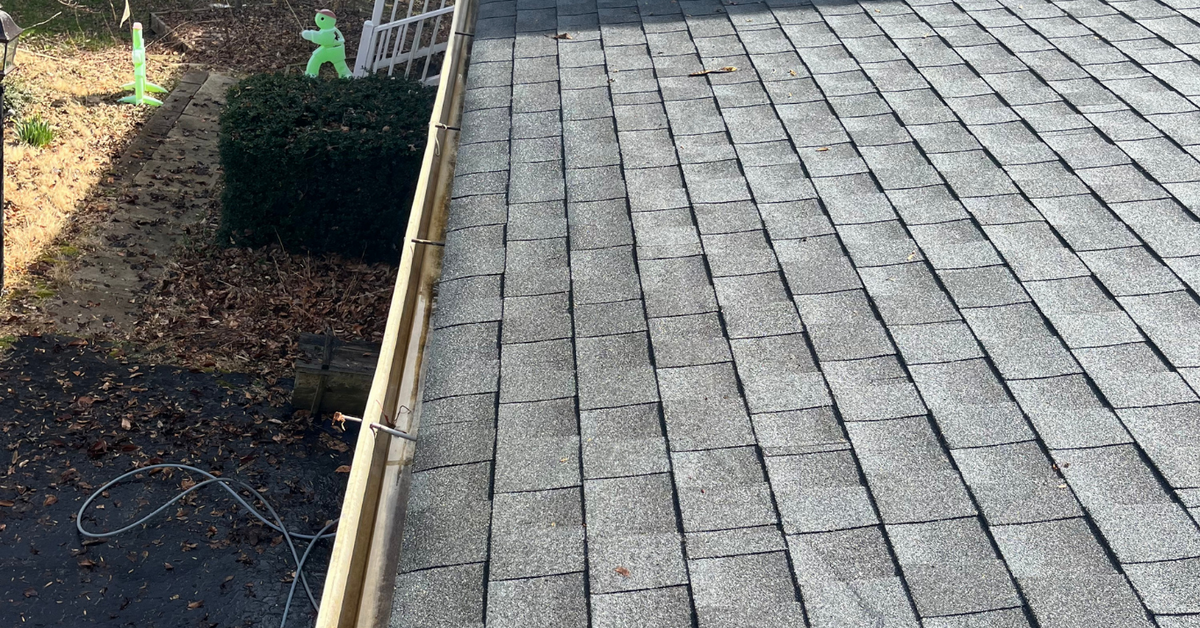
Manufacturers rarely specify an interval. They specify a standard: keep the roof free of debris, moss and accumulation.
In practice, for Central Connecticut:
| Task | Frequency |
|---|---|
| Visual inspection | Annually |
| Roof soft wash | Every 3 to 4 years |
| Heavily shaded or north-facing slopes | More often, sometimes every 2 to 3 years |
| Gutter clearing | At least annually |
Anchor it to a fixed month so it never gets forgotten. Late spring or early autumn, on a dry mild day, works best in Connecticut.
That is the whole product we recommend to anyone who cares about their coverage: a documented maintenance schedule where every visit produces a compliant, photographed, invoiced service record that goes straight into the roof file. Not a wash you remember to book when the roof looks bad. A record that accumulates.
See how the work itself is done on our roof soft washing service page and what soft washing actually is.
FAQs
Does roof cleaning void a shingle warranty? Cleaning by the correct low-pressure method does not. Pressure washing commonly falls under mechanical damage or improper maintenance exclusions.
Does not cleaning my roof void the warranty? It can. Neglect and debris-related damage are common exclusions, and moss damage in particular is not a manufacturing defect.
What records does a manufacturer ask for in a claim? Typically dated invoices, an explicit statement of the method used, photographs, and the contractor’s business and registration details.
How do I find out what shingles are on my roof? The roofing invoice, the Newington permit record, your home inspection report, or a leftover bundle wrapper in the garage or attic.
Can I transfer my roof warranty when I sell? Often once, and usually only within a limited window after the sale. Read your own warranty document and start the process before closing.
How often does a roof need cleaning to stay compliant? In Central Connecticut, inspect annually and clean every three to four years. More often on shaded or north-facing slopes.
What if my roofing contractor is out of business? Workmanship coverage generally goes with them. Manufacturer coverage on the materials does not, so your limited warranty and any algae-resistance coverage survive.
Is a cash receipt enough documentation? It is weak. An itemised invoice from a registered, insured contractor, with the sales tax line showing, is far stronger.
Get Service Records Your Warranty Department Will Accept
Documented Roof Maintenance, on Schedule
Annual inspection. Cleaning on a three to four year cycle. A compliant, photographed, itemised service record every single visit, stating the method in the language a warranty adjuster expects to see.
We cannot promise a manufacturer will approve your claim. Nobody honestly can. What we can promise is that when they ask you for records, you will have them.
Related: gutter cleaning for the debris side of the exclusion, and real before and after documentation from local jobs. See what neighbors are saying about our documented service approach in our customer reviews, and browse our full range of exterior services if your roof file leads you to check on siding, decks or pavers too.
Get a Free Quote or call (860) 263-9031
Veteran owned. Licensed, bonded and insured. HIC registered. Owner-supervised on every job. Serving Newington, Hartford, Wethersfield, Rocky Hill, Glastonbury and Central Connecticut.