
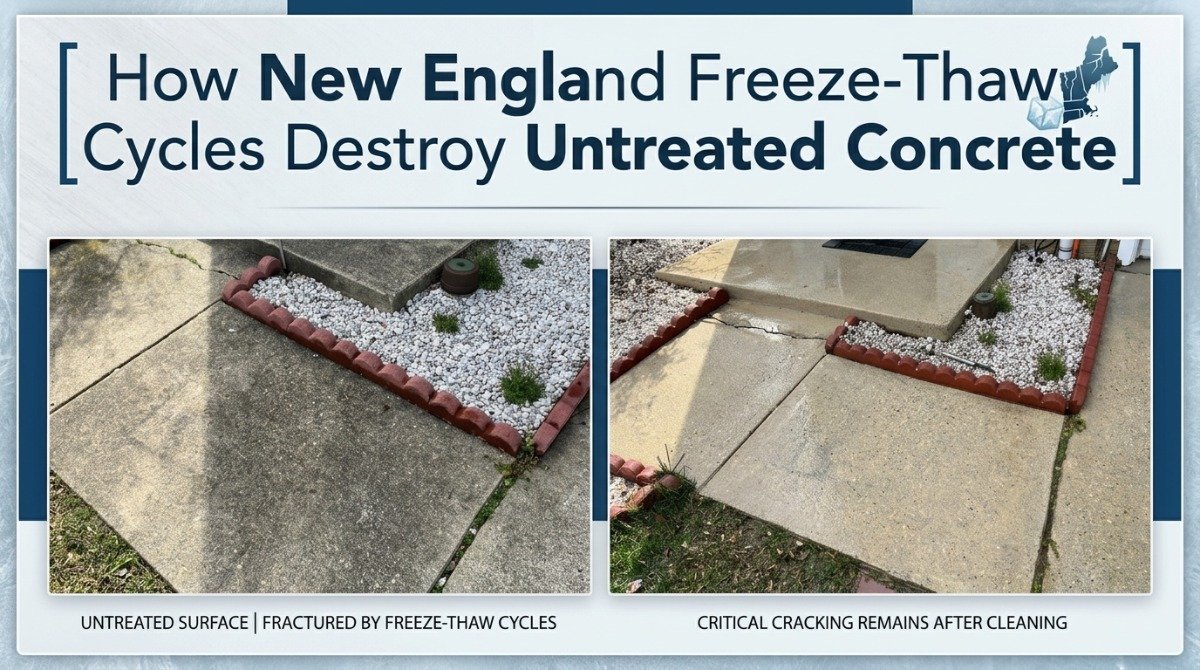
Last spring a homeowner in Newington called us about the driveway. The snow was gone, the slab looked gray and stained, and they wanted “just a wash.”
When I walked it, I noticed something else first. Right where the car parks by the garage, the top of the concrete was lifting in thin flakes.
That is what New England freeze-thaw cycles do to untreated concrete. Water gets into the slab, freezes, needs more room than it has, and pushes the surface apart. Then it happens again, all winter long.
Below I explain what goes on inside the slab, why salt makes it worse, what can still be saved, and when to clean and seal here in Connecticut.
What do freeze-thaw cycles do to untreated concrete?
Freeze-thaw cycles break down concrete when water soaks into its pores, freezes and expands by about 9 percent. The pressure cracks the weak top layer from inside. Each thaw lets more water into the new cracks, so the next freeze goes deeper, causing scaling, spalling and pitting on unsealed driveways and walks.
The short version:
- Water soaks into the pores of unsealed concrete.
- It freezes and expands by about 9 percent.
- The pressure cracks the weak top layer from inside.
- The thaw lets more water in, and the next freeze goes deeper.
One cycle does very little. Hartford has historically averaged about 75 of them a year, though, so small problems add up fast.
Why do New England freeze-thaw cycles hit concrete so hard?
People assume deep cold is the enemy. It really is not. A slab that freezes solid in January and stays frozen is having a fairly easy time.
How many freeze-thaw cycles does Hartford get a year?
The NOAA engineering weather data for Hartford lists an average of about 75 freeze-thaw cycles a year, based on a 1973 to 1996 record. It puts the 50 year frost depth at 52 inches.
A cycle is simply the temperature dropping below 32°F and climbing back above it. Nights in the 20s and afternoons in the high 30s, which is a normal Hartford late winter, give you one nearly every day.
The frost reaches deep, but the damage homeowners notice lives in the top fraction of an inch.
Why do March and November matter more than January?
The worst stretches are the shoulder seasons. At Hartford Brainard Field, the median last spring freeze is around April 25 and the median first fall freeze around October 10, per UMass Extension freeze tables.
March is the rough month. Snowmelt and spring rain keep slabs soaked, and a soaked slab is exactly what freeze-thaw needs.
What actually happens inside the slab during a freeze-thaw cycle?
Why does concrete soak up water?
Concrete is a hardened paste of cement and water around sand and stone. As it cures, water leaves behind tiny capillary pores. Unsealed, those pores drink water like a stiff sponge.
The top surface is usually the weakest part. Extra finishing water, bleed water and poor curing all concentrate there.
Why does freezing water break concrete?
Water expands about 9 percent when it turns to ice. In a pore that is mostly full, the ice has nowhere to go, so it builds hydraulic pressure against the walls.
Concrete handles squeezing well but is weak when pulled apart. So the pore walls crack.
The key condition is saturation. A dry slab survives freezing. A soaked one does not. That is why drainage and sealing both matter.
What is air entrainment and why does it help?
Good exterior concrete is mixed with tiny, evenly spaced air bubbles that give freezing water room to expand. Industry guidance calls for at least 4,000 psi, a maximum water to cement ratio of 0.45, and 5 to 7 percent air for concrete exposed to winter.
Older driveways, DIY pours and slabs finished with extra water may lack that protection. That is often why two driveways on the same street age so differently.
Why does it get worse every year?
Each cycle leaves microcracks. The next thaw fills them, and the next freeze pushes deeper. A driveway can look fine for years and then seem to fall apart in one winter. Really, it was wearing away the whole time.
What does freeze-thaw damage look like on a driveway?
Scaling: when the top layer flakes off
Scaling is flaking or peeling of the finished surface. It starts in small patches that slowly merge, and it is the usual answer to “why is my concrete flaking after winter?”
| Severity | What you see |
| Light | Thin surface mortar gone, no stone showing |
| Moderate | Stone starting to show, about 1/8 to 3/8 inch lost |
| Severe | Much of the surface gone, stone clearly sticking up |
It shows up first where cars drip slush, on the garage apron, along the street where plow piles sit, and on steps.
Spalling: when chunks break away
Spalling goes deeper. Larger pieces break off, often at edges, joints and corners. The simple difference: scaling is a thin skin peeling, spalling is a chunk coming out.
Pitting and popouts
Popouts are small cone shaped craters where a stone near the surface soaked up water, froze and popped the paste above it. A few are cosmetic, but each one holds water and salt and can start scaling around it.
Cracks and joint damage
Freezing water widens existing cracks and can heave sections in winter. Control joints and edges take the worst of it, because water and salt sit there longest.
How do road salt and ice melt speed up the damage?
Why does salt make freeze-thaw worse?
Salt melts ice, which means more meltwater soaking into the top layer and more refreezing right at the surface. That is why scaling is most common after long winters with heavy ice melt use.
Much of the salt on a Newington driveway apron never came out of the homeowner’s bag. It rides in on tires and gets thrown by plows from state and town roads. How far that salt travels from roads like the Berlin Turnpike is a topic we cover in a separate article.
Which deicers attack the concrete itself?
Researchers writing in the ACI Materials Journal in 2017 found that calcium chloride and magnesium chloride react with calcium hydroxide in the cement paste. That forms calcium oxychloride, which can expand and break down the concrete. Sodium chloride was less severe.
For context, the Connecticut Department of Transportation says it uses a 23 percent sodium chloride brine for anti icing, along with sodium, magnesium and calcium chlorides.
Which ice melt should Hartford homeowners use on concrete?
The Pennsylvania Aggregates and Concrete Association’s deicer guidance breaks it down like this:
| Deicer on the bag | What the guidance says for concrete |
| Sodium chloride (rock salt) | Generally acceptable on good, dense concrete; use sparingly |
| Calcium chloride | Generally acceptable on good, dense concrete; use sparingly |
| Magnesium chloride, potassium chloride | Linked to much higher deterioration |
| Calcium magnesium acetate (CMA), urea | Linked to much higher deterioration |
| Ammonium sulfate, ammonium nitrate | Never use on concrete |
The research and the trade guidance differ a little on calcium chloride. The honest summary: rock salt is the gentler common salt, calcium chloride works colder but carries more chemical risk, and less of any salt is better.
- Read the ingredient list on the back of the bag, not the “safe” claim on the front.
- No deicers on concrete in its first year. Use sand.
- Shovel early so you need less salt, and do not pile salty snow on the apron.
- Keep roof melt off the steps. Our piece on why ice dams form every winter in Newington explains where that water goes.
If you are not sure whether your driveway shows early scaling or just winter grime, we are happy to take a look. We check the surface before we clean, and we will tell you plainly whether cleaning and a sealer will help or whether it is a job for a concrete contractor. First time house cleaning customers in Hartford and surrounding towns get 15 percent off.
Why does cleaning come before sealing?
What kind of sealer protects against freeze-thaw?
The PACA guidance says silane or siloxane penetrating sealers give the highest resistance to deicer damage. They soak in and line the pores, so water beads off but vapor can still escape. That is what “breathable” means.
Film forming coatings sit on top instead. Some trap moisture and get slippery. If an old coating has gone hazy, our article on sealer that turns cloudy or white explains why. Asphalt sealcoat is a different product and does not belong on concrete.
Why must the concrete be clean first?
A penetrating sealer only works if it can reach the pores. Dirt, oil, tire marks, salt residue and efflorescence (that white crust) block it.
A silane sealer’s product data sheet I checked is direct about this. The surface must be clean, sound, frost free and dry, with dirt, oil and efflorescence removed, and high pressure water washing is an approved prep method.
That is where we fit in. We do the cleaning and stain treatment that gets the slab ready, and the homeowner or a sealing contractor seals afterward on a dry, clean slab. Tough spots get extra attention, like oil stains that will not come off a Newington driveway or rust bleeding through concrete from fertilizer.
How long should concrete dry after washing?
The same data sheet says penetration is best with no damp patches, and not to apply if rain is expected within 4 to 6 hours. After a wash, I usually suggest a couple of dry, warm days. The slab should look evenly light, including joints and shaded spots.
Is your old sealer still working?
Sprinkle some water on the slab. If it beads, a repellent is still there. If it darkens and soaks in, it is time to clean and reseal. Check the tire tracks and apron first, since they wear out before the edges.
How should a concrete driveway be pressure washed without damaging it?
What equipment is right for sound concrete?
Sound, cured concrete handles washing well, but technique matters more than raw pressure. On flatwork we use a surface cleaner, a round hood with a spinning bar underneath, which cleans evenly without wand stripes. If you have seen zebra lines on a driveway, our article on concrete that etches or stripes after washing explains them.
For edges and steps, we keep the wand well back from the surface. Zero degree and turbo tips can etch concrete and have no place on a driveway.
Our pressure washing in Newington always starts with a walk of the surface. As I often say, “The priority on every property is matching the right method to the right surface.”
Can you pressure wash concrete that is already scaling?
Yes, carefully. Scaled paste is already loose, and a narrow tip up close strips it off in sheets.
On damaged areas we ease off: wand farther back, wider fan, more cleaning solution and dwell time. Sometimes we leave the worst patch mostly alone, as we did on that Newington driveway.
To be honest, washing does not repair scaling. Real repair means removing the weak material and applying a bonded resurfacing, which is concrete contractor work.
How long should new concrete wait?
Give new concrete about a month to cure before washing. The sealer data sheet I mentioned gives 28 days or older for best results. And no deicers the first winter.
When should you wash and seal concrete in Connecticut?
Late summer to early fall is the sealing window
After a warm, dry stretch, concrete is about as dry as it gets, so sealer soaks in deep. Typical conditions are a 40 to 90°F surface, a dry slab and no rain for 4 to 6 hours. With the median first freeze around October 10, aim for late August through September.
Spring is the cleaning window
Once the last salt is down, clean off the salt, sand and grime so chlorides do not sit on the slab all summer. Spring is also when winter damage is easiest to see, including on nearby pavers that shift after cleaning or settle over winter.
Simple Connecticut concrete calendar
| When | Task | Why |
| Late March to April | Rinse off salt and sand once nights stay above freezing | Stops chlorides sitting on the slab |
| May to June | Professional cleaning; inspect for scaling and cracks | Clear view of winter damage |
| June to July | Fix downspouts and low spots that pond water | Saturation is what freeze-thaw needs |
| Late August to September | Clean if needed, let dry, apply penetrating sealer | Driest slab, inside the 40 to 90°F window |
| October | Final check before first freeze | Last safe window |
| November to March | Shovel early, use the least salt that works | Fewer chemicals in the pores |
What we found on a Newington driveway last spring
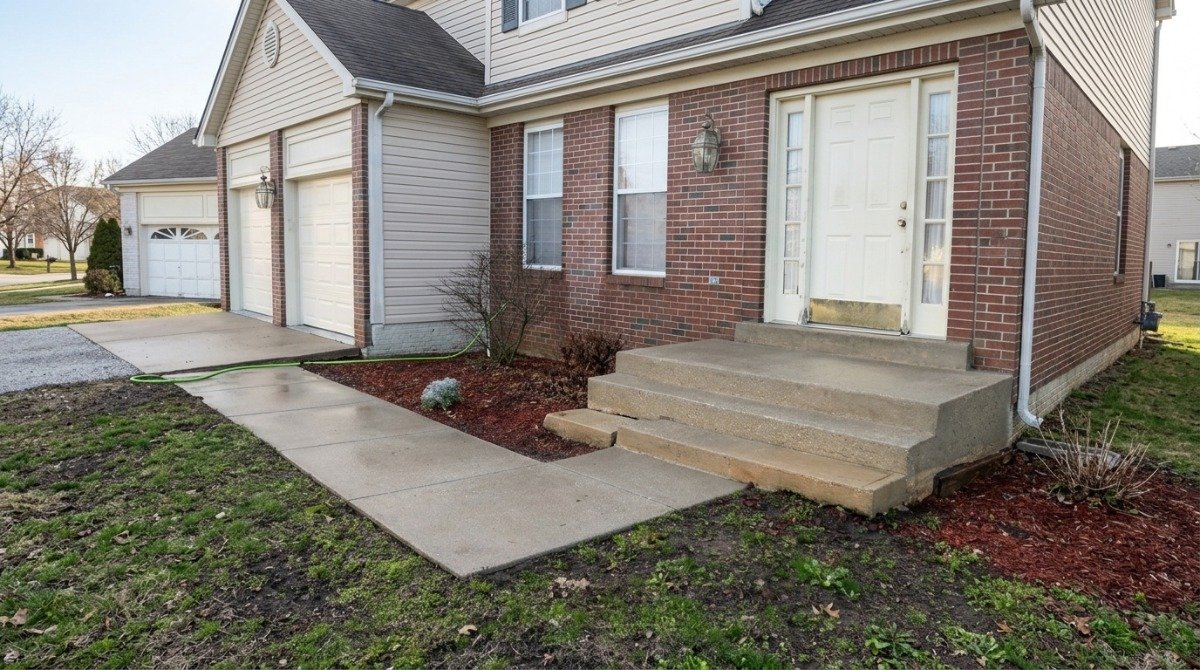
Back to that driveway. The homeowner called because it looked dirty after winter: dark tire tracks, a white crust where ice melt had been spread, and general grime. They were also nervous, because they had heard pressure washing can “eat” concrete.
On the walk around, the garage apron caught my eye first. The paste was flaking where the car sits and drips. Along the street edge, where the plow pile had sat, there were small pits and a few popouts. The rest of the slab was sound.
I judged the apron as light scaling, edging toward moderate in one corner where stone was starting to show.
We cleaned the main driveway with a surface cleaner, overlapping passes so there were no stripes, and let a cleaning solution dwell on the tire marks and salt crust. On the apron and street edge we slowed down, held the wand back and used more solution and less force. In the corner with exposed stone, we did little beyond a gentle rinse.
Afterward I told the homeowner what washing could and could not do. The slab was clean and still sound enough that a penetrating sealer in late summer would help protect it. The flaked areas would not grow back.
I suggested three things: seal in late August or September once it dried out, switch to plain rock salt used sparingly, and stop piling shoveled snow on the apron.
What Hartford and Newington homeowners should know about their concrete
Many homes around Newington, Wethersfield and West Hartford date from the 1950s through the 1970s. Their driveways and walks are often original or second pours of unknown mix quality, and front steps take a heavy dose of salt.
Homes along busy roads like the Berlin Turnpike, Route 175 and Route 173 tend to collect more thrown slush at the end of the driveway. North facing walks stay damp for days, and steps under overflowing gutters stay wet all winter.
New England freeze-thaw cycles hit commercial flatwork too. Condo sidewalks and entries are covered by our commercial exterior cleaning in Newington and Hartford, and concrete around pools belongs on the spring list as well, through our pool deck cleaning.
We work across Newington, Hartford, Wethersfield, Rocky Hill, Berlin, Cromwell and the surrounding Central Connecticut towns.
When is concrete too far gone for cleaning and sealing?
- Light scaling: Clean, dry, seal and change your ice melt habits. Very much worth doing.
- Moderate scaling: Same steps, plus a talk with a concrete contractor about resurfacing if looks matter.
- Severe scaling, deep spalls, heaving cracks: This needs repair or replacement.
One Boston area contractor guide uses a rule of thumb: once scaling covers more than about a quarter of the driveway, replacement starts to make more sense. A 2024 cost guide put Hartford concrete driveways at about $7 to $13 per square foot, plus $1.40 to $2.30 per square foot to remove the old slab. The full cost of putting off exterior maintenance is something we will cover in a separate article.
When a driveway is past the point where we can help, I will say so and point you toward a concrete contractor.
Freeze-thaw and concrete FAQs
How many freeze-thaw cycles does Hartford get each year?
Historically about 75 on average, based on NOAA data from 1973 to 1996. Most land in late fall and March, when days thaw and nights refreeze.
Why is my concrete flaking after winter?
That is scaling. Water in the top layer froze and thawed repeatedly, usually sped up by ice melt or a weak surface. Light scaling can be cleaned and sealed, but it will not grow back.
Does rock salt ruin concrete?
Rock salt is the gentler common salt on good, dense concrete when used sparingly. Magnesium chloride and several “safe” blends are linked to more damage. Never use ammonium based products, and skip deicers in the first year.
Should I seal my concrete driveway before winter in Connecticut?
Yes, if it is unsealed or fails the water bead test. Late August through September is best: a dry slab, 40 to 90°F, and no rain for 4 to 6 hours.
How long after pressure washing can I seal concrete?
Wait until the slab is fully dry with no damp patches, including joints and shade. I usually suggest a couple of dry, warm days.
Can pressure washing damage concrete?
Yes, with a zero degree tip, a wand held too close, or heavy pressure on scaled areas. A surface cleaner and a careful hand clean sound concrete safely.
How often should a concrete driveway be sealed?
Follow your sealer’s label, and do the water bead test every fall. If water soaks into the tire tracks, it is time to clean and reseal.
Can scaled concrete be repaired?
Light and moderate scaling can be resurfaced by a concrete contractor after the weak material is removed. Severe damage may mean replacement.
Get your concrete ready for the next Connecticut winter
Freeze-thaw damage starts small, and the cheapest time to slow it down is before the slab is soaked and salted again.
Mr-Suds Power Washing PROs is a local crew based at 130 Dewey Ave in Newington. We clean driveways, walks, patios and pool decks across Central Connecticut, including pressure washing services in Hartford and deck and patio cleaning. We look at the surface first, use the pressure it can take, and leave it clean and ready for sealing.
We are licensed, bonded and insured, with a 5.0 rating on Google. Call (860) 263-9031 or reach us through our contact page to book a spring cleaning or a late summer prep visit, and ask about 15 percent off your first house cleaning service.