
Ice dams form when heat escaping your attic melts snow on the upper roof and the water refreezes at the cold eave. To handle one now, rake snow off the lower three to four feet of roof from the ground and lay a calcium chloride sock across the dam to melt a drain channel. Never chip it.
That is the short version. The longer version is the part most Newington homeowners never get told, and it is the reason this keeps happening to the same house year after year.
The February Call That Starts Almost Every One of These
We got a call on a Tuesday in February from a street off Willard Avenue, one of those blocks lined with oaks that have been there longer than the houses. Two foot icicles hanging off the whole back eave. Water coming in somewhere.
By the time Roman pulled up, the homeowner was already on a stepladder in the driveway with a hammer and a look on his face that said he had been out there a while.
Roman’s first words were not about gutters. They were “put the hammer down.”
Here is why. From the ground, in February, you cannot see where the aluminum gutter ends and the ice begins. It is one solid white mass. Every swing you take is a coin flip between hitting ice and hitting the lip of a gutter that is already carrying a couple hundred pounds it was never designed to hold. When that lets go, it takes the fascia board with it. Now you have a February carpentry job on top of a February ice problem.
We have been cleaning gutters and roofs in Newington, Wethersfield and Rocky Hill long enough to have seen the aftermath of that swing more than once. So let us walk through what is actually happening up there, what to do today, and what to do in June so you are not reading this again next winter.
Why This Happens Every Single Year
If your roof dammed once, that is weather. If it dams every winter, that is a diagnosis.
Central Connecticut delivers somewhere in the range of 100 to 140 freeze thaw cycles in a normal season. Our winters do not sit at one temperature. They swing. Thirty eight degrees and sun in the afternoon, nineteen degrees and clear by ten at night, over and over from December into March.
A house with a well sealed, well insulated, well vented attic mostly shrugs that off. A house with heat leaking into the attic turns every one of those swings into another layer of ice at the roof edge.
The Melt and Refreeze Mechanism
Warm air from inside your home rises into the attic. It heats the underside of the roof deck. The snow sitting directly on top of that warmed deck melts, even when the outdoor temperature is well below freezing.
That meltwater runs downhill under the snowpack. It travels a few feet and reaches the part of the roof that hangs past your exterior wall. That section has no heated space underneath it, so it is sitting at whatever the air temperature is. The water freezes there.
Do that a few dozen times and you build a ridge of solid ice along the eave. Then the real damage starts. The next round of meltwater hits that ridge, has nowhere to go, and backs up. Asphalt shingles are designed to shed water running downhill. They are not designed to hold standing water. It works its way sideways under the shingle laps, through the deck, and into your ceiling.
That brown ring on the back bedroom ceiling is not a roof leak in the usual sense. Your roof did not fail. Your attic did. The Insurance Institute for Business & Home Safety describes this same mechanism: heat rising into the attic warms the roof deck, melts the snow sitting on it, and sends water underneath the snowpack straight toward the cold, unheated eave.
Why the Eave Is Always the Cold Spot
Two reasons. First, the overhang is outside your heated envelope by design, so it stays cold while the rest of the deck warms.
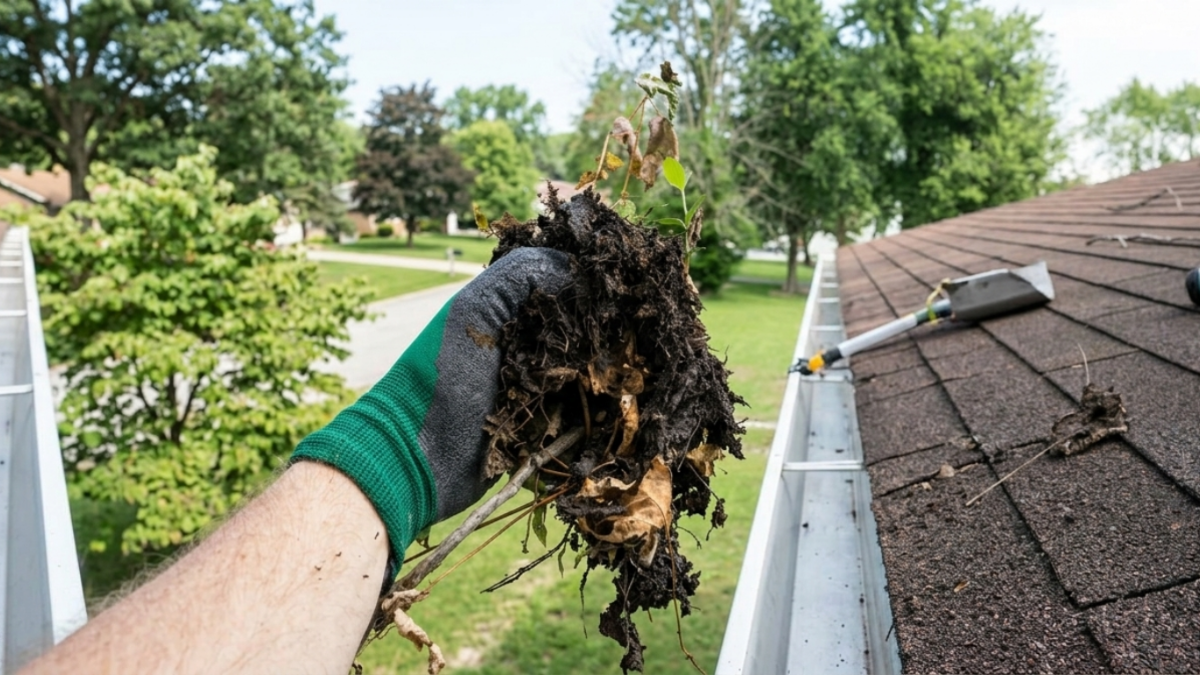
Second, whatever is sitting in the gutter adds to it. A trough packed with wet oak leaves freezes into a solid block of thermal mass right at the coldest point on the roof. That block does not cause the dam. It gives the dam something to grow onto.
The 1950s to 1970s Newington Cape Is an Ice Dam Machine
This is the part almost nobody writes down, and it is the reason your house dams while the one across the street does not.
A huge share of Newington housing stock is mid century. Capes, ranches and split levels built roughly between the end of the war and the mid seventies. Those homes were built to a completely different standard of air sealing than anything going up today, and most of them have been renovated at least once by somebody who was thinking about drywall, not building science.
The cape is the worst offender. Here is what we see from the ladder.
Knee Wall Attics and the Open Triangle Behind the Wall
A cape has a half finished second floor. The sloped ceiling meets a short vertical wall, usually three or four feet high, and behind that wall is an unconditioned triangle of attic space running the length of the house.
Nine times out of ten, the insulation in that knee wall is a batt stapled to the back of the studs with nothing sealing it, and the floor of that triangle is wide open to the joist bays underneath. Warm air from your first floor ceiling walks straight up into the triangle, then up the roof slope. It is a chimney with no damper.
Short Soffits, Blocked Vents, Insulation Jammed Against the Deck
Mid century overhangs are shallow. There is not much soffit to work with, and what is there has usually been painted. We have stood on a ladder in November looking at soffit vents that had been rolled over three separate times, until the perforations were basically sealed shut.
Then somebody in the 1990s blew cellulose into the attic and pushed it right out to the edge, jamming it against the underside of the deck. That kills the airflow path at exactly the point where it matters most. The fix is a baffle, a simple channel that keeps a gap open from the soffit up past the insulation, but you have to know to look for it.
Add a bath fan venting into the attic instead of out through the roof, which we see constantly in this vintage, and you have warm wet air being pumped into the coldest part of your house all winter.
Why the Colonial Next Door Stays Clean
Steeper pitch, so snow sheds instead of sitting. A real full attic with a walkable floor, so the insulation is easier to install correctly and easier to inspect. A continuous soffit run with actual depth to it. Usually a proper ridge vent.
It is not that your neighbor takes better care of their house. They just bought a different problem.
What Gutters Actually Have to Do With It, the Honest Answer
Time for the part where a cleaning company tells you something that does not sell a cleaning.
Clogged gutters do not create ice dams. The heat loss from your attic creates ice dams. If your gutters were brand new and spotless this morning, and your attic is leaking heat, you would still get a dam.
What clogged gutters do is remove the last drainage path the meltwater had.
Picture the sequence. Water melts upslope, runs down, and reaches the eave. If the gutter and the downspout are clear and the flow is decent, some of that water actually gets away before it can freeze. Not all of it, but enough that the ridge takes longer to build and stays smaller.
Now pack that trough with a black mat of wet leaves. Freeze the downspout solid at the elbow, which happens almost every time here because the elbow is the narrowest point and it is on the shaded north side. The water has nowhere to go from the moment it arrives. The dam starts earlier in the season, grows faster, and sits longer.
Same story with debris on the roof itself. A valley packed with oak leaves and pine needles holds a wet mat that freezes into its own little dam halfway up the slope. That is where our roof cleaning work overlaps with this, though again, it is drainage, not cause.
Roman puts it more directly than we probably should in a piece of marketing: “I am not going to tell you cleaning your gutters stops ice dams. It does not. It stops them from getting worse.”
Regular gutter cleaning in Newington is damage limitation. It is worth doing, it is cheap relative to a ceiling repair, and it buys you a milder winter. It is not the cure. Anybody who tells you it is has something to sell you.
What To Do Right Now, In the Middle of Winter
If there is ice on your eave today, here is the safe sequence. You need two things: a telescoping roof rake with a plastic or poly blade, and calcium chloride.
1. Rake the Lower Roof From the Ground
Stand on the ground. Not on a ladder, not on the roof. Ice, aluminum ladders and February are a bad combination, and roofs kill people every winter.
Use a telescoping roof rake to pull snow off the lowest three to four feet of the roof surface. That is the zone that feeds the dam. Pull downward in strips, do not scrape sideways, and keep the blade skimming rather than digging so you are not gouging shingles.
You are not trying to clear the whole roof. You are removing the snow that would otherwise melt and feed the ridge, and you are letting the eave get cold and stay cold.
2. Melt a Channel, Do Not Try to Remove the Dam
Do not attempt to take the ice out. Give the water a way through it.
Fill an old nylon stocking or a fabric tube sock with calcium chloride ice melt. Tie it off. Lay it across the dam so it runs vertically, straight up and down the slope, with one end hanging over the gutter edge. Place one every few feet along the length of the dam.
Over the next day or two each sock melts a narrow channel straight through the ice. That channel relieves the standing water behind the dam, which is the thing actually pushing water under your shingles. The dam is still there. It is just no longer a reservoir.
If you can get a sock into position from a second floor window or from the ground with a rake, do that. If the only way to place it is a ladder on ice, it is not worth it. Call somebody.
3. Rock Salt or Calcium Chloride, and Why It Matters
People grab the bag they already have in the garage for the driveway. That bag is almost always rock salt. Do not put it on your roof.
| Calcium chloride | Rock salt, sodium chloride | |
|---|---|---|
| Melts at low temps | Works well into the single digits | Loses effectiveness around 15 to 20 F |
| Effect on gutters and flashing | Much gentler on aluminum and steel | Aggressively corrodes aluminum gutters, fasteners, drip edge and flashing |
| Effect on shingles | Generally considered safe in sock form | Can accelerate granule and shingle wear |
| Runoff onto plants and lawn | Less harsh, still not harmless | Burns turf and foundation plantings at the drip line |
| Verdict for roof use | Yes, in a sock | No |
Also worth knowing: broadcasting loose pellets across the roof is not the method. Loose melt runs off, does nothing, and lands in your beds. The sock concentrates it exactly where you want the channel.
4. Manage the Water Inside
While the outside is being handled, deal with the inside.
Put a bucket under any active drip and pull anything valuable out of the room. If you have a ceiling that is bulging and holding water, the safest move is usually a small relief hole at the lowest point of the bulge with a bucket under it, so the weight comes out in a controlled way rather than the whole section letting go at once.
Before you tear out anything, take photographs. Date them. Photograph the exterior ice, the interior stain, and anything wet. If this turns into a claim later, those pictures are the difference between a conversation and an argument.
What Never To Do
Every one of these shows up on jobs we get called to clean up afterward.
Do not chip, hammer or pick at the ice. You cannot tell ice from gutter from the ground. Shingles at freezing temperatures are brittle and crack under impact. And a loaded gutter that gets struck hard tends to come off the fascia in one piece.
Roman’s version: “I have taken more gutters off a fascia with an ice pick than I care to admit, and every one of them was somebody trying to help.”
Do not use a pressure washer on your roof, ever. We are a pressure washing company and we are telling you this. High pressure strips the granules off asphalt shingles, which is the layer doing the actual protecting. It drives water up under the shingle laps, which is the exact failure you are trying to stop. And it voids most shingle manufacturer warranties outright.
For anything involving a roof surface, the correct approach is low pressure soft washing in the right season, not pressure in any season.
Do not pour hot water on a frozen roof. It feels productive for about ninety seconds. Then it refreezes in the seams and joints it just ran into, often in places that were dry before you started. You have also just thermal shocked a brittle surface. Net result is usually more ice in worse places.
Do not get on a ladder or a roof in ice. Nothing on your roof is worth a fall. Every method above is designed to be done with your feet on the ground for exactly this reason.
A Newington Cape That Dammed Three Winters Running
One job stands out because it walked the whole arc, and because the honest ending is more useful than a tidy one.
A 1962 cape, back side facing north, big maples in the yard and oaks along the property line. The owner had been in the house four years and had a ceiling stain in the back bedroom that got a little bigger every February. He had already tried a heat cable kit off the shelf one winter and rock salt the next.
When we got there in February, the gutters were not just clogged, they were a solid core of black leaf mat with about two inches of ice on top. The downspout was frozen at the elbow, which meant that even on a mild afternoon nothing was draining. We cleared what we safely could and got socks in place to open a channel.
The real information came in November when we went back for the fall cleaning. From the ladder, with the leaves off, you could read the house.
The batts in the knee wall attic stopped dead at the top plate, leaving the joist bays wide open to the triangle. The bath fan in the upstairs bathroom terminated into that same triangle, not out through the roof. The soffit vents on the north side had been painted over so many times you could barely see the slots.
We cleaned the gutters and the downspouts, cleared the valleys, and wrote up what we saw at the soffits. Then we told him the part that mattered: this needs an insulation contractor, not us.
He had the air sealing and the bath fan done that spring and had the attic re-insulated with baffles at the eaves.
The honest outcome: the following winter the eave still built a small ridge of ice during one bad stretch in January. It was maybe a fifth of what it had been, it never backed up, and the ceiling stayed dry. The gutter cleaning helped. The attic work is what actually changed the house.
If you want the drainage side handled before the season turns, that part is easy to schedule. Give us a call at (860) 263-9031 and we will tell you what we see while we are up there.
The Off Season Fix: How To End the Cycle
Order of operations matters here. Doing these out of sequence is how people spend real money and still get ice.
Step 1: Air Sealing, Before Any Insulation
Insulation slows heat transfer. It does not stop air movement. If warm air is physically travelling into your attic through gaps, adding insulation on top just filters it.
The targets are the attic hatch or scuttle, the top plates of interior walls, recessed can lights, plumbing stacks and wiring penetrations, the chimney chase, and in a cape, the floor of that knee wall triangle. Seal first. Always. ENERGY STAR’s do-it-yourself sealing and insulating guide walks through exactly this order and how to spot the biggest bypasses in your own attic.
Step 2: Insulation and R-Value for Connecticut
For our climate zone, attic floors are commonly specified somewhere around R-49 to R-60. Most mid century Newington attics we look into are nowhere near that, and a fair number are sitting on original batts that have settled and compressed.
What matters as much as the number is that the coverage is continuous and uncompressed, and that it does not choke the airflow channel at the eaves. Confirm current requirements with the Newington Building Department before you spec a job. Connecticut utilities also run home energy assessment programs, administered through EnergizeCT, that homeowners in this area use for exactly this work, so it is worth a phone call before you pay retail.
Step 3: Ventilation, Soffit In and Ridge Out
A properly vented attic stays close to outdoor temperature, which is the whole point. Cold deck, no melt.
The common guideline is roughly one square foot of net free vent area for every 300 square feet of attic floor, with intake and exhaust balanced. Intake comes in low at the soffit, exhaust leaves high at the ridge. Baffles keep the intake channel open where the insulation meets the eave.
One thing worth flagging: mixing a ridge vent with open gable vents often short circuits the airflow, so the ridge pulls from the gables instead of drawing air up from the soffits. If you have both, ask your contractor about it.
Where Ice and Water Shield Fits
A self adhering leak barrier along the eaves is standard practice on a Connecticut reroof, and it is genuinely valuable. Understand what it does though. It is a waterproof membrane under the shingles that keeps backed up water from reaching your deck and ceiling.
It limits the damage from a dam. It does not prevent the dam. If a roofer is selling you a full replacement as the solution to recurring ice dams and nobody has looked in your attic, get another opinion. Confirm the specifics for your project with the Newington building department.
Heat Cables, an Honest Verdict
Heat cables are management, not a cure. They keep a channel open, which is not nothing, and for some roof geometries with a genuinely unfixable cold spot they are a reasonable tool.
But they treat the symptom, they cost electricity every winter you run them, they need to be installed correctly to do anything, and they have a service life. If you are choosing between cables and fixing the attic, fix the attic.
Who Do You Actually Call?
This is the question nobody answers, so here it is plainly.
| Who | What they fix | When to call | What they cannot do |
|---|---|---|---|
| Insulation and air sealing contractor | The actual root cause: attic bypasses, insulation levels, ventilation, bath fan venting | Spring through fall, as soon as you have had a second bad winter | Nothing about the ice that is on your roof today |
| Roofer | Deck repair, shingle replacement, eave leak barrier, ridge and soffit venting hardware | When there is confirmed deck or shingle damage, or the roof is near end of life anyway | Fix a heat loss problem by replacing a roof |
| Gutter and roof cleaning company, which is us | Clear gutters, downspouts, underground outlets and roof debris so meltwater has somewhere to go | Fall, before the freeze, plus a second pass late in the leaf drop | Insulation, attic work, roofing, or removing an existing ice dam |
| Water damage restoration | Drying out wet wall and ceiling cavities, mold remediation | When water has already been inside for more than a day or two | Prevent the next one |
Roman again: “If I see your soffit vents painted shut in November, I am going to tell you to call an insulation guy, not me.”
The Fall Gutter Cleaning Schedule for a Hartford County Canopy
Generic advice says clean your gutters in the fall. That is too vague for our tree canopy.
Around here it takes two passes.
Early to mid November, after the maples have dropped. This clears the bulk of it.
Late November into early December, after the oaks. Oaks in Hartford County hold their leaves stubbornly, and plenty of them are still letting go well after Thanksgiving. A gutter cleaned in October will be full again by the time it matters.
A few things we would rather you knew, whether you hire us or do it yourself.
The downspout matters more than the trough. A clean gutter feeding a blocked downspout still holds water.
If your downspouts tie into an underground drain line, check the outlet. Those clog with silt and they freeze first.
Clear the roof valleys and the area behind chimneys, not just the gutters. Matted debris up there holds water.
Once temperatures drop below roughly 40 to 45 degrees, most washing chemistry stops working properly. So if you want roof cleaning done as well, it has to be booked before the season closes, not in December.
One more thing that surprises people. When a dam overflows repeatedly, the water sheets down the siding below it and leaves staining and organic growth that shows up in the spring. That is a separate job, and it is what soft wash house washing is for once the weather turns.
Insurance and Interior Damage
We are not insurance people, so treat this as general orientation and talk to your agent.
In broad terms, policies commonly distinguish between sudden and accidental water damage and damage from long term seepage or deferred maintenance. That distinction is why documentation matters so much, and why the timeline you can prove is often more important than the damage itself.
Practical steps:
Photograph everything, dated, before you remove or repair anything.
Call your carrier before demolition, not after.
Keep invoices for the maintenance you have done, including gutter cleaning. It supports the argument that this was not neglect.
Ask your agent directly how your policy treats ice dam damage. Ask before you need to know.
One thing we will say without hedging. If water got into a knee wall cavity, that space dries very slowly because there is almost no air movement in there. Wet insulation against a cold cavity wall is how mold problems start in this housing type. Do not assume that because the ceiling dried, the wall did.
Frequently Asked Questions
Do clogged gutters cause ice dams? No. Attic heat loss causes ice dams. Clogged gutters and frozen downspouts make them worse by removing the drainage path, so the ice builds faster and sits longer. Clean gutters reduce the severity. They do not remove the cause.
Will cleaning my gutters stop ice dams? Not on its own. If your attic is leaking heat, you will still get a dam. Gutter cleaning is worth doing because it limits how bad the dam gets and how long water stands behind it, but the permanent fix is air sealing, insulation and ventilation.
How do I get rid of an ice dam right now? Do not remove it. Melt a channel through it. Fill a nylon stocking with calcium chloride, lay it vertically across the dam every few feet, and let it open a drain path over a day or two. Also rake snow off the lowest three to four feet of roof from the ground.
Can you pressure wash an ice dam off a roof? No. Pressure strips shingle granules, forces water under the shingle laps, and voids most shingle warranties. It also creates an immediate refreeze problem. Nothing about a pressure washer belongs on a roof in winter.
Is it safe to chip ice off my gutters? No. From below you cannot tell where the gutter ends and the ice begins, cold shingles crack on impact, and an ice loaded gutter that gets struck often pulls away from the fascia. Chipping causes more repairs than it prevents.
Rock salt or calcium chloride for ice dams? Calcium chloride, and only in a sock. Rock salt is sodium chloride, which corrodes aluminum gutters, fasteners and flashing, loses effectiveness in the teens, and burns the plantings below. Never broadcast loose pellets across a roof.
How much attic insulation does a Connecticut home need? Attic floors in this climate zone are commonly specified around R-49 to R-60, but the number alone is not the answer. Air sealing has to come first, coverage has to be continuous and uncompressed, and the soffit airflow channel has to stay open. Confirm current requirements with the Newington building department.
Why does my cape get ice dams when my neighbor’s colonial does not? Capes have shallow pitch, knee wall attics with open joist bays, and short soffits with limited venting. That combination pushes warm air up the roof slope. A colonial usually has steeper pitch, a full accessible attic and a continuous soffit run, so it sheds snow and stays colder up top.
Do heat cables fix ice dams? They manage them. Cables keep a melt channel open but do nothing about the heat loss causing the ice, they use electricity all winter, and they have a limited service life. If you have to choose, fix the attic instead.
Does homeowners insurance cover ice dam damage? It depends on the policy and how the damage is characterized. Sudden water damage is often treated differently from long term seepage or maintenance neglect. Photograph everything with dates, call your carrier before you start demolition, and ask your agent how your specific policy handles it.
Should I call a roofer or an insulation contractor? Start with insulation and air sealing if the roof itself is sound, because that is where the cause lives. Call a roofer if there is confirmed deck or shingle damage, or the roof is near end of life anyway. Replacing a healthy roof will not stop a dam that starts in your attic.
Get the Part We Can Actually Fix Handled Before Winter
We are not going to sell you a cure for ice dams, because we do not have one. Nobody with a hose does.
What we do is clear your gutters, your downspouts and your underground outlets, get the matted debris out of your valleys and off the roof edge, and give the meltwater somewhere to go. That makes your winter milder and buys you time while the real work gets scheduled. And while we are up there, we will tell you honestly what we see at your soffits and whether you need to be calling somebody else.
Read more on our blog, check out our before and after results, or see what neighbors are saying in our reviews. Book your fall gutter cleaning in Newington before the leaves finish dropping, or get a free quote and we will take a look.
Mr-Suds Washing, Newington, CT. Learn more about us. Licensed, bonded and insured. Call (860) 263-9031.