

Quick Answer
Debris on top of gutter guards is normal, not a defect. Clear it with a leaf blower on dry days or a soft bristle brush pulled downward off the guard, never with a pressure washer, which deforms mesh and pushes debris into the trough. Then hose test the run and downspouts.
That is the fix. The bigger question, the one you are actually asking, is whether you wasted your money. Stay with us for a few minutes and you will know.
The Newington Cape That Looked Perfect From the Driveway
A homeowner off Cedar Street called us in late September. Water was pouring over the back corner of the gutter every time it rained hard, and it had been doing it for two seasons.
He had micro mesh guards installed three years earlier. From the driveway they looked brand new. Clean aluminum, no leaves piled up, nothing you would point at.
Roman went up the ladder and ran a thumb across the mesh. It came back grey.
There was no pile of leaves. There was something worse. A layer of felt, maybe a quarter inch thick, made of pine needle fragments, shingle grit and oak pollen that had been rained on and dried out a hundred times. It had matted into the weave like wet lint in a dryer filter. Water was not going through it. It was running across it, off the front lip, and behind the gutter into the fascia board.
That house had a shallow pitch and a big oak leaning over the back corner. The guards were not defective. They were just doing what a horizontal screen does under a tree, and nobody had ever told the owner it would need attention.
The guards stayed on. What changed was the schedule.
Why Debris Sits on Top Instead of Blowing Off
Here is the thing that never makes it into the sales pitch. A gutter guard does not make debris disappear. It relocates it.
Before the guard, leaves fell into the trough. Now they land on a flat or gently sloped screen sitting a few inches above the roof edge. That screen is a shelf. Gravity is not going to clear it for you.
Dry leaves do blow off, and on a windy October afternoon a lot of them will. The problem is what happens when they get wet first. A soaked oak leaf bonds to a mesh surface with real suction. It dries there, curls, and holds. Then the next one lands on top of it.
Shingle grit is the part people never think about. Every asphalt roof sheds granules constantly, more as it ages. That grit lands on the guard, works into the weave, and acts like glue for everything organic that follows.
Why One Section Is Always Worse Than the Rest
Look at where your roof valleys drain. A valley funnels the runoff from two roof planes into one narrow path, and everything on those planes rides down with it.
Wherever a valley dumps onto a guard, you get concentrated debris and concentrated water at the same spot. That is almost always the run that overflows first. It is also why “my gutters are fine except that one corner” is such a common thing for us to hear.
The Hartford County Canopy Makes This Local
National guard blogs are written for places with different trees. Ours are the problem.
Oak drops tassels in late April and May, then leaves that hang on stubbornly into December. Oak tassels are the single most effective thing at defeating a perforated guard.
Maple sends down seed helicopters in spring, which are shaped almost perfectly to wedge into a slot.
White pine drops needles heavily in late summer and fall, and needle fragments are small enough to enter a mesh weave and stay there.
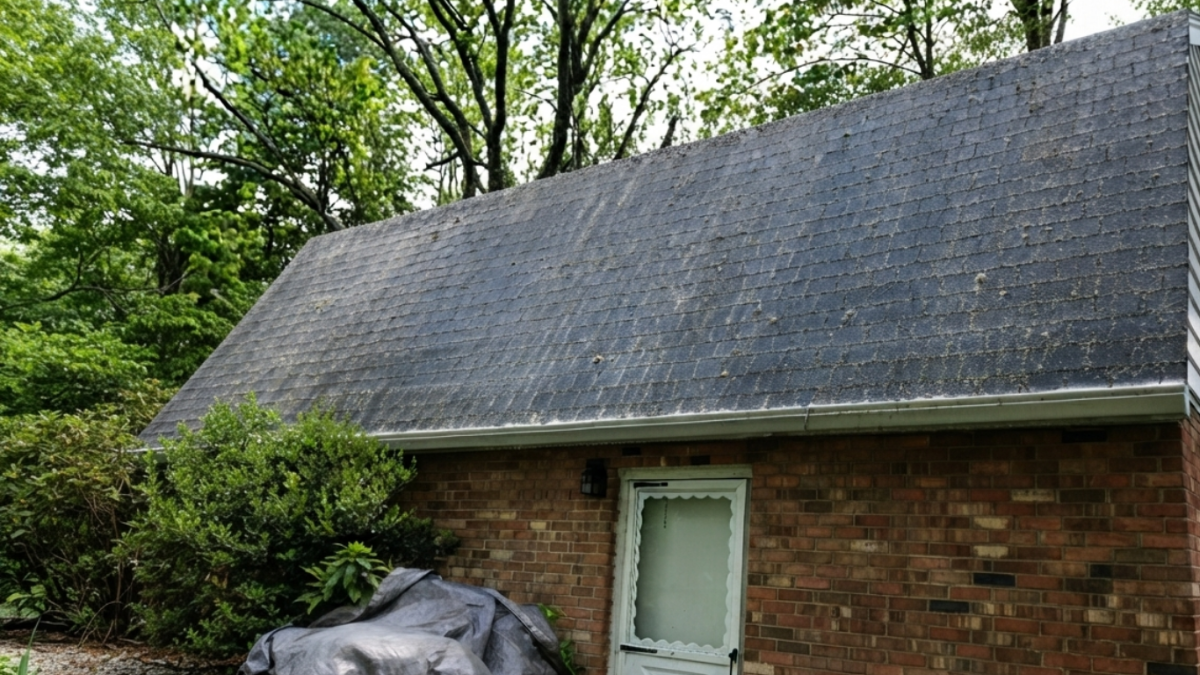
Then add central Connecticut humidity. Organic debris that stays damp does not just sit there. It composts. That is also the same debris that feeds algae and the black Gloeocapsa magma streaking you see running down roof planes here, which is why our roof cleaning work and gutter work usually turn up on the same house.
How Each Guard Type Fails, and What Beats It
Not all guards fail the same way. This is the section the manufacturers cannot write honestly, because each one is defending a product.
Micro Mesh
How it works: a fine stainless or aluminum screen over a frame. Water passes through, solids stay out.
What beats it here: pine pollen, shingle grit and needle fragments. Individually they are too small to notice. Together, wet and dried repeatedly, they felt into the weave and reduce it to a slow drip surface. Mesh is the best guard at keeping the trough clean and the easiest to blind over.
How to clear it: dry blower first, then a soft bristle brush pulled downward and off the front edge. If the mesh is truly blinded, a low volume hose from above with the brush working with the flow. No pressure, no scrubbing across the weave.
Perforated Aluminum and Screen
How it works: a solid panel with punched holes, or a simple screen over the trough.
What beats it here: oak tassels, hands down. Those thin stringy catkins thread partway through a hole, stand up on end, and catch everything else that lands. By June the run looks like it has a bird nest on it. Maple helicopters do the same trick with the stem.
How to clear it: it usually pulls off in a mat by hand or with a brush, which makes this the most DIY friendly type. Check the holes afterward for stems still standing in them.
Reverse Curve and Helmet Style
How it works: a solid hood that uses surface tension. Water clings around the nose and into a slot, debris is supposed to fall past.
What beats it here: small debris that follows the water into the nose slot, because that is what the design tells it to do. Needles and shingle grit end up inside the slot, and once they build up in there it is the hardest style to service. Heavy rain also causes overshoot, which we get to next.
How to clear it: generally you have to open or remove the hood, which most homeowners are not set up to do. This is the type where a service call actually makes sense.
Foam Inserts
How it works: a wedge of open cell foam pushed into the trough. Water soaks through, debris sits on top.
What beats it here: the foam does not trap debris on top so much as inside itself. It holds moisture constantly, which in our climate means it grows its own biology. We have pulled foam inserts out with seedlings rooted in them. Not a figure of speech.
How to clear it: pull the inserts, rinse or replace them, clean the trough underneath. Foam has a limited life. Plan on replacement, not cleaning.
Brush Inserts
How it works: a giant bottle brush laid in the gutter. Debris rests on the bristles.
What beats it here: pine needles weave into the bristles and functionally never come out. Under a pine, a brush insert becomes a damp sponge running the length of your house.
How to clear it: lift the whole brush out, shake and rinse it on the ground, clean the trough, put it back. Under heavy pine, honestly consider a different system.
Why Water Pours Over Even When the Guard Looks Clean
This one frustrates people the most, and there is a real physical explanation for it.
Reverse curve and hood style guards work by surface tension. Water clings to the curved nose and wraps around into the intake slot. That works beautifully in a normal rain.
Every one of those designs has a flow ceiling. Push more water across the nose than the curve can hold onto, and the sheet stops clinging. It launches straight off the front and lands in your beds. The guard is spotless. The gutter is empty. And you are watching a waterfall.
Central Connecticut summer downpours do this routinely. So does a roof valley dumping two planes worth of water onto one four foot section of guard.
Overshoot is not the only cause of overflow, though, so work through this before you blame the guards.
| What you see | Most likely cause |
|---|---|
| Overflow in every rain, guard visibly dirty | Debris mat on top, water cannot get in |
| Overflow only in heavy rain, guard clean | Surface tension overshoot, or a valley concentrating flow |
| Water backs up at one end, sits in the trough | Blocked downspout, or the underground outlet is plugged |
| Water standing along the whole run | Gutter pitch is off, often from sagging hangers |
| Water running behind the gutter onto the fascia | Guard mat plus a missing or misaligned drip edge |
| Overflow only in winter | Ice, covered below |
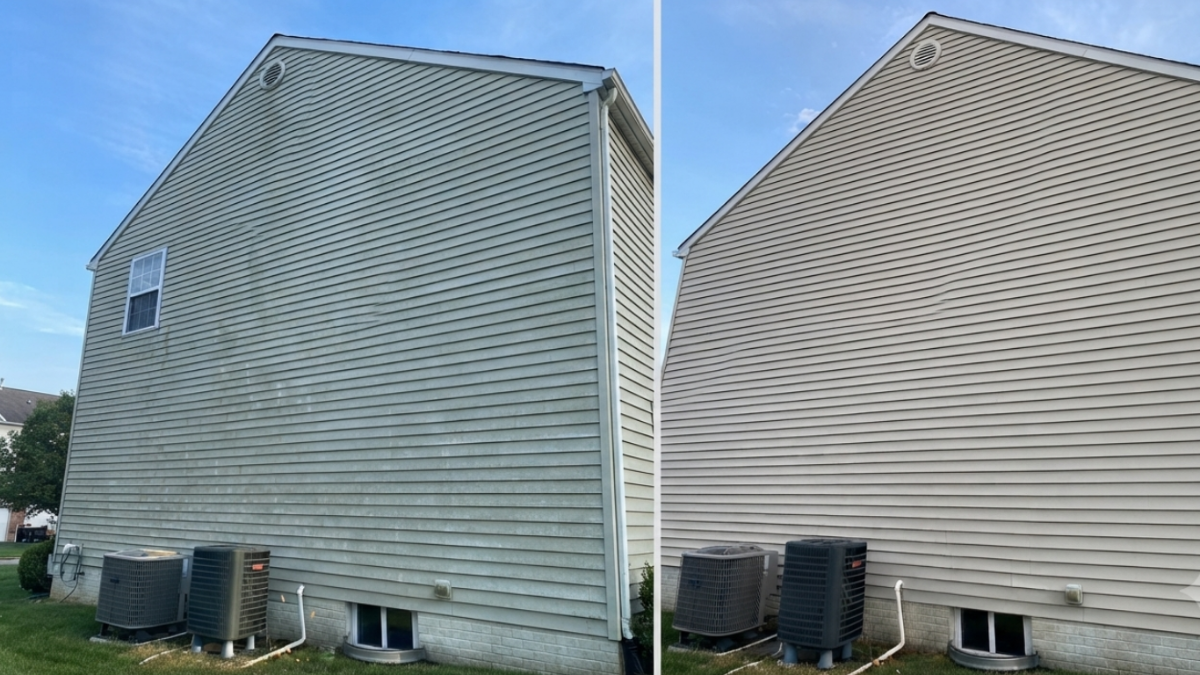
That last row matters more here than most places, and dark streaks running down your siding under the overflow point are the visible receipt. That staining is organic, it does not rinse off with a hose, and it is what soft wash house washing is for once the source is fixed.
The Winter Problem: When a Debris Mat Becomes an Ice Dam
We got a February call from a Wethersfield colonial. A solid line of icicles across the back gutter, and the homeowner was convinced the gutter itself had failed.
It had not. What was up there was a leaf mat, soaked from a November rain, frozen into a solid shelf on top of a perforated aluminum guard. It had turned a two inch wide gutter opening into a flat sheet of ice.
The sequence goes like this, and once you see it you cannot unsee it. Late fall rain soaks the debris sitting on the guard. The first hard freeze locks that wet mat onto the guard as one mass. Snow falls. Attic heat melts it from the roof side. Meltwater runs down and hits the frozen shelf, which has no opening. It backs up, works sideways under the shingle edge, and goes into the roof deck. The Insurance Institute for Business & Home Safety describes the same underlying chain: heat rising into the attic warms the roof deck, melts the snow sitting on it, and sends the water toward the cold eave where it refreezes.
That is an ice dam with a debris mat as the starting seed. Newington and Wethersfield housing stock makes it worse: shallow pitch, short soffits, and knee wall attics that leak heat straight up the roof slope.
The root cause on that colonial was not the guards and it was not the trees. It was timing. The fall cleaning had been done in early November, before the oaks finished dropping.
Why Late Fall Timing Matters More Than People Think
Maples are done by early November around here. Oaks are not. In a normal Hartford County season, oaks are still letting go well past Thanksgiving and into early December.
A gutter cleaned in October is a gutter that fills again before the first freeze. If you have oaks, the last pass has to come after they finish, and it has to come before the ground freezes hard. That window is narrow, and it is the single most valuable thing on this page.
If you would rather not find out in February, this is the part worth handling now. A free quote takes a few minutes.
How To Actually Clean Debris Off Gutter Guards
Assuming a single story or a safe, reachable second story, here is the method. This Old House’s guide to long-term gutter guard maintenance covers the same fundamentals if you want a second source before you climb up there.
What you need: a stable extension ladder, work gloves, a soft bristle brush on a pole, a leaf blower, a garden hose, and a tarp for the beds below.
Ladder Practice, Because This Is Where People Get Hurt
Level, solid footing. Nothing soft or sloped. Four to one angle, meaning the base sits one foot out for every four feet of height. Three points of contact at all times. Do not lean past your belt buckle, move the ladder instead. OSHA’s ladder safety guidance lays out these same load and angle requirements in more detail if you want the full standard.
And this one matters specifically for guards: never rest the top of the ladder on the guard itself. It will dent the panel, crush the mesh or pop the guard off its clips. Use a ladder standoff that bears on the roof or the fascia.
If it is a two story elevation, or the ground is not level, or the roof pitch is steep, stop. That is not a DIY job and no gutter is worth a fall.
Why We Will Not Pressure Wash Your Mesh
We own the machines. We use them every week. And a gutter guard is one of the very few places on a house where we will not point one.
Three reasons, all of them mechanical. It deforms the weave. Micro mesh is a fine screen held in a light frame. Concentrated pressure stretches and dishes it. Once the weave is distorted it filters worse, not better, and the dents hold debris.
It drives debris through instead of off. You are pushing the mat down into the trough, which is exactly the space the guard existed to protect. Now you have a clog you cannot reach without removing panels.
It voids warranties. A lot of guard warranties specifically exclude damage from high pressure equipment. Read yours before anybody points a wand at it.
Roman says it more bluntly than our marketing person would like: “We own the machine, and this is one of the few places on a house where I will not use it.”
For delicate surfaces the right tool is low pressure and the right chemistry, which is the whole idea behind soft washing. It is also why our pressure washing in Hartford CT work is built around matching pressure to the surface instead of turning everything up.
The Soft Brush and Blower Method
Work on a dry day. Wet debris smears, dry debris lifts.
Start with a leaf blower, aimed along the run and slightly downward, pushing debris off the front edge of the guard rather than across it. Most of a loose leaf load comes off in a couple of minutes.
What is left is the bonded layer. Take a soft bristle brush and pull downward, off the front lip of the guard. Never scrub side to side across a mesh weave, and never use a wire brush. Short strokes, light pressure, let the bristles do it.
Tarp the beds first. Everything you take off the roof is going to land on your hostas.
When Panels Come Off, and When They Should Not
Clip-in and snap-in panels lift out by hand and go back the same way. Fine to do yourself if you are already up there safely.
Screwed panels come off too, but note where every screw goes and do not overtighten going back. Stripped holes mean loose guards, and loose guards catch water behind them.
Guards tucked under the first course of shingles are a different story. Lifting shingles that are cold or brittle cracks them, and reseating them wrong invites a leak. Leave that type to somebody who does it regularly, or to the installer.
The Hose Test Nobody Bothers With
You are not done when it looks clean. You are done when water proves it.
Run a hose onto the roof above the guard at low volume first. Watch where the water goes. It should enter the guard and come out the downspout. If you see it running behind the gutter or dripping at the fascia, you have a drip edge or seating issue, not a debris issue.
Then open the hose to full flow and watch for overshoot. If it launches off the nose at high volume, you have found your heavy rain problem.
Last, check that the downspout is actually running. Put your hand on it. You should feel it. And if your downspouts tie into an underground line, walk to the outlet and confirm water is coming out the other end. Those silt up quietly.
Does Cleaning Your Guards Void the Warranty?
Not usually, but read your paperwork before anyone touches the guards, because the promise and the clause rarely match.
Most no clog or clog free warranties are performance promises, not maintenance waivers. In practice they commonly work like this:
The installer has to be the one who services it. Many guarantees include free callbacks. That is the service you already paid for.
You often have to give written notice. A phone call to a sales line may not count as a claim.
Third party panel removal is frequently excluded. Meaning if you or another contractor pulls panels, coverage on that section can end.
Pressure washing damage is usually excluded outright.
Transfer to a new owner is limited or prorated on a lot of lifetime products, which surprises second owners constantly.
Roman’s advice here costs us work and we say it anyway: “If the installer will come out free, call the installer.”
Call them first. If they will not come, or the guards are past warranty, or you no longer trust them, then bring in somebody neutral.
Should You Remove Your Gutter Guards?
We have no guard to sell you and no guard to defend, so here is the neutral version.
Keep Them If
Your canopy is deciduous and at moderate distance rather than directly overhead. The guard type actually matches your debris. Access is safe and you are willing to service them once or twice a year.
A matched guard genuinely earns its keep. It can turn four cleanings a year into one or two, and it keeps the trough itself clear, which is the part that causes real damage when it fills.
Service Them Differently If
Only one run is failing, or one elevation, or the section under a valley.
That is not a system failure. Put that run on a more frequent schedule and leave the rest alone. Most of the houses we service have exactly one problem corner.
Remove Them If
Heavy pine directly overhead with brush or foam inserts. That combination does not work here. Persistent overshoot on a steep roof, where the guard design and the water volume are simply mismatched. The guards are lifting the drip edge or the first shingle course. That is a roof problem now, not a gutter problem. The same failure has repeated three seasons running despite proper service.
We have told homeowners their guards were wrong for their trees. It is not a fun conversation. It is a better one than charging them twice a year forever for a system that was never going to work on that house.
Cost Reality: Annual Maintenance Versus Tearing It Out
Numbers move with house size, height, roof pitch and how bad the mat is, so treat these as typical ranges and get an actual quote.
| Path | Typical range | Notes |
|---|---|---|
| Routine guard servicing, average single family | Roughly one to one and a half times a standard gutter cleaning | Guards add time, panel handling and care |
| Removal plus open gutter cleaning | Removal labor plus a standard cleaning | One time cost, then normal cleaning frequency returns |
| Full new guard system | Highest by a wide margin, often several thousand on a full house | Only worth it if the current type is genuinely mismatched |
Run it over ten years, not one. Servicing a guard system you already own almost always beats replacing it, and it usually beats removal, because removal sends you back to three or four cleanings a year.
The exception is the mismatch case above. Paying to maintain the wrong system forever is the most expensive option on the list.
What a Guarded Gutter Still Needs Every Year in Central Connecticut
Three touchpoints, and you can skip one of them depending on your trees.
Late spring, roughly mid May to early June. After oak tassels and maple helicopters have finished. This is the pass almost everyone skips, and it is the one that prevents a summer of overflow.
Midsummer check, only if you have pine overhead. A quick look and a blow off. White pine sheds heavily and off schedule.
Late fall, early to mid December in Newington. After the oaks finish. This is the important one. It is what stands between you and the frozen shelf described earlier.
While you are booking that last pass, it is worth having the roof itself looked at. Matted debris in valleys and behind chimneys holds water and feeds growth, which is where roof cleaning comes in, and it has to happen before temperatures drop, because most washing chemistry stops working properly below roughly 40 to 45 degrees.
Frequently Asked Questions
Why is debris sitting on top of my gutter guards? Because that is where the guard puts it. A guard keeps debris out of the trough, but it becomes a shelf that debris lands on instead. Wet leaves bond to the surface, and shingle grit works into the weave and holds everything else in place.
Do gutter guards still need to be cleaned? Yes. Guards reduce how often you clean and change what you are cleaning, but no guard eliminates maintenance. Most guarded gutters in central Connecticut need one to two services a year, plus a check if there is pine directly overhead.
Can you pressure wash gutter guards? No. High pressure deforms mesh weave, drives debris down into the trough rather than off the guard, and is excluded by most guard warranties. Use a leaf blower on dry debris and a soft bristle brush pulled downward off the front edge instead.
Why does water run over my gutters even though the guards look clean? Usually surface tension overshoot. Reverse curve and hood guards rely on water clinging around the nose, and every design has a flow ceiling. In a heavy downpour the sheet stops clinging and launches past the gutter. A roof valley concentrating flow makes it worse.
Do pine needles get through gutter guards? Needle fragments get into micro mesh and weave permanently into brush inserts. Whole needles usually sit on top of perforated and hood style guards. Pine is the hardest debris on guards in this region, and brush and foam inserts handle it worst.
How often should gutter guards be cleaned in Connecticut? Plan on late spring after tassel and helicopter drop, and again in early to mid December after the oaks finish. Add a midsummer check if you have white pine overhead. Cleaning in October is too early here because oaks hold leaves into December.
Do gutter guards cause ice dams? Guards do not cause ice dams, attic heat loss does. But a wet debris mat sitting on a guard can freeze into a solid shelf that seals the gutter opening, so meltwater backs up under the shingle edge. Clearing debris before the first hard freeze prevents that.
Should I remove my gutter guards? Keep them if the type matches your trees and access is safe. Remove them if you have heavy pine overhead with brush or foam inserts, persistent overshoot on a steep roof, guards lifting the drip edge, or the same failure three seasons running despite proper service.
Does cleaning my own gutter guards void the warranty? Not always, but many clog free warranties require the installer to perform the service, require written notice of a claim, and exclude third party panel removal and pressure washing damage. Read your paperwork and call the installer first if free callbacks are included.
How much does it cost to clean gutters that have guards? Typically somewhat more than a standard gutter cleaning, because guards add time and panel handling. The exact figure depends on house size, height, roof pitch and how bonded the debris is. Ask for a quote that specifies whether panel removal is included.
Get It Looked At Before Winter
We do not sell gutter guards and we do not install them, which means we have nothing to defend when we tell you what is actually on yours.
What we do is get up there, clear the mat off the guards without damaging them, check the trough underneath, run the downspouts and the underground outlets, and tell you plainly whether your system is working for your trees or fighting them. If your installer should be handling it under warranty, we will tell you that too.
See more of our work on the blog, read what neighbors have said in our reviews, or learn more about us. Book your fall gutter cleaning in Newington after the oaks finish dropping and before the first hard freeze, or get a free quote and we will take a look at what you have.
Mr-Suds Washing, Newington, CT. Licensed, bonded and insured. Call (860) 263-9031.