
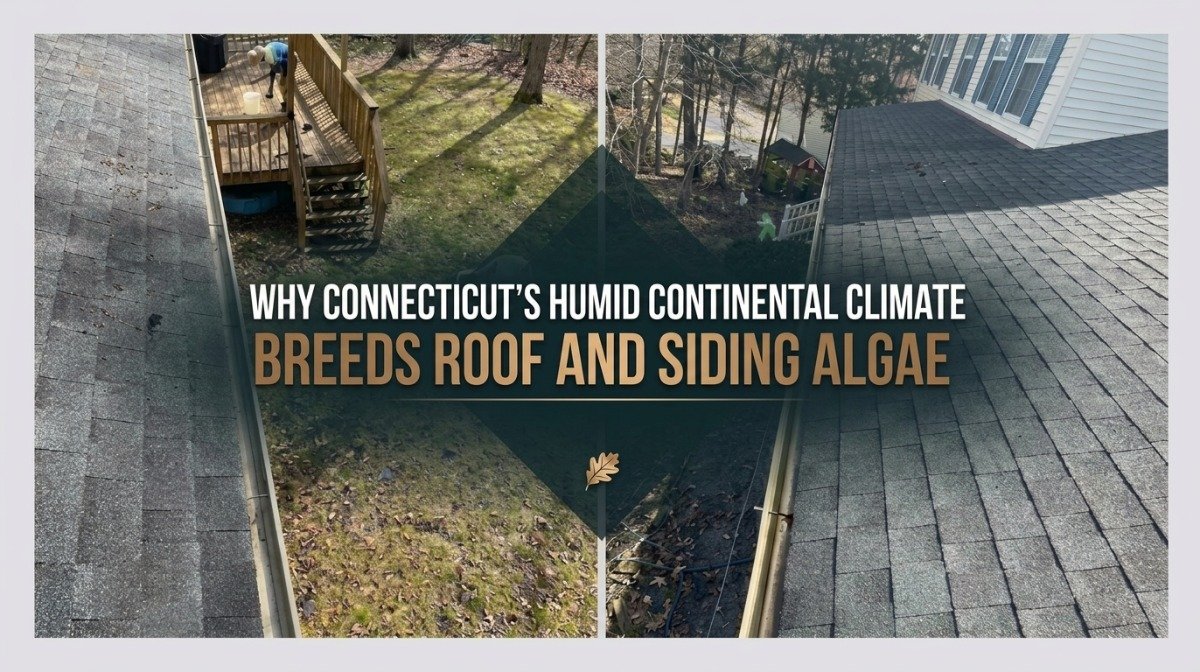
We pulled into a driveway in Newington early one morning in late summer, and the roof was wet. It had not rained overnight.
The homeowner came out and pointed at the dark streaks running down from the ridge, then at the green film on the north wall. “Is that dirt, or is my roof going?”
It was a fair question. That wet roof at 8 a.m. explains most of the roof and siding algae we clean in Connecticut.
It is not dirt, and in most cases the roof is not failing. Connecticut roof algae has more to do with where your house sits than with how you look after it.
Below I will walk through what is growing, why the Hartford area grows so much of it, and how we take it off without hurting shingles or siding.
Why does Connecticut grow so much roof and siding algae?
Roof and siding algae thrive in Connecticut because the Hartford area has a humid continental climate: muggy summers, about 47 inches of rain spread through the year, and frequent heavy dew. Roofs and shaded siding stay damp for hours each day, so airborne algae, mold and lichen settle in and spread.
The short version:
- Warm, humid summers (a Koppen Dfa climate)
- Rain in every month, about 47 inches a year in Hartford (NOAA 1991 to 2020 normals)
- Humidity that runs highest in late summer and early fall
- Clear nights that cool roofs and leave dew behind
- Algae cells drifting in from neighboring roofs and trees
- Shade and tree cover that slow drying
Our roof cleaning service page covers the service side. This article is the why.
What is actually growing on your roof and siding?
Not everything dark on a house is the same organism. Before we spray anything, we figure out what we are looking at.
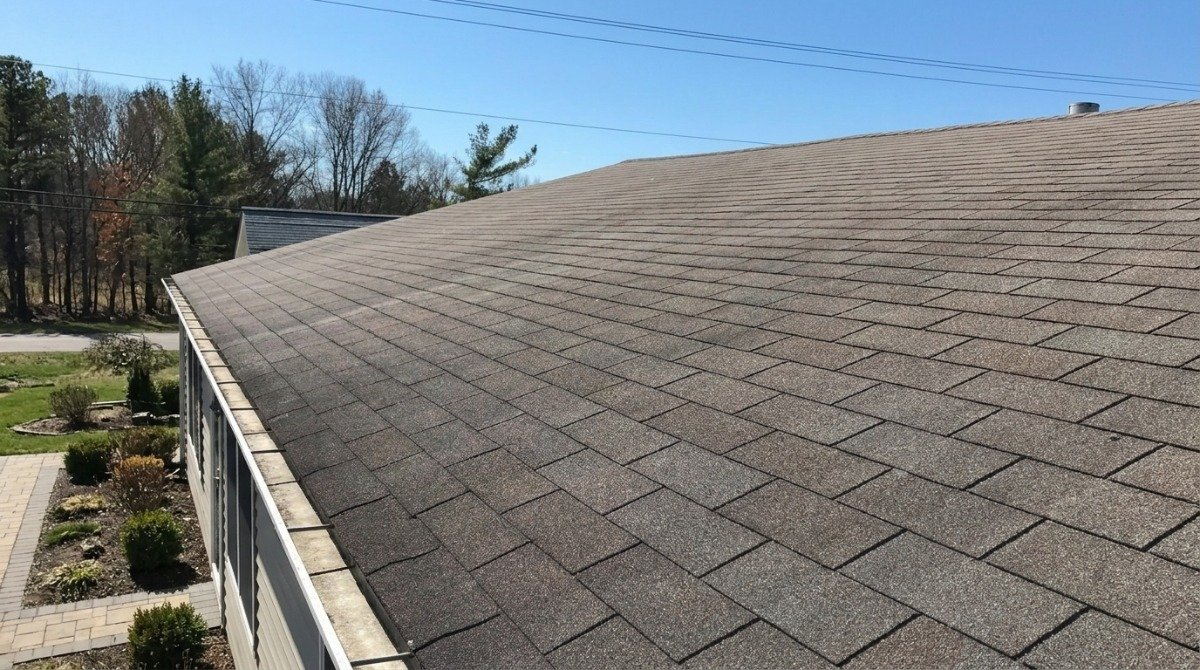
Black streaks on shingles: Gloeocapsa magma
The Asphalt Roofing Manufacturers Association names Gloeocapsa magma as probably the most prevalent of the algae species behind roof discoloration. Technically it is a cyanobacterium, often called blue green algae.
The cells build a dark outer coating to shield themselves from UV light. That is why the stain looks black or dark brown instead of green.
It shows up best on light gray, tan and white shingles, common on mid century capes and ranches here. A widely cited explanation is that limestone filler in many shingles gives it extra food, though that link is not fully settled. From here on I will just call it the black roof algae.
Green film on siding: green algae
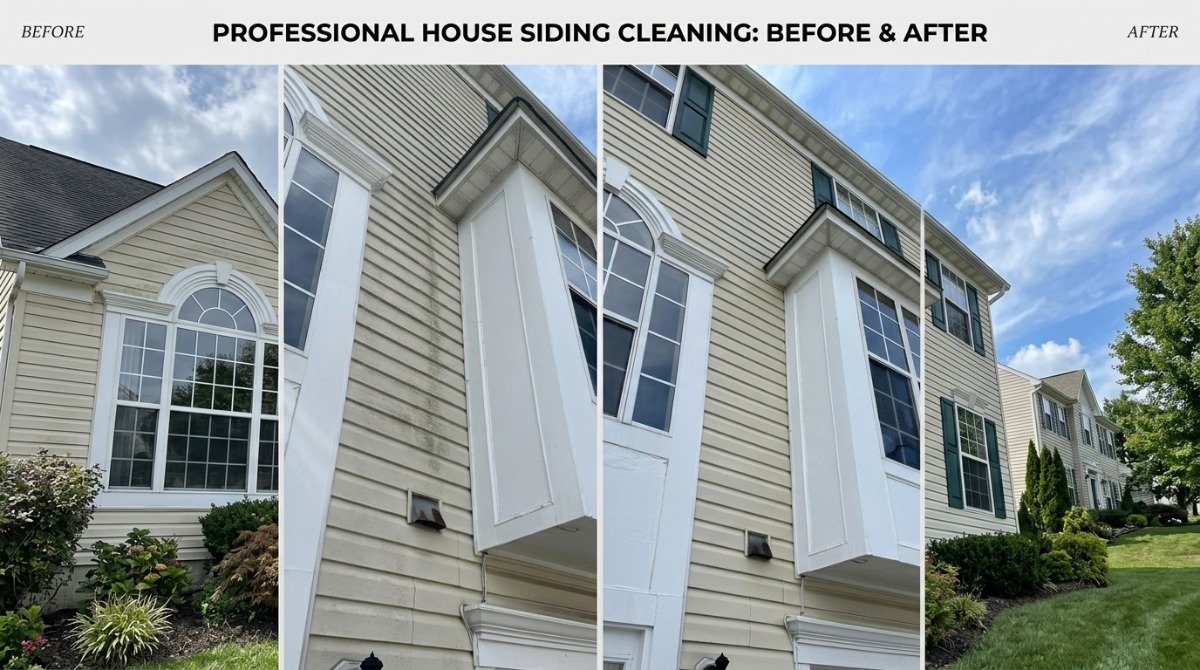
The green or yellow green cast on vinyl, aluminum and painted siding is usually ordinary green algae. It sits low on walls, on the north side, behind shrubs and under decks.
It needs the same three things as the roof organism: light, water and time. We have a fuller piece on green algae on north facing walls if that is the wall you are looking at.
Gray and black speckles: mold and mildew
Mold and mildew are fungi, not algae. They do not use sunlight; they feed on the dust, pollen and plant residue that settles on siding and trim.
Mildew is the flat, powdery kind; mold can look fuzzy and darker. Both love a damp Hartford summer.
Crusty patches and green cushions: lichen and moss
Lichen is a partnership between a fungus and an alga or cyanobacterium. It grips tightly and looks like flat gray green or pale yellow spots.
Moss is a small plant that holds water like a sponge. On roofs it starts in valleys, along the lower edge and under branches. Lichen and moss are the ones that can loosen granules, so they matter more for roof life.
Quick identification table
| Growth | What it looks like | Where it shows up on a Central CT house | What it is | Does it harm the surface |
| Gloeocapsa magma | Black or dark brown vertical streaks | Upper roof planes, below the ridge | Cyanobacterium | Mainly cosmetic, but holds moisture and helps lichen start |
| Green algae | Green or yellow green film | North siding, lower walls, fences | Algae | Cosmetic, stains and can make surfaces slippery |
| Mildew | Gray or black speckles | Siding under eaves, trim, soffits | Fungus | Cosmetic, stains paint |
| Mold | Fuzzy dark patches | Damp shaded wood, decks, fences | Fungus | Can break down wood fibers over time |
| Lichen | Crusty flat spots | Roofs, fences, stone | Fungus plus alga | Grips tightly and can loosen granules |
| Moss | Green cushions | Roof valleys, lower edges, shaded slopes | Plant | Holds water and can lift shingle edges |
What does a humid continental climate mean for a house in Hartford?
Hartford is a Koppen Dfa climate
The Koppen climate classification puts Hartford in the Dfa group, a hot summer humid continental climate. The letters break down simply:
- D means cold winters
- f means no dry season
- a means hot summers, with the warmest month averaging above about 72 F
In practice, July highs sit in the mid 80s F and January highs in the mid 30s. Winter slows algae and mold down, but it does not wipe out the colony. Come spring, growth picks up where it left off.
About 47 inches of rain, spread through every month
NOAA’s 1991 to 2020 normals put Hartford at about 47 inches of precipitation a year. There is no dry month. Even February, the driest, averages a little over 3 inches.
The wettest stretch runs June through October, roughly 4.2 to 4.5 inches a month. That is exactly when it is warm enough for growth to move fastest.
Hartford monthly precipitation (NOAA 1991 to 2020 normals)
| Month | Average precipitation (inches) |
| January | 3.27 |
| February | 3.12 |
| March | 3.80 |
| April | 3.88 |
| May | 3.79 |
| June | 4.28 |
| July | 4.17 |
| August | 4.21 |
| September | 4.38 |
| October | 4.52 |
| November | 3.51 |
| December | 4.08 |
| Annual | 47.00 |
Source: NOAA normals as compiled by Extreme Weather Watch.
Humid mornings: why late summer is peak growing season
Average humidity at Bradley International Airport climbs through summer and peaks in late summer and early fall. Mornings run much damper than afternoons, because the air cools overnight.
The dew point is the temperature at which air can no longer hold its moisture and water condenses. Once summer dew points reach the upper 60s F, the air feels sticky, and Central Connecticut gets long runs of those days.
I see the result on our own schedule. By September and October we notice the most fresh streaking and green film, and that is when roof calls pick up.
Dew: why your roof is wet when it did not rain
This is the driveway question from that Newington morning. On a clear, calm night, a roof radiates heat up to the open sky and can cool below the air around it.
When the shingle surface drops below the dew point, water condenses right on it. Thin, exposed shingles are often the first surface on a property to get wet.
That happens on many summer and fall nights here, giving algae a daily drink even in a dry spell.
Why do the black streaks spread down the roof and across the street?
Gravity and rain pull the colony downhill
A colony usually starts near the top of a roof plane, where dew sits and the first cells land. Rain and dew runoff carry cells down the slope, which creates the long vertical streaks.
Below a chimney with copper or galvanized flashing, there is often a cleaner stripe, because metal washing down with the rain slows growth.
Algae travels on the wind, birds and squirrels
ARMA notes that these algae species are transported through the air. Once one roof on a street is heavily stained, the roofs around it are exposed too.
On tightly spaced streets of postwar homes in Newington and Wethersfield, I often see several houses in a row with the same streaking on the same roof face.
Shade and trees make it worse
North facing slopes and walls under trees dry last, so they grow first. Our mature tree canopy multiplies what the climate is already doing.
That is really its own topic, so I will keep it short. If growth sits on only one side of your house, this piece on why green algae came back on the north side only explains why that is normal.
Is roof algae actually hurting my roof and siding?
On shingles: mostly cosmetic, until lichen and moss move in
ARMA treats this discoloration mainly as an appearance issue. Most roofs we see with black streaks are structurally fine.
The catch is that a damp, stained roof makes a better home for lichen and moss. Pulling those off by force can tear granules away, and in heavier cases moss can lift the shingles at the edges.
If your shingles were sold as algae resistant, check the warranty paperwork, since that coverage has often been limited.
Gutters matter too. Clogged ones keep the fascia and lower roof edge wet, right where moss likes to start, so regular gutter cleaning removes one more moisture source.
On siding, paint and trim
Green algae and mildew stain vinyl and painted surfaces. Left for years, they dull paint and make a house look tired.
Steps under the drip line can turn slippery. And if you are selling, inspection reports commonly mention “organic growth” on roofs and siding. A regular house washing in Newington or nearby keeps the walls ahead of it.
How does the climate change the picture going forward?
UConn’s climate researchers expect tropical nights, when the low stays above 68 F, to go from fewer than ten a year in the 1950s to around 45 a year by 2050. They also project a growing season 10 to 20 days longer by mid century, with more intense rainstorms.
Warm nights keep surfaces comfortable for algae for more hours a day. That is not cause for alarm; it just means roof cleaning here is maintenance, not a one time fix.
Practical Example: What we found on a Newington roof last season
The walk around before anything gets sprayed
Before anyone unrolled a hose, I walked the property with the homeowner. It was a mid century cape with light gray architectural shingles and vinyl siding.
The black roof algae ran in long streaks down the north facing plane, heaviest under the ridge. A few lichen spots sat near the lower edge. The north wall had a green film, thickest behind the shrubs.
The shingles still had plenty of life left, and I told the homeowner so first.
Why we did not bring out the pressure washer for the roof
ARMA is direct: do not use a power washer or any kind of brush on roof algae, because high pressure can damage asphalt roofing. It knocks granules loose, pushes water under the tabs and often leaves part of the colony alive.
We have written about what to do after a roof cleaner used high pressure and about black streaks that returned within a year. As I often put it, “Low pressure paired with eco friendly solutions removes mold and algae at the source.”
The soft wash, step by step
- We soaked the shrubs and beds with plain water first and covered the most delicate plants.
- We applied the cleaning solution to the roof at low pressure, so it soaked into the colony.
- We let it dwell long enough to work, then rinsed gently.
- The siding got its own milder mix and rinse, as with most vinyl siding cleaning we do.
- We rinsed the plants again at the end.
That is what soft washing in Newington looks like for us. The solution kills the cells and their dark coating instead of just rinsing off the top layer.
What the homeowner saw after, and what we told them about next time
The siding looked clean the same day. The roof looked much lighter right away, and when we checked back a few weeks later, the leftover shadow had faded off as rain cleared the dead material.
Then the honest part. With this much dew, regrowth is a matter of time, and ARMA itself says the effect of cleaning is temporary. How soon it returns depends on shade, roof direction and nearby trees.
If your roof has the same streaks or your north wall has gone green, we are happy to come take a look. We are based on Dewey Ave in Newington, we serve Hartford and the surrounding towns, and first time house cleaning customers get 15 percent off. Call (860) 263-9031, and I or someone from the crew will walk the property with you before anything gets sprayed. You can also read about our roof cleaning in Newington.
What we see across Newington, Hartford and Central Connecticut
Postwar capes and ranches with light shingles
Many Newington and Wethersfield neighborhoods went up in the 1950s to 1970s. Plenty have been reroofed with light gray or tan shingles that show streaking clearly.
“Newington homes cover a wide range of ages and building materials, and each surface calls for a slightly different approach.” That is why we look closely before choosing a mix.
The river valley factor
Hartford sits in the Connecticut River Valley, which tends to run hotter in summer than the shoreline. Warm days followed by humid nights suit these organisms well. How inland homes compare with coastal ones is a topic for another day.
Towns we serve where this shows up most
Our crew works across Hartford, Newington, Wethersfield, Rocky Hill, Glastonbury, Bloomfield, Avon, Farmington, Simsbury, Berlin, East Berlin, Cromwell, Middletown, Southington, Cheshire, Plainville, Portland and Wallingford. In the city itself, see our page on soft washing in Hartford.
The heaviest streaking I see is on wooded lots and north facing slopes in older neighborhoods.
FAQ
What causes black streaks on roofs in Connecticut?
Mostly a cyanobacterium called Gloeocapsa magma. It travels through the air and settles on shingles. Humid summers, about 47 inches of yearly rain and frequent dew keep roofs damp enough for it to grow. It is not dirt, and on its own it does not mean the shingles are failing.
Is roof algae harmful to my shingles?
ARMA treats it mainly as a cosmetic issue. The bigger concern is what follows: a damp, stained roof is a good home for lichen and moss, which hold water and can loosen granules. That is why it is worth removing gently.
Can I pressure wash algae off my roof?
We do not recommend it. ARMA warns that high pressure can damage asphalt shingles by stripping granules and forcing water under the tabs. Soft washing at low pressure with a cleaning solution is the safer method.
Why does algae come back after cleaning?
Because the conditions stay the same. Cleaning resets the roof, but the climate, the dew and the algae drifting in from nearby roofs are still there. How fast it returns depends mostly on shade, trees and roof direction.
Is the green on my siding the same as the black on my roof?
Related, but not the same. Green on siding is usually green algae, and black speckles are often mildew, a fungus. They share a moisture driver but call for different mixes, which is why siding cleaning is handled separately from the roof.
Do zinc or copper strips stop roof algae?
They can help. Rain washes metal ions down the roof, which slows growth, which is why clean stripes show up below copper flashing. The effect is strongest just below the metal and weaker further down a long slope. Algae resistant shingles use copper granules for the same reason.
Is soft washing safe for plants and pets?
With care, yes. Plants should be soaked before the solution goes on and rinsed again after, with a controlled, low pressure application. Keep pets inside until everything is rinsed.
When is the best time of year to clean roof algae in Central CT?
Late spring through fall works well, when surfaces are warm and the solution works best. Many homeowners book after the late summer peak, when streaks are most obvious. Feel free to reach out to us to talk about timing.
Keeping roof and siding algae in check
Connecticut’s climate is not going to change its habits, but your roof and siding do not have to show it. Roof and siding algae is a sign of where you live, not of anything you did wrong.
If you are in Hartford, Newington or any of the Central Connecticut towns we cover, call Mr-Suds Power Washing PROs at (860) 263-9031. We are licensed, bonded and insured, we carry a 5.0 rating on Google, and we will look at every surface before we choose how to clean it. First time house cleaning customers save 15 percent.