
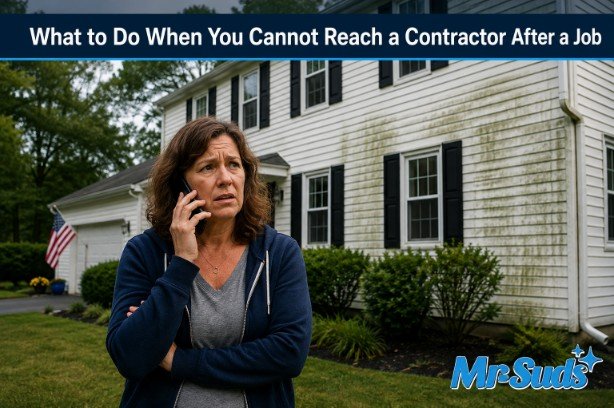
A homeowner in one of the outer towns had the house washed in late spring. Three weeks later the shaded north elevation had greened up again and a gutter end cap was hanging loose. She called the number on the invoice four times over eight days. By the fourth call the voicemail box was full.
The calls I get about this are almost never from my own customers. The first thing I ask is whether they still have the contract.
The short answer
Act in this order. Start a dated written record today. Send one certified mail demand with a firm deadline. Call your card issuer about a dispute before that window closes. Then file with the Connecticut Department of Consumer Protection. The state Guaranty Fund comes last, because it requires a court judgment first.
This is general information rather than legal advice. If real money is at stake, get advice on your own situation.
Before you escalate: is this a callback or a defect
Worth two minutes before you spend two months, because the answer changes which route you take.
What a legitimate callback covers
A spot missed. Streaking that only shows once the surface has fully dried. Organic growth returning far sooner than the company told you it would. Something knocked loose during the work: a screen, a downspout, a light fixture, a gutter hanger.
These happen on real jobs, including mine. A company that answers the phone about them is behaving normally, and none of it makes them a bad company.
What is usually not a callback
Algae coming back on a heavily shaded north wall after a full season. That elevation sits under trees, stays damp longer and greens back faster than the sunny side of the same house. It is physics, not workmanship.
Chalky oxidation on old vinyl or aluminum that was already chalky before the wash. Old deck sealer failing when it was at the end of its life anyway. Concrete that cleaned unevenly because the staining is in the slab rather than on it.
A good company sets these expectations in writing before the job. If nobody ever told you, that company owns part of your disappointment even though the surface is behaving as expected.
And what is a damage claim
Different category, different route.
Water pushed through a failed window seal. Torn screens. Etched or striped soft metal. Plantings burned by solution that was not rinsed. Chipped mortar or wood raised by too much pressure.
This is where “licensed, bonded and insured” stops being a slogan. Damage goes to the company’s general liability carrier, so ask for the carrier name and policy number. A contractor who will not give you that is telling you something.
Step one: build the paper trail today
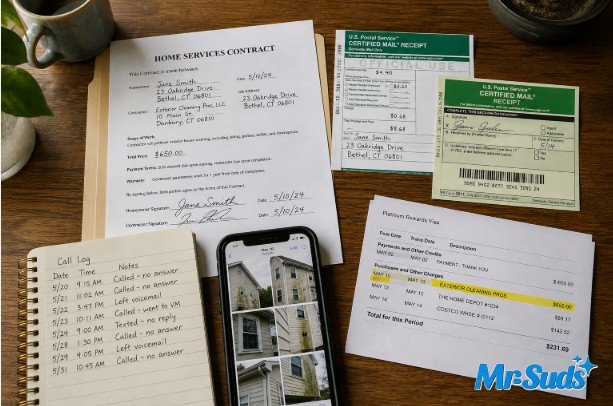
The six things to gather
- The signed contract or written estimate showing scope and dates.
- Every text and email, kept in one thread.
- A written call log: date, time, number dialled, outcome.
- Proof of payment: the card statement line, a cancelled check image, or the receipt.
- Photos of the current condition, taken in similar light to the originals, with the date metadata intact.
- Any advert, quote or web page where the company stated a warranty period.
How to write the call log
Paper or a plain text file. One line per attempt, written the same day.
A log kept as things happen carries real weight in a small claims setting, costs nothing, and is the item almost nobody keeps.
Photograph the way an adjuster would
Four shots. A wide one for context, a mid shot of the elevation, a close shot of the defect, and one with a familiar object in frame for scale.
Shoot at the same time of day as the original photos if you can. A wet surface and a dry surface look like different houses.
Step two: one written demand with a deadline
Certified mail, return receipt requested
In a texting era this still matters, because it produces a third party record that something was delivered to the contractor’s address of record.
That is the address on the contract and the address on the registration. If they are different, send to both.
What to put in the letter
Six things: the contract date and job address, what was agreed, what is outstanding, the specific remedy you want, a response deadline, and a plain sentence about what you will do if it passes.
Ten to fourteen days is the common response window.
What to leave out
Threats, insults, inflated damage claims, and any number you cannot document.
This letter often ends up in front of a magistrate or a reviewer at a state agency. Its tone becomes part of your case, so write it like someone reasonable is going to read it, because someone reasonable probably will.
Step three: protect the money before the window closes
This is the step people do last and should do early.
Card disputes are the fastest-closing door
Card dispute rights are time-limited, and the clock runs from the transaction or delivery date depending on the type of claim. Issuers also set their own procedures.
So do not save this for after everything else. Call your issuer’s dispute line now and ask two questions: what is my deadline on this transaction, and what documentation do you need.
A dispute can reverse a charge for work not performed or not as described. It cannot help at all with cash, a check or a bank transfer.
Debit, check and cash
Debit card protections are generally weaker and shorter than credit card protections.
A cashed check proves you paid but gives you no reversal route. Cash gives you almost nothing, which is exactly why a contractor pushing a cash discount on a deposit is a signal worth reading.
One related check. In Connecticut, house washing is a taxable maintenance service on residential property under Department of Revenue Services guidance, at 6.35 percent, so a residential invoice with no sales tax line is worth asking about. A company working off the books tends to leave no paper trail anywhere else either.
Withhold payment carefully
There is a difference between withholding payment for work that was not performed and simply breaching your own side of the contract.
The safer posture is to say in writing why you are withholding, tied to a specific unmet obligation, rather than going silent in return. Section 20-429 of the General Statutes also requires any change to a home improvement contract to be in writing and signed by both parties, so nothing that was agreed verbally after the fact does much for either side.
Step four: the Connecticut escalation path
Verify the registration first
Take the exact business name from the contract and search it on the state eLicense portal.
Do this before anything else downstream. Registration status is a condition of the Guaranty Fund later, and unregistered home improvement work is a separate problem in its own right.
File with the Department of Consumer Protection
File online with the contract, receipts, permits and written accounts of the conversations attached.
It creates an official record, it can prompt DCP to contact the contractor, and it feeds the pattern the state relies on when it starts publicly asking for complaints about a repeat offender.
It is not a payment mechanism. A complaint on its own will not return your deposit, and you should plan around that rather than wait on it.
Connecticut small claims
Small claims is built for people representing themselves, and it produces a judgment. The judgment is what unlocks everything after it.
Confirm the current dollar limit with the Connecticut Judicial Branch before you file, because the ordinary consumer limit and the limit for home improvement contract claims are not necessarily the same figure.
Home Improvement Act violations are also commonly pleaded alongside claims under the Connecticut Unfair Trade Practices Act, Section 42-110a and following, which is why some homeowners consult an attorney even on a modest claim.
The choice of court matters more than people realise
Here is the detail that almost nobody publishes.
A Superior Court or Federal Court judgment requires a failed collection attempt through a state marshal’s writ of execution before a Guaranty Fund application will be considered. A small claims judgment does not require that step.
If your real goal is the Fund rather than collection, the smaller forum can be the faster road. Confirm the current requirements with DCP before you choose.
The Home Improvement Guaranty Fund, in full
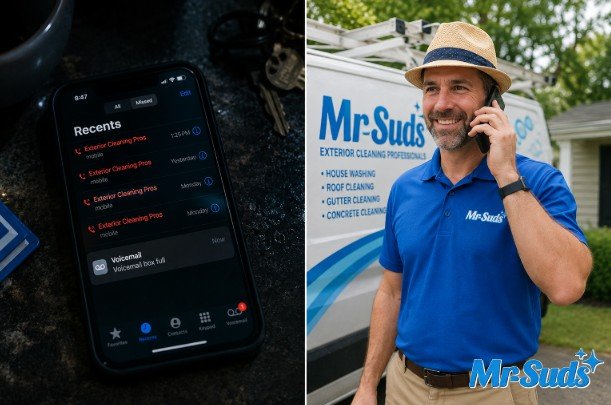
Back to that full voicemail box for a moment. By the time a homeowner reaches the point of applying to this Fund, the clock they needed to start usually started months earlier. That is why the deadlines below matter more than the dollar figure.
What it is
The Fund is administered by the Department of Consumer Protection, paid for out of contractor registration fees, and established under Section 20-432 of the General Statutes.
The right mental model: it is not insurance and it is not a complaint desk. It is a last-resort reimbursement fund that pays against a court judgment the contractor has not satisfied.
The conditions, stated plainly
- You hold a court judgment against the contractor.
- The contractor was registered either when the contract was signed, within two years after signing, or at the time of judgment.
- The work was on residential property: a single or multifamily dwelling of six units or fewer, a condominium, or a cooperative.
- The contract price was more than 200 dollars.
- The application is filed within two years of the judgment.
- New home construction is not covered.
Eligibility questions go to dcp.guarantyfunds@ct.gov.
What it pays and how long it takes
Up to 25,000 dollars for actual damages, court costs and attorney’s fees as ordered in the judgment.
Processing can take up to 24 weeks. Those two numbers belong in the same sentence, because the second one is the part nobody is told in advance.
The eligibility table
| Condition | What it means for you |
|---|---|
| A court judgment first | A complaint to DCP is not an application. You need a judgment. |
| Registration timing | Registered at signing, within two years after, or at judgment. Check eLicense early. |
| Residential property | Six units or fewer, a condominium or a co-op. New home construction is excluded. |
| Contract price over 200 dollars | Very small jobs fall outside the Fund entirely. |
| Filed within two years of judgment | The deadline runs from the judgment, not from the job. |
| Court chosen | Superior or Federal Court judgments need a failed marshal’s writ of execution first. Small claims does not. |
| Payout and timing | Up to 25,000 dollars for actual damages, court costs and fees as ordered. Up to 24 weeks to process. |
The mistakes that disqualify people
Waiting past the two year filing deadline. Assuming a DCP complaint is the same thing as an application. Never checking whether the contractor was registered at any of the three qualifying points. Work on a property that falls outside the residential definition. Accepting a partial settlement that extinguishes the judgment without understanding what that does to the claim.
None of that is legal advice. It is simply where people get caught.
What a real callback policy looks like
The opposite of a full voicemail box is not a promise. It is a phone that gets picked up.
On our jobs I answer the phone myself, because there are not enough layers between me and the truck for it to work any other way. A callback request gets a date, not a maybe. If a spot was missed or something got knocked loose during the work, that is ours and we come back.
If the regrowth is on a shaded north wall eight months later, I will tell you that on the phone rather than schedule a visit and then argue about the bill. Registration and insurance details go out on request without a pause.
Here is the honest counterweight. In peak season a callback might get answered on day two or three rather than the same hour. June and July each average around ten days with precipitation here, and a rained-out week compresses the next one badly.
Busy and gone are different things. Busy answers on day three. Gone does not answer in three weeks.
How to hire so you never need this article again
Five checks before you pay anything
- Verify the registration on eLicense against the exact business name on the contract.
- Confirm the contract carries the transaction date, start date, completion date and cancellation notice, as Section 20-429 requires.
- Ask for the general liability carrier and confirm the coverage is live.
- Pay the deposit by credit card, never cash.
- Get the callback policy in writing before the crew arrives.
What to read in the reviews
Do not read the five star praise. Search the reviews for the words “came back,” “returned,” “after” and “warranty.”
Post-job behaviour is the thing that predicts this problem, and it is visible in review text if you look for it specifically.
Frequently asked questions
What should I do first if a contractor stops answering after the job? Start a dated written record the same day, then call your card issuer about the dispute window before it closes. Those two steps cost nothing and both get harder the longer you wait.
How long should a contractor take to respond to a callback request? Same day is ideal, two or three days is normal in peak season. Silence past a week, with no reply to a text or an email either, is a different problem from being busy.
Can I dispute a credit card charge for work that was done badly? Often yes, for work not performed or not as described, but the window is time-limited and set by your issuer. Call the dispute line and ask what your deadline is on that specific transaction rather than assuming a number.
Do I need a lawyer to sue a contractor in Connecticut? Not for small claims, which is designed for self-represented people. Larger disputes, or claims pleaded under the Connecticut Unfair Trade Practices Act, are where people usually get advice.
What is the Home Improvement Guaranty Fund and who qualifies? A last-resort reimbursement fund run by the Department of Consumer Protection. It requires a court judgment, a contractor registered at signing, within two years after, or at judgment, residential property of six units or fewer, and a contract price over 200 dollars.
How much can the Guaranty Fund pay and how long does it take? Up to 25,000 dollars for actual damages, court costs and attorney’s fees as ordered in the judgment. Processing can take up to 24 weeks.
Does a Department of Consumer Protection complaint get my money back? Not by itself. It creates an official record and can prompt DCP to contact the contractor, but it is a regulatory route, not a payment route. Money comes from a dispute, a settlement or a judgment.
Is a contractor responsible for damage caused during pressure washing? Damage caused by the work is normally a general liability matter. Ask for the carrier and policy number. That is different from a surface behaving as an aged surface behaves, which is not a damage claim.
What if the contractor was never registered in Connecticut? Then the Guaranty Fund route is closed, because registration at one of the three qualifying points is a condition. A card dispute and small claims are still open to you, and the lack of registration is worth reporting to DCP.
When you are ready to hire someone who answers
I am not going to invent an ending for the homeowner with the full voicemail box.
What I can tell you is what that same call sounds like here. It gets answered. We ask for the invoice date and a photo. Then you get one of two things: a date for us to come back, or an honest explanation of why the regrowth is not a workmanship issue. Both answers come on the phone, that day.
That includes work another company did. If you want a second opinion on a wash that did not hold, call and describe it.
Mr-Suds Power Washing PROs is based at 130 Dewey Ave in Newington and covers eighteen towns across central Connecticut including Hartford, Wethersfield, Rocky Hill, Berlin, Farmington and Glastonbury. Licensed, bonded and insured, 5.0 across roughly 39 Google reviews, open Monday to Friday 8am to 4pm with weekends by appointment.
Call (860) 263-9031 or email roman@mr-suds.com. First house cleaning service is 15 percent off.