

A homeowner on a street of 1960s colonials called us late last spring, after the wash was already done by somebody else. She was not calling to complain about the work. She was holding a handwritten invoice with a single number on it, and she wanted to know whether that was normal.
It is a better question than it sounds, and it has a checkable answer.
The short answer
Connecticut treats house washing as a taxable maintenance service on residential real property, at the 6.35 percent sales and use tax rate, and all maintenance services to commercial or income producing property are taxable. So a residential exterior cleaning invoice should normally show sales tax as its own line. If yours does not, ask about it.
Three things to do with that:
- Check whether the document is a final invoice, and whether the total is meant to be tax-inclusive
- Ask one polite question rather than making an assumption
- Remember the authority here is the Department of Revenue Services, not the contractor and not this page
Is exterior cleaning taxable in Connecticut
What the state actually says
Connecticut’s sales and use tax rate is 6.35 percent.
The Department of Revenue Services publishes a list of services subject to sales and use taxes, and maintenance services, janitorial services and window cleaning services all appear on it. Under DRS guidance on maintenance and janitorial services, house washing and window washing are taxable when performed on residential real property, and all maintenance and janitorial services performed on commercial, industrial or income producing property are taxable.
The word “housewashing” appears explicitly in LSN-93, the DRS legal special notice covering maintenance and janitorial services. That notice took effect on July 1, 1989 and has been partially superseded since, so treat the current DRS list of taxable services as the live reference and LSN-93 as where the specific housewashing language sits.
One thing to say plainly before going further: we are an exterior cleaning company, not tax advisors. Everything below is our reading of published DRS guidance. For your own situation, DRS or your tax preparer is the authority.
The residential exclusions people confuse this with
Here is where the “I heard exterior work is not taxed” belief comes from.
DRS guidance excludes painting, staining, wallpapering, floor sanding, garbage removal and septic services from the residential maintenance category. Those are real exclusions and people repeat them.
They do not cover washing. Painting a deck and washing a deck are different services with different treatment, and the exclusion for one says nothing about the other.
They also do not apply to commercial or income producing property, where those same services are taxable. So if a contractor waves the painting exclusion at you to explain a missing tax line on a house wash, that is not an answer to the question you asked.
Commercial, rental and income producing property
All maintenance and janitorial services performed on commercial, industrial or income producing property are taxable in Connecticut.
That catches more people around here than they expect. A landlord with a two-family in Hartford or Wethersfield. A condo association paying to have common element siding washed. A small retail plaza in Newington or Berlin. An office building anywhere in the county.
If you own your home and also own a rental, your assumptions from your own house do not carry across. The property type changes the answer.
Exterior cleaning services and typical Connecticut treatment
| Service | Residential real property | Commercial or income producing | Source |
|---|---|---|---|
| House washing and soft washing | Taxable | Taxable | Named as housewashing in LSN-93 |
| Window washing | Taxable | Taxable | Named separately for all property types |
| Driveway sealing | Taxable | Taxable | Named in LSN-93 |
| Roof cleaning | Confirm with DRS | Taxable as a maintenance service | Not named individually |
| Gutter cleaning | Confirm with DRS | Taxable as a maintenance service | Not named individually |
| Deck and patio cleaning | Confirm with DRS | Taxable as a maintenance service | Not named individually |
| Paver and driveway cleaning | Confirm with DRS | Taxable as a maintenance service | Not named individually |
| Fence cleaning | Confirm with DRS | Taxable as a maintenance service | Not named individually |
| Pool and pool deck cleaning | Pool cleaning and maintenance is taxable | Taxable | Named in the DRS services list |
| Painting or staining a deck | Excluded from residential maintenance | Taxable | Named exclusion, residential only |
Where a service is not named individually in DRS guidance, the honest answer is to ask DRS rather than to guess. Any company invoicing you should be able to tell you how they treat it and why.
Three reasons a tax line might be missing, and one that matters
It is not a final invoice
Deposits, progress bills and holding payments can be structured differently from a final invoice.
Look at what the document actually says it is before you conclude anything from it.
A bookkeeping mistake
Small operators run their own invoicing, usually out of a template on a phone or a laptop.
A tax field left switched off is genuinely common, and it is not evidence of anything. The right response is a question, not an accusation. A compliant company will fix it and reissue without any drama at all.
The tax is buried in the total
Some invoices show one tax-inclusive number with nothing broken out.
That is opaque rather than wrong, and you are entitled to ask for it itemized. A clear invoice should show the scope, a subtotal, the tax line and the total, so you can check each part separately.
The company is not registered to collect it
This is the one that matters, and it is worth stating without heat.
A business making taxable sales in Connecticut is required to register with the Department of Revenue Services and hold a Sales and Use Tax Permit. A company that never charges tax on any job, residential or commercial, is usually not registered.
That is a compliance matter between that business and the state. What it means for you is a different question, and it is the more useful one.
What a missing tax line usually signals

Registration tends to travel in a bundle
Here is the pattern I see, offered as a pattern rather than a rule.
The same paperwork discipline that produces a DRS permit tends to also produce a Home Improvement Contractor registration with the Department of Consumer Protection, a general liability policy, and workers compensation coverage where there are employees. It is all the same kind of work, done by the same person, for the same reason.
So a company skipping one has often skipped the others, because the reason is identical in each case.
That is exactly how the call from the homeowner with the handwritten invoice went. She asked about the tax line first. Then she asked whether the company had been insured, and found there was nothing to check in either direction. No registration number, no certificate, no business name that matched anything.
Your recourse is what actually changes
This is the part that costs money, so it is worth being concrete.
If a roof gets damaged, siding gets streaked, a window seal gets blown or a planting bed gets burned, an insured company has a policy behind it and a registered company leaves a paper trail you can follow.
Connecticut also runs the Home Improvement Guaranty Fund, administered by the Department of Consumer Protection. It can pay up to 25,000 dollars for actual damages, court costs and attorney’s fees as ordered in a court judgment, on residential property of six units or fewer, a condominium or a co-op, at a contract price over 200 dollars. It requires that the contractor was registered either when the contract was signed, within two years after signing, or at the time of judgment.
Read that last condition again. If the contractor was never registered at any of those points, that route is closed to you.
Cash-only jobs and what they cost you
Paying cash is legal, and this is not a lecture about currency.
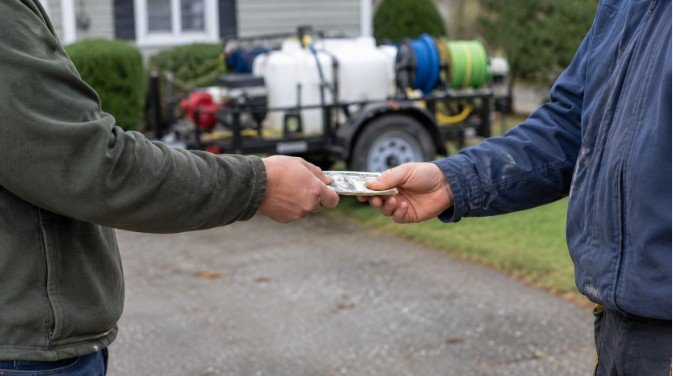
The problem is what tends to travel with the arrangement. No written contract with start and completion dates. No Home Improvement Contractor number on the paperwork. No invoice. No warranty you can enforce. No insurance certificate. And nothing for a complaint to attach itself to if you ever need to file one.
You are not saving the tax. You are buying the same work with the risk moved from the contractor’s balance sheet onto yours.
Do you owe the tax yourself
Connecticut individual use tax, plainly
Connecticut has an individual use tax that applies to taxable goods and services used in Connecticut where Connecticut sales tax was not paid.
The use tax rate matches the sales tax rate, so 6.35 percent for most taxable services. Individuals report it on Form OP-186, or on the CT-1040, CT-1040NR/PY or CT-1040X, with payment due by April 15 for the preceding calendar year.
What that means in practice
This is a real obligation, not a scare tactic. It is also not the main reason to avoid an unregistered contractor.
The bigger exposure is the one in the previous section: having no policy, no registration and no paper trail behind a job that went wrong on your house.
Again, we are not tax advisors. For what you personally owe on a specific invoice, ask DRS or your tax preparer.
A worked example, a 600 dollar house wash
The compliant invoice
Take a 600 dollar house wash. Connecticut sales tax at 6.35 percent adds 38 dollars and 10 cents, for a total of 638 dollars and 10 cents.
On the paperwork it looks like this: company name and Newington address, the Home Improvement Contractor registration number, the date, the scope written out surface by surface, a subtotal of 600, a separate sales tax line of 38.10, and a total of 638.10.
The invoice with no tax line
Same job, same 600 dollars, one number, no tax line, total 600.
Look at what you now do not know. Whether the 600 was meant to be tax-inclusive. Whether the company is registered with DRS at all. Whether any tax was collected on this job, and if it was, whether it was ever remitted.
The comparison people actually make
Now the honest version of the price argument, because this is what the reader is really weighing.
Set the 638.10 compliant total against a cash quote somewhere in the range of 450 to 500 dollars for the same house. Those figures are an illustration to show the shape of the gap, not a quote from any real company.
That gap is not free money. On the higher side it is buying sales tax that is actually remitted, a state registration, a general liability policy, a written contract with start and completion dates, and a company that will still exist next spring if the siding streaks.
None of that means the cheaper operator does bad work. Plenty do fine work. It means that if something goes wrong, you are the one carrying it.
Side by side
| Line item | Compliant invoice | Cash-only invoice |
|---|---|---|
| Service subtotal | 600.00 | 600.00 or a lower cash figure |
| Connecticut sales tax at 6.35% | 38.10 | None shown |
| Total | 638.10 | One number, unexplained |
| HIC registration number shown | Yes | Usually not |
| Written contract with dates | Yes | Usually not |
| Insurance certificate available | Yes | Often nothing to produce |
| Guaranty Fund eligibility | Possible, if registered | Closed if never registered |
| Who pays if something is damaged | The contractor’s insurer | You |
How to raise it without starting a fight
The one sentence to send
Copy this and change what you need to:
“Quick question before I pay this. Is the price tax-inclusive, or should there be a Connecticut sales tax line on the invoice? Happy either way, I just want my records straight.”
That works because it gives the company an easy exit, it accuses nobody, and the answer tells you something useful no matter which way it goes.
What a good answer sounds like
A registered company tells you which it is, reissues the invoice if it needs correcting, and does not get prickly about being asked. Most can tell you their Connecticut tax registration status without a pause, because they deal with it every quarter.
What a poor answer sounds like
Deflection. Irritation. “Nobody charges tax on washing.” A sudden discount if you pay cash. An unwillingness to put anything at all in writing.
That is information. What you do with it is your call.
If you want to report it
Tax registration and remittance questions go to the Department of Revenue Services. Contractor registration and consumer complaints go to the Department of Consumer Protection.
Reporting is entirely your choice, and this page is not urging it.
What our invoices look like
Ours show the scope by surface, a subtotal, a separate Connecticut sales tax line, and a total, with the Newington address and the registration number on the paperwork.
I will be straight about the motive. Collecting sales tax is a nuisance and it makes my headline number look higher than the truck-and-pump quote down the road. I do it because the rules require it, and because it means a homeowner can check every part of what they just bought.
Frequently asked questions
Is pressure washing taxable in Connecticut? House washing is treated as a taxable maintenance service on residential real property under DRS guidance, at 6.35 percent, and all maintenance services on commercial or income producing property are taxable. For a specific service not named individually by DRS, ask DRS directly.
What is the Connecticut sales tax rate on services? The general Connecticut sales and use tax rate is 6.35 percent. Some categories carry different rates, so check the DRS services list for the specific service on your invoice.
Why did my contractor not charge sales tax? Usually one of four reasons: it is not a final invoice, the tax was left off the template by mistake, the total is tax-inclusive with nothing broken out, or the company is not registered with DRS to collect it. One question sorts out which.
Do I owe use tax if a contractor did not charge me sales tax? Connecticut’s individual use tax applies to taxable goods and services used in the state where Connecticut sales tax was not paid, at a rate matching the sales tax rate. It is reported on Form OP-186 or the CT-1040 series. Ask DRS or your tax preparer about your specific invoice.
Is window washing taxable in Connecticut? Yes. DRS treats window washing as taxable on all property types, residential included, which is different from how some other maintenance services are handled.
Are painting and staining taxable in Connecticut? Painting, staining, wallpapering, floor sanding, garbage removal and septic services are excluded from the residential maintenance category. On commercial, industrial or income producing property, those same services are taxable.
Is commercial property cleaned under different rules than residential? Yes. All maintenance and janitorial services on commercial, industrial or income producing property are taxable, which includes rental property. Residential treatment is narrower and depends on the specific service.
Is it illegal to pay a contractor in cash? No. Cash is legal. What usually disappears alongside it is the written contract, the registration number, the invoice, the insurance certificate and any practical recourse, which is the actual cost of the arrangement.
If you would rather just see a clean invoice
Back to that handwritten invoice with one number on it.
The reason ours carry a tax line, a registration number and the scope written out surface by surface is simple. A homeowner should be able to check every part of what they just bought, without needing to call anybody.
Mr-Suds Power Washing PROs is based at 130 Dewey Ave in Newington and works across eighteen towns in central Connecticut including Hartford, Wethersfield, Rocky Hill, Berlin, Farmington and Glastonbury. Licensed, bonded and insured, 5.0 across roughly 39 Google reviews.
Call (860) 263-9031 or email roman@mr-suds.com for a free written quote showing the scope by surface and the tax line before any work starts. First house cleaning service is 15 percent off.