
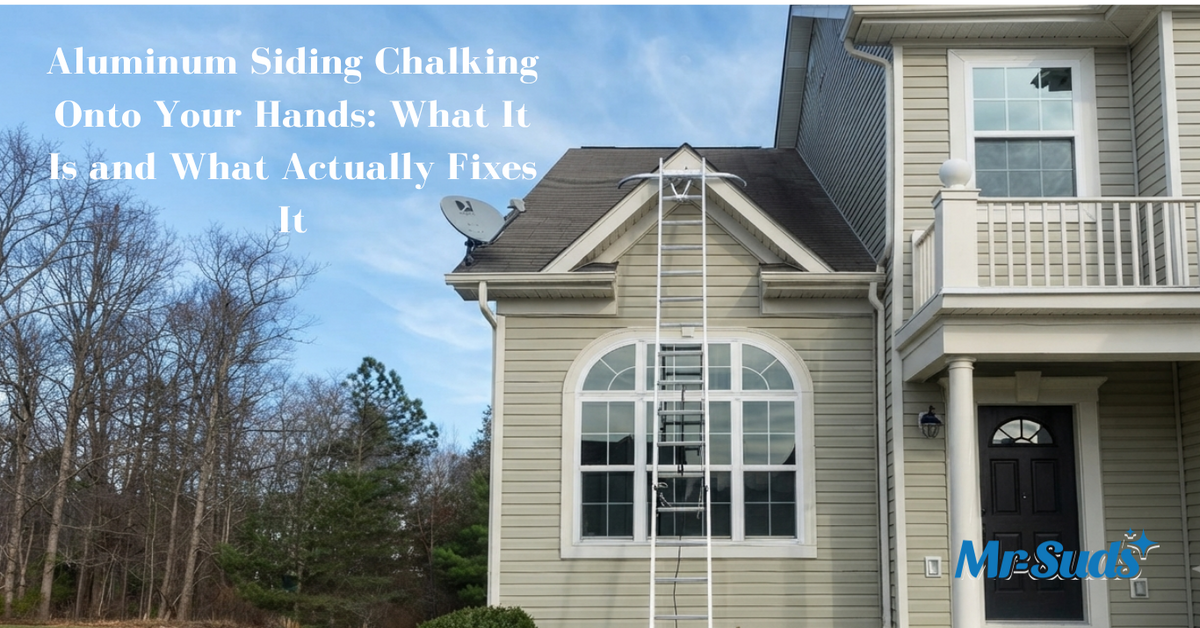
That white powder on your palm is not dirt, mould or a failed cleaning. It is the finish itself.
Aluminum siding is coated with a baked enamel, and that enamel is held together by a resin binder that slowly breaks down under decades of ultraviolet light. As the binder degrades, it releases the pigment particles it was holding. Those particles come off on anything that touches the wall.
That is chalking. On siding installed in the 1950s through the 1970s across Newington, Wethersfield and Rocky Hill, it is not a defect. It is the expected end state of a finish that has done its job for fifty years.
What matters now is knowing exactly what washing can and cannot do about it. I would rather tell you here than have you find out on the day.
What Chalking Actually Is
Aluminum siding carries a factory-applied baked enamel: pigment suspended in a resin binder. UV light degrades that binder from the surface inward, releasing pigment as a fine powder. It is progressive and uniform, and it is a finish failure rather than a material failure. The aluminum underneath is usually completely sound.
A few things follow from that.
Sun exposure decides the pace. South and west walls chalk years ahead of north and east walls on the same house. That is not uneven manufacturing. It is just sunlight.
The siding is not failing. It is not rotting, rusting through or coming off the wall. Homeowners often assume the worst when they see the powder, and the worst is usually not what is happening.
Other materials behave differently. Vinyl fades rather than chalks. Steel siding can chalk and can also rust at cut edges. If you are unsure which one you have, there is a quick test further down.
How to Tell How Bad It Is: The Cloth Test
Five minutes, one dark cloth, and you will know more than most contractors will tell you.
Wipe a dark, dry cloth firmly across a clean, dry section of siding.
| Result | Grade | What it means |
|---|---|---|
| Faint dusting, barely visible | Light | Normal for aged siding. A wash will look good. |
| Clear, obvious deposit; a hand leaves a mark on the wall | Moderate | A wash will help but will look flatter afterward. |
| Cloth loads immediately; colour looks faded and flat; a wet finger drags a streak | Heavy | A wash is maintenance, not restoration. |
Do this on every elevation. A Newington ranch is commonly light on the north wall and heavy on the south. That difference is precisely why washing an older aluminum house can produce uneven results, and it is better understood before the quote than after the job.
Photograph each test with the elevation labelled. Those four photos are the most useful thing you can hand a contractor.
Do the cloth test and send us the photo. We will tell you which of the four options actually makes sense for your house. Text or email Roman at (860) 263-9031.
What Happens When You Wash Chalked Aluminum Siding
This is the part most companies will not put in writing. We will.
Washing removes loose chalk. It cannot restore a degraded binder. Nothing can.
On light chalking, a soft wash produces a good, even result and the house genuinely looks refreshed.
On moderate to heavy chalking, expect three things:
The colour will look flatter and lighter afterward. The chalk layer was scattering light. Once it is gone you are seeing the degraded finish directly.
The result can be uneven. Chalk does not release uniformly. The south wall behaves differently from the north wall, and no technique changes that.
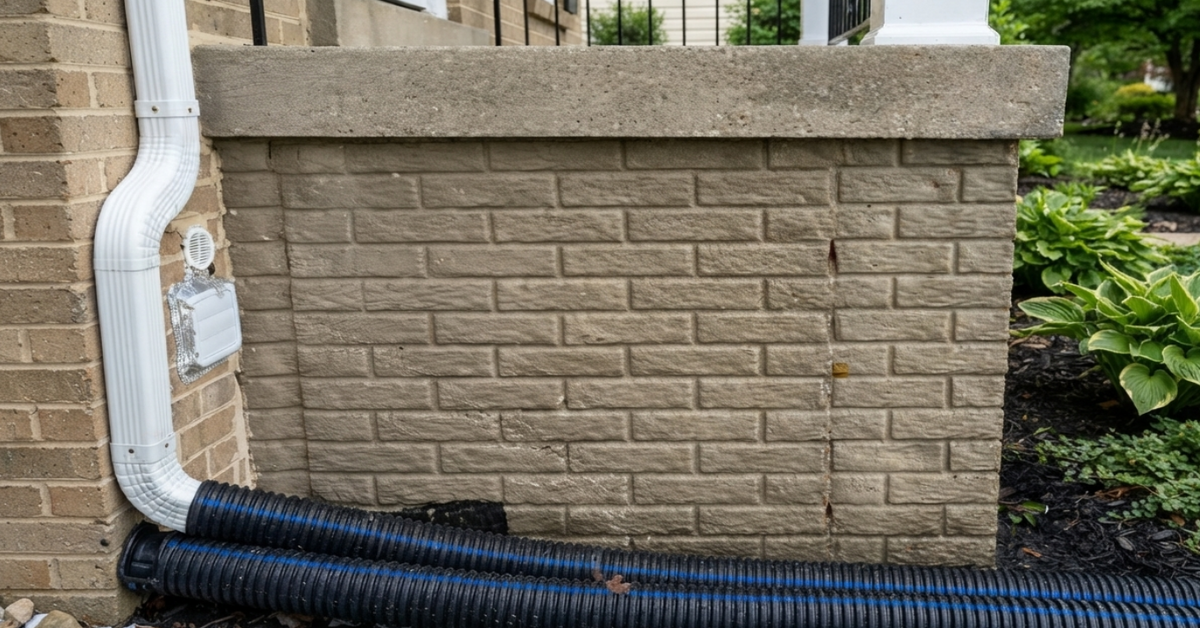
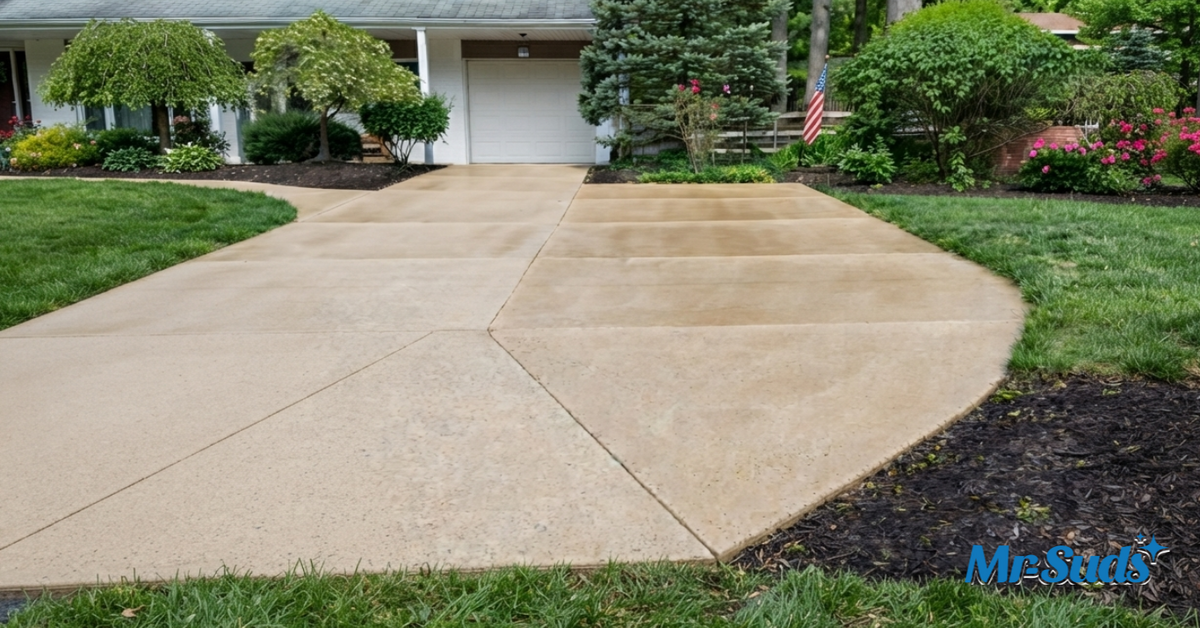
The runoff is white and it stains. Chalk-laden water running onto brick foundations, concrete walkways, driveways, painted trim and landscaping leaves pale streaks. It has to be rinsed off as the work goes, not afterward once it has dried.
Here is the sentence I say on driveways all over this town:
On heavily chalked siding, a house wash is a cleaning, not a restoration. Anyone who tells you a wash will bring the colour back is selling you a disappointment.
One more hard rule. Never pressure wash chalked aluminum. Aluminum dents easily, high pressure drives chalk into a streaked pattern that is worse than what you started with, and it forces water behind the panels.
The Lead Question: Take This Seriously on Pre-1978 Homes
This section matters, and it is factual information rather than an assessment of your house.
The aluminum siding’s factory enamel is not the concern. The concern is everything around it and underneath it.
On a typical Newington home of this vintage that means original wood trim, fascia, soffits, window casings, door frames, porch columns, and in a great many cases the original wood siding still sitting behind the aluminum.
Homes built before 1978 may contain lead-based paint. Under the EPA Renovation, Repair and Painting Rule, firms performing renovation, repair or painting for compensation that disturbs painted surfaces in pre-1978 housing must be EPA lead-safe certified, use certified renovators, and follow specified work practices including containment and cleanup.
What that means for you in practice:
- Aggressive washing of peeling or deteriorated paint on a pre-1978 home is not a routine cleaning job. It can disperse paint chips and contaminated water into soil where children play.
- If your home is pre-1978 and has any deteriorated paint on trim or wood elements, ask any contractor directly whether they are EPA lead-safe certified and how they will contain and clean up.
- If repainting is the plan, this matters far more, because surface preparation on pre-1978 paint sits squarely inside the RRP Rule.
Connecticut also runs a childhood lead poisoning prevention program through the Department of Public Health. Between DPH and epa.gov/lead you can find testing guidance and the consumer pamphlet.
The message here is not to panic. It is to find out your home’s build year and ask the right question before anyone starts work.
Your Four Real Options
Option 1: Clean it and accept it
Gentle soft wash, thorough rinse, chalk runoff cleared off the hardscape immediately as the work proceeds.
Result: clean, even, honest. The colour is what it is.
Best for: light chalking, homeowners not selling soon, budget-conscious projects.
Option 2: Clean it and repaint
This is the genuine fix for moderate to heavy chalking. It is not a service we sell, and we recommend it anyway, because it is the correct answer.
The critical technical point: paint will not bond to chalk. The chalk has to be removed thoroughly first. Skipped or rushed prep is the single most common reason repainted aluminum siding fails within a few years.
The sequence:
- Full chalk removal and surface preparation
- Appropriate primer where required
- Quality exterior acrylic latex
On a pre-1978 home this work falls under the RRP Rule and should go to an EPA lead-safe certified firm.
Be realistic about cost. A properly prepped and painted aluminum siding job is a substantial project, and the prep is most of the cost. Any quote that comes in dramatically low is a quote that is skipping it.
Option 3: Oxidation removal and restoration products
Products exist that chemically strip oxidised finish.
Balanced view: results vary considerably, they can produce blotchy outcomes on unevenly weathered walls, and they are aggressive on an old finish. Test on a small hidden area first, always.
They are not a substitute for painting on heavily chalked siding.
Option 4: Replace the siding
Appropriate when the aluminum is also dented or damaged, or when you want to address insulation and the weather-resistive barrier at the same time.
Re-siding requires a permit through the Town of Newington Building Department, and any residential contractor must be CT DCP HIC registered. Verify at eLicense.ct.gov.
Also worth knowing: removing aluminum siding on a pre-1978 home exposes whatever is behind it, so RRP considerations apply there too.
Which option fits your house
| Chalking level | Selling soon? | Recommended path |
|---|---|---|
| Light | Either | Clean it. Revisit in a few years. |
| Moderate | No | Clean now, plan a repaint within a couple of years |
| Moderate | Yes | Clean and repaint as one project before listing |
| Heavy | No | Repaint, or replace if dents and damage are also present |
| Heavy | Yes | Repaint properly, or price the house accordingly |
What to Do Right Now, Step by Step
- Do the cloth test on all four elevations and photograph the results.
- Confirm the material. Aluminum dents and sounds different from vinyl. A magnet will not stick to aluminum, but it will stick to steel siding.
- Find the build year through Newington property records, your closing file, or the assessor’s database.
- If pre-1978, inspect trim, soffits, fascia and window casings for deteriorated paint before anyone washes anything.
- Get quotes that state the expected outcome in writing, not just the price. Ask specifically: “Given the chalking level, what will this look like when you’re finished?”
- Ask any contractor working on a pre-1978 home whether they are EPA lead-safe certified.
- Confirm HIC registration and ask for the certificate of insurance.
- If a repaint is likely within a couple of years, sequence it. Clean and paint as one project rather than paying for cleaning twice.
- Protect the hardscape. Make sure whoever washes it is rinsing the foundation, walkways and driveway as they go.
Preventing and Slowing Chalking
You cannot stop UV. You can manage the pace and the appearance.
- Regular gentle washing removes the loose layer and slows visible accumulation. It does not slow binder degradation
- Keep sprinklers off the siding. Repeated wetting and mineral deposits make chalking look considerably worse
- Deal with it before it reaches heavy. A repaint on moderately chalked siding is cheaper and far more successful than on heavily chalked siding
- Once painted, the maintenance cycle changes entirely. You are maintaining paint from then on, not enamel, which brings its own considerations
FAQs
Why does my aluminum siding leave white powder on my hands? It is oxidation of the enamel finish. UV has broken down the resin binder and released the pigment.
Is chalking damage? It is finish wear rather than structural failure. The aluminum underneath is usually completely sound.
Will pressure washing remove chalking? It removes loose chalk only, and high pressure makes the result worse by streaking it and denting the panels.
Why does my siding look worse after washing? Because the chalk layer that was scattering light is gone, so you are seeing the degraded finish directly. On unevenly weathered walls the result can also be patchy.
Can chalked aluminum siding be painted? Yes, provided the chalk is fully removed first. Paint will not bond to a chalked surface.
How do I know if my siding is aluminum or vinyl? Aluminum dents and sounds metallic when tapped. Vinyl flexes. A magnet sticks to steel siding but not to aluminum.
Does chalking mean I need new siding? No, unless there is dent or impact damage as well, or you want to address insulation behind it.
Is there a lead risk on older Connecticut homes? Homes built before 1978 may contain lead-based paint on trim and wood elements. Under the EPA RRP Rule, paid work disturbing those surfaces requires a lead-safe certified firm. Check your build year and ask the question.
Find Out Where Your Siding Really Stands
Know What a Wash Will and Won’t Do
We will come out, run the cloth test with you on all four walls, and give you a written statement of the expected outcome before you commit to anything. If the honest answer is “clean it now, but budget for a repaint,” that is what you will hear.
We would rather set the expectation than defend a result.
See our house washing service, what soft washing actually is, real before and after results, and what homeowners say in our reviews.
Get a Free Quote or call (860) 263-9031
Veteran owned. Licensed, bonded and insured. HIC registered. Owner-supervised on every job. Serving Newington, Wethersfield, Rocky Hill, Hartford, Berlin, Plainville and Central Connecticut.