

What to Do When a Freeze Is Forecast the Night After a Wash
Mid-November on a Newington street. A ranch with an older concrete walk, a bright 50F afternoon, and a homeowner who wanted the driveway and front walk done before the holidays.
We finished early and blew the walk and the step nosings dry before the truck moved. The overnight low that night was 30F.
That gap between a pleasant afternoon and a freezing night is the whole subject of this page. It is not a January problem. It is a March and November problem.
The short answer
If a freeze is forecast the night after a wash, clear standing water off walkways, steps, decks and paver joints before dark, and keep people off those surfaces until they are dry. Use traction sand rather than rock salt, which is corrosive to concrete, and light the front walk.
What actually freezes, and what does not
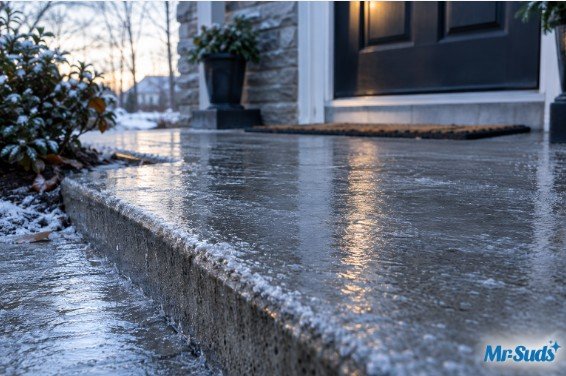
The risk is not the wash. It is water that has nowhere to go before dark.
It sits in four places, and they matter in very different ways.
Water in concrete and paver joints
Concrete is porous, so a washed slab holds water in its surface pores. Pavers hold it in the sand joints, which is worse, because joints stay wet long after the surface looks dry.
When that water freezes it expands and pushes outward. Repeated cycles are what drive spalling and surface loss.
Be clear about the scale though. A single freeze on sound, mature concrete is unlikely to cause visible damage. The real exposure is older concrete that is already weathered, previously spalled, or has a compromised surface, because there the water gets deeper and the surface has less left to give.
Standing water on decks, walkways and steps
This is the dangerous category, and it has nothing to do with damage.
It is horizontal, it is where people walk, and it refreezes as a smooth clear sheet rather than as visible ice.
The worst spots are step nosings and the transition from walkway to driveway, where the surface changes and people are already adjusting their footing.
Water in gutters and downspouts
Late-autumn gutter cleaning leaves water sitting in the run.
If a downspout is slow or blocked, that water stays there, freezes, adds weight, and backs up behind itself. The fix is drainage, not de-icer. Make sure the run is clear and the downspout is actually discharging.
Water in the crew’s equipment
Worth mentioning, because it tells you what a competent operator is thinking about at four in the afternoon in November.
Pumps, hoses, injectors and tanks all have to be drained or protected once nights go below freezing. A burst pump is a real cost of getting the forecast wrong, and a crew that has planned for their own equipment has usually planned for your walkway too.
The slip hazard is the real risk tonight
Of everything on this page, this is the one most likely to actually happen.
A freshly washed walkway that has not dried is black ice waiting for a schedule. Not the grey, obvious ice of February. A thin clear layer over a clean surface, almost invisible in low light, at its worst on the front walk and the steps at seven in the morning.
Picture who uses that walk first. An elderly parent. Somebody leaving before sunrise. A delivery driver who is not looking down.
That is the thing to solve tonight, and it is solvable in about twenty minutes.
What to do this evening, before dark
- Walk the property while there is still light. Find every low spot holding water. They are not where you expect.
- Squeegee or push-broom standing water off walkways, steps, patios and decks, toward drainage rather than across the walking route.
- Use a leaf blower on paver joints, deck boards and step nosings. It moves water a squeegee cannot reach, and those three places hold the most.
- Check the downspouts are clear and discharging away from the walkway rather than across it.
- Redirect any downspout that drains onto a walking surface, even with a temporary extension.
- Keep traffic off the washed surfaces until they are visibly dry. Use a different door tonight if you have one.
- Put a light on the front walk so anybody using it in the morning can see what they are stepping on.
- Decide on a de-icer before you need it, and read the next section before you reach for the bucket in the garage.
De-icers: what is safe on concrete and what is not
This is where two separate bodies of advice never meet, so here they are together.
Rock salt, sodium chloride. The common one, and the corrosive one. It can do significant damage to concrete and is only effective down to roughly 15F to 20F.
Calcium chloride. Melts fastest and works down to around minus 25F. Effective, still a chloride.
Magnesium chloride. Faster acting than rock salt, effective to around minus 13F, less corrosive and gentler on plantings.
Potassium chloride. Plant-safe, but loses effectiveness below about 25F, which limits it here.
Calcium magnesium acetate, CMA. Concrete Network describes it as the only product safe for use on newer concrete, biodegradable and non-corrosive.
Sand or volcanic granules. No melting at all, just traction. On a surface you have just paid to have cleaned, this is the safest thing you can put down tonight.
Then the timing rule that matters most, and it catches people out. Avoid de-icers on concrete during its first winter, because concrete less than a year old has significantly less freeze-thaw resistance than mature concrete.
Two more things worth thinking about before you scatter anything. Runoff from a walkway lands in the beds beside it, so plantings take whatever you use. And chlorides are hard on paws, which matters if the dog goes out that door.
Freeze-thaw and spalling, explained properly

Water enters the pores of concrete and the joints between pavers. It freezes, expands, and pushes the surface apart from the inside.
One night rarely does anything visible. It is the repetition, cycle after cycle over seasons, that produces the flaking and pitting people call spalling.
Chlorides make it worse in a way that surprises people. They do not just corrode. They increase the number of freeze-thaw cycles a surface goes through in a season and draw more moisture into the concrete, which is exactly what you do not want in a surface already holding water.
Now the honest part about washing, because you are entitled to it.
A wash does not create this problem. What it does is put water on a surface on a day when that surface would otherwise have been dry. So the only real question is whether it dries before dark, which is why the timing of a shoulder-season job matters more than anything else about it.
On older concrete, a penetrating sealer limits how much moisture and chloride get in, and it is worth asking a masonry contractor about if your slab is already showing pitting. It is not a wash service and it is not a fix for concrete that has already lost its surface.
Are wood and composite decks at risk
A fair question, and one nothing on the internet seems to answer.
Wood absorbs water. A saturated deck that freezes for one night is unlikely to be damaged by it. What does cause harm is repeated saturation and freezing, which accelerates checking, splitting and fastener movement on older boards.
Composite and PVC absorb far less, so the damage risk is lower still. The hazard shifts instead to the person on the deck, because composite is slick when wet and worse when that wet turns to ice.
The practical rule for both: blow the boards off, clear the gaps between them where water sits, and keep the deck out of use overnight.
What a professional does differently in a shoulder-season wash
Start earlier. A shoulder-season job needs the afternoon for drying, not for washing. That changes the arrival time, not the price.
Work the sun. Take the south and west elevations and the sunlit half of a driveway. Leave shaded north-side concrete for a warmer week.
Watch the overnight low and the dew point, not the daytime high. A 55F November afternoon routinely gives way to a 32F night, and the app on the truck shows both.
Build the schedule backwards from sunset. Not forwards from arrival. That one change decides most of it.
Choose surfaces. Siding drains and dries. Horizontal concrete, steps and decks hold water. In a late-season slot, do the vertical work and defer the horizontal.
Clear the water rather than leaving it. Blowing down a walkway and the step nosings at the end of a job takes two minutes and removes most of the overnight risk. On that November ranch, the walk was blown dry before the truck left and the shaded north-side patio was left for spring.
Protect the equipment. Drain and winterise between jobs once nights are below freezing.
Say no and reschedule. Some jobs in late November should wait until April, and the honest thing is to say so on the phone rather than in the driveway.
When to just reschedule to spring
A clear rule, so you can make the call yourself.
Push the job when the overnight low is forecast below about 32F and the surface is horizontal. When the work is sealing, staining or jointing sand. When the surface sits in permanent shade. When the job cannot start early enough to dry before dusk. Or when the concrete is already spalling, or is under a year old.
The exception worth knowing: siding soft washing has the widest workable window of anything we do, because a vertical surface drains and dries fastest. A November siding job is usually fine on a day a November driveway is not.
Newington overnight lows: when this actually matters
Overnight lows in the Newington area sit below freezing from December through March, with January averaging around 22F and February around 24F.
But deep winter is not the risk window, because nobody is booking exterior cleaning in January.
The risk sits in the shoulder. March averages an overnight low of about 31F against a daytime high near 48F. November averages about 36F overnight against a high near 51F. That is precisely the pattern that gives you a pleasant washing afternoon and a freezing night on the same calendar day.
April at about 41F and October at about 45F are usually safe on average, and they still throw individual nights into the low 30s, which is why the average is not the number to look at.
So in Newington, Wethersfield, Rocky Hill, Berlin and the rest of the towns around here, March and November are the two months where the forecast gets checked twice before a horizontal surface gets washed.
Surfaces and overnight freeze risk
| Surface | Risk if it freezes wet | Before dusk | Reschedule threshold |
|---|---|---|---|
| Vinyl or aluminium siding | Very low, it drains | Nothing needed | Rarely |
| Concrete driveway | Slip risk, minor freeze-thaw | Squeegee low spots | Low below 32F |
| Concrete walkway and steps | Highest slip risk | Squeegee and blow nosings | Below 32F, reschedule |
| Pavers with sand joints | Joints hold water longest | Blow the joints out | Below 32F, reschedule |
| Wood deck | Slick, minor long-term wear | Blow boards and gaps | Below 32F if shaded |
| Composite or PVC deck | Very slick when iced | Blow boards and gaps | Below 32F, keep off |
| Gutters and downspouts | Weight and back-up | Confirm they drain | Clear the run first |
| New or spalling concrete | Highest damage risk | Keep de-icers off entirely | Defer to spring |
Frequently asked questions
Is it bad if it freezes the night after pressure washing? Usually not for the surface itself. A single freeze on sound, mature concrete rarely causes visible damage. The genuine risk is standing water refreezing on walkways and steps as black ice, which is why clearing it before dark matters more than anything else.
Can pressure washing damage concrete in cold weather? The washing does not cause the damage. Water left sitting in a porous or already-spalling surface, freezing and expanding, is what does, and it takes repeated cycles. Clear the water before dusk and the risk drops sharply.
What is concrete spalling and what causes it? Spalling is the flaking and pitting of a concrete surface, caused by water entering the pores, freezing, expanding and pushing the surface apart over repeated freeze-thaw cycles. Chlorides accelerate it by increasing cycles and drawing in moisture.
What ice melt is safe for concrete? Traction sand is safest because it does not melt anything. Calcium magnesium acetate is described by Concrete Network as the only product safe on newer concrete. Rock salt is corrosive and worth avoiding on a surface you have just had cleaned.
Can you use ice melt on new concrete? Avoid de-icers on concrete during its first winter. Concrete less than a year old has significantly less freeze-thaw resistance than mature concrete, so traction sand is the sensible choice there.
Will a freshly washed driveway turn to black ice? It can, if water is still standing when the temperature drops. The walkway and steps are the real concern rather than the open driveway. Squeegee the low spots, blow out the step nosings and keep people off until it is visibly dry.
Does freezing damage a wood or composite deck? One freeze on a wet deck rarely damages it. Repeated saturation and freezing accelerates checking and splitting on older wood boards. Composite resists the damage but becomes extremely slick, so the risk moves from the deck to the person walking on it.
Should I wash in March or wait until spring? Siding is usually fine in March, because it drains and dries fast. Driveways, walkways, steps and decks are the ones to defer, since March averages an overnight low near freezing against a mild afternoon.
Book the shoulder season with someone watching the overnight low
The walk on that November job was dry by dark, nobody slipped, and the patio got done in April.
What I tell homeowners in November is that I would rather do half the job now and the rest in the spring than hand you an ice rink.
So call and we will tell you honestly whether your job should go now or wait. Sometimes the answer is the siding this month and the concrete in April, and that is a real answer rather than a way of holding a booking.
Mr-Suds Power Washing PROs is at 130 Dewey Ave in Newington and covers eighteen towns across central Connecticut including Wethersfield, Rocky Hill, Berlin, Farmington and Glastonbury. Licensed, bonded and insured, 5.0 across roughly 39 Google reviews, and named Ranked #1 Pressure Washing Service in Newington for 2026 by BusinessRate. You can check our registration yourself at elicense.ct.gov.
Call (860) 263-9031 or email roman@mr-suds.com for a free quote. First house cleaning service is 15 percent off.