

A July soft wash on a Newington side street. Split-level, vinyl siding, solution on the back elevation and dwelling. Nothing in the sky ten minutes earlier.
Then one of those summer cells comes across, and the homeowner is out on the step asking whether that is a problem.
The honest answer is that it depends entirely on what we were doing when it started.
The short answer
Whether rain ruins a wash depends on the stage, not the forecast. Light rain during rinsing is usually fine. Rain during dwell time dilutes the cleaning solution before it has worked, so that section needs redoing. Sealing, staining and roof work stop entirely until conditions are dry and safe.
Why “can you wash in the rain” is the wrong question
Every exterior cleaning job has stages, and rain does something different at each one.
There is an application stage, where solution goes onto the surface. A dwell stage, where it sits and does the work. A rinse stage, where it comes off. And on hard surfaces, a drying stage afterwards.
Ask “can you wash in the rain” and you get a shrug, because half the time the answer is yes and half the time it is no.
Ask “which stage are we in” and the answer is immediate. That is the frame the rest of this page runs on.
What rain actually does to each service
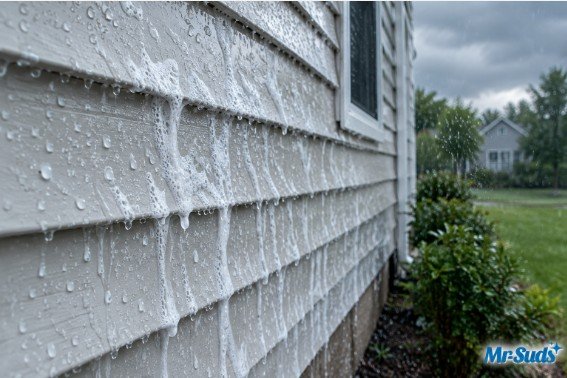
Soft washing siding, and why dwell time decides everything
Soft washing is not a pressure job. The solution does the work, and it needs to sit on the surface long enough to kill and release the algae and organic growth.
That window is dwell time, and it varies with product, dilution, temperature and how heavy the growth is. What matters is not the number of minutes, it is that the solution has to be at working strength for the whole of it.
Rain arriving mid-dwell does two things. It dilutes the mix below working strength, and it rinses it off early.
The result is the part people get wrong. The wall looks cleaner, because you have washed dirt off it. But the growth has not been killed properly, so it comes back fast, and everybody blames the product or the company six weeks later.
Surfactants in the mix exist partly to keep solution clinging to a vertical surface long enough to work. A steady downpour beats them. That is not a failure of the product, it is water winning an argument with water.
If a section was mid-dwell when the rain came, that section needs doing again. A good crew will tell you that rather than hoping you do not notice in October.
Rinsing, where rain is mostly harmless
Here is the honest concession that makes everything above believable.
A rinse is water. Light rain during a rinse is often fine, and occasionally it helps.
So a crew rinsing a wall in a light shower is not necessarily cutting corners. They may be doing exactly the right thing.
Concrete, pavers and driveways
Surface cleaning works fine on wet concrete. The machine does not care.
The problem is afterwards. Rain landing on a freshly cleaned slab before it has dried evenly can leave marks and streaking, and dirty runoff tracking from an unwashed section across a finished one leaves a line you will look at for a month.
Concrete wants an even dry more than a fast one. That is why a driveway finished at four in the afternoon before an evening shower can look worse than one finished at ten in the morning.
Wood and composite decks
Wood absorbs. A wet deck cleans less predictably, holds the water for far longer, and takes a long time to be genuinely dry rather than dry on top.
A rainy day is a poor choice for deck cleaning, and it is a worse choice if there is any coating scheduled behind it.
Composite and PVC absorb far less, but they are slick when wet and they still need to dry properly before anything is applied.
Sealing, staining and polymeric sand: the hard stop
No judgment call here at all.
Coatings need a dry, clean surface to bond to and a dry window afterwards to cure. Polymeric sand needs to activate and set, and rain before it does washes it straight out of the joints.
These jobs also carry temperature windows. Paver installation guidance commonly sits in the range of roughly 50F to 85F, which tells you how narrow the conditions can be even before rain enters it.
If rain is forecast inside the cure window, the work does not start. A company that starts anyway is gambling with your driveway rather than theirs.
Roof cleaning, where safety decides first
Roof work stops on safety grounds before anyone gets to a conversation about results.
A wet asphalt shingle roof is a fall risk, and no cleaning outcome justifies it. There is nothing on your roof worth someone coming off it.
Manufacturer and warranty guidance matters on roof surfaces too, which is a second reason not to improvise in changing conditions.
When a light shower actually helps
Nobody writes this down, so here it is.
On a hot summer day the enemy is evaporation. Solution that dries on the surface stops working and can leave residue behind, which is why crews work smaller sections and move faster in August than in May.
A light shower slows that down. It keeps the surface wet, it extends the working window, and on the right day it makes the job easier rather than harder.
The limit is precise. A passing drizzle helps. Steady rain does not. The difference is whether water is simply keeping the surface damp or actually running off it, carrying your solution to the ground.
The first five minutes when it starts raining
- Look at the stage, not the sky. Applying, dwelling, rinsing or drying. That decides everything else.
- If solution is dwelling, deal with that section. Finish the rinse there rather than leaving a wall half worked.
- Shut down anything on a ladder or a roof immediately. This one is not a judgment call.
- Stop all sealing, staining and jointing sand work, and protect any product already down.
- Watch the runoff. Heavy rain moves wash water further and faster than the setup planned for.
- Give it ten minutes before deciding. Central Connecticut summer cells pass quickly, and a lot of decisions make themselves.
- Agree out loud with the homeowner what is finished, what is paused and what happens next.
- Photograph the state of the work before leaving. That protects both sides and settles any question later.
Pause or stop, and how to decide
A real rule rather than a feeling.
Pause if it is a passing cell, the work in progress is a rinse, and there is enough daylight left to resume and let things dry evenly.
Stop if anyone is on a roof or a ladder. If solution has been diluted mid-dwell on a section. If a coating, sealer or polymeric sand was scheduled. If there is lightning anywhere in the area. Or if the remaining daylight will not give an even dry.
There is a shoulder-season condition on top of that. Stop if an overnight freeze is forecast and surfaces will not dry before dusk, because water standing on a walkway or an apron in March or November becomes a different problem by morning.
On that July job, the back elevation got rinsed out and left, the front went the following week, and there was no second charge.
Who pays for the return trip
The question every article on this topic avoids, so here is a flat answer.
Weather is nobody’s fault. A professional absorbs the return trip on a job they chose to start. You bought a finished house, not a number of visits.
What matters more than the policy is having it in writing before anybody starts.
In Connecticut a home improvement contract must be in writing, signed by both parties, and contain the entire agreement, including a starting date and a completion date, under the Home Improvement Act at General Statutes Section 20-429. Any change to it has to be in writing and signed by both parties.
Notice how that interacts with rain. A weather delay moves the completion date, and the statute says a change is papered rather than assumed. So the new date belongs in a text or an email the same day, not in somebody’s memory.
Before you sign, ask for the weather clause and the return-trip position in writing. Registration is verifiable free at elicense.ct.gov, which is worth two minutes on any company including ours.
How to judge a company that keeps working in a downpour

You are allowed to wonder. Here is a fair test rather than a verdict.
Are they rinsing or applying? Rinsing in light rain is fine. Applying solution into steady rain is not.
Is anyone still on the roof or a ladder? That is the one with a right answer.
Did somebody explain the plan? A crew that has thought about it will tell you without being asked.
Did they offer to come back? Offering unprompted is the strongest signal there is.
Are they working the section they can finish, or spraying everything to look busy? The first is a plan. The second is a schedule being protected.
And the honest part. Working in light rain is not automatically a red flag. The tell is whether they can explain why.
Rain in central Connecticut: what the calendar actually says
| Month | Average days with precipitation in Newington |
|---|---|
| March | 5.9 |
| April | 7.9 |
| May | 9.9 |
| June | 10.0 |
| July | 10.3 |
| August | 9.3 |
| September | 8.0 |
| October | 7.7 |
| November | 7.6 |
Read that against the season. June and July, the two busiest washing months here, are also the two wettest by frequency, at roughly one day in three carrying measurable precipitation. May and August are barely behind.
October is the useful contrast. It averages fewer wet days than July but is the wettest month by volume, at roughly 3.7 to 3.8 inches. Summer brings frequent short cells that pass in twenty minutes. Autumn brings fewer, heavier soakings that end a day outright.
March is the driest of those months at about 5.9 days, and it carries freeze risk instead, which is its own scheduling problem.
The conclusion for anyone booking in Newington, Wethersfield, Rocky Hill or the towns around them: a rain interruption is routine. It should be planned for in the quote, not treated as a crisis in the driveway.
Rain by service and stage
| Service | Stage | Light rain | Steady rain | Pause or stop |
|---|---|---|---|---|
| Soft wash siding | Application | Poor, solution runs | No | Stop |
| Soft wash siding | Dwell | Dilutes the mix | Section needs redoing | Stop that section |
| Soft wash siding | Rinse | Fine, sometimes helps | Usually fine | Continue |
| Driveway or paver | Surface cleaning | Fine | Usually fine | Continue |
| Concrete | Drying | Can mark the slab | Marks and streaking | Pause |
| Deck, wood | Cleaning | Poor choice | No | Stop |
| Roof | Any stage | Unsafe | Unsafe | Stop |
| Sealing or staining | Any stage | No | No | Stop |
| Polymeric sand | Before it sets | Washes out | Washes out | Stop |
Frequently asked questions
Can you pressure wash in the rain? Often yes, depending on the stage. Rinsing in light rain is usually fine, and surface cleaning a driveway works on a wet slab. Applying solution into steady rain, sealing, staining and any roof work should not go ahead.
Does rain ruin a soft wash? It can, if it lands during dwell time. The solution gets diluted below working strength and rinsed off before it has killed the growth, so the wall looks cleaner but is not done and the growth returns quickly. That section needs redoing.
What is dwell time and why does rain affect it? Dwell time is the period a cleaning solution sits on the surface doing its work. It varies with product, dilution, temperature and how heavy the growth is. Rain during that window dilutes and removes the solution before it has finished.
Should a pressure washing company keep working in the rain? Sometimes. Rinsing in light rain is reasonable and so is surface cleaning. Applying solution into steady rain, working on a wet roof, or sealing anything is not. A good crew can explain which of those they are doing.
Can you seal a driveway if rain is forecast? No. Sealers need a dry surface to bond to and a dry window afterwards to cure. Polymeric sand washes out of the joints before it sets. If rain is forecast inside the cure window, the work should be postponed.
Is roof cleaning safe in the rain? No. A wet asphalt shingle roof is a genuine fall risk, and roof work should stop on safety grounds before anyone discusses the cleaning result. A crew that refuses a wet roof is showing good judgment.
Does rain after pressure washing undo the cleaning? No. Once the wash is finished and rinsed, ordinary rain runs off clean siding without harm. What stains a house is organic growth over time, not rainwater. On freshly cleaned concrete that has not dried evenly, rain can leave marks.
Who pays if a job has to be rescheduled for rain? The fair standard is that the contractor absorbs the return trip on a job they chose to start, because weather is nobody’s fault. Ask for the weather clause and the return-trip position in writing before you sign anything.
If the sky opens on your job, here is what we do
That July job took two visits, and the back wall did not need doing twice.
What I tell homeowners is that the weather is nobody’s fault, so the second trip is on us. We stop when stopping is the right call, we tell you which sections are finished and which are not, and the new date goes to you the same day in writing.
That is a policy rather than a promise, which means you can hold us to it.
Mr-Suds Power Washing PROs is at 130 Dewey Ave in Newington and covers eighteen towns across central Connecticut including Wethersfield, Rocky Hill, Berlin, Farmington and Glastonbury. Licensed, bonded and insured, 5.0 across roughly 39 Google reviews, and named Ranked #1 Pressure Washing Service in Newington for 2026 by BusinessRate.
Call (860) 263-9031 or email roman@mr-suds.com for a free quote. First house cleaning service is 15 percent off.