

What to Do When Well Water Runs Low During a Wash
Early autumn, a long gravel drive in one of the outlying towns, a mid-century colonial on a private well. At the door the homeowner mentioned, almost in passing, that the water “gets funny in August.”
Halfway through the second elevation the pattern at the wand went soft. We shut down before anyone inside had noticed anything.
That is the whole skill on a well job. Stopping early.
The short answer
If your well runs low during a pressure washing job, stop drawing water right away. Shut the machine down, close the supply and let the pump rest so the well can recover, which takes hours rather than minutes. Never keep running a pump that is pulling air, because a dry pump can burn out.
How much water an exterior wash actually uses
Most people have never had a number attached to this, so here it is.
A pressure washing machine typically draws about 4 to 8 gallons per minute while it is running. A house wash uses roughly 100 to 300 gallons over the job. Driveways, patios and paver work use more, because a surface cleaner runs at continuous flow rather than in bursts.
Now the distinction that matters more than any of those figures. Flow rate beats total volume.
A well that can comfortably supply 300 gallons across an afternoon can still fail badly at 6 gallons per minute for forty straight minutes. The aquifer is not being asked for a total, it is being asked for a rate, and the rate is where wells give out.
Why soft washing draws less
Not a slogan, a mechanism.
Soft washing puts a cleaning solution on the surface and lets it do the work. The machine is not running flat out for the whole job, and the rinse is low pressure rather than a sustained high volume blast.
A surface cleaner on a driveway is the opposite: continuous, unbroken demand for as long as the slab takes.
That is why a well-water house wash frequently works fine and a well-water driveway job on the same property, in the same week, does not.
How a private well actually supplies water
Yield, recovery rate and why they differ
Two different things that people use interchangeably.
Yield is how fast the aquifer feeds the well. Recovery rate is how fast the water level climbs back after you have drawn it down.
The trade classification runs roughly like this: 10 gallons per minute and above is excellent, 5 to 10 is good, 3 to 5 is adequate, 1 to 3 is a low yield well, and under 1 is marginal. A lot of Connecticut wells sit somewhere in the 3 to 10 range.
The line worth remembering: the well delivers only as fast as the aquifer gives it. Everything else is storage.
Casing storage, the buffer nobody thinks about
This is the part almost nobody explains, and it is the most useful arithmetic on the page.
The water standing in the well casing above the pump is your buffer. A typical 6-inch well holds approximately 1.5 gallons per foot of casing, a figure published in New York State Department of Health guidance and used widely in the trade.
So work it through. If you have 100 feet of water standing above the pump, that is roughly 150 gallons sitting there.
A machine drawing 6 gallons per minute goes through that in about 25 minutes of continuous running.
After that, you are living entirely on whatever the aquifer is feeding in, which on a 4 gallon per minute well is less than the machine wants. That is the moment a wash starts outrunning a well, and it arrives faster than most people expect.
Drilled versus dug wells
Shallow dug wells are far more sensitive to a dry stretch, because they sit close to the water table. Drilled wells are generally steadier.
Your driller’s report says which you have, along with depth and the yield measured at the time it was drilled.
The warning signs during a job
Roughly in the order they appear.
Pressure dropping at the wand. The first and most reliable sign. On a setup running through a buffer tank, the tell is that the tank empties faster than it fills.
Sputtering and air in the line. The water level has reached the pump intake. Damage is now possible rather than merely theoretical, and this is the point to stop.
Cloudy, silty or brown water. The pump is drawing from nearer the bottom of the well. That sediment goes into the plumbing, the water heater, the aerators, the filters and the softener, and it is the part that costs money after the crew has left.
The pump cycling constantly or not shutting off. It is not getting a full column of water to work with.
What you notice inside. Weak fixtures, a spitting tap, a toilet filling slowly. Go check inside once during a long job on a well, because you will often notice it before the crew does.
What to do in the first five minutes
- Say something. A good operator would far rather stop than finish. Nobody on a truck wants to be the reason a family has no water tonight.
- Shut the draw down. Stop the machine, close the supply, take the load off the pump.
- Do not restart to test it. Repeated dry starts are worse than one.
- Turn off anything else calling for water. Dishwasher, laundry, irrigation, ice maker.
- Let the well rest. Recovery is measured in hours. Overnight beats an afternoon guess every time.
- Check the breaker, and listen. If the pump has tripped on thermal overload, do not sit there resetting it repeatedly.
- Draw the first water afterwards from an outside spigot, so any sediment goes onto the lawn rather than into the house.
- Decide together about the rest of the job. Usually that means a second visit rather than pushing through.
The real risk is the pump, not the wash
A submersible pump is cooled and lubricated by the water it moves. Take the water away and it heats up.
That gives you two failure modes. A burnt motor or a thermal trip from running dry, and cavitation, where the pump is pulling a mix of air and water and the collapsing vapour damages it from the inside.
Then there is the second, quieter problem: sediment. Once the pump is drawing from the bottom of the column, silt travels into the water heater, the aerators, the sediment filter and the softener, and that shows up over the following days rather than in the moment.
Put it in proportion. A house wash costs a few hundred dollars. A pump replacement is a multiple of that, and it comes with a well contractor’s schedule rather than yours.
How a professional plans around a well before starting
Ask before quoting
Water source belongs in the first phone call, not in the driveway.
Most of Newington is on public water from The Metropolitan District, so this genuinely does not come up on a typical Newington street. It comes up in the outer ring: Simsbury, Avon, Glastonbury, Portland and Cheshire, street by street.
Test the flow first
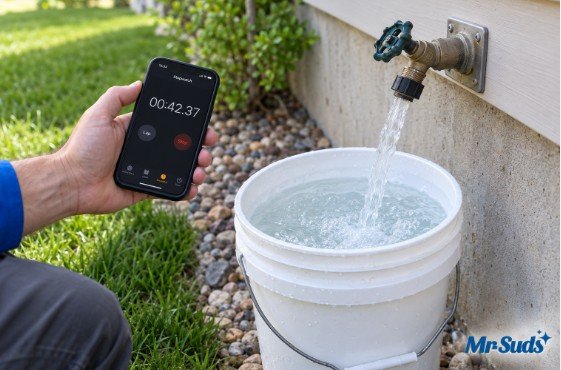
Time a five gallon bucket from an outside spigot with nothing else in the house running. Sixty seconds to fill is 5 gallons per minute.
Be honest about what that measures. It tells you what the well is doing in that minute, not what it sustains. A well can pass the bucket test comfortably and still run short forty minutes into a job, which is exactly what casing storage explains.
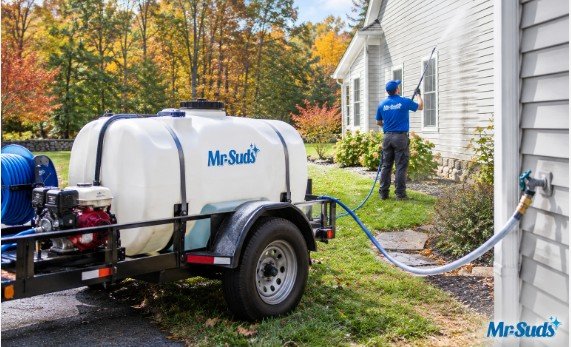
Buffer tank on the trailer
A tank lets you fill at a rate the well can sustain and draw from the tank at the rate the machine wants.
That converts a peak demand problem into an average demand problem, which is the single most useful piece of equipment on a well job. It is not unlimited, though. A tank buys you headroom, not a different well.
Stage the job in sections
Wash one elevation, let the well catch up, come back to the next. On a low yield well that is not a compromise, it is the correct method.
The important part is saying it in the quote rather than discovering it on the day. That colonial with the gravel drive went to two visits, and the homeowner had water that evening.
Schedule with the season
Book a well job after a wet stretch rather than at the end of a dry August.
June and July each average around ten days with precipitation here, and October is the wettest month by volume at roughly 3.7 to 3.8 inches. Late summer into early fall is when water tables sit lowest, which is precisely when people notice their siding and call.
Match the method to the supply
Soft wash the house. That is the low draw option and it is also the right method for vinyl and painted surfaces anyway.
And say plainly when a full driveway job is a poor match for a low yield well in a dry month, rather than starting it and finding out.
When we say no
Some jobs should not be done on some wells at some times of year. I would rather tell somebody that in August and book them for May than get halfway up a wall and shut down.
What to check after a wash on a well
Nobody covers this part, and it is where the lingering problems live.
Run an outside spigot first and watch for sediment before you use water inside. Check the tap aerators for grit a day later, because that is where silt shows up first. Change a loaded sediment filter rather than leaving it.
Watch the pressure tank for a day. New short cycling that was not there before the job is a reason to call a well contractor, not something to wait out.
If the water does not clear within a few hours, stop drinking it. And if the well was drawn hard, a bacteria test through a Connecticut state-certified laboratory is a reasonable precaution rather than an overreaction.
Who is responsible if something goes wrong
The homeowner normally supplies the water. That is standard across the trade and it is what the contract usually says.
It does not follow that a contractor can ignore obvious warning signs and keep pulling. Pressure fading and air in the line are not subtle.
The practical protection for both sides is getting it in writing. In Connecticut a home improvement contract must be in writing, signed by both parties, and contain the entire agreement, with any change also in writing and signed by both, under the Home Improvement Act at General Statutes Section 20-429. Water source, and what happens if the job has to pause, belong in that document.
Registration is verifiable free at elicense.ct.gov, and complaints go to the Connecticut Department of Consumer Protection. This is general information rather than legal advice.
Who around here actually has a well
Worth being straight about the geography rather than pretending every house has this problem.
Most of Newington is served by The Metropolitan District, so a homeowner on a typical Newington street is very unlikely to be on a private well.
Wells are more common out in Simsbury, Avon, Glastonbury, Portland and Cheshire, and even there it is street by street rather than town wide. Larger lots, older subdivisions, and roads that were built before the mains reached them.
The seasonal rhythm is the same everywhere. Recovery is better in spring and after a wet October. It is tightest at the end of a dry summer.
Quick reference
| Situation | What it means | What to do now | Who to call |
|---|---|---|---|
| Pressure fading at the wand | Draw is outrunning supply | Stop the machine, close the supply | Nobody yet |
| Sputtering, air in the line | Level has reached the pump | Shut down, do not restart to test | Well contractor if it repeats |
| Cloudy or brown water | Drawing near the bottom | Rest the well, flush outside first | Well contractor if it persists |
| Pump cycling rapidly | Not getting a full column | Stop all draw, let it rest | Well contractor if it continues next day |
| No water at all | Well drawn down or pump tripped | Cut power at the breaker, wait | Well contractor |
| Clears within an hour | Normal recovery after heavy use | Resume light use only | Nobody |
| Still cloudy next morning | Something has not settled | Do not drink it | Well contractor, and consider a test |
Frequently asked questions
How much water does a pressure washing company use on a house? Machines typically draw 4 to 8 gallons per minute, and a house wash uses roughly 100 to 300 gallons. Driveway and paver work uses more, because a surface cleaner runs at continuous flow.
Can you pressure wash a house on well water? Usually yes, especially a soft wash, which draws less because the solution does the work and the rinse is low pressure. The deciding factor is your well’s sustained flow, not the total gallons.
How do I know if my well is running low during a wash? Pressure fades at the wand first, then the line sputters with air, then the water turns cloudy. Inside, taps go weak and toilets fill slowly. Any of those is a reason to stop immediately.
Will pressure washing damage my well pump? It can, if the well is drawn down far enough that the pump runs dry. A submersible pump is cooled by the water it moves, so running dry means heat, a possible burnt motor and cavitation damage.
How long does a well take to recover after heavy use? Hours rather than minutes, and it depends on the recovery rate. Leaving it overnight is far more reliable than guessing after an afternoon.
Do pressure washing companies bring their own water? Many carry a buffer tank, which fills at a rate the well sustains and feeds the machine at the rate it needs. That helps considerably, but a tank is headroom rather than an unlimited supply.
Why is my water cloudy or brown after pressure washing? The pump has been drawing from nearer the bottom of the well and pulling sediment with it. Flush from an outside spigot first, check aerators and filters the next day, and do not drink it until it clears.
Should I have my well tested before booking exterior cleaning? A flow check is worth doing, and the bucket test takes a minute. If the well was drawn hard during a job, a bacteria test through a Connecticut state-certified laboratory is a sensible precaution afterwards.
Talk to us before you book, not after
That colonial got clean. It took two trips, and nothing broke.
What I tell homeowners on a well is that I would rather come back than call a well contractor for you.
So when you call, tell us your water source. If it is a private well we will ask a couple more questions, run the bucket test when we arrive, and plan the job around what the well can actually give.
Mr-Suds Power Washing PROs is at 130 Dewey Ave in Newington and covers eighteen towns across central Connecticut including Simsbury, Avon, Glastonbury, Portland, Cheshire and Farmington. Licensed, bonded and insured, 5.0 across roughly 39 Google reviews, and you can check our registration yourself at elicense.ct.gov.
Call (860) 263-9031 or email roman@mr-suds.com for a free quote. First house cleaning service is 15 percent off.