
What to Do When You Suspect a Contractor Is Unregistered in Connecticut
First warm Saturday of the spring in Newington. A flyer under the wiper, a decent price quoted over the phone for the front elevation of a split-level, and one question asked before booking: do you have a Connecticut registration number?
The answer took three days to not arrive.
That question should take about a minute to answer. Here is how to answer it yourself.
The short answer
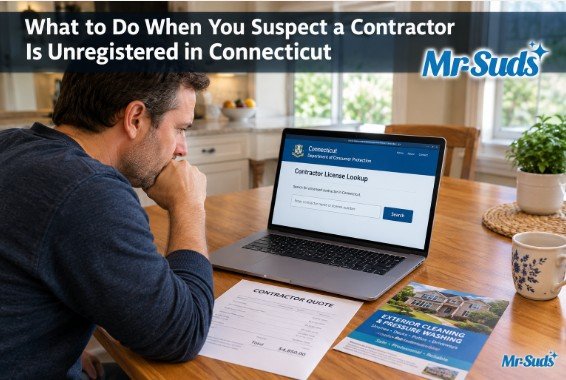
Check a Connecticut contractor free at the state eLicense portal, elicense.ct.gov, run by the Department of Consumer Protection. Select the Home Improvement Contractor credential type, search by business name, owner name or registration number, and confirm the status reads active with an expiry date beyond your project. Save a dated screenshot of the result.
If they are registered, keep going with the rest of your checks. This is a floor, not a verdict.
If they are not, do not sign anything yet, and read the section below for your situation.
If you already paid, skip ahead to the already-paid section. Your order of operations is different.
How to check a Connecticut contractor registration, step by step
Step 1: go to the state eLicense portal
Go to elicense.ct.gov. It is free, public, and you do not need an account. The Department of Consumer Protection’s own home improvement pages link to it.
Step 2: choose the right credential type
The portal covers every regulated credential in Connecticut, so you have to tell it what you are looking for. You want Home Improvement Contractor.
You may also see Home Improvement Salesperson. That is a separate credential held by an individual who sells the work, not by the company performing it, so do not accept one in place of the other.
Step 3: search by business name, owner name or registration number
Here is the practical problem nobody warns you about: the name on the truck is often not the registered legal name.
Try the legal entity name from the quote or contract first. Then the owner’s surname. Then any number printed on the paperwork. Partial name searches usually work better than exact ones, so search “Suds” rather than the full trading name with punctuation.
Step 4: read the status, the name and the expiry date
Three fields matter.
Status should read active. Name should match the entity on your contract, not merely resemble it. Expiry date should sit beyond the whole expected duration of your job, not just beyond today.
Step 5: save what you found
Screenshot it, or print to PDF, with the date visible.
Registration status can change. A dated record of what the portal said on the day you signed is genuinely useful if there is ever a dispute.
What if nothing comes up
Do not conclude anything yet.
Try alternate spellings, the owner’s personal name, the LLC name, a shortened form. Plenty of small companies are registered under an owner’s name rather than a trading name, which is exactly the kind of thing that makes a search come back empty for a perfectly legitimate business.
Only after those attempts does a blank result mean much. Even then, the honest next step is to ask the company directly rather than to decide.
What an HIC number looks like on a contract
Where it should appear
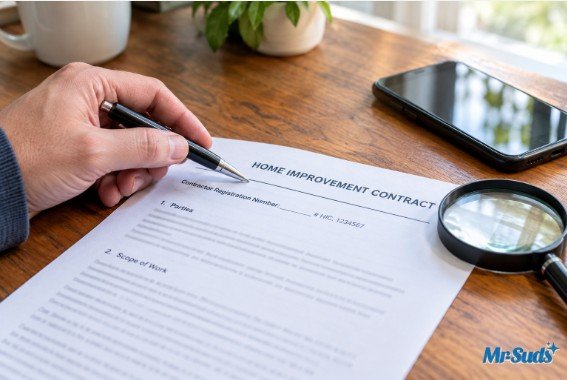
Section 20-429 of the General Statutes requires the contract to carry the contractor’s name and address and the contractor’s registration number, so it belongs on the contract itself, usually in the header or near the signature block.
Many companies also print it on estimates, invoices, vehicle lettering and their website. Missing from one of those is nothing. Missing from all of them is a question.
How to read it
The rule is simpler than the format. Whatever number appears on your paperwork should match, character for character, what eLicense returns for that company.
If it does not match, that is not a typo to shrug at. Ask about it before you sign, and treat the portal record as the truth rather than the printed page.
Registration is not a license
Connecticut registers home improvement contractors. It does not license them in the trade-exam sense, so “licensed” in a marketing headline may refer to something else entirely, or to nothing at all.
That is precisely why you check the record instead of reading the badge on a website.
Does a pressure washing company need to be registered
Fair question and worth answering carefully.
The Home Improvement Act, at Chapter 400, Section 20-418 and following, defines the field broadly around work performed on residential property. Whether a specific service sits inside that definition is a question for the Department of Consumer Protection, not for a contractor’s blog post.
The practical guidance for a homeowner is the same either way: ask the company directly, and check eLicense. Do not assume in either direction based on the name of the service.
What the contract itself should contain
Hold your paperwork against this list.
The requirements under Section 20-429
In writing. Signed by both the owner and the contractor. Contains the entire agreement. Carries the date of the transaction, the contractor’s name and address, and the contractor’s registration number. Includes notice of your cancellation rights. Includes a starting date and a completion date. Is entered into by a registered contractor or a registered salesperson. Any change to it is in writing and signed by both parties. And you get a completed copy at signing.
The four dates and the cancellation notice
Department of Consumer Protection guidance adds that the contract needs four dates: the signing date, the start date, the completion date and the cancellation deadline, plus a duplicate Notice of Cancellation.
You may cancel any time before midnight on the third business day after the transaction. In Connecticut, Saturday counts as a business day for that. Sundays and the ten designated holidays do not, which means a Thursday signing runs out sooner than most people assume.
Contract checklist
| Requirement | Where to look | What a gap means |
|---|---|---|
| In writing, signed by both | The whole document | A verbal agreement gives neither side much |
| Entire agreement contained | Body of the contract | Side promises that are not written are hard to rely on |
| Date of the transaction | Header or signature block | Starts the cancellation clock, so it matters |
| Contractor name and address | Header | Should match the eLicense record exactly |
| Registration number | Header or signature block | Worth one direct question before signing |
| Notice of cancellation rights | Attached or on the reverse | A required element, and a common omission |
| Starting date | Schedule section | Without it, “soon” is unfalsifiable |
| Completion date | Schedule section | Without it, a delay cannot be measured |
| Changes in writing, signed | Change order section | This is what stops a price moving after the fact |
| A completed copy at signing | Your own file | You should leave with paper, not a promise |
A missing completion date is sloppiness. A missing registration number is a question. All of them missing at once is a pattern.
What changes for you if the contractor is not registered
If you have not signed yet
Do not sign. That is the whole answer.
It is not a judgment about the person. It is about what you can rely on afterward, and a company that intends to keep working in Connecticut can register.
If you have already paid a deposit
Work it in this order.
Ask directly, in writing, whether they are registered and under what name. Check the answer on eLicense yourself. If the transaction is recent enough, look at the three business day cancellation right. Put any cancellation in writing rather than by phone. Keep every document, text and receipt.
Be realistic: recovering a deposit can be slow, and it may end in small claims. Starting early is the only part of it you control.
If the work is already done and something went wrong
At this point the registration question shapes which remedies exist rather than whether you are owed anything.
The routes are a complaint to the Department of Consumer Protection, small claims, and the Guaranty Fund conditions in the next section. Connecticut small claims handles most consumer money claims up to 5,000 dollars, and you should confirm the current limit with the Judicial Branch before filing.
The contract may not be enforceable against you
Connecticut courts have treated home improvement contracts that fail the Section 20-429 requirements as unenforceable by the contractor, which is a meaningful protection for homeowners.
That analysis is fact-specific and it belongs with an attorney, not with a web page. This article is general information, not legal advice, and it is not telling you that you can simply refuse to pay for work you received.
The Home Improvement Guaranty Fund, in full
What it is
Administered by the Department of Consumer Protection and funded by contractor registration fees. It pays up to 25,000 dollars for actual damages, court costs and attorney’s fees as ordered in a court judgment.
The structural point people miss: it follows a judgment. It does not replace one.
Who qualifies
- The contractor was registered when the contract was signed, within two years after signing, or at the time of judgment.
- The work was on residential property: a single or multifamily dwelling of six units or fewer, a condominium or a cooperative.
- The contract price was more than 200 dollars.
- New home construction is not covered.
What the process requires
A Superior Court or Federal Court judgment requires a failed collection attempt through a state marshal’s writ of execution first. A small claims judgment does not, which is one practical reason many homeowners use the smaller forum.
The application must be filed within two years of the judgment, and processing can take up to 24 weeks. Eligibility questions go to dcp.guarantyfunds@ct.gov.
The registration timing point that surprises people
Read the first condition again, because it is more generous than it looks.
A contractor who registers after signing your contract can still bring you inside the Fund’s conditions, provided that registration lands within two years of signing or by the time of judgment.
So before you conclude the route is closed, check eLicense again. A company that was unregistered in April may not be unregistered now.
CUTPA, briefly
Connecticut’s unfair trade practice law is CUTPA, at Section 42-110a and following, and Home Improvement Act violations are commonly pleaded as CUTPA violations.
It matters because it opens remedies beyond a plain contract claim. It is also a matter for a Connecticut attorney, and that is as far as I am going to take it.
Filing a complaint with the Department of Consumer Protection
DCP takes consumer complaints online. Have ready the contract, the invoice, the payment record, photographs, and your dated record of what eLicense showed.
Set expectations honestly. DCP is a regulator that can act on a registration and build a file on a repeat problem. It is not a service that recovers your money.
Registration is a floor, not a quality signal

What it proves
That a company paid a fee and filed with the state. That supports the Guaranty Fund route and gives the state something to act on. Both of those are real and worth having.
It is not a skills test, an inspection, or a guarantee of anything.
What it does not prove
Let me say the unhelpful part out loud, since I am the one with the registration.
A registered company can still burn siding with too much pressure, strip a deck, blow a window seal, force water behind vinyl, or take a deposit and vanish in July. Registration is the price of entry, not a verdict on the work.
Five things to check on top of it
- A certificate of general liability insurance, sent by the agent or insurer rather than photographed off a card, with your name on it where possible.
- Workers compensation, if anyone other than the owner will be on your property.
- A written scope by surface, naming the process used on each one. This is where exterior cleaning competence actually shows.
- Reviews that describe specific surfaces and specific problems, across more than one platform, rather than generic praise.
- Connecticut sales tax on the invoice. House washing is a taxable maintenance service on residential property under Department of Revenue Services guidance, at 6.35 percent, so a missing tax line is worth a question.
Why the pressure question tells you more than the paperwork
The most damaging thing an exterior cleaner can do is use pressure where a soft wash was needed. On vinyl, on a roof, on painted trim, on aged aluminum, that is how you get streaked siding, stripped paint, water behind panels and shingle granules in the driveway.
Ask any company this: what pressure will you use on my roof, and what solution. Thirty seconds of that answer will tell you more about competence than any lookup will.
Do both checks anyway. They measure different things.
How to raise it with a contractor you actually like
The one sentence to ask
“Before we go ahead, can you send me your Connecticut home improvement registration number and a certificate of insurance? I check it for everyone, it is nothing personal.”
That works because it is framed as your policy rather than your suspicion, it is easy to comply with, and it gives the company a clean route to say yes.
What a good response sounds like
The number arrives without fuss, often already printed on the paperwork. The certificate comes from the agent.
On my side of it, homeowners ask me this regularly. It takes a minute to send, and in my experience the people who ask turn out to be the best customers to work for, because they read what they sign.
What a poor response sounds like
Delay. Irritation. “We have been doing this twenty years.” An offer of a discount to skip the paperwork. A photo of a card instead of a certificate. Or a number that does not match the portal record.
That is information. What you do with it is your decision.
If they are not registered and you still want to use them
Some of you will go ahead anyway with a small operator you trust, and I am not going to lecture about that.
Know what you are accepting. No Guaranty Fund route. A contract that may not be enforceable in either direction. And no registration for DCP to act on if it goes wrong.
If you proceed, reduce the risk where you can: a written scope by surface, a small deposit rather than a large one, the balance on completion, proof of insurance before the truck arrives, and your own photographs before and after.
Frequently asked questions
How do I check if a contractor is licensed in Connecticut? Search the state eLicense portal at elicense.ct.gov under the Home Improvement Contractor credential type, using the business name, the owner’s name or the registration number. Confirm the status reads active and the name matches your contract.
What is a Home Improvement Contractor registration number? The credential number the Department of Consumer Protection issues to a registered home improvement contractor. Section 20-429 requires it to appear on your contract, and it should match the eLicense record exactly.
Is registration the same as a license in Connecticut? No. Connecticut registers home improvement contractors rather than licensing them through a trade examination, so “licensed” in an advert may mean a different credential or none at all. Check the record instead.
Do pressure washing companies need to be registered in Connecticut? The Home Improvement Act defines the field broadly around work on residential property. Whether a particular service falls inside it is a question for the Department of Consumer Protection, so ask the company and verify on eLicense rather than assuming.
What happens if I already paid an unregistered contractor? Ask in writing whether they are registered, verify it yourself, check the three business day cancellation right if the signing was recent, and keep every document. Recovery can be slow and may end in small claims.
Can an unregistered contractor sue me for payment in Connecticut? Connecticut courts have treated contracts failing the Section 20-429 requirements as unenforceable by the contractor. The analysis is fact-specific, so speak to a Connecticut attorney about your own situation.
What is the Home Improvement Guaranty Fund? A Department of Consumer Protection fund that pays up to 25,000 dollars for actual damages, court costs and attorney’s fees as ordered in a court judgment. It requires a judgment first, plus registration timing, residential property of six units or fewer and a contract price over 200 dollars.
Does registration mean the contractor is insured? No. They are separate things. Ask for a certificate of general liability insurance from the agent, and ask about workers compensation if anyone other than the owner will be on the property.
How do I file a complaint against a contractor in Connecticut? File online with the Department of Consumer Protection, attaching the contract, invoice, payment record, photographs and your eLicense screenshot. It creates a record and can prompt action on the registration, but it does not recover money.
Check us the same way
Back to that unanswered question under the wiper blade.
The answer should take about a minute. If it takes three days, you already know something, and it has nothing to do with how good the price was.
So run this exact process on us before you book. The registration number and a certificate of insurance go out on request, same day, and I would rather you checked.
Mr-Suds Power Washing PROs is based at 130 Dewey Ave in Newington and covers eighteen towns across central Connecticut including Hartford, Wethersfield, Rocky Hill, Berlin, Farmington and Glastonbury. Licensed, bonded and insured, 5.0 across roughly 39 Google reviews, and named Ranked #1 Pressure Washing Service in Newington for 2026 by BusinessRate.
Call (860) 263-9031 or email roman@mr-suds.com for a free written quote with the scope set out surface by surface. First house cleaning service is 15 percent off.