
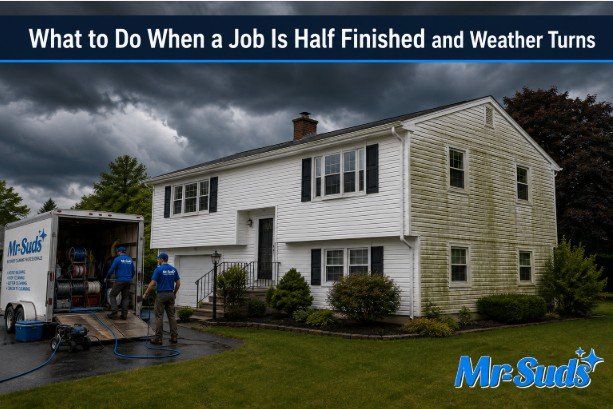
A July afternoon on a split-level with a long concrete apron. The front and one side elevation washed and rinsed, the back still untouched, and the crew standing by the trailer looking at a phone screen instead of at the house.
The homeowner comes out and asks the question everybody asks: are you coming back?
Fair question, wrong order. The urgent one is what is still sitting on the siding right now.
The short answer
If a crew stops mid-job for weather, three things should happen before they leave. Every surface already treated gets fully rinsed, the site gets made safe, and you get a specific return date the same day. In Connecticut a home improvement contract must carry a start date and a completion date, so the new date belongs in writing.
The first question is not who pays, it is what is still on the house
Money can wait until tomorrow. Chemistry cannot.
A stoppage between application and rinse is not an inconvenience. It is an unfinished process, and the surfaces are still working while everybody argues about the schedule.
Why a partially rinsed soft wash is a real problem
Soft washing is three steps, not one. A cleaning solution goes on at low pressure. It is left to dwell so it can kill and release the organic growth. Then it gets rinsed off.
The rinse is not cleanup. It is the last step of the process, and skipping it changes the outcome.
Here is the mechanism. That solution was mixed to a working strength that is safe on the surface at that strength. When it is left to dry instead of being rinsed, the water evaporates and what remains concentrates, and it concentrates most exactly where it pools: at panel laps, under window sills, along trim edges, in the low corner of a run.
What that looks like on a house varies. On vinyl and aluminum siding it can leave streaking and visible residue lines following the run pattern, and on older chalky siding it interacts with oxidation that was already there. On adjacent brick, stone and painted trim there is a staining risk that depends on the surface and on how long it sat.
The bigger risk is below the wall. Foundation plantings and lawn under a treated elevation are protected by dilution and by rinse water. Take away the rinse and the protection goes with it. If a crew has left an elevation unrinsed and you have beds underneath it, water those beds well. That is safe to do and it buys time.
Heat makes all of it faster. A sunny south elevation at two in the afternoon in July behaves very differently from a shaded north wall in the same hour.
Now the part most homeowners get backwards. Rain arriving is not the same as a rinse. A rinse is even, deliberate and top down. A shower is uneven, runs in channels, and can leave a worse pattern than either a proper rinse or no rain at all. So “it’s about to rain anyway” is not a reason to pack up an unrinsed wall. It is a reason to rinse faster.
None of this means damage is certain. It means the risk is real, it grows with time and heat, and it is entirely avoidable in about ten minutes.
What a crew should do in the last ten minutes
When a stoppage becomes necessary, the sequence is not complicated.
Stop applying immediately. Rinse everything already treated. Rinse down the plantings and lawn below the treated area. Then start packing.
Applying takes far longer than rinsing. That is why “we ran out of time to rinse” is almost never a real reason.
Why half-cleaned concrete leaves a visible line
A surface cleaner cuts a defined path, so the boundary of that path is a hard edge rather than a fade. Stop halfway across a driveway and you get a line, not a gradient.
That line is not a defect in the part that got cleaned. It is contrast between cleaned and uncleaned concrete, and it is most obvious on a flat open surface in full sun.
The honest complication is the second visit. Concrete is porous. A section cleaned today and left through a rain event can settle to a slightly different tone from a section cleaned a week later, so finishing a concrete surface in one visit matters more than finishing siding in one visit.
And where a chemical treatment was put down on concrete or pavers and not rinsed, the same concentration problem applies as on siding.
Decks, roofs and where stopping costs the most
A wood deck mid-strip is the worst place to stop. A cleaner or stripper left to dry can raise grain unevenly and lighten in patches, and a deck that has been cleaned but not neutralised or brightened is in an unfinished chemical state, not just a wet one.
Composite and PVC decking is more forgiving, but it still shows residue lines if it dries unrinsed.
Roof soft washing is the opposite case. It is the surface where stopping is most often correct rather than avoidable, because wind carries solution well beyond the roof and wet asphalt shingle is a genuine fall hazard. What still has to happen is the treated area being handled properly from the ground before the crew leaves.
What should be secured before the crew leaves
Ten minutes of work, and you can ask for all of it at the truck.
- All treated surfaces rinsed. The reason is the whole section above.
- Plantings and lawn below treated elevations rinsed down. Dilution is the protection.
- Hoses and lines cleared off walkways and steps. The most common trip hazard left behind.
- Ladders down and secured or removed. Never left leaning overnight.
- Spigots shut off and connections removed. An open connection is a slow flood waiting for a bad night.
- Tarps and coverings secured properly or taken away. A loose tarp becomes a sail.
- Downspout extensions and gutter guards put back. If they were moved, they need to go back before rain.
- Furniture, grills and planters replaced or moved somewhere safe.
- Drains and window wells clear. Debris washed loose has to go somewhere.
- A walk-around with you before the truck moves. Two minutes, and it settles almost every dispute this article exists for.
One local note. Overnight lows in Newington fall below freezing December through March, and March and November nights regularly sit in the low 30s. A rinsed walkway, step or driveway apron left wet in shoulder season is a slip hazard by morning. A crew stopping in November should be clearing standing water off walking surfaces, not just coiling hose.
Genuine safety call or convenient excuse
Back to the crew by the trailer looking at their phone.
Checking radar and then rinsing is a crew behaving correctly. Checking radar and then packing wet is not. From your driveway, those two look identical for about ninety seconds.
Here is how to tell them apart after that.
The stops that are always legitimate
Lightning anywhere in the area, and especially with anyone on a roof or a ladder. Wind strong enough to carry solution onto a neighbour’s car, a vegetable garden or an open window. A wet roof surface. Standing water or ice underfoot. Poor visibility. Temperature outside the working range for a sealing or coating step.
A crew that stops for these is showing you its safety culture. That is a reason to trust them more, not less.
The stops that deserve a question
A stop with no rain in the forecast and no wind. A stop immediately after a phone call. A stop where the crew leaves without rinsing. A stop with no return date offered. A stop where the reason changes between the crew on site and the office on the phone. A stop late in the day on a job that was never going to fit the window it was booked into.
The three questions to ask at the truck
Say these plainly. None of them start a fight.
- What is still on the surfaces right now, and does it need rinsing before you go?
- When are you coming back, and can you text me that date before you leave?
- Is there anything I should not walk on or water tonight?
The answers tell you nearly everything about the company you hired.
Reading the stoppage
| Situation | Legitimate stop | Something else |
|---|---|---|
| Conditions | Lightning, wind, wet roof, ice, poor visibility | Clear sky, no wind, nothing in the forecast |
| The rinse | Finished before anything was packed | Surfaces left wet with solution on them |
| Return date | Given on the spot, with a day | “We’ll be in touch” |
| In writing | Texted or emailed the same day | Nothing, and no offer to send it |
| Site condition | Hoses, ladders, spigots, tarps all handled | Gear left where it fell |
| The explanation | Specific and consistent | Changes between the crew and the office |
| Walk-around | Offered before the truck moved | Truck left while you were inside |
| The balance | Not requested in full on an unfinished job | Full payment pushed before completion |
Who pays for the return trip
The default
When a company stops for its own operational reasons, including weather it chose to work through and then retreated from, the return trip is the company’s cost.
You contracted for a finished result, not for a number of visits. A weather delay changes the schedule, not the price.
The honest exceptions
To be fair to the trade, there are cases where a second visit reasonably carries a charge. You cancelled or rescheduled at short notice. Access was not available on the return date. The scope changed after the first visit. A separate service was added.
In every one of those the charge should be agreed in writing before the return visit. Section 20-429 requires that anyway, since a change to a home improvement contract has to be in writing and signed by both parties.
What about the balance
Paying for completed work is normal. Paying the full contract balance on an unfinished job gives away the only leverage you have, so that part should wait for completion.
The fair posture: pay for what is genuinely done if the company asks, hold the remainder until the job is finished, and say so in writing rather than going quiet in return.
What the contract should say about weather
The Connecticut baseline
Under the Home Improvement Act, in Chapter 400 of the General Statutes, Section 20-429 requires a home improvement contract to be in writing, signed by both parties, and to contain the entire agreement, the date of the transaction, the contractor’s name, address and Home Improvement Contractor registration number, notice of your cancellation rights, and a starting date and a completion date.
The point that matters today: a weather delay does not delete the completion date. It makes a written change necessary.
You should also receive a Notice of Cancellation, with the right to cancel before midnight on the third business day after the transaction. In Connecticut, Saturday counts as a business day for that. Sundays and the ten designated holidays do not.
The four lines worth having in writing
Who makes the weather call, and by what time of day. What happens to a partially completed job, specifically that all treated surfaces get rinsed before the crew leaves. How quickly a return date is provided and in what form. Whether a return visit carries any charge, and under what conditions.
A company willing to put those four in writing has done this before.
Verify who you are dealing with
Connecticut requires home improvement contractors to register with the Department of Consumer Protection, and you can check free on the state eLicense portal using the exact business name from your contract.
Why this happens so often in central Connecticut
| Month | Average days with precipitation in Newington |
|---|---|
| March | 5.9 |
| April | 7.9 |
| May | 9.9 |
| June | 10.0 |
| July | 10.3 |
| August | 9.3 |
| September | 8.0 |
| October | 7.7 |
| November | 7.6 |
In June and July, roughly one day in three carries measurable precipitation, and summer convection means a clear 8am promises nothing about 2pm. That July afternoon in the opening was very likely one of about ten wet days that month, which is exactly why a company working central Connecticut in summer should already have a stoppage routine rather than improvising one in your driveway.
October is a different risk. Average highs sit around 62F with lows near 45F and fewer precipitation days than July, but it is the wettest month by volume at roughly 3.7 to 3.8 inches. Fewer interruptions, heavier ones.
The shoulder months constrain the work in another way. Average highs of about 48F in March and 51F in November, with lows around 31F and 36F, limit rinse water on walking surfaces and rule out sealing or coating steps that carry a minimum application temperature and a cure period.
A weather-stopped job in peak season should be back on the calendar within the same week or the next, with the date given the same day it stops. A second push in June or July is statistically normal. A third with no firm date is a scheduling problem wearing a weather costume, and a good company will tell you where you sit in its makeup capacity.
How we handle a stoppage on our trucks
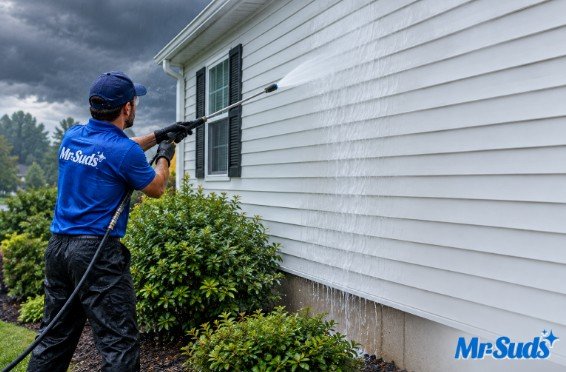
The weather call is made in the morning, off the radar, by me.
We try not to start an elevation the crew cannot finish and rinse. When the call comes mid-job anyway, application stops, the rinse gets completed, the beds and lawn below the treated wall get watered down, and only then does anything get packed.
There is a walk-around with the homeowner before the truck moves. The return date is given on the spot and confirmed by text or email the same day. A weather return trip is not billed, because the price was for a finished house.
And I have misjudged an afternoon. More than once, in July, watching a cell that was supposed to go north of us. When that happens you get told it was our call, not the weather’s, and you get a date.
We are at 130 Dewey Ave in Newington, open Monday to Friday 8am to 4pm with weekends by appointment, licensed, bonded and insured, and the phone reaches me rather than a call centre.
Frequently asked questions
Can you pressure wash in the rain? Light rain is workable on some surfaces if footing is stable and there is no lightning. Steady rain cuts the dwell time a cleaning solution needs, so the clean is weaker. Roof and ladder work stops well before driveway work does.
What happens if soft wash solution is not rinsed off? As the water evaporates the remaining solution concentrates, which can leave streaking and residue on siding, carries a staining risk on adjacent surfaces, and removes the dilution protecting plantings below. Risk grows with time and heat, so it should be rinsed before the crew leaves.
Is rain the same as a rinse? No. A rinse is even and deliberate. Rain is uneven, runs in channels, and can leave a worse pattern than a proper rinse would. A shower in the forecast is a reason to rinse faster, not a reason to skip it.
Why does half-cleaned concrete leave a visible line? A surface cleaner cuts a defined path, so its boundary is a hard edge rather than a fade. The line is contrast between cleaned and uncleaned concrete, and it is most visible on flat open surfaces in full sun.
Should a crew finish the rinse before leaving in bad weather? Yes. Rinsing takes far less time than applying, and it is the final step of the process rather than tidying up. Leaving treated surfaces unrinsed is the one part of a weather stoppage that is genuinely avoidable.
Who pays for the return trip after a weather delay? The company, in almost every case. You bought a finished result, not a set number of visits. A charge is reasonable only where you cancelled at short notice, access was unavailable, or the scope changed, and it should be agreed in writing first.
Do I have to pay the full price for a job that was stopped partway? Pay for what is genuinely completed if asked, and hold the balance until the job is finished. Say that in writing rather than going silent, so the record shows you as reasonable.
Is it safe to clean a roof when it is wet or windy? No. Wet asphalt shingle is a real fall hazard and wind carries solution onto plantings, vehicles and neighbouring property. A crew that refuses a wet roof is showing you good judgment.
If you want the rinse finished before the truck leaves
Back to that July afternoon.
On our trucks, the same afternoon looks like this: application stops, the rinse gets finished, the plantings get watered down, there is a walk-around at the truck, and the return date is on your phone before the crew leaves the street.
Hire on that standard rather than on the number at the bottom of the quote. It is testable on the first job, which is the only kind of promise worth publishing.
Mr-Suds Power Washing PROs covers eighteen towns across central Connecticut from Newington, including Hartford, Wethersfield, Rocky Hill, Berlin, Farmington and Glastonbury, with a 5.0 rating across roughly 39 Google reviews.
Call (860) 263-9031 or email roman@mr-suds.com. First house cleaning service is 15 percent off.