
What to Do When a Contractor Cannot Produce Proof of Insurance
Three quotes on the kitchen counter of a 1960s split-level in Newington. Vinyl siding, a tall maple leaning over the back roof, and one of those quotes several hundred dollars under the other two.
At the door the homeowner asks the question everybody asks: “You’re insured, right?”
The answer comes back fast and friendly. It also comes back completely unverifiable. What happens over the next week is a paperwork story, not a disaster story, and the only real question in it is whether the homeowner asks a second time.
The short answer
If a contractor cannot produce proof of insurance, do not hire them. Ask for a certificate of insurance sent directly from their insurance agent, with your name and property address in the certificate holder box. Then call the agency listed on the certificate and confirm the policy is active today.
A screenshot does not count. A PDF forwarded from the contractor’s own phone does not count either, because you have no way of knowing when it was issued or whether that policy is still in force this morning.
What a certificate of insurance actually is, and what it is not
The document you are asking for is usually an ACORD 25, and the insurance agent issues it, not the contractor.
It is a summary of coverage that was true on the day it was printed. It is not the policy, and it does not create coverage. Read the small print and you will find language saying the certificate is issued as a matter of information only and confers no rights on the holder.
That sounds like a technicality. It is not. It means a certificate can be entirely genuine on Monday and worth nothing by Friday, because a policy can lapse mid-term for non-payment.
Which is exactly why the date on the document and the name in the holder box matter so much.
How to read the certificate, box by box

The producer box, top left
This is the insurance agency, not the contractor. It is who you call.
A certificate with no producer phone number is a certificate you cannot verify, and that alone is enough to send it back.
The insured box
This is the legal business name of the company carrying the policy.
It has to match the name on your quote, on the contract and, ideally, on the truck. A different legal entity is a different business, and coverage does not follow a similar-sounding name.
The insurer and policy numbers
You should see a real carrier name, a policy number and an NAIC code for each line of coverage.
Blank policy numbers, a carrier you cannot find, or numbers that look inconsistent between lines are all worth one phone call to the producer.
The dates
Every line of coverage has an effective date and an expiration date. Check both.
A certificate issued eight months ago proves what was true eight months ago. Ask for one issued recently, with your name on it.
The limits
Two numbers matter most. “Each occurrence” is the most the policy pays for a single incident. “General aggregate” is the most it pays across the whole policy year.
For exterior cleaning work in Connecticut, one million per occurrence and two million aggregate is a common range. Do not stop at the number though. Whether the policy actually covers the work you are buying matters more than how big the limit is.
The description of operations box
This is the box people skip and it is one of the most useful.
If you are buying roof cleaning and this box describes janitorial work or landscaping, ask the agent directly whether roof work is covered under that policy. Some policies exclude work above a certain height.
The certificate holder box
Here is the field that quietly tells you the most.
If the certificate names you and your property address, it went through the agent’s office on the date it was issued. That makes it current by definition, because nobody produces a fresh certificate for a policy that is not in force.
If it reads “To Whom It May Concern,” or names somebody else entirely, you are holding a recycled document. That is the shape this usually takes in real life: the homeowner asks, a PDF arrives forwarded from the contractor’s phone, and the holder line has another customer’s name still sitting on it.
So ask to be listed as certificate holder, with the property address, and ask for it to arrive from the agent’s email.
The cancellation notice language
Older certificates promised the holder would be notified before cancellation. Modern ones say notice will be delivered in accordance with the policy provisions, which is not a promise to you.
Assume nobody will call you if that policy lapses. That is the whole argument for a recent certificate rather than one from last spring.
The two coverages that matter for exterior cleaning
General liability, and what it does not cover
General liability responds to third party property damage and bodily injury arising from the work.
In this trade that means water forced into a soffit or behind a window frame, chemical damage to foundation plantings, overspray on a car, a broken light fixture, damage to a neighbour’s property across a narrow side yard, or a passerby going down on a wet walk.
Now the honest half. General liability generally does not pay to redo the contractor’s own defective work, and it does not cover the contractor’s own injured employees. That second gap is the one that lands on you.
Workers compensation, and why it matters most here
In Connecticut, a business with one or more employees, full time or part time, must carry workers compensation coverage under the Workers’ Compensation Act.
Sole proprietors, partners, LLC members and corporate officers may elect not to cover themselves, but they still have to cover their employees. Enforcement sits with the Connecticut Workers’ Compensation Commission and can include a stop work order and per worker, per day fines.
That election is where the ghost policy comes from. A genuine one-man operation excluding himself is perfectly legitimate. The problem is when the policy shows coverage, the owner is excluded, and three men show up on the day. On paper there is a policy. Underneath it there is effectively nobody insured.
Ask the plain question: are the people who will actually be on my property covered by this policy.
What happens to your own insurance if an uninsured worker is hurt on your property
This is the part homeowners rarely say out loud, and it is the real reason the question matters.
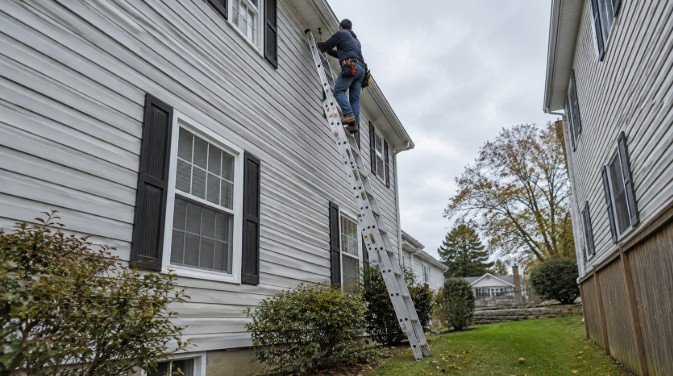
Exterior cleaning puts people on ladders and roof edges above your driveway. If someone is hurt there and has no workers compensation behind them, there is one place left to look for medical bills and lost wages, and that place is the property owner.
Most homeowners policies carry personal liability coverage and a small medical payments coverage. The medical payments part is limited and is meant for minor incidents. The liability part may only respond where there is a finding of negligence, and that is a fight, not a formality.
There is a further wrinkle worth knowing. Some policies limit or exclude coverage where the injured person is treated as the homeowner’s own employee, which is a category an uninsured worker can end up in more easily than people expect.
All of that varies by policy and by carrier. Ask your own insurance agent how your policy would respond, and ask before you hire, not after. It is a five minute phone call and it is free.
Your fifteen minute verification routine
- Ask for the certificate of insurance, and ask to be listed as certificate holder with your property address.
- Insist it arrives from the agent’s email address, not forwarded by the contractor.
- Check the insured name against the quote, the contract and the truck.
- Check the effective and expiration dates on every line.
- Read the description of operations for the work you are actually buying.
- Call the producer’s number and ask one question: is this policy active today. That is the whole call.
- Look up workers compensation independently through the Connecticut Workers’ Compensation Commission Coverage Verification Service at ewccv.com/cvs/, searching the exact business name. Note its limits: it shows traditional policies and does not show self-insured employers.
- Check home improvement registration on the state eLicense portal at elicense.ct.gov, run by the Department of Consumer Protection.
- Confirm the written contract carries the Home Improvement Contractor registration number. Section 20-429 requires it, along with a start date, a completion date and a notice of cancellation.
None of that requires you to be rude. Steps 1 through 5 are reading. Step 6 is one sentence to a stranger who answers this question all day.
“Licensed, bonded and insured” is a claim, not proof
You will see that phrase on nearly every exterior cleaning website in Connecticut, ours included. It is worth unpacking, because the three words carry very different weight.
Licensed, in this trade, usually means registered as a home improvement contractor with the Department of Consumer Protection. That is verifiable free on eLicense in about a minute.
Bonded is the least understood and often means the least. A surety bond typically covers a specific failure and is not a substitute for liability coverage. Do not read it as insurance.
Insured is the only one of the three that requires the certificate we have been talking about.
I put that phrase on my own site. I also expect to be made to prove all three, and the state tools linked above work just as well on us as on anyone else.
What to say when the contractor stalls
Start friendly and in writing, so there is a record:
“Before we book, could you have your insurance agent send me a certificate of insurance with my name and address as certificate holder? Happy to wait a day for it.”
That is a normal request. Most companies will have it to you the same afternoon, because an agent can usually issue a certificate in minutes.
The tells are the answers that are not a certificate:
- “My agent is out this week.”
- “I’ll bring it the day of.”
- “The certificate costs money.”
- “Nobody else asks for that.”
The last one is the one to take most seriously, because it is often true and it is not a reason.
If a few days pass with no certificate, you have your answer without anyone having to be unpleasant about it. “Thanks for coming out, I’ve decided to go a different way” is a complete sentence. You do not owe an explanation to a company that would not produce a document.
How this plays out in Newington
The housing stock here does most of the arguing for me. Newington and the towns around it are largely 1950s to 1980s ranches, colonials and split-levels, vinyl or aluminum siding, mature trees, and lots that were laid out when side yards were narrower than they are today.
That combination creates the exact risks insurance exists for. Gutter and roof work on a two story colonial means ladder work at height. Sloped side yards mean footing a ladder on ground that is not level. Tight lot lines mean a soft wash solution carried on a breeze can reach a neighbour’s car before it reaches the ground.
Timing makes it worse. June and July each average around ten days with precipitation in this area, so the good working window is narrow and everybody is trying to book into it at once. Hiring in a hurry is exactly when verification gets skipped.
The same applies across Hartford, Wethersfield, Rocky Hill, Berlin and Farmington. Older stock, close neighbours, and a short season.
Certificate red flags at a glance
| What you see | What it might mean | What to do |
|---|---|---|
| Holder box reads “To Whom It May Concern” | A recycled certificate of unknown age | Ask for one issued to you, from the agent |
| Holder box names another customer | The same document is being reused | Same, and read the dates carefully |
| Expiration date has passed | The policy may have lapsed | Do not proceed until a current one arrives |
| Insured name does not match the quote | A different legal entity may hold the policy | Ask which entity is doing your work |
| No producer phone number | You cannot verify anything on the page | Request a complete certificate |
| Description of operations omits your work | The policy may not cover roof or pressure washing | Call the agent and ask directly |
| Workers compensation section blank or excluded | Possibly a one-man policy, possibly a gap | Ask who will actually be on site, then check the state service |
| A PDF forwarded from the contractor’s phone | Unknown issue date, unknown current status | Ask for it from the agent’s email |
| A business card offered instead | No verifiable coverage at all | Walk away |
Frequently asked questions
Is a certificate of insurance the same as an insurance policy? No. A certificate is a one-page summary issued by the agent, showing what was in force on the date it was printed. It does not create coverage and it confers no rights on you. That is why the issue date and a call to the agency both matter.
Can a contractor just send me a screenshot of their insurance? No, and you should not accept one. A screenshot or a forwarded PDF tells you nothing about when the document was issued or whether the policy is still active. Ask for a certificate sent directly from the insurance agent with you named as certificate holder.
What is the certificate holder box and should my name be in it? It is the box naming who the certificate was issued to. Your name and property address in that box means the agent produced it for you on that date, which makes it current. A generic or unfamiliar name means it is a recycled copy.
Does general liability cover a worker who falls off a ladder? Generally no. Injuries to the contractor’s own employees are the job of workers compensation, not general liability. That is the single most important gap for a homeowner to understand before hiring.
Is workers compensation insurance required in Connecticut? Yes for businesses with one or more employees, full or part time, under the Workers’ Compensation Act. Owners, partners, LLC members and corporate officers may elect not to cover themselves, but employees must be covered.
What happens if an uninsured worker gets hurt at my house? With no workers compensation behind them, the injured person’s remaining route is often a claim against the property owner. How your homeowners policy responds depends on the policy, so ask your own agent how yours would handle it before you hire anyone.
How do I know if a certificate is still active? Call the producer listed on the certificate and ask whether the policy is active today. For workers compensation you can also search the business name yourself through the Connecticut Workers’ Compensation Commission Coverage Verification Service.
What if the contractor gets offended when I ask? Then you have learned something useful at no cost. Insured companies produce certificates constantly and think nothing of it. Being asked to prove coverage is a normal part of the job, not an accusation.
Before you sign, one last thing
Back to the split-level with the three quotes.
The homeowner in that story did the simplest possible thing. Called the agency number printed on the certificate and asked whether the policy was active. Ninety seconds later they had a straight answer from someone with no stake in the sale, and made the decision on information instead of instinct.
That is the whole standard, and any company should be able to survive it. On our jobs the certificate goes out before the trailer does, and a company that cannot manage that inside a day is telling you something without meaning to.
Mr-Suds Power Washing PROs is based at 130 Dewey Ave in Newington and works across eighteen towns in central Connecticut including Hartford, Wethersfield, Rocky Hill, Berlin and Farmington. Open Monday to Friday 8am to 4pm, weekends by appointment, with a 5.0 rating across roughly 39 Google reviews.
Call (860) 263-9031 or email roman@mr-suds.com. Ask for the certificate before you ask for the price. First house cleaning service is 15 percent off.