
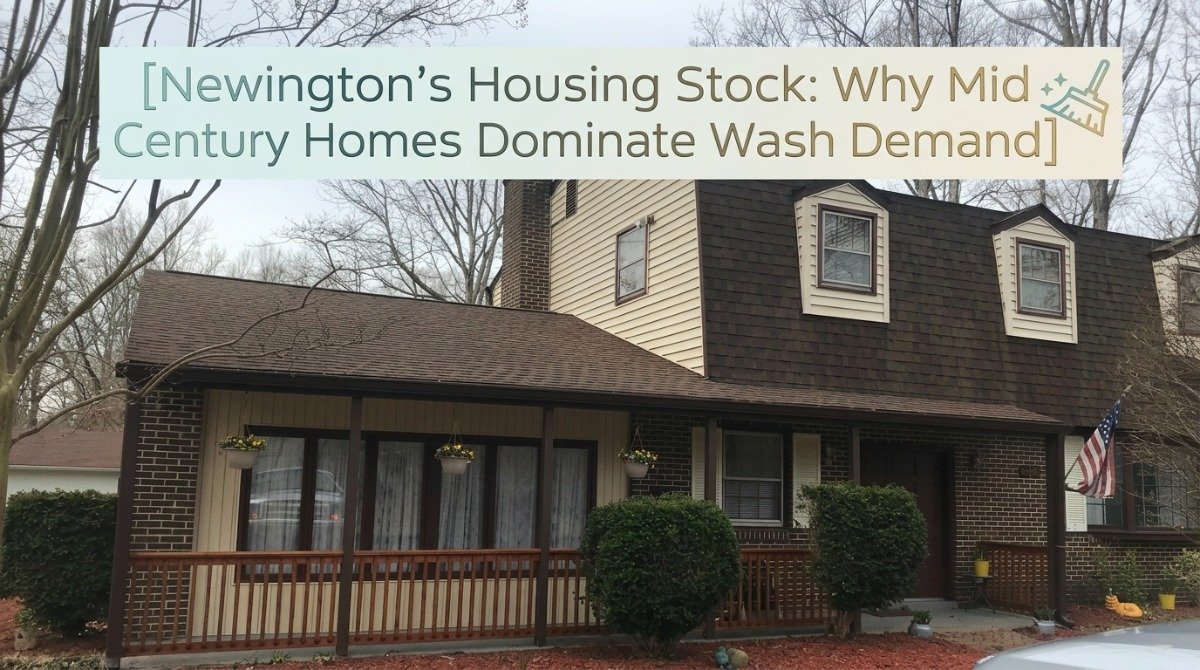
Last spring we pulled up to a cape on a quiet side street near Mill Pond Park. I had guessed the decade before I was out of the truck. Steep roof, two dormers, a small concrete stoop and aluminum siding down both sides.
The homeowner met us in the driveway with the question I hear most weeks. “Can you just power wash the whole thing?”
That house is a fair snapshot of Newington housing stock. Census data shows that about six in ten homes in town were built between 1950 and 1979. Below I will walk through what the numbers say, what these houses are made of, and why that changes how we wash them.
Why does Newington housing stock drive so much wash demand?
About 60 percent of Newington’s homes were built between 1950 and 1979, and the median home dates to 1967, per Census data. These capes, ranches and split levels carry older siding, painted wood and aging roofs under mature trees. They collect algae and grime, and they need gentle, low pressure washing.
Here is how the town lines up against the county and the state.
| What | Newington | Hartford County | Connecticut |
| Median year built | 1967 | 1970 | 1967 |
| Built 1950 to 1979 | 59.5% | 44.1% | 40.8% |
| Built before 1980 | 74.7% | 70.1% | 67.2% |
| Single family detached | 62.3% | 55.1% | 58.6% |
| Owner occupied | 78.2% | 64.9% | 66.5% |
Source: U.S. Census Bureau, American Community Survey 2019 to 2023 5 year estimates (tables B25034, B25035, B25024, B25003). The 1950 to 1979 and before 1980 shares are sums of the published decade counts.
Connecticut has the same median year, but a big block of prewar homes. Newington is packed into three postwar decades.
When were most homes in Newington built?
The Census counts 13,577 housing units in Newington. This is how they break down by year built.
| Year built | Units | Share |
| 1939 or earlier | 942 | 6.9% |
| 1940 to 1949 | 1,128 | 8.3% |
| 1950 to 1959 | 2,799 | 20.6% |
| 1960 to 1969 | 2,691 | 19.8% |
| 1970 to 1979 | 2,587 | 19.0% |
| 1980 to 1989 | 1,505 | 11.1% |
| 1990 to 1999 | 980 | 7.2% |
| 2000 to 2009 | 601 | 4.4% |
| 2010 to 2019 | 334 | 2.5% |
| 2020 or later | 10 | 0.1% |
The 1950s, 1960s and 1970s are almost equal, and together they hold 8,077 homes. Fewer than 1,000 have been added since 2000. The typical house in town is now 50 to 75 years old.
Why did Newington grow so fast after the war?
- 1940: 5,449
- 1950: 9,110
- 1960: 17,664
- 1970: 26,037
- 1980: 28,841
- 2020: 30,536
Newington’s growth in the 1940s was the fastest in Connecticut, tied with North Haven. Then the 1950s added another 93.9 percent.
The trolley reached town in 1894, linking Hartford and New Britain, and cars later did the same job. The old turnpike through town was renamed the Berlin Turnpike in 1942.
When Newington incorporated in 1871 it had roughly 130 farms. After the war, much of that land became house lots for Hartford area families. By 1980 the town was close to built out, which is why the population line flattens.
How does Newington compare with Hartford and nearby towns?
| Place | Median year built | Built before 1940 | Built 1950 to 1979 |
| Hartford (city) | 1951 | 40.2% | 30.9% |
| Wethersfield | 1960 | 19.9% | 55.3% |
| Newington | 1967 | 6.9% | 59.5% |
| Hartford County | 1970 | 18.9% | 44.1% |
Newer suburbs lean later still. In the same Census release, the median year built is 1979 in Rocky Hill and 1980 in both Farmington and Glastonbury.
Hartford is a city of older, prewar housing. Newington is almost purely a mid century suburb, with very little from before 1940. That is why so many of our Newington jobs are capes and ranches.
What kinds of houses were built in Newington from 1950 to 1979?
About 62.3 percent of Newington’s homes are single family detached. Another 15.8 percent are single family attached, mostly townhouse style units, which is a topic of its own.
Most of the town’s housing is post World War II, when modest capes and ranches were common. From the driveway, I would add split levels and raised ranches from the 1960s and 1970s.
Capes
The Cape Cod revival style was popular from the 1930s into the 1950s. Demand peaked after World War II, when returning soldiers needed inexpensive housing.
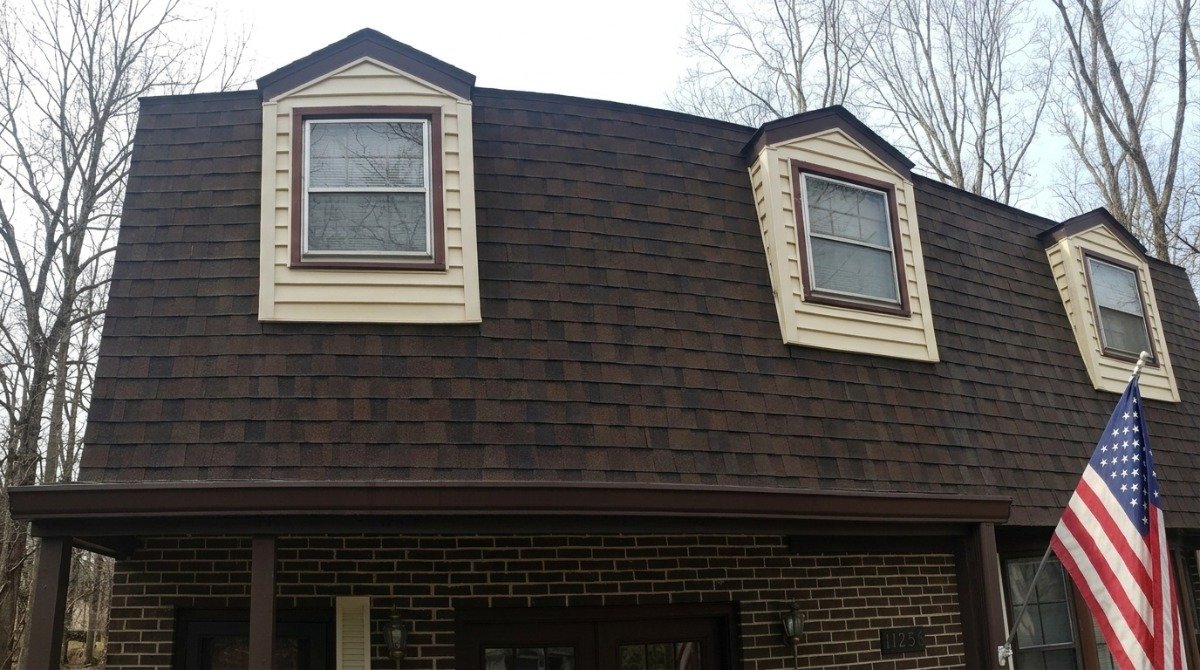
A cape is low and symmetrical, with a steep side gabled roof. Early capes had no dormers; owners added them later for space and light.
Traditional capes wore wide clapboard or wood shingles, sometimes left unpainted to weather gray. Postwar versions usually got asphalt roofs, and many later got aluminum or vinyl over the wood.
On a wash day, the steep pitch makes the roof a soft wash and safety job. Dormer cheeks and north roof slopes are usually the first places to streak.
Ranches
Ranch houses were the favorite of the postwar middle class from the 1940s to the 1970s. By the 1950s, the California ranch accounted for nine out of ten new houses, by one widely cited count.
They are single story, with a long, low roofline, broad eaves, an attached garage and big windows.
Ranches are easy to reach. But long walls and foundation plantings mean more soil splash and mildew along the bottom courses, and deep eaves keep the siding damp longer.
Split levels and raised ranches
Split levels spread with the postwar suburbs from the 1950s on. In the Northeast, people often say “split level” when they mean a bi level house with a split entry.
A raised ranch has the basement level at the bottom and a full flight of stairs up to the main living floor. The front door opens between the two.
You often see brick or block on the lower level and siding above. That lower level sits close to grade, where soil splash and algae collect first.
What are older Newington homes made of?
Most mid century homes have been re sided or re roofed at least once, so one house can show three eras of material. That is why we walk every house first. At that cape near Mill Pond Park, the walk around changed the plan quickly.
Aluminum siding
Aluminum siding in its modern form was patented in 1939 and spread quickly after World War II. A 1947 development in Pennsylvania is reportedly the first subdivision clad entirely in it. It was the go to imitation clapboard until vinyl took over that role.
On 50 to 70 year old aluminum, the baked factory finish often chalks. Rub a hand across it and you get white powder. That is what we found on the sides of the cape.
High pressure on chalky aluminum can leave streaks you cannot undo, and it dents thin panels. Not sure if it is aluminum or vinyl? Tap it. Aluminum sounds metallic, while vinyl flexes.
Our aluminum siding cleaning uses a gentle wash, a soft brush where needed and a careful rinse. We also wrote about why aluminum siding chalks onto your hands.
Asbestos cement shingles
Asbestos cement was widely used after the war as an affordable cladding, often made to look like wood shingles. It is rigid, often with a dimpled or striated face, nailed up in even courses.
Intact material is generally considered low risk. The EPA’s advice is to leave undamaged asbestos containing materials alone and not to saw, sand, scrape or drill them.
It does get brittle with age and weathering. Some places, such as Queensland in Australia, prohibit pressure washing it because the spray can spread fibers.
If you are unsure what is on your walls, treat it as if it may contain asbestos. Do not pressure wash or scrape it. A low pressure soft wash cleans without abrading the surface.
Only an accredited professional taking samples for lab analysis can confirm asbestos. To be plain, Mr-Suds does not test for, remove or abate asbestos. We clean surfaces, and on this one we do it gently.
Cedar shingles and wood clapboard
Many original capes were clad in cedar shingles or wood clapboard. Wood does not like high pressure. The fibers raise and fur, and a narrow tip can gouge it.
A soft wash and gentle rinse lifts mildew and some of the graying without cutting into the wood. Our cedar and wood siding cleaning works this way. If you want the wood stained or restored, that is a separate job, and we explain why cedar can turn gray again after restoration.
Painted wood and lead paint on homes built before 1978
About three in four Newington homes (74.7 percent) were built before 1980. In 1978 the federal government banned consumer uses of lead based paint. The EPA notes that homes built before 1978 are more likely to have lead based paint, often under newer layers.
Paint in good shape is usually not a problem, according to the EPA. Peeling, chipping or cracking paint is a different matter and needs attention.
The EPA’s Renovation, Repair and Painting rule, fully in effect since 2010, covers paid work that disturbs paint in homes built before 1978. That work needs certified firms and lead safe practices. Exterior jobs that disturb more than 20 square feet of paint fall under it, and ground covering must extend at least 10 feet out.
Our job is cleaning, not paint removal. We wash painted surfaces at low pressure and never use the washer to strip loose paint. If paint is failing, scraping and repainting is a job for a certified painter. We covered what peeling paint during a house wash actually means.
Older asphalt roofs
Most mid century homes in town are on their second or third asphalt roof. The dark streaks are usually algae, most often Gloeocapsa magma.
The Asphalt Roofing Manufacturers Association says not to use a power washer or a brush on these roofs. It recommends a cleaning solution left on for 15 to 20 minutes, then a gentle rinse, and it encourages hiring professionals. That is what roof cleaning in Newington looks like for us.
Original concrete and later vinyl
Driveways, walks and stoops from the 1950s to 1970s are often original concrete with worn surfaces. Concrete can take pressure, but a surface cleaner helps avoid striping.
Vinyl is the most common re siding material and is fairly forgiving. It still should not be blasted upward at the seams. We explained how vinyl siding warps after a pressure wash, and our vinyl siding cleaning page shows the gentler route.
Not sure what your siding is? We look before we wash. I or one of the crew will walk the house with you, point out each surface and explain how we will clean it. Call (860) 263-9031.
Why do mid century homes need washing more often?
Age is only part of it. The lots themselves have changed.
- Mature trees. Trees planted 50 to 70 years ago now shade walls and roofs and drop pollen, sap and leaves.
- Shaded walls. In my experience, north walls and tree covered sides go green first, usually low and under the eaves.
- Tired finishes. Chalking aluminum and weathered wood hold dirt more than a new finish.
- Busy roads. Homes near the Berlin Turnpike or Main Street collect traffic grime faster.
- Long term owners. With 78.2 percent owner occupied, people stay and invest in upkeep.
- Sales. When an older home is listed, the agent wants curb appeal for the photos.
Big trees also fill gutters quickly, and overflow streaks the siding below. Gutter cleaning in Newington often goes hand in hand with a house wash on these lots.
Why gentle methods matter on older homes
Rental machines and crews from out of the area tend to treat every house like new vinyl. On a 60 year old house, that guess can be expensive.
| Surface | Main risk with high pressure | What we do instead |
| Aluminum siding | Streaks in chalky finish, dents | Low pressure wash, soft brush, rinse |
| Asbestos cement shingles | Abrading the surface | Low pressure soft wash only, no scraping |
| Cedar and wood | Furring, gouges | Soft wash, gentle rinse |
| Painted wood, before 1978 | Stripping or disturbing old paint | Low pressure, no paint removal |
| Asphalt roof | Granule loss | Roof soft wash per ARMA guidance |
| Concrete | Striping | Surface cleaner at suitable pressure |
“Soft washing is where many older Newington roofs and painted surfaces benefit most,” as I tell homeowners. That is the core of our soft washing in Newington.
“Low pressure paired with eco friendly solutions removes mold and algae at the source.” We pre wet plantings and rinse them after.
Pressure still has its place on concrete and hard surfaces, which is why pressure washing in Newington is its own service. The skill is knowing which surface gets which.
A mid century Newington house wash, start to finish
Here is how that cape near Mill Pond Park went.
What the homeowner asked for
The homeowner wanted the house “power washed, top to bottom.” They did not know the year it was built; by the look of it, sometime in the fifties. The front had gone gray, the sides felt chalky and the roof had black streaks on the back slope.
What the walk around showed
We walked the house together before anything came off the truck.
- Front: cedar shingles, weathered gray, with mildew low near the shrubs.
- Sides: aluminum siding with a tired factory finish. It left white chalk on my palm.
- Back: the north wall had green algae under the eaves and along the bottom courses, under a big maple.
- Roof: asphalt shingles with dark streaks on the north slope and dormer cheeks.
- Trim: older painted wood, mostly sound, with one small area starting to lift.
I explained that a full power wash would likely streak the aluminum, fur the cedar and shorten the roof’s life.
How we cleaned each surface
We soaked the plantings, then soft washed the cedar front and let the solution dwell before a gentle rinse.
On the aluminum we used a mild wash and soft brush, rinsing in sections so the chalk did not dry in streaks.
The north wall got a soft wash for the algae. The painted trim got a low pressure rinse, and we stayed well away from the lifting spot and pointed it out for a painter.
The roof got a soft wash with a dwell time and an easy rinse, in line with ARMA guidance. The front walk and stoop got a surface cleaner.
The result
The cedar came back warmer, though not new. The aluminum looked even with no stripes, and the north wall and roof were clean.
The homeowner walked around twice and said it looked cared for, not attacked. That is the goal on these houses.
Mid century homes across Newington, Hartford and Central Connecticut
Mid century homes are spread all over town. We see a lot of them around the Town Center, in Newington Junction, near Mill Pond Park and off Main Street.
Wethersfield is the closest match, with a median year of 1960 and 55.3 percent of homes built from 1950 to 1979. Hartford is different. With 40.2 percent of the city’s housing built before 1940, it brings older multifamily wood and masonry.
Mr-Suds Power Washing PROs is based at 130 Dewey Ave in Newington and serves 18 towns, from Hartford and Wethersfield to Rocky Hill and Glastonbury. Our house washing in Newington page has the local details, and our siding cleaning page covers every material we work on.
Frequently asked questions about washing older Newington homes
When were most homes in Newington built?
Most were built between 1950 and 1979. Those three decades hold 59.5 percent of the town’s 13,577 housing units, and the median year built is 1967, per the Census Bureau’s American Community Survey (2019 to 2023).
Can you pressure wash aluminum siding?
Not at high pressure. Older aluminum has a chalky factory finish that streaks easily, and the panels dent. A gentle wash with a soft brush where needed and a careful rinse cleans it without damage.
Is it safe to pressure wash asbestos siding?
No. The EPA advises leaving undamaged asbestos containing material alone and not sanding or scraping it. Pressure washing can abrade the surface, and a low pressure soft wash avoids that. Only an accredited professional’s samples can confirm asbestos.
Does my house have lead paint if it was built before 1978?
It might. The EPA says homes built before 1978 are more likely to have lead based paint, often under newer layers. Paint in good shape is usually not a problem. Washing should clean paint, not strip it. Any paid work that disturbs paint on these homes falls under EPA’s lead safe rules.
Should I pressure wash my asphalt roof?
No. The Asphalt Roofing Manufacturers Association says not to use a power washer or brush on asphalt shingles. It recommends a cleaning solution left on for 15 to 20 minutes, then a gentle rinse. That is a roof soft wash, and it protects the granules.
Why does one side of my house turn green?
That side is usually north facing or under trees. It stays shaded and damp longer, so algae and mildew grow there first.
How often should an older Connecticut house be washed?
Many homes do well with a wash every year or two. Heavy tree cover, busy roads or chalky aluminum can mean more often, while sunny lots with newer vinyl can go longer.
Do you wash newer homes too?
Yes. Vinyl siding and newer roofs benefit from the same approach. We look at the surface first and match the method to it.
Caring for a mid century home in Newington or Hartford
“Newington homes cover a wide range of ages and building materials, and each surface calls for a slightly different approach.”
If your cape, ranch or split level is due for a wash, we will walk it with you first and match the method to the surface.
Mr-Suds Power Washing PROs, 130 Dewey Ave, Newington. Licensed, bonded and insured, with a 5.0 rating on Google. Call (860) 263-9031 or reach us through our contact page. First time house wash customers in Hartford and surrounding towns get 15% off.