
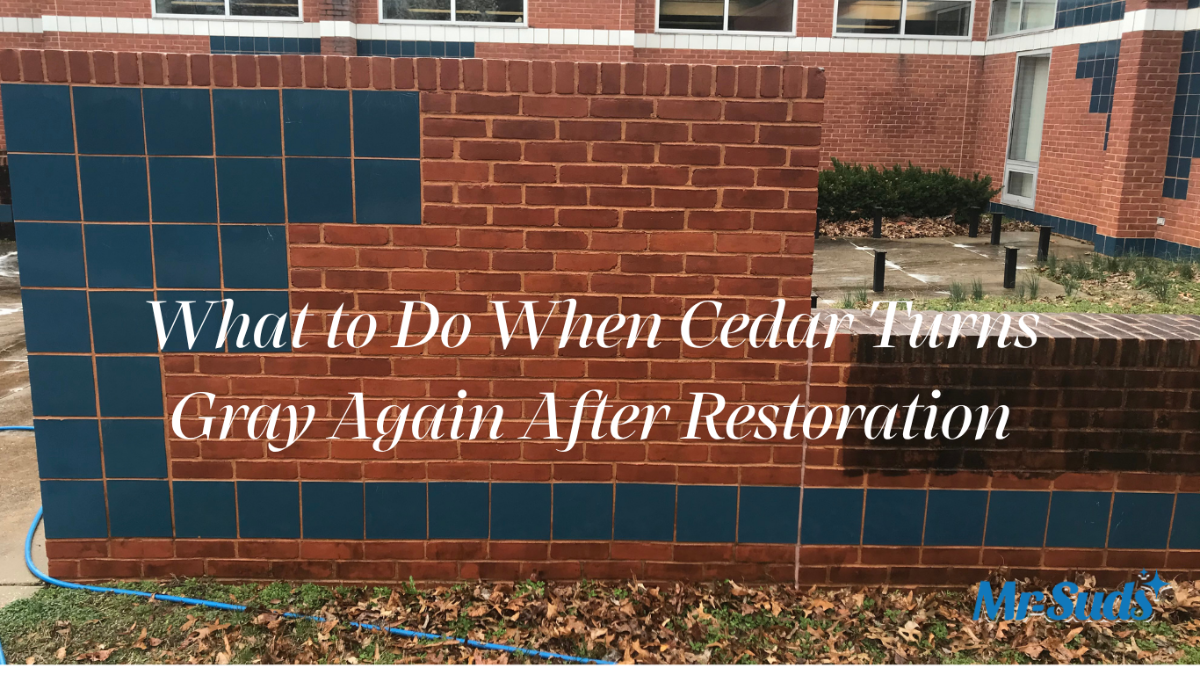
Cedar turns gray again after restoration because cleaning and brightening remove dirt and reverse surface color, but they add no UV protection. Graying is ultraviolet light breaking down lignin at the wood surface. Without a pigmented coating, bare cedar begins graying again within 6 to 12 months, fastest on south and west exposures.
So the question is not what went wrong. The question is what was never applied.
Your Restoration Did Not Fail, It Was Incomplete
There are three separate things people call cedar restoration, and they get quoted, sold and understood as if they were one thing.
Cleaning removes mildew, algae, dirt and the organic film sitting on the wood. Real work, and necessary.
Brightening reverses the surface gray with oxalic acid, restores the natural color, and lifts staining. Also real work, and it is the step that makes people gasp when they see it happen.
Protecting means putting something on the wood that stops UV from reaching it again. Different scope, different product, different day.
The first two together make cedar look spectacular for a season. Neither of them does a single thing about the mechanism that took the color away, because that mechanism is not dirt.
Nobody necessarily misled you. Cleaning and coating are frequently quoted separately, sometimes by different trades, and it is very easy to walk away from a beautiful looking house assuming the job is done.
Roman hears the same sentence more than any other on these calls: “but we just had it done.” And the honest answer is usually that yes, you had it cleaned, beautifully, and nothing was ever applied afterward.
What You Actually Paid For
Wash, brighten, admire.
That is a legitimate service and it is worth having. It gets years of biological growth off the wall, it stops mildew colonizing further, and it makes the house look like itself again.
What it cannot do is block ultraviolet light. Only pigment does that, and there was no pigment involved.
Why Cedar Goes Gray: The Actual Chemistry
You will read in a lot of places that cedar grays because it loses its natural oils. That is not what happens, and the wrong mechanism leads to the wrong fix.
Lignin Is the Glue, and UV Eats It
Wood is essentially bundles of cellulose fiber held together by lignin. Think of cellulose as the reinforcing and lignin as the mortar between it. The USDA Forest Products Laboratory has documented this weathering mechanism extensively in its wood research.
Lignin absorbs ultraviolet light strongly. It is very good at it, and that is exactly the problem, because absorbing UV energy breaks the lignin molecules apart.
Once the lignin at the surface has degraded, rain washes the byproducts away. What is left behind is a thin layer of loose, bare cellulose fiber with nothing binding it.
That loose fiber scatters light instead of reflecting the warm brown tones underneath. Scattered light reads to your eye as silver gray.
So the gray is not a stain, not dirt, and not the wood dying. It is a physical surface left behind after a chemical process, and that distinction determines everything you do about it.
Why It Is a Surface Event and Not Rot
The degradation zone is remarkably shallow. Often a fraction of a millimeter, and it advances very slowly into the wood because the degraded surface layer partly shields what is below it.
That is precisely why brightening works. Oxalic acid and a light rinse can reverse the visible color because you are treating a whisper-thin layer, not the board.
Gray cedar is not failed cedar. A gray shingle wall can be structurally perfect. Silver siding on an old Connecticut farmhouse has often been doing its job for fifty years.
Why It Comes Back So Fast the Second Time
Here is the part that surprises people, and it explains the timeline that brought you here.
A freshly cleaned and brightened surface is more absorbent and more exposed than the weathered surface it replaced. The protective layer of degraded fiber has been removed. The grain has been opened up.
Bare, open, freshly brightened cedar with no coating is the most UV-vulnerable state that wood will ever be in.
That is why a house that looked spectacular in June can be visibly shifting by the following spring, and fully silver on the south wall within eighteen months. Nothing failed. The wall was left undressed at exactly the moment it was most exposed.
Three Different Discolorations People Confuse
Before you buy anything, work out which of these you actually have. Most cedar houses in Hartford County have at least two of them at once, on different walls.
| What you see | Where it appears | Test to confirm | What removes it | Will it come back |
|---|---|---|---|---|
| Silver or dull gray, fairly uniform | South and west walls, exposed gables, anything without an overhang | Sand a small hidden area lightly. Brown underneath means UV gray | Oxalic acid brightener, or light sanding | Yes, within 6 to 12 months unless you coat it |
| Black or dark green, patchy | North walls, under overhangs, behind shrubs, bottom courses | Dab a drop of diluted sodium hypochlorite on a rag onto the spot. If it lightens in a minute, it is biological | Appropriate cleaner with dwell time, at low pressure | Yes, seasonally, unless airflow and moisture change |
| Blue black tears or streaks, often from a fastener | Below nail and screw heads, at butt joints, under window sills | Look at the source. If every mark starts at a metal fastener, it is iron tannate | Oxalic acid, though not always completely | Yes, if the fasteners are still corroding |
Gray, Which Is UV
Fairly uniform across a whole elevation. It follows sun exposure with real precision, so it will be dramatic on the south gable and mild on the north wall of the same house.
No odor, no slime, no fuzz. Just color loss.
The test is simple. Sand a small patch somewhere hidden, behind a downspout or under an eave. If warm brown appears immediately under a light sanding, you are looking at surface UV gray and nothing more.
Black and Green, Which Is Biological
Mildew and algae, and they are a completely different problem.
They concentrate where moisture stays: north facing walls, under deep overhangs, behind foundation plantings that block airflow, and along the bottom courses where rain splashes up off the ground or mulch.
They are patchy and irregular rather than uniform, and they often appear worst exactly where UV gray is mildest, because shade encourages one and prevents the other.
The confirming test takes a minute. Put a drop of diluted sodium hypochlorite on a cloth and hold it against the spot. Biological growth lightens noticeably. UV gray does not respond at all.
Worth noting: heavy biological growth on a roof seeds the walls below it every time it rains. If you have black streaking on the roof as well, treating the walls alone is a short term result, which is why roof cleaning and wall work often belong on the same visit.
Dark Streaks and Stains, Which Are Chemical
Three related things live here.
Tannin bleed is cedar’s own natural extractives migrating to the surface, common on newer cedar and after heavy wetting.
Water staining is dark discoloration where water repeatedly ran the same path, typically under a failed gutter joint or a window sill with no drip edge.
Iron tannate is the important one, and it is unmistakable once you know it. Steel reacts with the tannins in cedar to create a blue black compound. So every corroding nail head grows a dark halo, and every rain drags a tear stain down the shingle below it.
Oxalic acid addresses iron tannate and often lightens it dramatically. Be realistic though: on a deeply established stain it may lighten substantially and never fully disappear.
And cleaning does not fix the cause. If the fasteners are plain steel or failing galvanized, they will keep reacting. Stainless fasteners are the actual answer, and that is a repair conversation rather than a cleaning one.
Field Story: A Newington Cedar Cape, One Year Later
A cedar shingle cape in Newington, washed and brightened the previous spring. The homeowner sent us a photo from the day it was finished, and it looked genuinely beautiful. Warm honey brown, even, the way cedar looks in a catalog.
Fourteen months later she called because she thought something had gone wrong.
Standing in the driveway on a warm afternoon in late spring, three different problems were visible on one house.
The south elevation and the west gable had gone silver. Not blotchy, not dirty, just uniformly lighter than the photo.
The north wall still held most of its warm brown. Same house, same wash, same day, same product, and a completely different result fourteen months on.
And along the bottom three courses on the north side, where a snow bank had sat against the wall until March, there were blue black tears running down from every nail head.
The clearest thing on the whole property was the corner where the south and north walls meet. You could stand there and follow a single course of shingles around the corner and watch the color change at the transition. Same shingles, cut from the same bundle, nailed up the same afternoon, on two different schedules purely because of which way they face.
That corner is the entire article in one image.
Roman’s summary to her was short. Nothing failed here. Nothing was ever applied.
What Actually Holds Color, and What Does Not
Here is the whole product ladder, explained by mechanism rather than by brand.
One rule explains all of it: pigment is the UV blocker. Everything else follows from that.
| Product class | Pigment level | UV defense | Typical life, vertical | Typical life, horizontal | Failure mode | Maintenance coat friendly |
|---|---|---|---|---|---|---|
| Clear sealer or water repellent | None | Almost none | Months | Months | Grays underneath the coating | Yes, but pointless |
| Transparent stain | Low | Modest | Roughly 18 to 24 months | Roughly 12 to 18 months | Fades evenly | Yes |
| Semi transparent stain | Moderate | Good | Roughly 2 to 6 years | Roughly 1 to 3 years | Fades and thins | Yes |
| Semi solid | High | Very good | Longer still | Moderate | Begins to show wear edges | Sometimes |
| Solid stain | Highest, opaque | Best | Roughly 3 to 7 years | Roughly 1 to 3 years | Peels and flakes | No |
Treat every one of those as a typical range rather than a promise. They are starting points that your exposure then modifies, sometimes drastically. The Western Red Cedar Lumber Association publishes its own finishing guidance that broadly aligns with this ladder, if you want a manufacturer-side reference alongside ours.
Clear Sealers and Water Repellents: The Fastest Failure
This is the single most common expensive mistake on cedar.
Water repellency and UV protection are two different properties. A clear product can be excellent at the first and offer essentially nothing on the second.
UV passes straight through a clear film and reaches the lignin underneath exactly as it would on bare wood. The wood grays under the coating.
That is why you can end up with a wall that is genuinely sealed, genuinely shedding water, and visibly silver at the same time. The homeowner concludes the sealer failed. It did what it said it would do. It just never claimed to do the thing that mattered.
Transparent and Semi Transparent: Pigment Is the Sunscreen
Transoxide and iron oxide pigments work by absorbing and scattering UV before it can reach the wood surface. They are, functionally, sunscreen for lignin.
That single fact explains the entire ladder. More pigment means more UV blocked means longer color life. It also means less grain showing through.
Semi transparent carries meaningfully more pigment than transparent, which is why it lasts substantially longer while still letting the cedar look like cedar. On most Hartford County cedar, semi transparent is the sweet spot between protection and appearance.
Semi Solid and Solid Film Formers: Longest Color, Real Peeling Risk
Opaque products hold color longest because there is the most pigment in the way of the UV. That part is true and it gets quoted a lot.
What gets left out is the trade. A solid stain builds a film on top of the wood, and cedar moves seasonally. Film plus movement eventually equals adhesion failure.
On shingles specifically, that matters more than it sounds. When a penetrating finish wears out, you wash and recoat. When a film fails on a shingle wall, you are into stripping and sanding thousands of small overlapping pieces, and that is a genuinely difficult, expensive job.
Solid stain is a reasonable choice on cedar clapboard that has already been painted or solid stained. It is a harder recommendation on bare shingles.
Oil Based Penetrating Versus Water Based
Penetrating oils soak into the fiber. They fade rather than peel, and that failure mode is what makes maintenance coats simple.
Modern water based products have closed most of the historic gap. They generally hold pigment well, carry good mildew resistance, and clean up easily.
One local factor worth knowing. Connecticut DEEP regulates the VOC content of architectural coatings sold in the state, so several high-solvent oil formulations sold in other parts of the country are either reformulated for sale here or not available at all.
That matters practically, not just administratively. If somebody remembers an oil product from fifteen years ago that soaked in beautifully and took forever to dry, the version on the shelf today likely behaves differently. Do not assume old application habits transfer.
Real Maintenance Intervals, Adjusted for Your Exposure
Published intervals assume an average wall. You do not have an average wall, you have eight of them and they are all different.
Baseline Intervals by Product Class
Use the table above as your starting point, and note the split between vertical and horizontal.
Vertical siding and fence boards substantially outlast horizontal decking with the same product. Two reasons. Water runs off instead of standing, and the sun strikes at an angle rather than square on for hours.
A semi transparent that gives you four years on siding may give you two on a deck. That is not a product problem, it is geometry.
South and West Fail in Half the Time
State it flatly, because nobody else does: a south facing wall and a north facing wall on the same house are on two completely different schedules, and the difference is roughly a factor of two.
South gets the most hours of direct sun. West gets the harshest late afternoon sun combined with the highest surface temperatures of the day.
You have two sane strategies.
Plan around the worst wall. Recoat the whole house on the south wall’s schedule. Simpler, more consistent appearance, more product.
Spot maintain. Do the south and west elevations on a shorter cycle and the north and east on a longer one. Less product, but you have to accept some variation and keep track.
Most people are better served by the first approach on a house and the second on a deck and fence.
The Other Exposure Multipliers
Four things shorten your intervals regardless of compass direction.
Reflected heat and light off a light colored driveway, a pool deck or a patio, which effectively gives a wall a second dose from below.
No roof overhang, meaning rain runs down the wall rather than being thrown clear.
Snow banked against the bottom courses all winter, which is where most iron tannate staining and lower course failure starts here.
Sprinkler overspray hitting the same fence pickets or the same lower siding every single morning through the growing season.
| Surface and exposure | Typical recoat interval, semi transparent |
|---|---|
| North facing siding, good overhang | Toward the long end of the range |
| South or west facing siding | Roughly half of the north wall interval |
| Cedar fence, both faces exposed | Shorter than siding, and each face may differ |
| Cedar deck, horizontal | Shortest of all, plan on frequent light maintenance |
| Any surface with sprinkler overspray or snow contact | Shorter again, and inspect annually |
Horizontal surfaces are their own conversation, and they usually need attention long before the walls do. That work sits under deck cleaning and restoration.
If you would rather have somebody tell you what schedule your specific house is on, that is what the visit is for. Get a free quote or call (860) 263-9031.
The Correct Restoration Sequence
Five steps. Each one exists for a reason.
Step 1: Soft Wash With the Right Cleaner
Low pressure plus chemistry. Never pressure as the cleaning method.
For a wood-safe organic clean, sodium percarbonate. For heavy biological growth, a properly diluted and subsequently neutralized hypochlorite mix.
Apply, let it dwell, agitate gently where the growth is heavy, rinse at low pressure. The solution does the work and the water only carries it away. That is soft washing, and cedar is one of the surfaces that most demands it.
High pressure on cedar erodes the soft growth rings out from between the harder ones and leaves a furrowed, fuzzy surface. On shingles it can also drive water behind the courses. This is exactly why our pressure washing in Hartford CT approach starts from the material rather than from the machine.
Step 2: Oxalic Acid Brightener
Two jobs in one step.
It neutralizes the alkaline residue left by the cleaner, which matters because coating over alkaline wood causes problems later.
And it reverses the surface gray, restores the warm tone, and lifts iron tannate staining. It also opens the grain so a penetrating product can actually get in.
This is the step that produces the dramatic before and after photos, and it is also the step most often skipped on a cheap job.
Step 3: Dry to a Target Moisture Content
Roughly 15 percent or lower before anything is applied.
Cedar can feel completely dry to the hand and still be carrying moisture in the core after a heavy wash. In Connecticut River valley humidity that means several days, not one warm afternoon, and longer on a shaded north wall.
Coating over wet cedar traps moisture behind the finish and is a common cause of early failure that gets blamed on the product.
Step 4: Sand Only Where You Need To
Spot sanding, not a whole wall.
Sand raised grain, mill glaze on new replacement material, and the edges of any failed coating. Feather those edges rather than leaving a hard line.
Do not sand an entire shingle wall smooth. Over-sanding closes the grain and starves the coating of the absorption it needs.
Step 5: Coat, Back Prime and Seal the End Grain
Any replacement shingle or board gets coated on all six sides before it goes up. All six.
End grain absorbs many times what a face absorbs, and unsealed butt ends are where cupping, splitting and black staining begin. It is the cheapest step in the whole job and the most frequently skipped.
The Maintenance Coat: The Real Answer to Your Question
If you take one thing from this page, take this.
What a Maintenance Coat Is
A light refresher coat of a penetrating product, applied before the existing finish has fully weathered away.
The whole job is: clean the surface, let it dry, apply one thin coat. No stripping, no brightening, no sanding, usually no ladder work beyond what the original coat needed.
It is a fraction of the labor of a restoration because you are topping up a finish that is still partly there rather than rebuilding from bare wood.
Why Timing Beats Effort
At year two or three, the surface still holds enough finish to accept a refresher cleanly. The job is a wash and a coat.
At year six, the finish is gone, the wood has grayed, and you are back to a full restoration: clean, brighten, dry, coat. Several times the labor and several times the cost.
The cost curve is not linear, and neither is the effort. Waiting does not save money, it defers a small bill into a large one.
A simple comparison from two jobs on our schedule. A cedar fence in Wethersfield and a cedar deck in Glastonbury, both coated with the same class of penetrating semi transparent in the same season.
The fence owner had us back at year two for a light refresher. Wash it, let it dry, one thin coat, done in an afternoon.
The deck owner waited. By year five that deck needed the full sequence again, including brightening and spot sanding.
Same product, same starting point, two very different bills. That is the whole argument for the maintenance coat, and it is why fence cleaning customers who stay on a cycle tend to spend less over ten years than the ones who call when it looks bad.
Which Products Allow It and Which Do Not
Penetrating products refresh cleanly. There is no film to fight, so a new coat soaks into whatever is left of the old one.
Film formers generally do not. A maintenance coat over a partially failed film locks the failure underneath a fresh layer, and it will delaminate together later.
That is a real argument for choosing a penetrating semi transparent on cedar even though a solid stain would hold color longer. You are buying an easier future, not just a finish.
The Honest Alternative: Let It Go Silver On Purpose
This is a legitimate choice, not surrender, and on some Connecticut houses it is the better looking one.
Roman will say so on site when he thinks it is true, and it costs us the coating work. On an older shoreline-style house or a traditional shingled cape, an even silver patina looks right in a way that a fresh stain sometimes does not.
What Natural Weathering Actually Gets You
A true, even silver takes a few years to develop, and it only forms on surfaces that get consistent sun and rain.
It is stable, it is honest, and it costs almost nothing to maintain in product terms. The wood is not being harmed. Weathered cedar on New England houses has lasted generations.
How to Get Even Silver Instead of Blotchy Gray
Blotchiness is the thing people actually dislike, and it does not come from the weathering itself. It comes from uneven exposure and from biology.
Sheltered areas under overhangs stay brown while exposed areas go silver. Damp shaded areas go black with mildew while sunny areas go light. The result is a patchwork, and that is what reads as neglected rather than weathered.
Two ways to address it.
Clean annually to keep mildew in check, so the difference between walls is exposure rather than growth.
Use a bleaching oil. These push the whole surface toward a uniform silver from the start rather than waiting years for it to happen unevenly. It is a legitimate traditional product for exactly this look.
Natural Does Not Mean No Maintenance
Choosing silver removes the coating cycle. It does not remove the cleaning cycle.
An uncoated cedar house still needs an annual soft wash to stop mildew colonizing the surface and to reduce the moisture cycling that drives cupping and splitting.
That is the honest version, and it is the same annual soft wash house washing visit either way. The difference is only whether a coating follows it.
Why Hartford County Is Harder on Cedar Than the Blogs Assume
Three stresses stack here, and most published intervals were written somewhere with only one of them.
Summer UV load. Real, direct, and concentrated in a few intense months.
Roughly 100 or more freeze thaw cycles a season, consistent with typical NOAA climate data for central Connecticut. Every cycle expands and contracts moisture in the wood surface and in any coating on it. Coatings that would simply fade in a mild climate get mechanically worked here.
Connecticut River valley humidity. High moisture in the air keeps the surface damp longer after every rain, which feeds biological growth and slows every drying window in the restoration sequence.
Any one of those is manageable. Together they shorten essentially every interval you will read on a national site.
The Local Calendar
Wet spring slows drying and delays the start of the season.
Heavy oak and pine pollen from late April into May settles onto freshly cleaned or freshly coated cedar within hours. Coating during pollen drop embeds a yellow film in the finish.
Snow banked against the bottom courses into March. This is where lower course damage and iron tannate staining begin on most cedar houses here.
March into April is when last winter’s damage becomes visible, which makes it the right time to look and the wrong time to coat.
The Application Window
Roughly late May through September.
Watch the dew point, not just the air temperature. A coating applied on a pleasant 70 degree September afternoon that gets hit with heavy dew at four in the morning will blush, stay tacky, or bead up. The daytime number told you nothing about that.
Roman will not coat a cedar wall in October regardless of how good the ten day forecast looks. Nights are too cool, dew arrives too early, and cure windows have shrunk to almost nothing. Better to wash it in October and coat it in June than to coat it badly in October and strip it in two years.
What We Do On a Cedar Job
For transparency, here is the actual order of operations.
We walk the house first and identify which of the three discolorations are present on which elevations, because they usually are not the same on every wall.
We test a small area, somewhere out of the sightline, to confirm what the surface will do before committing to a chemistry.
Then soft wash, brighten, and verify dryness with a meter rather than by eye.
And then, before anybody quotes a number for coating, we have the honest conversation about product class and schedule. Whether semi transparent is right for the house, whether the south wall needs a shorter cycle than the rest, whether the silver option is actually the better look here.
The number matters less than the schedule. A cheap wash on a house that then gets left bare is money spent on twelve months of appearance.
Frequently Asked Questions
Why did my cedar turn gray again so fast after being restored? Because cleaning and brightening restore appearance but add no UV protection. Graying is ultraviolet light breaking down lignin at the wood surface. Freshly brightened cedar is more exposed than weathered cedar, so with no pigmented coating it can start shifting within a single Connecticut summer.
Is gray cedar damaged or just discolored? Just discolored, in almost every case. UV degradation affects a layer often less than a millimeter deep, which is why brightening or light sanding brings the color back. A gray cedar wall can be completely sound structurally. Silvered cedar on old New England houses has lasted generations.
Does a clear sealer stop cedar from graying? No. Water repellency and UV protection are different properties. UV passes straight through a clear film to the lignin underneath, so the wood grays beneath the coating. You can end up with a wall that genuinely sheds water and is visibly silver at the same time.
How long does semi transparent stain last on cedar in New England? Typically in the range of two to six years on vertical siding and one to three on horizontal decking, and those are ranges rather than promises. A south or west facing wall runs at roughly half the interval of a north wall on the same house with the same product.
Why does the sunny side of my house gray faster than the shady side? Because graying is caused by ultraviolet exposure, so hours of direct sun is the variable that matters most. South elevations get the most sun and west elevations get the harshest late day sun at the highest surface temperatures. Expect roughly double the life on north and east walls.
Can I stain over cedar that has already grayed? Not directly. Gray means a layer of loose degraded fiber at the surface, and a coating applied over it bonds to that loose material rather than to sound wood. Clean and brighten first to remove it, then dry to about 15 percent moisture, then coat.
Do I need to sand cedar shingles before staining? Usually only in spots. Sand raised grain, mill glaze on new replacement shingles, and the feathered edges of any failed coating. Sanding an entire shingle wall smooth closes the grain and reduces how much finish the wood will absorb, which shortens the life of the coat.
What is a maintenance coat and how often does cedar need one? It is a light refresher coat of a penetrating product applied before the finish fully weathers away, usually around year two or three. Clean, dry, one thin coat, no stripping or brightening. It costs a fraction of a full restoration and prevents you ever needing one again.
Is it bad to let cedar weather naturally to silver? Not at all, and on many traditional Connecticut houses it looks right. The wood is not being harmed. What it still needs is an annual cleaning to keep mildew from colonizing the surface, because untreated biology is what turns an even silver into a blotchy grey.
How do I get an even silver instead of a blotchy gray? Blotchiness comes from uneven exposure and from mildew, not from weathering itself. Clean annually so biological growth does not create dark patches, and consider a bleaching oil, which drives the whole surface toward a uniform silver from the start rather than waiting years.
When is the right time of year to coat cedar in Connecticut? Roughly late May through September. Avoid the late April to May pollen drop, which embeds in a fresh finish, and stop by early autumn. Watch the overnight dew point rather than the daytime temperature, because heavy pre-dawn dew on an uncured coating causes blushing and tackiness.
Why do black streaks run down from the nails on my cedar? That is iron tannate. Steel fasteners react with the natural tannins in cedar and produce a blue black compound that rain then drags down the shingle below. Oxalic acid often lightens it substantially, but the staining continues until the corroding fasteners are replaced with stainless.
Get a Straight Answer on Your Cedar
If your house was washed last year and it is silver again this year, nothing went wrong. Something was left out.
What we will tell you on a visit is which of the three discolorations are on which walls, whether a maintenance coat will do it or you need the full sequence, and what schedule this specific house is actually on given its exposure and overhangs. If we think the honest answer is to let it go silver and just clean it annually, we will say that too.
We serve Newington, West Hartford, Wethersfield, Farmington, Avon, Simsbury, Glastonbury and the surrounding Hartford County towns, Monday to Friday, 8am to 4pm. Cedar coating season here runs roughly late May through September, so scheduling matters more on this work than on most.
Get a free quote or call (860) 263-9031.
Mr-Suds Washing, Newington, CT. Licensed, bonded and insured.