
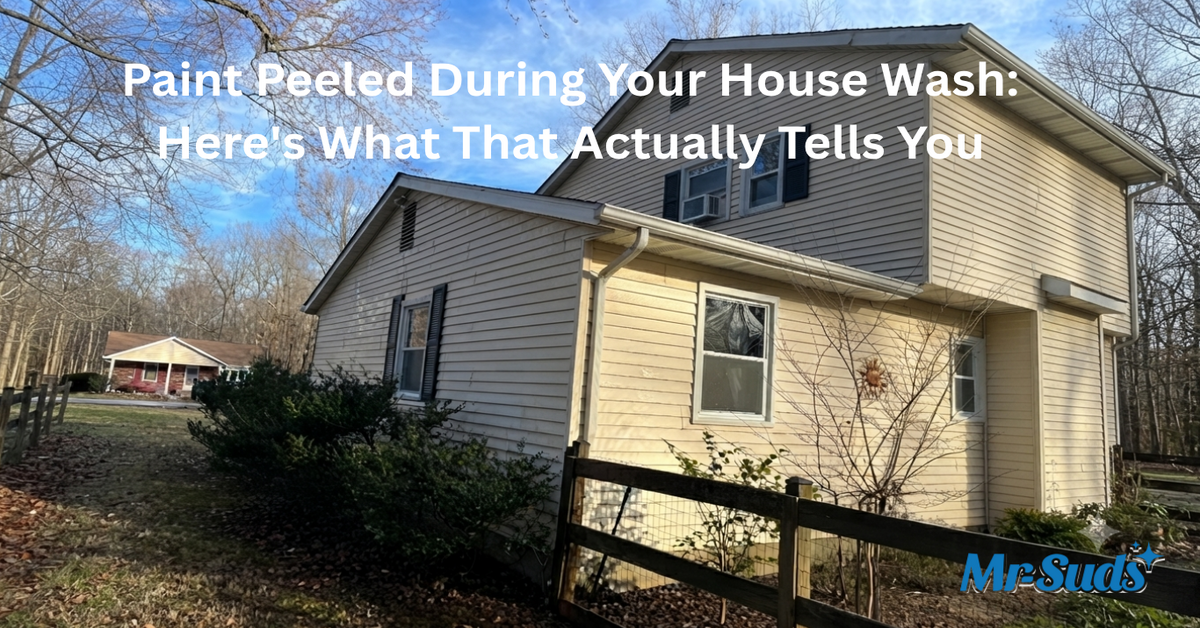
Home built before 1978? Peeling paint may contain lead. Do not scrape, sand, dry-sweep the chips, or continue washing. Go straight to the lead safety section below.
Paint holds onto a surface by adhesion, and adhesion either exists or it does not.
Sound, well-bonded exterior paint will not lift under a low-pressure house wash. It survives Connecticut rainstorms, ice, and forty-mile-an-hour wind driving water at the wall for hours on end.
When paint comes off during a wash, it is almost always because the bond had already failed and something was holding the film in place. Dirt, a surface film, or simply the stiffness of an old coating. The wash removed what was holding it.
That is genuinely useful information, because it means you have a paint problem you were going to face anyway.
One thing takes priority over all of it. If your home was built before 1978, peeling paint is a lead-safety question first and a cosmetic question second. Newington’s housing stock is heavily pre-1978, so read that section before you do anything else.
Can a House Wash Actually Strip Paint?
A correct soft wash, meaning cold water at low pressure with the chemistry doing the work, will not remove sound paint. It removes dirt, algae, mildew and chalk. High-pressure washing absolutely can strip paint, including paint in acceptable condition, because pressure washers are used deliberately as paint-removal tools in some settings. The distinguishing question is whether the paint came off only where it was already failing, or in clean strips wherever the wand passed.
That second scenario is a method problem. The first is a paint problem that predates everybody involved.
There is a grey area worth naming. On a house where the paint is at the very end of its life, with widespread alligatoring and chalking, even a gentle wash will release material. A good contractor should have flagged that before starting, and put it in writing.
How to Tell Whether the Paint Had Already Failed
Signs the paint was already failing
- Peeling in sheets or curls that lift cleanly. That is adhesion loss, and it takes years to develop
- Bare wood underneath is grey, weathered or soft, not fresh. The paint had been separated from the substrate for some time
- Blistering or bubbling visible before the wash
- Alligatoring: a cracked scaly pattern like reptile skin, caused by an old brittle coating over a more flexible one
- Peeling concentrated on south and west elevations, on horizontal surfaces such as sills, railings and porch decks, and below windows and gutters. All classic moisture and UV failure zones
- Multiple visible paint layers at the peel edge. You can literally count them
- Old photos showing flaking beforehand
Signs the method was too aggressive
- Clean, straight bands of removal following the path of a wand
- Paint removed uniformly across an area regardless of its condition
- Furring, fuzzing or gouging of the wood grain itself
- Damage concentrated where a nozzle was held close, at corners and trim edges
- Removal at high, hard-to-reach areas, where an operator increased pressure to compensate for distance
Wood fuzzing deserves special attention. It is the single clearest evidence of over-pressure. Failed paint peels off wood. High pressure damages the wood underneath it, eroding the soft spring wood between the grain lines. If the exposed substrate is fuzzy and raised, that was not the paint failing.
The evidence to gather
- Pre-wash photos from Street View, listing photos, insurance photos or family pictures
- Close-ups of the peel edges and the exposed substrate
- Photos of areas the wash did not reach. If unwashed elevations show the same failure pattern, that settles the question completely
If you want a second opinion on whether the paint was already failing, send us photos of the peel edge and the exposed wood. That usually answers it. Text or email Roman at (860) 263-9031.
Lead Safety First: Pre-1978 Homes in Newington
Why this matters here specifically. A large share of Newington’s housing stock dates from the post-war decades through the 1970s. Many of these homes still have original wood trim, fascia, soffits, window casings, porch elements and doors, and in a good number of cases original wood siding sitting behind later aluminum or vinyl. Lead-based paint was in common residential use until it was banned for that use in 1978.
What the rule actually says. Under the EPA Renovation, Repair and Painting Rule, firms performing renovation, repair or painting for compensation that disturbs painted surfaces in housing built before 1978, and in child-occupied facilities, must be EPA lead-safe certified, must assign a certified renovator to the job, and must follow specified work practices. Those include containment of the work area, restrictions on certain practices, and specified cleanup and verification, with recordkeeping required. Homeowners doing work on their own homes are generally outside the rule. Hired work is squarely inside it.
Why washing matters here. Aggressive washing of deteriorated paint disperses chips and paint-laden water into the soil, onto walkways and into neighbouring yards. Soil around the foundation is exactly where children play and where contamination persists. Containment and controlled cleanup are the reason the rule exists at all.
What to do right now if paint is peeling on a pre-1978 home
- Stop the wash on the affected elevations. Nobody should continue washing, scraping or sanding.
- Do not dry-sweep the chips. Do not blow them, and do not rake them across the lawn.
- Keep children and pets off the affected soil and hardscape.
- Ask the contractor directly whether their firm is EPA lead-safe certified, and whether a certified renovator was assigned. Ask for the certification number.
- Ask whether you were given the EPA lead pamphlet before work began. Providing it is part of the required process for covered work.
- Find out whether the paint actually contains lead. Options include an EPA-recognised test kit, a certified lead inspector or risk assessor, or laboratory analysis. Do not assume in either direction.
- Contact the Connecticut Department of Public Health lead program and your local health department for state-specific guidance. Connecticut has its own childhood lead poisoning prevention framework alongside the federal rules.
- If you have young children in the home, speak to your paediatrician about blood lead testing. Connecticut has screening requirements for young children, so ask your doctor what applies.
Nothing in this article can tell you whether your home contains lead paint. It can only tell you the questions to ask and where the authorities are. Start at epa.gov/lead and CT DPH.
Why Paint Fails in the First Place
Worth understanding, because otherwise you will repaint and it will fail again in the same place.
- Moisture from behind. The most common cause on Connecticut homes. Vapour driving out through the wall, roof or gutter leaks wetting the siding, missing flashing, or a bathroom or kitchen with inadequate ventilation. Paint peeling in a defined patch below a window, behind a gutter, or on the exterior of a bathroom wall is telling you exactly where water is.
- Painting over a dirty, chalky or damp surface. The classic prep failure. Paint applied over chalk or mildew has nothing to grip, which is exactly why aluminum siding chalking has to be fully removed before any repaint.
- No primer, or the wrong primer for the substrate. Bare wood, cedar and redwood with tannin bleed, and old alkyd coatings all have specific requirements.
- Incompatible coatings. A rigid old coating under a flexible new one, or the reverse. Intercoat adhesion failure shows up as one layer peeling cleanly off another.
- Too many layers. Decades of accumulated paint becomes brittle and loses the ability to move with the wood. That is what produces alligatoring on older Newington homes.
- UV and thermal cycling. South and west exposures fail first, every single time.
- Painting in the wrong conditions. Too cold, too hot, too humid, on a damp surface, or too late in the day when dew forms before the film cures. This matters in Connecticut’s compressed painting season, where the temptation is to squeeze in one more wall before dark.
- End of life. Sometimes paint has simply done fifteen years of work and is finished.
What to Do Right Now, Step by Step
- If the home is pre-1978, follow the lead section first. Everything else waits.
- Stop the wash on the affected elevations.
- Photograph everything. Wide shots, peel edges, exposed substrate, and any wood fuzzing.
- Find pre-wash photos.
- Contain the chips. They blow around, and they end up in the beds and the lawn. Follow lead-safe guidance if applicable. Otherwise collect them rather than leaving them in the soil.
- Check for the moisture source. Look above the failure. Gutters, flashing, roof edge, window heads. Paint failure has a geography and it usually points upward.
- Ask the contractor in writing: what pressure was used, what nozzle, at what distance, and were they aware of the paint’s condition beforehand?
- Get an independent assessment from a painting contractor, with a written opinion on whether the failure was pre-existing.
- If the method was genuinely at fault, verify HIC registration at eLicense.ct.gov, request the certificate of insurance, notify in writing, and escalate to CT DCP if unresolved.
- Do not repaint over failing paint. Whatever caused the failure will cause it again, usually within a year or two.
The Silver Lining: You Were Going to Repaint Anyway
Most people reading this need a paint job, not a dispute. So here is the constructive version.
Paint that lifts in a wash was going to lift within a year or two regardless. Better to find out now than after paying for a fresh topcoat over a failing base, which is the genuinely expensive mistake.
Washing is a required step before painting anyway. Every paint manufacturer specifies a clean, sound, dry surface, and the wash is how you get there. The fact that it revealed failure means the prep did its job.
The correct sequence:
- Wash
- Let it dry fully
- Assess, then scrape and sand as needed (lead-safe certified firm if pre-1978)
- Repair the moisture source
- Prime
- Paint
Step four is the one people skip, and it is the one that decides whether the new paint lasts.
On drying time: Connecticut humidity means wood siding needs genuine drying days before paint goes on, not hours. A painter who wants to start the morning after a wash is rushing you.
How Painted Surfaces Should Be Washed
- Cold water, low pressure, down and across
- Assess the paint condition before starting and tell the homeowner what is likely to happen. A pre-wash walkthrough that documents blistering, alligatoring and bare areas protects both sides
- No rotary, turbo or zero-degree nozzles on painted wood
- Distance maintained, with no close-range work at trim edges and corners
- Older homes and failing coatings treated more gently, not more aggressively
- On a pre-1978 home with deteriorated paint, the correct answer may be that a wash is not appropriate at all until the paint condition is addressed by a lead-safe certified firm
That last point costs us work every year. We have walked away from Newington houses with peeling original trim and told the owner to get a lead-safe painting contractor involved before anyone puts water on that wall. A contractor who tells you that is protecting you, not dodging the job.
To be clear about scope: Mr-Suds does not do painting, lead abatement or lead testing. We clean, and we know where our line is.
On the paperwork side: residential home improvement contractors in Connecticut must be CT DCP HIC registered, and exterior housewashing on residential property is a taxable maintenance service at 6.35% per CT DRS.
See our house washing service, what soft washing actually is, and pressure washing services in Hartford for the hardscape surfaces where high pressure belongs.
FAQs
Can pressure washing remove paint? Yes, at high pressure. A correct cold-water soft wash will not remove sound, well-bonded paint.
How do I know if the paint was already failing? Look for peeling in clean sheets, grey weathered wood underneath, blistering, alligatoring, and failure concentrated on south and west walls or under gutters and windows.
What is wood fuzzing and what does it mean? It is raised, furry wood grain caused by water eroding the soft spring wood. It is definitive evidence of excessive pressure, because failed paint alone does not damage the wood underneath.
My house is from the 1960s and paint is peeling. What should I do? Stop work, do not dry-sweep the chips, keep children and pets away from the soil, and start with EPA lead guidance and the Connecticut Department of Public Health lead program.
Should I wash my house before painting? Yes. Every paint manufacturer requires a clean, sound, dry surface. Just allow real drying days afterward before painting.
Why does paint keep peeling in the same spot? There is a moisture source above it. Fix the gutter, flashing or ventilation problem, or the next coat fails in exactly the same place.
Who pays if a washer stripped my paint? It depends on whether the paint had already failed. Get an independent written assessment, then follow the Connecticut process if the method was at fault.
How long should the house dry before painting? Days rather than hours in Connecticut humidity, and longer on shaded elevations.
Get the Paint Assessed Before the Wash
An Honest Look First
Free on-site assessment. A documented pre-wash walkthrough that covers paint condition, with photos, before anyone turns on a hose. Cold water and low pressure only on painted surfaces.
And where the right answer is to hold off until a lead-safe certified firm has been involved, that is the recommendation you will get, even though it means we do not do the job that week.
See real before and after results, our deck and patio cleaning since painted and stained decks fail in exactly the same ways, and fence cleaning since painted and stained fences fail the same way too, plus what homeowners say in our reviews.
Get a Free Quote or call (860) 263-9031
Veteran owned. Licensed, bonded and insured. HIC registered. Owner-supervised on every job. Serving Newington, Hartford, Wethersfield, Rocky Hill, Glastonbury and Central Connecticut.