
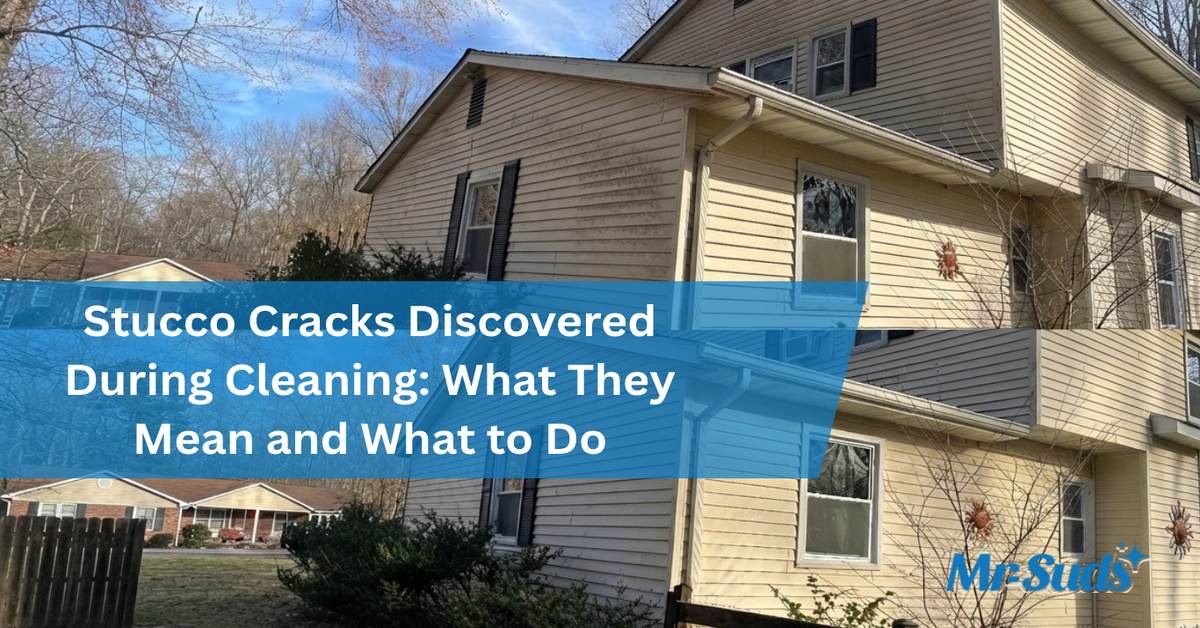
Cracks in stucco are so common that their presence tells you almost nothing on its own.
What matters is three things: how wide they are, where they run, and most importantly what kind of wall you actually have.
Traditional three-coat stucco is a drained system. Water that gets past the surface hits a weather-resistive barrier behind it and drains back out at the bottom.
EIMA, the trade association for EIFS, describes the synthetic stucco used widely on homes built from the 1980s onward as originally designed as a barrier system with no drainage path at all. In a barrier EIFS wall, a crack that lets water in gives it nowhere to go, and the sheathing behind it can rot for years without a single visible sign inside the house.
Same-looking wall. Entirely different level of urgency. So we start there.
First: Do You Have Traditional Stucco or EIFS?
Everything downstream depends on this answer, and most homeowners genuinely do not know which they own.
The knock test
Tap the wall firmly with a knuckle or the handle of a screwdriver.
Traditional stucco is hard and solid, like tapping concrete. No give, no hollow sound.
EIFS sounds and feels hollow and slightly soft, because there is expanded polystyrene foam directly behind a thin synthetic finish. Firm thumb pressure may produce a small amount of give.
The thickness test
Look at an exposed edge. A window return, a door jamb, the underside of a soffit return, a gable end.
Traditional stucco is thick, typically around three-quarters of an inch over metal lath, per ASTM C926. Broken edges usually show lath texture.
EIFS is a thin synthetic coat over thick foam. The total assembly is often much thicker than traditional stucco, while the visible finish layer is very thin.
Other tells
| Traditional stucco | EIFS | |
|---|---|---|
| Sound when tapped | Solid, hard | Hollow, slightly soft |
| Thickness at an edge | Around 3/4 inch over lath | Thin finish over thick foam |
| Typical Connecticut era | Pre-1970s | Mid-1980s through 2000s |
| Weep screed at the base | Usually present | Not typical |
| Sealant joints at openings | Less common | Characteristic |
| Rounded foam trim details | No | Almost always EIFS |
| Drains? | Yes | Barrier EIFS does not; drainage EIFS does |
| Risk if cracked | Usually manageable | Treat as a water entry point |
Two additional checks worth doing:
- Look for a weep screed at the base of the wall, a metal drip edge just above the foundation line. That is characteristic of traditional stucco.
- Look at the decorative details. Rounded, soft-edged quoins, bands, keystones and arched trim are almost always foam shapes, which means EIFS.
You can also pull the construction or re-clad date and specification from building permit records at the Town of Newington Building Department, or your own town’s.
If you cannot tell, do not guess. A qualified home inspector or an EIFS-experienced contractor can confirm it, and on an EIFS home that confirmation is worth paying for.
Not sure which type you have? Send us a photo of a window return or a soffit edge and we will tell you what we are looking at. Text or email Roman at (860) 263-9031.
Are Hairline Cracks in Stucco Normal?
On traditional stucco, largely yes. Cement stucco shrinks as it cures and moves with seasonal temperature change, so fine craze and hairline cracking is very common and often not a functional problem, because the wall drains behind the stucco. On EIFS, treat every crack as a potential water entry point until proven otherwise, because a barrier assembly has nowhere for that water to go.
Rough guidance on what you are looking at:
- Hairline and craze cracking. Fine, web-like, shallow, no displacement. Generally cosmetic on traditional stucco. Still sealed on EIFS.
- Narrow but continuous. A defined line running some distance, especially one starting at a window or door corner. Worth attention on either system.
- Wide, stepped, diagonal, or displaced. One side sitting proud of the other, or a crack you could slip a card into. This is a structural or movement question, not a cleaning question, and it needs a professional assessment.
We deliberately do not publish crack-width thresholds in millimetres, because they are not a code standard and treating them as one gets people into trouble. Look at the pattern, and get anything in the third category assessed.
What the Crack Pattern Is Telling You
This is where reading a wall actually gets useful.
- Diagonal cracks radiating from window and door corners. The classic stress-concentration pattern, very common, often from normal settlement or missing control joints. Usually not alarming on traditional stucco. Needs sealing on EIFS.
- Horizontal cracks along a line. These often follow a floor line, a lath joint or a control joint. Can indicate movement or simply an installation joint doing what it was meant to.
- Vertical cracks at inside and outside corners. Commonly movement related.
- Map or craze cracking across a whole field. Usually a curing or mix characteristic on traditional stucco. Cosmetic.
- Stepped cracking following a pattern. Suggests movement in the substrate behind the finish.
- Cracking with rust staining. Corroding lath or fasteners behind the surface. Water has been getting in for a while.
- Cracking with efflorescence, the white powdery deposit. Water is actively moving through the wall and carrying salts out with it. That is evidence of moisture movement, not just a crack.
- Bulging, soft spots, or a drummy hollow sound around a crack. Delamination, or on EIFS potentially deteriorated substrate. Stop and get it assessed properly.
Did the Cleaning Cause the Cracks?
Almost never.
Cracks develop over years. Cleaning removes the dirt, algae and staining that were concealing them, which is exactly why they seem to appear on the day the wall gets clean. We have had this conversation on a Glastonbury colonial where the owner was certain we had done it, and the previous owner’s listing photos from four years earlier showed the same cracks under a layer of grime.
That said, pressure washing genuinely can make things worse. All of the following are real:
- High pressure drives water through existing cracks and behind the finish, which on EIFS is precisely the failure mode you are trying to avoid
- It erodes a soft or degraded finish coat, widening what was already there
- It blasts out failing sealant at joints and penetrations
- On EIFS specifically, it can damage the thin synthetic base and finish coats outright
The correct method for both traditional stucco and EIFS is a low-pressure soft wash. Appropriate cleaning solution, gentle rinse, no concentrated pressure, no rotary or turbo nozzles, no close-range blasting at joints or penetrations.
And if cracks are already present, a good contractor should flag them before washing and adjust the approach, or decline that wall until they are addressed. That is the same pre-wash walkthrough principle covered in what to do when water gets behind siding during a wash.
What to Do Right Now, Step by Step
- Identify the wall type using the knock and thickness tests. Everything else follows from this one answer.
- Photograph every crack with a coin or ruler in frame for scale, noting the elevation and location.
- Map them. Sketch the elevation and mark where they run. Patterns tell you far more than individual cracks do.
- Check the interior of those walls for staining, soft drywall, musty smell, peeling paint or damp at the baseboard.
- Check the penetrations. Around windows, doors, hose bibs, lights, vents, deck ledgers and railing attachments. On EIFS, penetrations and sealant joints are where failures actually happen, far more often than the open field of the wall.
- Check every roof-to-wall junction for kick-out flashing. A missing kick-out above a stucco or EIFS wall is one of the most reliable causes of concealed rot in this construction type.
- If it is EIFS, get a moisture assessment. Inspectors experienced with EIFS use probe-based moisture testing and infrared to find wet substrate that is completely invisible from outside. On an EIFS home with cracks, this is not an optional extra. It is the entire point.
- If it is traditional stucco with hairline cracking and no interior signs, you most likely have a maintenance item rather than an emergency. Plan sealing and repainting instead of panicking.
- Get repair quotes from a stucco or EIFS specialist, not a general handyman. EIFS repair in particular is a specialist trade, and a bad repair seals water in.
- Verify credentials. CT DCP HIC registration at eLicense.ct.gov, certificate of insurance, and permits through the Town of Newington Building Department where the scope requires them.
How Stucco and EIFS Cracks Get Repaired
Realistic expectations, so nobody gets talked into the wrong scope.
- Traditional stucco, hairline. Cleaned, then typically bridged with an elastomeric coating or an appropriate patching compound and refinished. Colour and texture matching is the hard part. Patches show, and anyone who says otherwise has not done many.
- Traditional stucco, wider or structural. Cut out, re-lathed where needed, re-coated in layers, refinished. That is substantial work.
- EIFS. Repairs must restore the water management, not just the appearance. Failed sealant joints replaced with correct backer rod and sealant. Damaged areas cut out, base coat and mesh restored, finish matched. Where substrate is wet, it has to be opened and dried or replaced.
- The bigger EIFS question. Some homes with widespread barrier-EIFS moisture problems are ultimately re-clad, sometimes converting to a drainage EIFS assembly or a different cladding entirely. That is a major project and a decision to make with a building envelope professional, not from a blog post.
One thing not to do: never simply paint over cracks on EIFS. It hides the entry point without closing it and makes the next inspection harder for everyone.
The Connecticut freeze-thaw point, which is genuinely urgent. Water sitting inside a crack expands when it freezes. A crack that started admitting water in November is measurably worse by March. Cracks on Connecticut stucco and EIFS should be addressed before winter, not after it. If you are reading this in September, that timing matters.
How Stucco and EIFS Should Be Cleaned
The checklist to hold any contractor to.
- Low pressure only. Chemistry, dwell, gentle rinse
- No rotary, turbo or zero-degree nozzles. No surface cleaners
- No close-range spraying at sealant joints, penetrations, window perimeters or existing cracks
- An appropriate solution for the finish, since some stucco and EIFS finishes are sensitive to strong chemicals and to over-scrubbing
- A pre-wash walkthrough documenting existing cracks, failed sealant and damaged areas before work begins, with photos
- Landscaping and hardscape protected, runoff managed under the CT DEEP MS4 stormwater general permit that applies in Newington and neighbouring towns
A contractor who declines to wash an EIFS wall with open cracks until they are sealed is giving you good advice, not avoiding work. We have said no to those walls and referred the homeowner to an envelope specialist first. It is the right sequence.
On the paperwork: exterior housewashing on residential property is a taxable maintenance service in Connecticut at 6.35% per CT DRS, and residential contractors require CT DCP HIC registration.
See what soft washing actually is for the method, and pressure washing services in Hartford for the hardscape surfaces where high pressure is correct.
FAQs
Are hairline cracks in stucco normal? On traditional stucco they are very common and often cosmetic, because the wall drains behind the finish. On EIFS, treat them as potential water entry points.
How do I know if I have EIFS or real stucco? Knock test for hollowness, check the thickness at a window return or soffit edge, look for a weep screed at the base, and consider the era of construction.
Can you pressure wash stucco? Not at high pressure. Both traditional stucco and EIFS should be soft washed at low pressure, because force drives water through cracks and can erode the finish.
Did the pressure washer cause my cracks? Almost certainly not. Cleaning revealed cracks that dirt and algae were hiding. High pressure can, however, widen existing cracks and push water behind the finish.
Is EIFS bad? No. Modern drainage EIFS is a legitimate, well-performing assembly. The issue is specifically older barrier assemblies with compromised penetrations and failed sealant joints.
How much does stucco crack repair cost? It varies enormously with wall type, extent, access and finish matching. Get local quotes from a specialist rather than budgeting from a general figure.
Should I paint over stucco cracks? Not on EIFS. It conceals the entry point without sealing it. On traditional stucco, sealing then coating is a legitimate maintenance approach.
When should cracks be repaired in Connecticut? Before winter. Freeze-thaw cycling widens water-filled cracks through the cold months.
Get the Wall Assessed Before It Gets Washed
An Honest Look First, a Wash Second
Free on-site assessment. A documented pre-wash walkthrough with photographs of every existing crack and failed joint. Low-pressure soft wash only on stucco and EIFS.
And where the right answer is an envelope specialist and a moisture survey rather than a cleaning, that is the referral you will get from us.
To be clear on scope: Mr-Suds does not perform stucco repair, sealant work or moisture testing. We clean, and we tell you honestly when cleaning is not the first step.
See real before and after results, our house washing service, and what homeowners say in our reviews.
Get a Free Quote or call (860) 263-9031
Veteran owned. Licensed, bonded and insured. HIC registered. Owner-supervised on every job. Serving Glastonbury, Avon, Simsbury, Farmington, Cheshire, Newington, Wethersfield, Rocky Hill and Central Connecticut.