
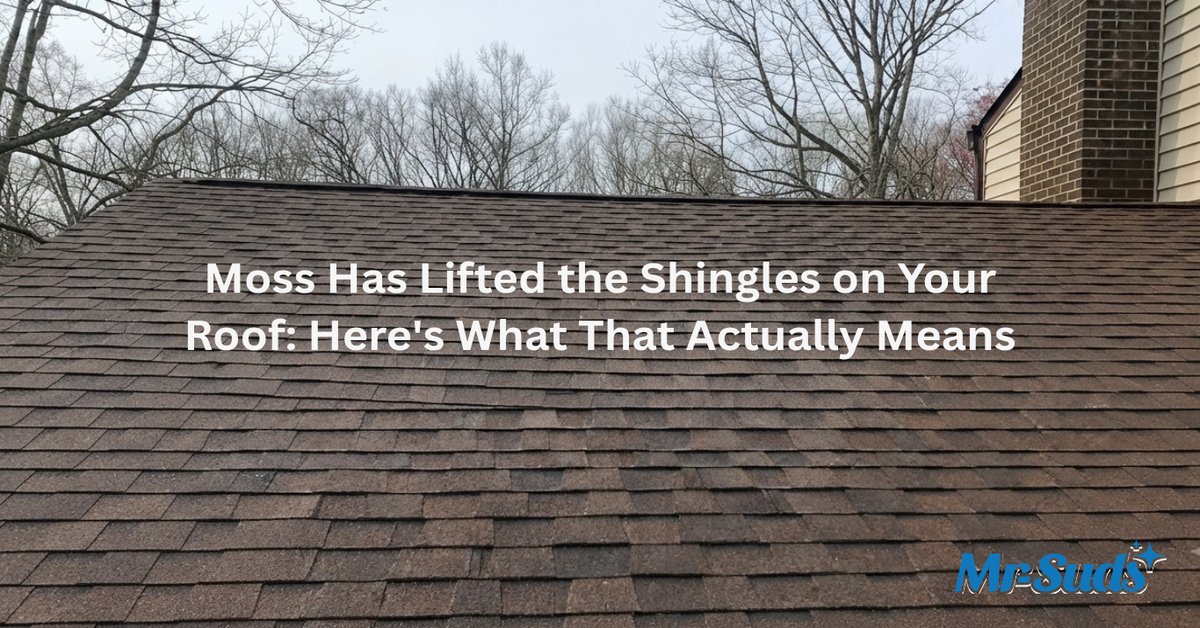
Moss does not sit on top of a roof. It grows under the bottom edge of each shingle course, where the surface stays damp the longest. As the mat thickens and swells with every rain, it works like a slow wedge, physically prying the shingle tab upward.
Once a tab is lifted, two things become possible that were not possible before. Wind can get underneath it, and water can run beneath it instead of over it. That is the real problem. The green is just how you found out.
So the question is not “how do I get rid of the green.” The question is whether your roof is still a cleaning job or has already become a roofing job. Below is the exact decision tree we walk through on site.
Moss, Lichen or Algae: You Need to Know Which One
Most homeowners use these three words interchangeably. They are three different organisms, they do three different kinds of damage, and only one of them lifts shingles.
Algae (Gloeocapsa magma). Flat black streaks running down the slope. Cosmetic. It stains, it does not lift. If that is what you have, the fix is different and simpler, and we covered it in what to do when black streaks return within a year.
Moss. Green, three-dimensional and spongy. It clumps along the horizontal shingle edges and packs into valleys. It holds water like a sponge and anchors itself with rhizoids that grip the granule surface.
This is the one that lifts shingles.
Lichen. Crusty grey-green circular patches that look almost painted onto the shingle. It is a fungus and algae partnership that roots chemically into the asphalt itself.
Lichen is the hardest of the three to remove, and I would rather tell you this now than after the invoice: even a correct treatment often leaves a faint ghost mark where the colony sat. The organism dies. The outline sometimes stays.
| Appearance | Where it grows | Lifts shingles? | Removable? | Leaves a mark? | |
|---|---|---|---|---|---|
| Algae | Flat black streaks | Down-slope, north side first | No | Yes | No |
| Moss | Green, thick, spongy | Shingle edges, valleys, eaves | Yes | Yes, slowly | Usually not |
| Lichen | Crusty grey-green discs | Anywhere, often mid-slope | Rarely | Partially | Often faintly |
Does Moss Actually Damage a Roof, or Is It Just Ugly?
Yes, moss causes real damage. It wedges shingle tabs upward as the mat swells, keeps the roof surface wet for days instead of hours, and in Connecticut’s freeze-thaw winters that trapped water expands and forces the lift further. A raised tab with a broken sealant strip is then exposed to wind uplift. The staining is cosmetic. The lifting is not.
Breaking that into the four mechanisms:
Wedging. The mat grows thicker each season and pushes the tab up from underneath.
Moisture retention. Asphalt shingles are engineered to shed water and dry out quickly. A moss mat holds moisture against the surface for days after the rain has stopped.
Freeze-thaw. This is the Connecticut-specific killer. Water trapped in and under the mat freezes, expands, and forces the lift further open. Central Connecticut runs through dozens of freeze-thaw cycles between November and March. A roof with a mild moss problem in October can have genuinely damaged shingles by April.
Wind uplift. A lifted tab with a broken sealant strip is a flag in a nor’easter. Winter storms and remnant tropical systems are how most homeowners around Hartford County find out their tabs were already loose.
There is a bonus problem too. Moss along the eaves blocks meltwater flow at the coldest part of the roof, which feeds ice damming.
The Three Levels of Moss Damage: Which One Is Your Roof?
This is the framework we use on every moss inspection, and it decides everything that follows.
Level 1: Growth without lift (cleanable)
Moss is present, mostly in the valleys, on the north slope and along shaded eaves. The shingle tabs still lie flat. Granule coverage looks even across the field.
Action: soft wash treatment plus prevention. No roofer needed. Outcome: full recovery.
Level 2: Lifted tabs, intact shingles (treat, then reassess)
Tabs are visibly raised. The sealant strips underneath are almost certainly broken. But the shingles themselves are not cracked, curled or bare.
Action: treat the moss first and let it die and release. Then have the lifted tabs hand-sealed with roofing cement by a roofer. In practice, a good number of tabs re-seal on their own during the first properly hot stretch of summer once the moss is out from underneath them.
Outcome: usually recoverable at modest cost. Cleaning is absolutely worth doing at this level.
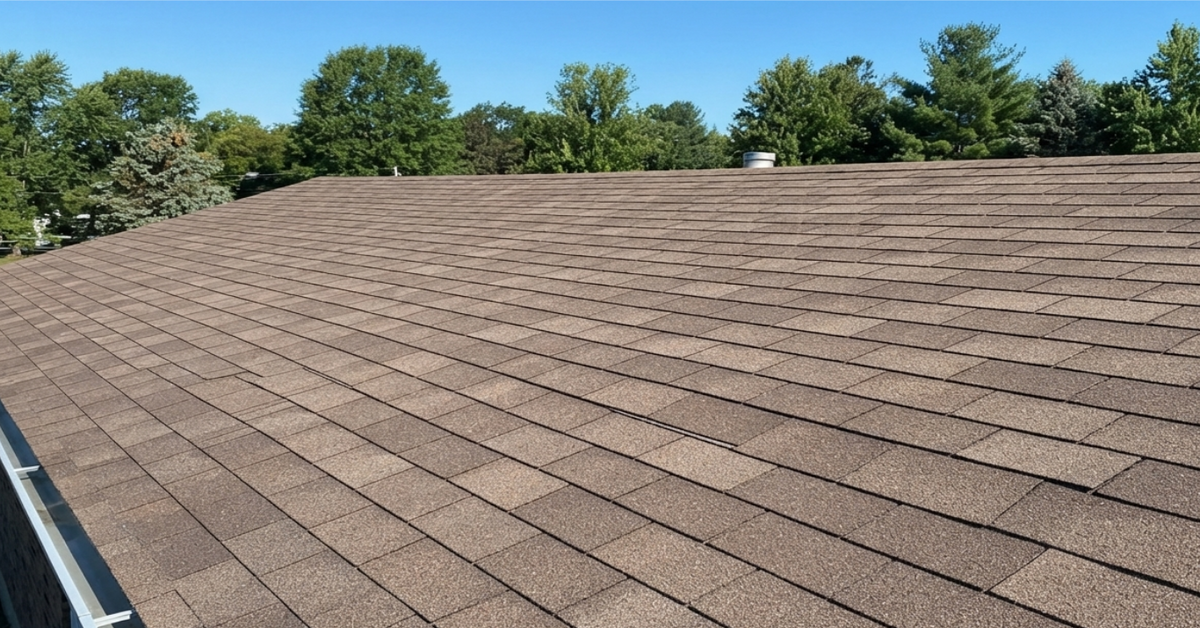
Level 3: Structural involvement (roofer first, cleaner second or not at all)
Red flags, any one of which puts you here:
- Shingles cracked or split
- Edges curled and brittle
- Large bare patches with no granules left
- The deck feels soft or spongy underfoot
- Daylight, staining or damp insulation visible in the attic under that slope
- The roof is 20-plus years old with multiple layers
Action: independent roofer inspection before anyone cleans anything.
I will be blunt, because this is the part that costs us money and earns us trust. If your roof is at Level 3, we will tell you, and we will not take the job. Washing a roof that needs replacing helps nobody. We have driven away from Newington and Rocky Hill driveways without writing a ticket for exactly this reason, and more than one of those homeowners called us back the following year for the house wash after their new roof went on.
Not sure which level you are at? We will inspect it and tell you straight, including if the answer is “call a roofer, not us.” Call Roman at (860) 263-9031.
How Moss Is Actually Removed (and Why It’s Slower Than You Expect)
This section exists because almost every moss complaint in this trade comes from mismatched expectations, not bad work.
What never to do
- No pressure washing. Ever. It strips granules, drives water under the tabs, and on a Level 2 roof it will finish the job the moss started.
- No aggressive scraping or wire brushing. It takes the granules with it and cracks cold shingles.
- No pulling moss upward against the shingle grain. That lifts tabs further. Any manual work goes down-slope only.
- No homemade bleach-and-hose jobs on a wet pitched roof. The slip risk alone is not worth it, and your foundation plantings will pay for it
What a correct treatment looks like
- Careful, dry, gentle removal of the thickest mats by hand first where appropriate, which reduces the volume before any chemistry goes down
- Low-pressure application of the correct solution at the correct concentration, with surfactant, and full dwell time
- Landscaping pre-wetted and protected, with runoff controlled (Newington’s storm drains fall under the CT DEEP MS4 stormwater general permit, so rinse water should not be sent straight into a catch basin unmanaged)
- Gutters cleared during the same visit, because dying moss sheds into them for weeks afterward. That is why we bundle annual gutter cleaning with most moss jobs
The timeline nobody warns you about
Read this part twice.
Moss does not vanish the way algae does. After treatment it dies, turns brown, loses its grip, and gets carried off by rain and wind over four to eight weeks. A thick mat on a shaded north slope can take a full season.
Your roof will look worse before it looks better. Brown, patchy, and honestly a bit ugly for a few weeks.
Anyone promising you an instantly moss-free roof is either pressure washing it or scraping it. Both cause damage you will pay for later.
What to Do Right Now, Step by Step
- Don’t climb up. A moss-covered asphalt roof is one of the most slippery surfaces in residential construction, and lifted tabs mean loose footing. Use binoculars, a phone zoom, or a drone from the ground.
- Check the attic before you check the roof. Go up on a bright day with the lights off. Look for daylight through the deck, dark water staining on the sheathing, damp or compressed insulation, and a musty smell, all on the same slope where the moss is. Ten minutes up there tells you whether you are at Level 3.
- Photograph the eaves, valleys and north slope at the same time of day so you have a baseline.
- Clear the gutters, or have them cleared. Blocked gutters keep the bottom courses saturated and are usually why the moss started at the eaves in the first place.
- Get a written, photo-documented inspection. Ask three specific questions: are any tabs lifted, are any shingles cracked, and is the sealant strip broken? Those three answers determine everything else.
- If repair or re-roofing is recommended, know that a re-roof in Newington requires a building permit through the Town of Newington Building Department. Any contractor doing residential home improvement work in Connecticut must be registered with CT DCP, and you can verify the HIC number at eLicense.ct.gov before you sign anything.
- Understand the insurance reality up front. Homeowners policies in Connecticut generally cover sudden accidental perils such as wind, hail and falling trees. Damage that developed gradually from moss or lack of maintenance is typically excluded as wear and tear. If a storm blows off tabs that moss had already loosened, that claim gets complicated fast. Call your own agent before you assume anything.
- Check your shingle warranty. Several manufacturers’ limited warranties exclude damage caused by moss, algae or failure to maintain, and some require evidence of reasonable maintenance. Keep every cleaning invoice.
Why Central Connecticut Roofs Get Moss in the First Place
There is a reason we see far more moss here than a contractor in a dry climate ever would.
Humid summers, a long wet shoulder season, and heavy winter snow-load moisture across Hartford County keep roof surfaces damp for a large part of the year.
Then there is the canopy. Elm Hill, Churchill Park, Newington Junction and Cedar Mountain are full of mature oak, maple, pine and hemlock. Overhanging limbs mean permanent shade plus a constant supply of organic debris, which is effectively fertiliser sitting on your shingles.
The housing stock does not help either. Newington’s post-war ranches and capes often have low-pitch roofs, wide shaded eaves and deep valleys. Every one of those is a moisture trap.
Attic ventilation is the root cause nobody in my industry likes to mention, because we do not sell it. On older homes with poor soffit and ridge ventilation, warm moist air from inside keeps the deck warm and damp, feeding growth from underneath. If your moss keeps coming back faster than it should, get the ventilation looked at.
And if your south slope is pristine while your north slope is carpeted, that is completely normal. It is also a useful diagnostic clue.
What It Costs Around Newington
| Work | Typical range |
|---|---|
| Moss treatment, average Newington ranch or cape | $500 to $1,100 |
| Larger colonials, steep or multi-valley roofs | $1,100 to $1,800 |
| Hand-sealing lifted tabs (roofer) | Usually a half-day minimum charge |
| Zinc or copper ridge strips | $3 to $8 per linear foot |
| Limb trimming to open the canopy | Quoted by a licensed arborist |
Moss treatment runs higher than a plain algae wash for real reasons: more product, longer dwell, often hand work on the thick mats, and a gutter clean-out afterward.
On the trimming, use a licensed arborist rather than a general handyman. Arboriculture in Connecticut requires a state arborist licence, and tree work near a roofline is not the place to save fifty dollars.
Expect 6.35% Connecticut sales tax on residential maintenance services including roof cleaning, per CT DRS. It should appear on any legitimate invoice.
The honest framing: treatment plus prevention costs a fraction of a re-roof, but only if you are at Level 1 or 2. At Level 3, that money belongs to the roofer, not to us.
Making Sure It Doesn’t Come Back
- Zinc or copper ridge strips
- Limb clearance of six to ten feet where practical
- Annual gutter cleaning
- An attic ventilation check, especially on pre-1970 homes
- Debris cleared out of the valleys each autumn
- A maintenance treatment every two to three years rather than waiting for the mat to rebuild
- Best window in Connecticut: late spring through early autumn, on a dry, mild, low-wind day
FAQs
Will removing moss fix my lifted shingles? It stops the cause. Some tabs will re-seal naturally in summer heat once the moss is gone. Others will need hand-sealing by a roofer, which is usually a small job.
How long does it take for moss to come off after treatment? Four to eight weeks typically. Thick mats can take a full season. The roof looks brown and patchy in between.
Can I just scrape the moss off myself? Scraping takes granules with it and can crack cold shingles, and pulling upward lifts tabs further. On top of that, wet moss on a pitch is genuinely dangerous footing. This is one we recommend leaving alone.
Does moss on a roof mean I need a new roof? Usually not. Run the Level 1, 2, 3 test above. Most of the roofs we see are Level 1 or 2.
Is moss covered by homeowners insurance in Connecticut? Generally it is treated as a maintenance issue rather than a covered peril. Call your own agent before assuming either way.
What’s the difference between moss and lichen on a roof? Moss is green, thick and spongy and lifts shingles. Lichen is a flat crusty grey-green disc that roots chemically into the asphalt and sometimes leaves a faint mark even after correct treatment.
Do zinc strips stop moss? They suppress regrowth. They will not remove what is already established on your roof.
What time of year should moss be treated in Connecticut? Late spring through early autumn, on a dry and mild day with little wind.
Not Sure Which Level Your Roof Is At?
Get an Honest Read on Your Roof
We will come out, look at the tabs, the valleys and the attic if you want us to, and tell you which of the three levels you are actually at. If the answer is “roofer first,” you will hear that from us, free, with photos.
See our professional roof soft washing in Hartford and Newington, our real Newington-area roof results, and what Central CT homeowners say.
Get a Free Quote or call (860) 263-9031