
Last fall, I got a call from a homeowner in Rocky Hill who was getting ready to list their house. Their real estate agent had walked the exterior and told them the house needed to be cleaned before listing photos. “It is not that bad,” the homeowner said on the phone.
When I pulled up, I understood why they thought that. They saw the house every day. They had adjusted to it gradually, the way you adjust to a room getting cluttered one item at a time. But standing on the sidewalk looking at it with fresh eyes, the story was different.
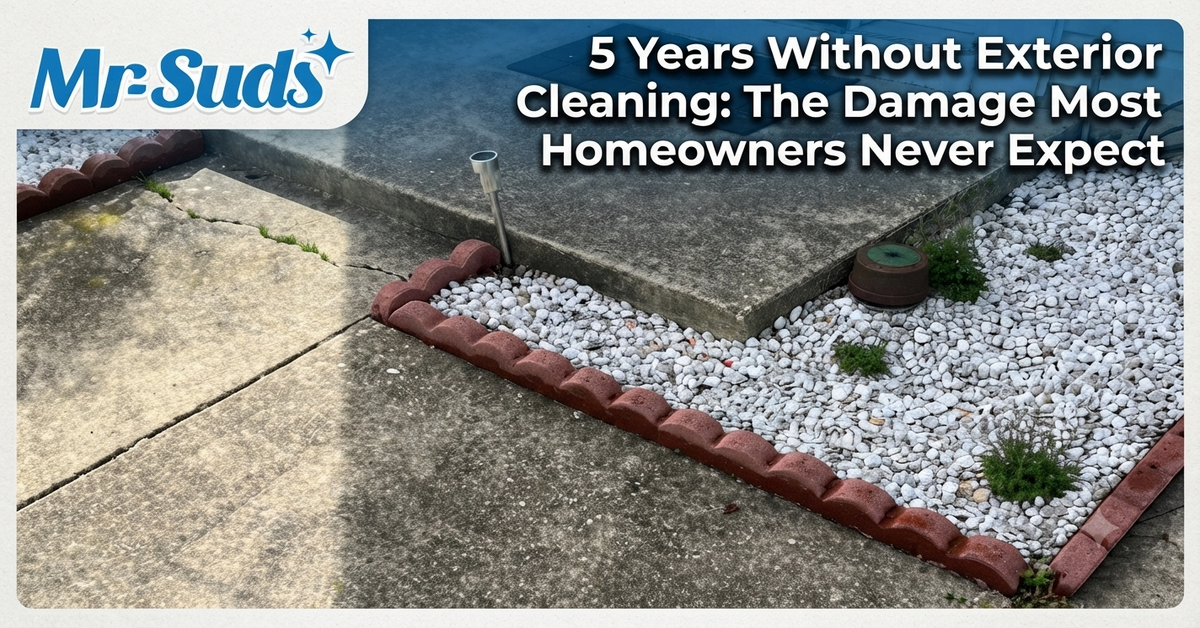
The siding that had been white five years ago was gray-green on the north side. Black streaks ran under every window. When I ran my hand across the vinyl, it felt chalky and rough instead of smooth. The gutters had dark oxidation lines running down the fascia boards. The concrete driveway had a dark biological film that was visibly slippery near the shaded edges.
The homeowner had no idea it had gotten this bad. And this is what five years of skipped exterior cleaning looks like in Hartford County. The damage goes deeper than what is visible from the street.
After five years without exterior cleaning, most Connecticut homes develop embedded mold and algae that discolor siding, premature paint failure from trapped moisture, gutter staining that does not wash off easily, concrete surfaces covered in slippery biological film, and in severe cases, early-stage wood rot on trim, fascia, and deck boards. The cost to repair this damage often exceeds ten times the cost of annual preventive cleaning.
This post walks through what actually happens year by year, what it costs to fix, and what to do if you are starting from years of neglect.
What Actually Happens When You Skip Exterior Cleaning for Five Years?
The damage does not happen all at once. It builds gradually, and each year the problem compounds on the year before. Here is what the progression looks like on a typical Hartford County home.
Year 1: The Buildup You Cannot See Yet
In the first year without cleaning, the changes are invisible to the naked eye. A thin layer of pollen, dust, and airborne particulates settles on every exterior surface. Mold and algae spores begin colonizing the areas where moisture lingers longest, mainly north-facing walls, the underside of eaves, and the zones behind downspouts.
Gutter debris starts accumulating but has not yet caused overflow. The driveway looks the same. The siding looks the same. Nothing feels urgent.
At this stage, a single professional house washing removes everything in a few hours with zero lasting effects. Most homeowners do not notice any change at year one, which is exactly why they skip year two.
Year 2 to 3: The Visible Change Begins
This is when things start showing up. Green algae becomes visible on north-facing walls and heavily shaded sections of the house. Black streaks appear under windows and along drip lines where water runs regularly during rain.
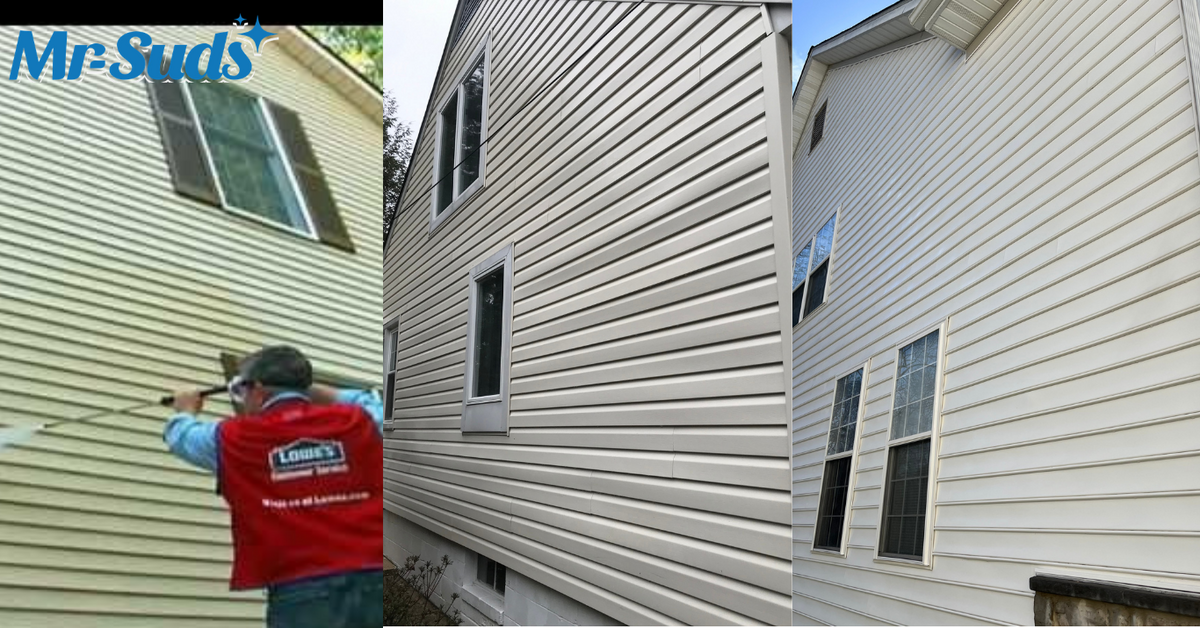
Vinyl siding starts losing its bright appearance. It takes on a dull, grayish tone that most homeowners mistake for fading or aging. It is neither. It is a thin layer of biological growth coating the surface.
Gutter overflow begins staining the fascia and upper siding below the roofline. Those dark vertical streaks below the gutter line are not dirt. They are mineral and organic deposits from roof runoff, and they get harder to remove the longer they sit.
Concrete driveways and walkways develop dark patches, especially in shaded areas and along the edges where moisture lingers. Mold begins penetrating paint surfaces on wood trim, causing early-stage blistering that is easy to miss unless you look closely.
At this stage, professional cleaning still removes most of the buildup. But some staining may leave a faint ghost mark where the growth has started bonding to the surface.
Year 4 to 5: The Damage Stage
This is where the situation shifts from cosmetic to structural.
Algae and mold are now embedded in the texture of the vinyl siding, not just sitting on the surface. When I run my hand across vinyl that has not been cleaned in five years, it feels chalky. That is not just dirt. It is oxidation and embedded biological growth starting to break down the surface itself.
Paint on wood trim, fascia, and window frames begins to peel and blister as moisture gets trapped underneath. The mold is not just on the paint. It is under it. And paint cannot hold when the substrate beneath is damp and compromised.
Gutter oxidation, sometimes called “tiger striping,” becomes permanent without a chemical brightening treatment. Standard washing will not remove it at this point. The streaks have bonded with the aluminum.
Concrete surfaces develop a thick biological film that creates a genuine slip-and-fall hazard, especially when wet. We have seen driveways in Wethersfield and Southington where the homeowner did not realize how dangerous the surface had become until someone nearly fell.
Deck boards, whether wood or composite, begin to gray, warp, or show early signs of softness from moisture retention. Wood decks are especially vulnerable. The mold traps moisture against the wood fibers, and over years that sustained dampness leads to the beginning of rot.
On brick and masonry, years of moisture retention from algae and mold can deteriorate mortar joints. In Connecticut, the freeze-thaw cycle accelerates this dramatically. Water trapped in porous brick and mortar freezes, expands, thaws, and contracts. After hundreds of these cycles over five winters, spalling and cracking begin to appear.
Roof shingles in heavily shaded areas may show Gloeocapsa magma, the black algae that feeds on the limestone filler in asphalt shingles. Over time, it loosens the protective granules on the shingle surface, reducing the roof’s effective lifespan. The Asphalt Roofing Manufacturers Association (ARMA) identifies algae growth as a factor in premature shingle degradation.
At this stage, cleaning alone may not be enough. Some surfaces may require repainting, re-staining, sealing, mortar repair, or in the worst cases, full replacement.
The Real Cost of Neglect vs. the Cost of Maintenance
The numbers tell the story more clearly than anything else. Here is what annual maintenance costs compared to the repair bills that pile up when exterior cleaning is skipped for five years.
What Annual Cleaning Costs for a Typical Hartford County Home
| Service | Frequency | Annual Cost |
| House soft wash | Once per year | $250 to $500 |
| Gutter cleaning | Twice per year | $200 to $500 total |
| Driveway pressure washing | Every 1 to 2 years | $150 to $350 |
| Deck cleaning | Every 2 to 3 years | $150 to $400 |
| Annual average | $500 to $900 | |
| 5-year total | $2,500 to $4,500 |
What Repair and Replacement Costs After 5 Years of Neglect
| Repair | Estimated Cost |
| Full house repainting (exterior) | $3,000 to $8,000+ |
| Vinyl siding replacement (partial or full) | $5,000 to $15,000+ |
| Wood trim, fascia, and soffit repair | $1,500 to $5,000+ |
| Deck re-staining or replacement | $1,000 to $10,000+ |
| Roof cleaning with shingle treatment | $300 to $700 |
| Concrete driveway resurfacing | $1,500 to $3,000+ |
| Gutter replacement (severe oxidation) | $800 to $2,500+ |
| Potential total | $5,000 to $30,000+ |
The math is straightforward. Spending $500 to $900 per year on maintenance prevents $5,000 to $30,000 or more in repair and replacement costs after five years of doing nothing.
The Costs You Do Not See: Home Value and Buyer Perception
Beyond physical damage, neglect hits your wallet in ways that are harder to measure but equally real.
A neglected exterior can reduce perceived home value by 5 to 10%. For a $350,000 Hartford County home, that translates to $17,500 to $35,000 in lost perceived value at the closing table. Research from the National Association of Realtors consistently shows that curb appeal is one of the strongest factors influencing buyer perception and offer price.
Real estate agents frequently tell us that exterior cleaning is the first thing they recommend before listing. Buyers who see a dirty exterior assume the interior has been neglected too. They start looking for problems before they have even opened the front door. That mindset drives down offers and extends time on market.
Why Connecticut Homes Deteriorate Faster Without Cleaning
Not all climates are equally punishing. Connecticut’s weather creates conditions that accelerate exterior deterioration faster than most homeowners realize.
The Freeze-Thaw Factor
Connecticut experiences roughly 100 or more freeze-thaw cycles every winter. Here is why that matters for neglected exteriors.
When mold and algae coat a porous surface like brick, concrete, or mortar, they trap moisture against it. That moisture does not just sit there. During winter, it freezes and expands inside the pores of the material. When temperatures rise, it thaws and contracts. This expansion and contraction cycle repeats dozens of times between November and March.
Over five years, that repeated stress causes spalling on brick, cracking in concrete, and mortar joint failure between bricks. Clean, dry surfaces resist freeze-thaw damage far better because there is less trapped moisture to begin with. The cleaning itself is a form of freeze-thaw prevention.
The Humidity and Shade Combination
Hartford County’s humid continental climate keeps exterior surfaces damp for extended periods during spring, summer, and fall. The heavy tree canopy in suburban neighborhoods like Newington, Wethersfield, Glastonbury, and Simsbury creates persistent shade on north and west-facing walls.
That shade does two things. It prevents surfaces from drying out between rain events. And it blocks the UV light that naturally slows mold and algae growth. In sunnier, drier climates, UV exposure kills a significant portion of surface organisms. In shaded Connecticut neighborhoods, mold accumulates year-round, not just during warm months.
This combination of humidity and shade means exterior surfaces in Hartford County deteriorate faster when uncleaned than the same materials would in a drier or sunnier region. Five years of neglect here is not the same as five years of neglect in Phoenix.
The 118-Day Precipitation Problem
With 118 precipitation days per year and approximately 49 inches of annual rainfall, Connecticut surfaces rarely get a sustained period to fully dry out. According to NOAA climate data, the state averages precipitation roughly one out of every three days.
Constant dampness feeds biological growth and prevents natural breakdown of organic matter on surfaces. Gutter systems work harder in Connecticut than in drier climates, which makes overflow and clogging more common. When gutters are neglected, the overflow staining and water damage happen faster and hit harder.
Can You Reverse Five Years of Damage? What Is Recoverable and What Is Not
This is the question most homeowners are really asking when they call. They want to know if it is too late. The honest answer is that it depends on the surface and the type of damage.
Damage That Professional Cleaning Can Fix
The good news is that most surface-level damage from five years of neglect is fully reversible with professional cleaning.
Surface mold, mildew, and algae on vinyl siding come off with a proper soft wash, even heavy buildup that has been there for years. Black streaks under windows and along drip lines respond to the right cleaning solution and dwell time. Biological film on concrete driveways and walkways cleans up with professional pressure washing. Gutter oxidation and tiger striping can be treated with a chemical brightening process. Dull or gray composite decking typically restores to its original appearance. Light staining on brick and stone responds to targeted cleaning with surface-safe solutions. Roof algae streaks (Gloeocapsa magma) can be removed with a soft wash treatment.
We have cleaned houses in Newington and Wethersfield that had not been touched in over a decade. The siding came back to life. The homeowner could not believe it was the same house. But we also found two fascia boards during that same job that needed replacing because the wood underneath had softened from years of trapped moisture.
That is the other side of the story.
Damage That Requires Repair Beyond Cleaning
Before every job on a neglected property, I walk the full perimeter. I press on wood trim with my thumb. If it gives, that is rot, and cleaning alone will not fix it. I tell the homeowner before we start so there are no surprises.
Here is what falls into the repair category after years of neglect.
Peeling or blistered paint on wood surfaces needs scraping, priming, and repainting after the surface is cleaned. Soft or spongy wood on trim, fascia, or deck boards means rot has set in and those sections need to be replaced. Cracked mortar joints or spalled brick require repointing or, in severe cases, brick replacement. Permanently discolored or etched window glass from years of mineral deposit bonding may not respond to any cleaning method. Cracked or heaved concrete from freeze-thaw damage requires resurfacing or replacement. Shingle granule loss from years of algae feeding cannot be reversed. The roof may still function, but its lifespan has been shortened.
For surfaces that need restoration beyond what cleaning alone can achieve, our rejuvenation service combines deep cleaning with surface restoration to bring materials as close to original condition as possible.
The Inspection Step Most Homeowners Skip
There is a common mistake homeowners make when they finally decide to address years of neglect. They book a cleaning without first understanding what is underneath the buildup.
Cleaning a surface with underlying rot or structural failure can mask problems that need to be addressed first. You do not want to pay for a beautiful soft wash only to discover three months later that the fascia board behind the clean siding was already rotting.
The correct order is: inspect, clean, re-inspect, then repair or seal as needed. At Mr-Suds, we perform a walkthrough before every job specifically to identify areas that need attention beyond cleaning. If we find wood rot, mortar failure, or any structural concern, we let you know before any work begins.
What to Do If You Have Not Cleaned Your House in Years
If you are reading this and realizing your house has not been cleaned in three, five, or even ten years, here is the path forward. It is not as overwhelming as it feels.
Step 1: Schedule a Professional Inspection and Cleaning
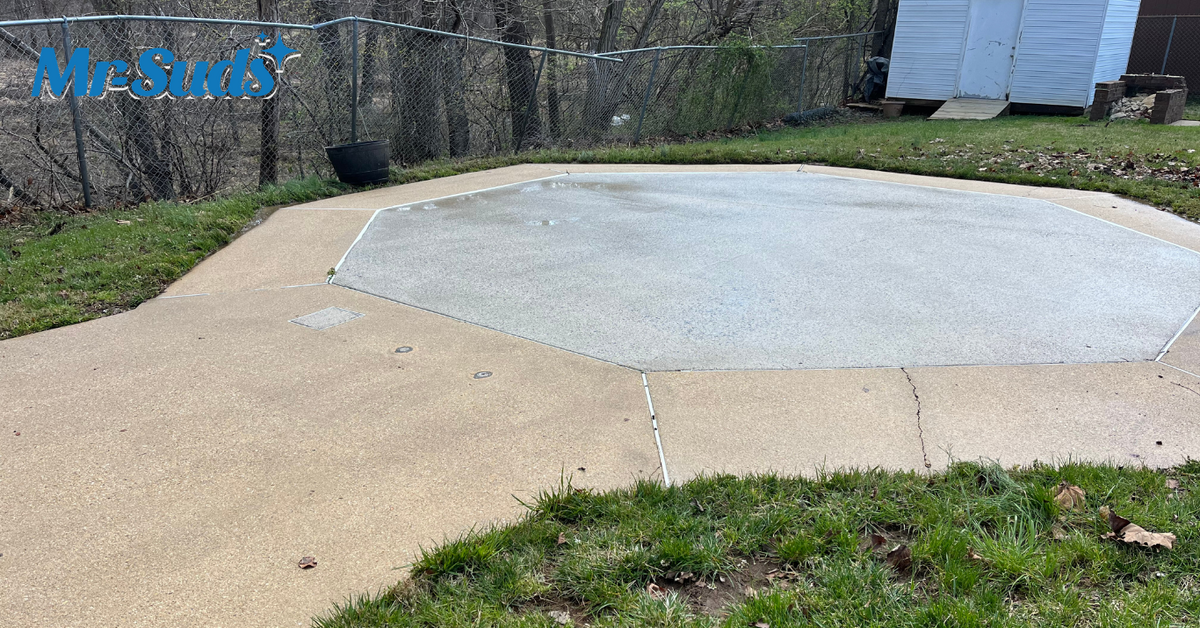
A professional soft wash is the right first move regardless of how long it has been. Even after five or more years of neglect, most siding, concrete, and roofing surfaces can be restored with professional methods.
The first wash does two things. It removes the visible buildup and transforms the appearance of the house. And it reveals the true condition of the surfaces underneath. You cannot properly assess damage when everything is covered in years of mold and grime.
The initial deep clean on a heavily neglected home typically costs 20 to 40% more than a routine annual wash. For a typical Hartford County home, expect $350 to $700 for that first wash compared to $250 to $500 for annual maintenance washes going forward. The extra cost reflects the additional time, solution strength, and thoroughness required.
Step 2: Address Any Repairs Identified During or After Cleaning
Once the surfaces are clean, walk the property with your contractor and inspect for paint failure, wood softness, mortar cracks, and any surface damage that was hidden under the buildup.
Prioritize repairs that affect structural integrity first. Wood rot on fascia or trim boards, mortar failure between bricks, and compromised deck boards are more urgent than cosmetic paint touch-ups. Schedule repainting or sealing after all structural repairs are complete so the new finish goes onto sound material.
Step 3: Start a Maintenance Schedule Going Forward
This is the step that breaks the cycle. An annual house wash prevents future buildup from ever reaching the damage threshold again. Twice-yearly gutter cleaning prevents overflow staining. Driveway and walkway cleaning every 1 to 2 years prevents biological film from becoming a safety hazard.
This maintenance schedule costs approximately $500 to $900 per year. That is $40 to $75 per month. It prevents the repair cycle from starting over and keeps your home looking maintained year-round.
The homeowner in Rocky Hill who called before listing? We cleaned the house, identified two soft fascia boards that needed replacing, and referred them to a carpenter. After the cleaning and repairs, the real estate agent said the house looked ten years younger from the street. The listing photos came out great, and the home sold within three weeks.
That is what a recovery plan looks like when you do it in the right order.
Frequently Asked Questions
What happens if you never pressure wash your house?
Without regular cleaning, mold, mildew, and algae accumulate on siding, trim, and concrete surfaces. Over time, this buildup traps moisture against the surface, leading to paint failure, wood rot, discoloration, and in Connecticut, accelerated freeze-thaw damage to brick and concrete. After five years, the cost to repair this damage typically exceeds ten times the cost of what annual preventive cleaning would have cost.
Can mold on exterior siding make my family sick?
Exterior mold releases spores into the air around your home. While outdoor mold is generally less concentrated than indoor mold, it can trigger allergic reactions and respiratory symptoms in sensitive individuals. The risk increases near windows, doors, and HVAC air intakes where spores can enter the home. The EPA’s mold resource guide recommends reducing mold exposure wherever possible, including on exterior surfaces.
Is the damage from five years of neglect reversible?
In most cases, surface-level damage like mold, algae, staining, and biological film is fully reversible with professional cleaning. Structural damage, including wood rot, paint failure, mortar cracking, and shingle granule loss, requires repair or replacement. The key is to clean first, then assess what needs repair underneath. Most homeowners are relieved to find that the majority of the visible damage cleans up far better than they expected.
How much does it cost to clean a house that has not been washed in five years?
The initial deep clean on a heavily neglected home typically costs 20 to 40% more than a routine annual wash due to additional time and solution required. For a typical Hartford County home, expect $350 to $700 for the first wash. After that initial cleaning, annual maintenance washes drop back to the $250 to $500 range.
Does exterior neglect affect my home’s resale value?
Yes. A neglected exterior can reduce perceived home value by 5 to 10%. For a $350,000 Hartford County home, that represents $17,500 to $35,000 in lost perceived value. Buyers and appraisers associate a dirty exterior with deferred maintenance throughout the property, even if the interior is in excellent condition. Professional exterior cleaning is consistently ranked by real estate agents as one of the highest-ROI pre-listing investments.
What should I clean first if I have not maintained my house in years?
Start with a full house soft wash to remove biological growth from all siding, trim, and soffits. Then have the gutters cleaned. Follow with driveway and walkway pressure washing. After everything is clean, inspect all surfaces for damage that was hidden under the buildup. Address structural repairs first, cosmetic repairs second, and then start a regular annual maintenance schedule to prevent the cycle from repeating.
It Is Not Too Late, But Every Year You Wait Costs More
Five years without exterior cleaning does not just make your house look tired. It creates real damage that costs real money to fix. The mold, algae, and moisture buildup that accumulates over years of neglect attacks paint, wood, brick, concrete, and roofing materials from the outside in.
The good news is that most of this damage is preventable with a simple annual cleaning routine. And even after years of neglect, recovery is possible if you act before structural damage takes over.
The homeowners who call us at Mr-Suds after years of putting it off always say the same thing after the job is done: “I should have done this years ago.” They are right. But the second-best time is today.
Not sure how much damage has built up on your house? Call us at (860) 263-9031 or request a free quote. We will walk your property, tell you exactly what we see, and give you a clear path forward. No judgment. Just honest answers and a plan.