
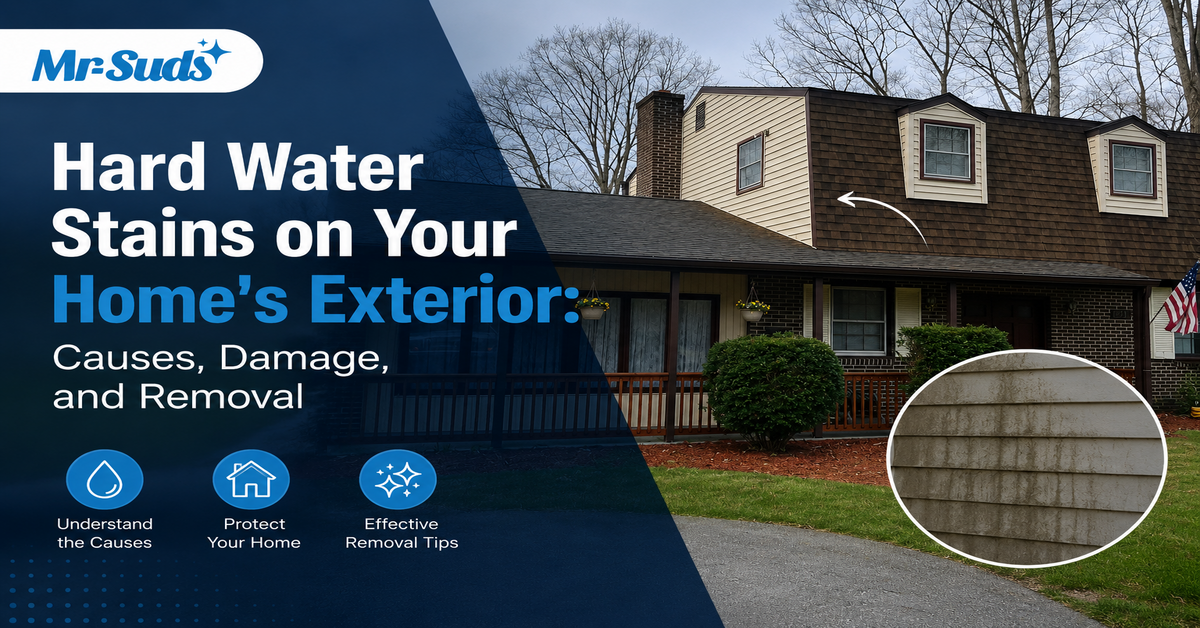
A few months ago, a homeowner in Wethersfield called us about “white stuff” spreading along the bottom three feet of their vinyl siding. They were convinced it was mold. When I arrived and took a closer look, I could tell immediately it was not mold at all.
It was mineral buildup. Their irrigation system had been spraying directly onto the siding every morning for years. The calcium and magnesium in the water evaporated in the sun each day, leaving behind a thin chalky crust. Layer after layer, watering cycle after watering cycle, it built up into a thick white film that looked terrible and would not come off with a garden hose.
This is one of the most common exterior issues we encounter at Mr-Suds across Hartford County. And most homeowners have no idea what they are looking at until it gets difficult to remove.
Hard water stains on your home’s exterior are caused by mineral deposits, primarily calcium and magnesium, left behind when mineral-rich water evaporates on surfaces like vinyl siding, brick, concrete, and glass. These stains appear as white, chalky, or cloudy marks and can become permanent if left untreated. Professional soft washing or targeted acid-based cleaning is the most effective removal method.
This post covers what causes these stains, how to tell them apart from mold or efflorescence, which removal methods actually work on each surface, and how to prevent them from coming back.
What Are Hard Water Stains and Why Do They Appear on Your House?
The Simple Science Behind Those White Marks
Hard water contains dissolved minerals. The two main culprits are calcium carbonate and magnesium. Every water source has some level of these minerals, but some sources carry much more than others.
When water from your sprinklers, garden hose, gutter overflow, or even rain runoff touches your home’s exterior, it eventually evaporates. The water disappears into the air. The minerals do not. They stay behind as a solid white or cloudy deposit on whatever surface the water was sitting on.
One watering cycle leaves a deposit so thin you cannot see it. But after weeks and months of daily sprinkler runs, those invisible layers stack on top of each other. Eventually, you notice a chalky white film that feels rough to the touch and will not rinse away with water.
The longer these mineral deposits sit on a surface, the harder they bond to it. Fresh stains wipe off with mild acid. Year-old stains sometimes need professional chemical treatment to break free.
Common Sources of Hard Water Stains on Connecticut Homes
We see hard water staining from five main sources on homes across Hartford County. Understanding where your stains are coming from is the first step to fixing them.
Sprinkler systems are the number one cause. Irrigation heads aimed at or too close to the house spray mineral-rich water onto siding, brick, and windows every single day during the growing season. We see sprinkler-caused staining on at least two out of every five house washing jobs in Newington and Wethersfield. The homeowner almost never realizes it until the buildup is thick enough to notice from the street.
Garden hoses create stains where water drips from a hose bib or pools at the base of the siding. That small puddle evaporates repeatedly in the same spot and leaves a concentrated mineral ring.
Gutter overflow is another big one. When gutters are clogged or undersized, water spills over the edge and runs down the face of the siding. It picks up minerals from roofing materials along the way and leaves streaky white stains as it dries.
Well water affects many Connecticut homes, especially in towns like Glastonbury, Avon, Simsbury, and Farmington where private wells tap into limestone or dolomite bedrock. That groundwater carries higher mineral concentrations than treated municipal water, and when it is used for irrigation, the staining shows up faster.
Rain runoff from masonry is the source people rarely think about. Water running off a brick chimney, stone veneer, or concrete ledge picks up calcium on the way down and deposits it on whatever surface it lands on below.
Hard Water Stains vs. Efflorescence vs. Mold: How to Tell the Difference
This is the question that trips up most homeowners. All three can look white or light-colored on an exterior wall, but they are completely different problems that require completely different solutions.
Hard water stains are white or cloudy and typically appear in patterns that match the water source. You will see a spray arc from a sprinkler, a drip line from a gutter, or a splash zone at the base of a wall. They feel like a hard, crusty film. You can find them on any exterior surface, including vinyl siding, brick, concrete, glass, and stone.
Efflorescence looks like a white powdery coating, but it comes from inside the masonry itself. Salts naturally present in brick, concrete block, or stone migrate to the surface when moisture passes through the material from the inside out. Efflorescence only appears on masonry surfaces, never on vinyl or glass.
Mold and mildew are green, gray, or black. They thrive in shaded, damp areas and have a fuzzy or slimy texture. They respond to bleach-based cleaners. Hard water stains do not respond to bleach at all.
Here is a quick way to narrow it down. If the stain wipes off as a dry powder and only appears on brick or concrete, it is likely efflorescence. If it is a hard crusty film that follows a water spray or drip pattern, it is a hard water stain. If it is dark-colored and concentrated on a shady north-facing wall, it is likely mold or algae.
What Damage Can Hard Water Stains Actually Cause?
Most homeowners assume hard water stains are just cosmetic. For fresh stains, that is mostly true. But the longer mineral deposits sit on a surface, the more problems they create.
When Stains Go From Cosmetic to Permanent
Fresh hard water stains, the kind that have been there for a few weeks or a couple of months, are surface-level deposits. They sit on top of the material and can usually be removed with the right cleaning approach.
Stains that have been there for a year or more start bonding chemically to the surface. The minerals are no longer just sitting on the siding or brick. They are becoming part of it.
On glass, this is where the real damage happens. Prolonged mineral contact causes etching, which is a permanent physical change to the glass surface. Etching cannot be cleaned away. The glass is literally scarred. We have seen windows on homes in Rocky Hill and Southington where the sprinkler staining had been ignored for so long that the glass had to be replaced.
On vinyl siding, mineral buildup interacts with UV exposure and heat over time. The sun “bakes” the deposits into the surface, creating a stain that resists even professional-grade cleaning. South-facing walls are worst affected because they get the most direct sunlight.
On brick, calcium deposits penetrate the porous surface and become embedded in the texture. At that point, surface cleaning alone is not enough. The minerals are inside the brick.
How Hard Water Stains Affect Your Home’s Value and Curb Appeal
White streaky siding or spotted brick makes a house look poorly maintained, even if everything else about the property is in great shape.
Real estate agents and appraisers notice exterior staining during property evaluations. Buyers often assume the white marks indicate something worse than mineral deposits. They think there might be a plumbing leak behind the wall, a foundation moisture problem, or deteriorating siding that needs replacement.
Removing hard water stains before listing a home is one of the simplest curb appeal improvements a homeowner can make. The house looks cleaner, newer, and better cared for. It is a small investment that affects how people perceive the entire property.
The Hidden Damage You Might Not See
Beyond cosmetics, hard water stains create problems that are not immediately obvious.
Mineral buildup on window glass reduces natural light clarity. Over time, windows develop a permanent cloudy haze that makes rooms feel darker and makes the glass look old.
On concrete and pavers, mineral deposits trap moisture against the surface. During Connecticut winters, that trapped moisture freezes and expands, accelerating freeze-thaw damage. Cracks and spalling that might have taken years to develop can show up much sooner on mineral-stained concrete.
Calcium deposits around window frames and door frames can also interfere with paint adhesion. When it is time to repaint, the new paint will not stick properly over mineral buildup, leading to peeling and flaking within a season or two.
Gutter overflow stains are worth paying extra attention to. If you see white mineral streaks running down your siding below the roofline, the staining itself is a problem, but it also signals a gutter issue that, if not addressed, can lead to foundation water damage.
How to Remove Hard Water Stains From Different Exterior Surfaces
The biggest mistake homeowners make is treating all hard water stains the same way. What works on concrete can damage vinyl. What works on vinyl does nothing to brick. Surface matters.
Vinyl Siding
Start with a white vinegar solution, mixed at 50/50 with water, applied with a soft-bristle brush. Let the vinegar sit on the stain for 10 to 15 minutes before scrubbing gently in a circular motion. Rinse thoroughly.
For stains that have been building for more than six months, household vinegar usually falls short. A commercial hard water stain remover containing oxalic acid is the next step. Always test it on a small, hidden area of the siding first to check for discoloration.
One thing that does not work on vinyl, even though many homeowners assume it will, is high-pressure water. Blasting vinyl siding with a pressure washer moves the mineral deposit around the surface but does not dissolve it. Worse, the high pressure can drive water behind the panels, creating moisture damage behind the wall.
The professional approach is soft washing, which uses a targeted chemical application at low pressure with proper dwell time. We have tested dozens of cleaning approaches on vinyl siding hard water stains. Soft washing with the right solution is the only method that consistently dissolves the mineral bond without risking damage to the siding.
Brick and Stone
Light surface stains on brick respond to vinegar, but anything that has penetrated the porous surface needs something stronger.
For moderate to heavy buildup, an acid-based masonry cleaner containing phosphoric acid is more effective than vinegar. These products are designed to dissolve calcium without damaging the brick itself. The Brick Industry Association recommends wetting the brick surface with clean water before applying any acid-based cleaner, which prevents the acid from being absorbed too deeply.
Never use muriatic acid on brick without professional experience. Muriatic acid is extremely aggressive. Applied at the wrong concentration, left on too long, or used without proper neutralization, it will etch the brick surface and leave permanent discoloration that looks worse than the original stain.
Professional pressure washing with surface-safe chemicals and a controlled rinse is the most reliable removal method for brick and stone hard water stains. After cleaning, applying a penetrating siloxane or silane sealer helps prevent future mineral deposits from bonding to the masonry.
Concrete Driveways, Walkways, and Patios
Concrete is porous. It absorbs mineral deposits quickly and holds onto them stubbornly.
For moderate stains, diluted phosphoric acid applied and scrubbed with a stiff-bristle brush will break down most calcium buildup. Vinegar can work on lighter stains, but concrete often needs something stronger because the minerals soak into the surface rather than sitting on top.
Professional pressure washing at the right PSI is the most effective method for hard water stains on concrete. The mechanical force of the water combined with the right pretreatment chemical dissolves and removes embedded minerals that hand-scrubbing cannot reach.
Sealing the concrete after cleaning is an important step that most homeowners skip. A quality concrete sealer prevents water from penetrating the surface in the first place, which dramatically reduces mineral deposit buildup. This is especially valuable for deck and patio surfaces and walkways near sprinkler zones.
Windows and Glass
White vinegar applied with a soft cloth and allowed to soak for 15 to 30 minutes removes light mineral stains from glass. A baking soda paste, made by mixing baking soda with a small amount of water, provides gentle abrasion for heavier surface spots.
Do not use a pressure washer on glass to remove hard water stains. The force can push mineral particles across the surface and worsen any etching that has already begun.
For severe stains or glass that has already been etched by long-term mineral contact, professional glass restoration may be necessary. In cases where etching is deep, glass replacement becomes the only real option. This is why catching sprinkler stains on windows early matters so much.
Why DIY Hard Water Stain Removal Often Falls Short
The Vinegar Ceiling: When Home Remedies Stop Working
Vinegar is acetic acid, and it genuinely works on fresh, light mineral deposits. For stains that appeared in the last few weeks or couple of months, a vinegar solution and some elbow grease can produce good results.
But there is a ceiling. Once calcium carbonate has been bonding to a surface for six months or more, vinegar lacks the chemical strength to break that bond. The acid is simply too weak for hardened, layered deposits.
What usually happens next is the homeowner scrubs harder. On vinyl siding, aggressive scrubbing can scratch the surface finish and leave dull marks that look almost as bad as the stain. On brick, scrubbing with abrasive pads can damage mortar joints and create spots where moisture enters.
The frustration cycle is predictable. Vinegar does not work. Scrubbing makes it worse. The homeowner either gives up and lets the stain get thicker, or they reach for a stronger chemical without understanding what it does to their specific surface material.
The Risk of Using the Wrong Chemical on the Wrong Surface
This is where DIY hard water stain removal gets dangerous, both for the house and for the homeowner.
Muriatic acid on brick without proper dilution and neutralization causes permanent discoloration. We have seen it on homes across Hartford County where a homeowner bought muriatic acid from a hardware store, applied it full strength, and ended up with bleached-out splotches on their brick that looked far worse than the mineral stain.
Bleach does nothing to mineral deposits. Bleach is designed to kill organic matter like mold and algae. Applying it to a hard water stain wastes product and time, and in some cases the chlorine can interact with minerals to create new staining.
Mixing cleaning chemicals, especially acid-based products and bleach, can produce harmful fumes. This is particularly dangerous in enclosed areas near foundations where air does not circulate well.
When to Call a Professional
There is no shame in reaching the limit of what DIY can handle. Here are the situations where professional removal is the right call.
The stain has been present for more than six months and household vinegar has failed after multiple attempts. A large area is affected, such as an entire wall or a full driveway. The stain is on a second-story surface that requires ladder work. Or you are not sure whether you are dealing with hard water stains, efflorescence, or mold.
If you are not sure what type of stain you are looking at, send us a photo or give us a call at (860) 263-9031. We will tell you what it is and whether you need professional help or can handle it yourself.

How Does Connecticut’s Water Affect Your Home’s Exterior?
Hartford County Water Hardness: What Homeowners Should Know
Connecticut’s groundwater is generally classified as soft to moderately hard, according to the CT Department of Public Health. But that state-level average hides significant local variation.
Municipal water in Hartford County is treated, which removes some mineral content. But treated water still contains measurable levels of calcium and magnesium. It is not mineral-free.
The bigger factor for exterior staining is well water. Homes on private wells, especially in towns sitting on limestone or dolomite bedrock like Glastonbury, Avon, Simsbury, and Farmington, often have significantly harder water. When that well water feeds an irrigation system that runs daily from April through September, the mineral deposition adds up fast.
Even homes on municipal water can develop hard water stains if the irrigation system runs frequently enough. The key is volume and repetition, not just mineral concentration.
Why Sprinkler Systems Are the Biggest Culprit in Suburban Connecticut
Most homes in Newington, Wethersfield, Rocky Hill, Southington, and Cheshire have in-ground irrigation systems. These are suburban neighborhoods with maintained lawns, and automated sprinklers are standard.
These systems run daily during spring and summer. Each cycle sprays water onto the same surfaces. Each cycle deposits another microscopic layer of minerals. Over a full growing season, that is roughly 150 to 180 consecutive days of daily mineral deposits on your siding, windows, and foundation walls.
South-facing walls take the worst hit. The sun accelerates evaporation on these surfaces, which means the water disappears faster but the minerals concentrate and bond more aggressively. By the end of a Connecticut summer, the south side of a house near a sprinkler zone can have a noticeable white film while the north side looks fine.
The Rain Factor: How Connecticut’s Annual Rainfall Contributes
Connecticut averages about 49 inches of rain per year. That rain interacts with hard water staining in two ways.
First, rain running off masonry surfaces like brick chimneys, stone walls, and concrete caps picks up minerals as it flows. That mineral-loaded water then deposits calcium onto whatever lower surface it drains across, often vinyl siding, foundation walls, or window sills.
Second, clogged gutters during fall leaf season cause overflow that runs directly down the face of the siding. The water carries roof minerals and deposits them in streaky vertical lines below the gutter line. When we see vertical white streaks on siding during a house washing job, nine times out of ten it traces back to a gutter problem.
The combination of sprinkler minerals and rain runoff creates compound staining that no single DIY cleaning method can fully address. It takes a targeted, surface-specific approach.
How to Prevent Hard Water Stains From Coming Back
Removing hard water stains is only half the job. If the water source is not addressed, the stains will return. Here is what actually works for prevention.
Adjust Your Sprinkler System
Redirect spray heads so they do not hit the house, fence, or driveway edges. This sounds simple, and it is, but most homeowners never check their sprinkler head angles after the system is installed.
Use drip irrigation or low-profile spray heads for zones near the foundation. These deliver water to the soil without spraying it onto vertical surfaces.
Schedule watering for early morning or late evening. Lower sun angles mean slower evaporation, which reduces how quickly minerals concentrate on surfaces.
Check heads seasonally. Mowing, landscaping work, and even settling soil can shift a sprinkler head direction over time. A head that was pointed at the lawn in May might be spraying the siding by August.
Maintain Your Gutters
Clean gutters at least twice a year, once in spring and once in fall. Ensure downspouts direct water away from the house, not alongside the siding.
Install gutter guards if leaf and debris buildup is a recurring problem. Fix any sections where water overflows, especially above areas where staining has already appeared.
A combined gutter cleaning and house washing visit addresses two of the biggest stain sources in a single appointment.
Schedule Annual Exterior Cleaning
An annual house washing removes light mineral deposits before they have time to bond permanently. Think of it like getting your teeth cleaned. The buildup is manageable when you address it regularly. Let it go for years and you are dealing with a much bigger problem.
Professional soft washing is gentle enough for regular maintenance and effective at removing early-stage mineral buildup. Pairing annual washing with gutter cleaning handles the two most common stain sources together.
Consider Sealing Vulnerable Surfaces
Brick, concrete, and natural stone can be sealed with a penetrating siloxane or silane sealer after professional cleaning. These sealers do not change the appearance of the surface, but they create a barrier that prevents mineral deposits from bonding.
Sealed surfaces are dramatically easier to clean in future years. A quick rinse removes what would have otherwise required chemical treatment on an unsealed surface.
Sealing is especially valuable for brick foundations, concrete walkways, and stone patios near sprinkler zones, the areas most prone to recurring hard water staining. For heavily stained or aged surfaces, our rejuvenation service combines deep cleaning with restoration to bring the material back to its original condition.
Frequently Asked Questions
What causes hard water stains on the outside of a house?
Hard water stains are caused by mineral deposits, mainly calcium and magnesium, left behind when water evaporates on exterior surfaces. The most common sources are sprinkler systems, garden hoses, gutter overflow, and well water runoff. Over time, these microscopic mineral layers stack up and form a visible white or cloudy film that becomes increasingly difficult to remove.
Can pressure washing remove hard water stains?
It depends on the surface and how long the stains have been there. Professional pressure washing combined with the right chemical pretreatment can remove hard water stains from concrete, brick, and stone. However, high-pressure water alone will not dissolve the mineral bond. On vinyl siding and glass, soft washing with a targeted cleaning solution is safer and more effective than high-pressure methods.
Are hard water stains permanent?
They can be, if left untreated long enough. On glass, prolonged mineral contact causes etching, which is physical damage to the glass surface that no amount of cleaning can reverse. On vinyl siding and brick, stains that have been baking in direct sunlight for years may leave a faint ghost mark even after professional treatment. The sooner you address them, the better the outcome.
What is the difference between hard water stains and efflorescence?
Hard water stains come from an external water source, like sprinklers, hoses, or gutter overflow, depositing minerals on the surface from the outside. Efflorescence comes from inside masonry materials. Salts naturally present in brick or concrete migrate through the material and appear as a white powdery coating on the exterior face. Hard water stains follow the pattern of the water source. Efflorescence appears more uniformly across masonry and often returns after cleaning until the internal moisture source is resolved.
Does vinegar damage vinyl siding?
White vinegar diluted 50/50 with water is generally safe for vinyl siding and effective on light, fresh hard water stains. Do not use undiluted vinegar or let it sit on the surface for more than 15 to 20 minutes. Prolonged acid exposure can dull the finish on some siding colors. Always rinse the area thoroughly with clean water after treatment.
How do I stop my sprinklers from staining my house?
Adjust or redirect your sprinkler heads so they do not spray onto the house, fence, or driveway edges. Switch to drip irrigation or low-angle spray heads for zones near the foundation. If the system layout makes adjustment impossible, a physical barrier like a small hedge, mulch bed, or splash guard between the spray zone and the house can reduce direct contact. And check your head positions at least twice a season, because they shift over time.
Take Care of It Before It Becomes Permanent
Hard water stains are not just an eyesore. Left untreated, they bond to your siding, etch your glass, and accelerate wear on your concrete and brick. The good news is that early-stage stains are straightforward for a professional to remove, and preventing them from coming back is manageable once you know where the water is coming from.
At Mr-Suds, we have removed hard water stains from vinyl siding, brick, concrete, and stone across Hartford County. We know which cleaning method works on which surface, and we know the difference between a stain that needs a gentle treatment and one that needs something more aggressive. That is the kind of judgment that comes from cleaning hundreds of homes in Newington, Wethersfield, Glastonbury, Rocky Hill, and the surrounding towns.
If you are not sure what those white marks on your house are, or you have tried vinegar and it did not work, give us a call at (860) 263-9031 or request a free quote. We will take a look and tell you exactly what you are dealing with. No guesswork, no pressure.