
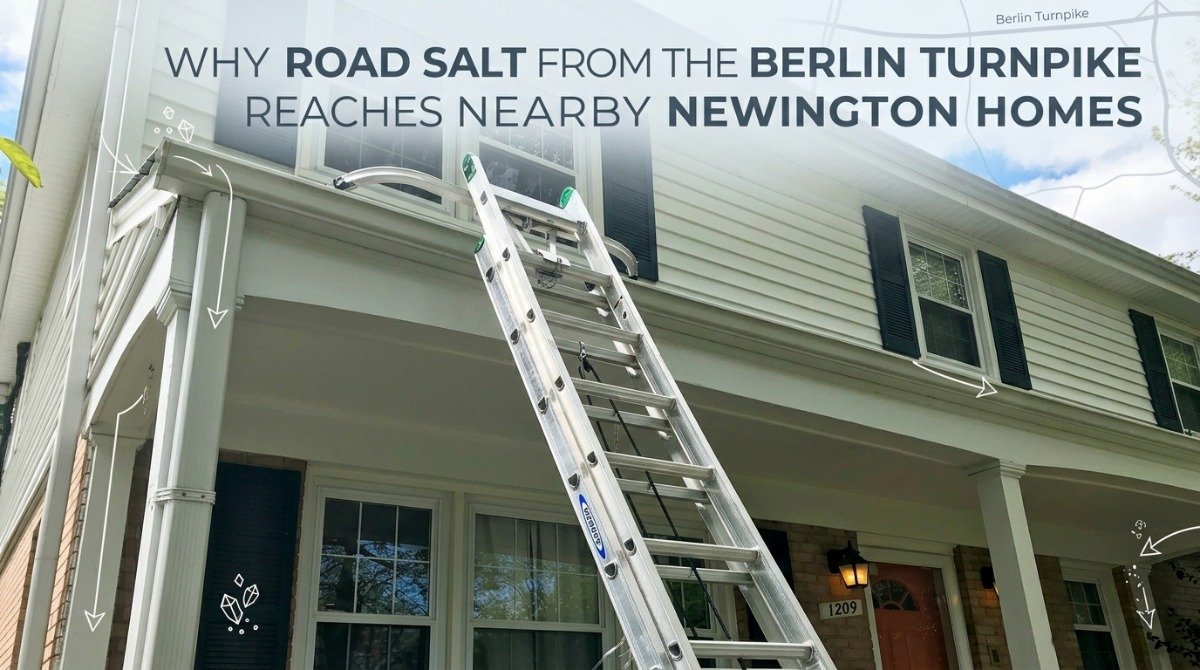
One spring we washed a cape a couple of streets off the Berlin Turnpike in Newington. The homeowner called because the house “looked dingy” and the front windows stayed smeared no matter how often they were wiped.
Walking around it, I saw two different houses. The road facing side wore a dull gray film, and the back was noticeably cleaner. That film was Berlin Turnpike road salt, carried a lot farther than most people expect.
I’m Roman, and I run Mr-Suds Power Washing PROs here in Newington. Below I’ll walk through how salt leaves the road, how far it travels, what it does to each part of a house, and a simple plan to rinse it off in spring.
How does Berlin Turnpike road salt reach homes that are not on the road?
Road salt from the Berlin Turnpike reaches nearby Newington homes four ways: plows cast salty slush, tires splash it, fast traffic lifts a fine brine mist that wind carries downwind, and cars track it onto side streets. Most spray damage appears within about 60 feet of a road, but traces travel hundreds of feet.
- Plow cast. Plows throw salty slush onto shoulders, sidewalks and front yards.
- Tire splash. Wet, salty spray comes off tires and lands in the first few feet.
- Brine mist. Fast traffic lifts a fine salty mist, and the wind carries it past the curb.
- Tracking. Tires and boots carry salt onto side streets, driveways and garages.
What goes on the Berlin Turnpike in winter?
To understand the film on your siding, it helps to know what goes down on the road first.
What is the Berlin Turnpike, and why does it get so much treatment?
The Berlin Turnpike carries US Route 5 and Connecticut Route 15 north from Meriden through Berlin, Newington and Wethersfield to the Hartford line, roughly 12 miles in all.
Most of it is a four lane divided road lined with plazas, big box stores, hotels and diners. It meets Routes 173, 176 and 287, with an interchange at Route 175.
A state road with that much traffic gets steady treatment all winter. The side streets feeding it are town roads, treated separately.
What does CT DOT put on the road?
According to the Connecticut Department of Transportation snow and ice page, the state uses a 23 percent sodium chloride brine, which can go down up to three days before a storm. This anti icing step keeps snow and ice from bonding to the pavement.
During storms, CT DOT uses sodium, magnesium and calcium chlorides, at roughly 100 pounds per lane mile statewide. It has moved away from sand, since sand alone does not melt anything.
A 2015 Connecticut Office of Legislative Research report adds that since 2009 the state has used salt pre wetted with magnesium chloride, which works better in the cold. By the 2011 to 2012 winter, sand use had nearly stopped.
How much salt are we talking about?
That report looked at one study year, the 2013 to 2014 winter. CT DOT used about 227,500 tons of salt, and towns applied an estimated 483,000 tons more.
Totals change every winter, but the scale explains why so much ends up somewhere other than the pavement.
Why does brine stick around longer than rock salt?
Brine goes down as a liquid. It coats the road evenly, and tires lift it easily as mist.
Magnesium chloride also holds water. A Colorado DOT study, summarized in the auto repair trade press, found it clings to metal and turns back to liquid in humid air. The same work found blends with sodium chloride were not more corrosive than sodium chloride alone for most metals tested.
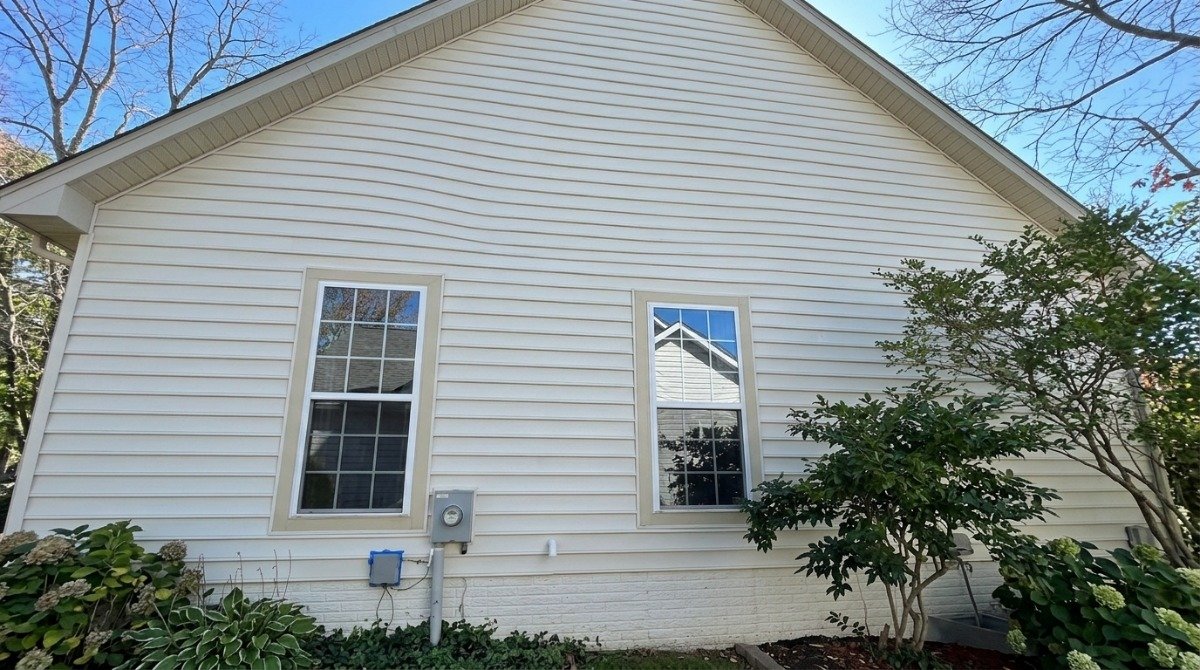
For a homeowner, this means the residue on lower siding is often dried brine that gets damp again every foggy morning. Rain spreads it around, but in my experience it rarely clears lap joints, sills and screens.
How far does road salt spray actually travel?
Here is what published research shows.
| Zone | Typical distance from road | Source |
| Splash zone | First few feet, falling sharply within about 6.5 feet | Pedersen and colleagues, 2000 |
| Spray zone | About 30 to 60 feet | CAES; UW Extension |
| Drift zone | Hundreds of feet, with traces near 1,000 feet | UW Extension; Lazarcik and Dibb, 2017 |
The splash zone: the first few feet
A Danish study in the Journal of Arboriculture (2000) found salt deposits fell off sharply within about 2 meters (about 6.5 feet) of the road edge on roads posted around 43 mph.
This is where sidewalks, fence lines, mailbox posts, curbside shrubs and the end of the driveway take the worst of it.
The spray zone: 30 to 60 feet
The Connecticut Agricultural Experiment Station fact sheet on deicing salts says spray damage to trees and shrubs usually shows up within 30 to 50 feet of the road, often only on the side facing it.
University of Wisconsin Extension puts most damage within about 60 feet. It suggests keeping sensitive plants 60 to 100 feet from highways and 30 to 40 feet from city streets.
On many Newington lots along roads that feed the Turnpike, the front of the house sits inside this zone.
The drift zone: hundreds of feet and beyond
UW Extension notes salt spray can travel hundreds and even thousands of feet, with sensitive plants affected 1,000 feet or more from major highways. Researchers in New Hampshire found road salt in snowpack up to 300 meters, about 985 feet, from the nearest road (Lazarcik and Dibb, 2017).
So you do not have to live on the Turnpike to get its salt. You get less the farther away you are, but it does not stop at the curb.
Why speed, traffic and wind make it worse
Older research on roadside pines along a major Ontario highway found damage grew with traffic volume, speed and the amount of salt applied. It was worse on the downwind side (Lumis, Hofstra and Hall, 1975).
Four lanes of steady Turnpike traffic put far more spray in the air than a quiet side street. It also fits that cape. The road side faced traffic and the winter wind, and it carried the film. The back, sheltered by the house itself, barely had any.
The fourth path: tracking
Every car that leaves the Turnpike for a neighborhood carries salty slush in its wheel wells. It drips onto side streets, driveway aprons and garage floors.
That is why homeowners who never use ice melt still find a white crust at the end of the driveway.
If your house sits within a few blocks of the Turnpike or another busy road, it probably went through the same thing this winter. We are a Newington crew, and our house washing in Newington uses a low pressure soft wash to take salt film off siding, trim and windows. First time house cleaning customers in Hartford and surrounding towns get 15 percent off.
What does road salt do to each part of your home?
When people ask about road salt damage to a house, I separate cosmetic from real wear. Most of it is cosmetic, but a few parts deserve attention.
Does road salt damage vinyl siding?
Honestly, salt is not going to eat your vinyl siding. Vinyl does not rust or corrode.
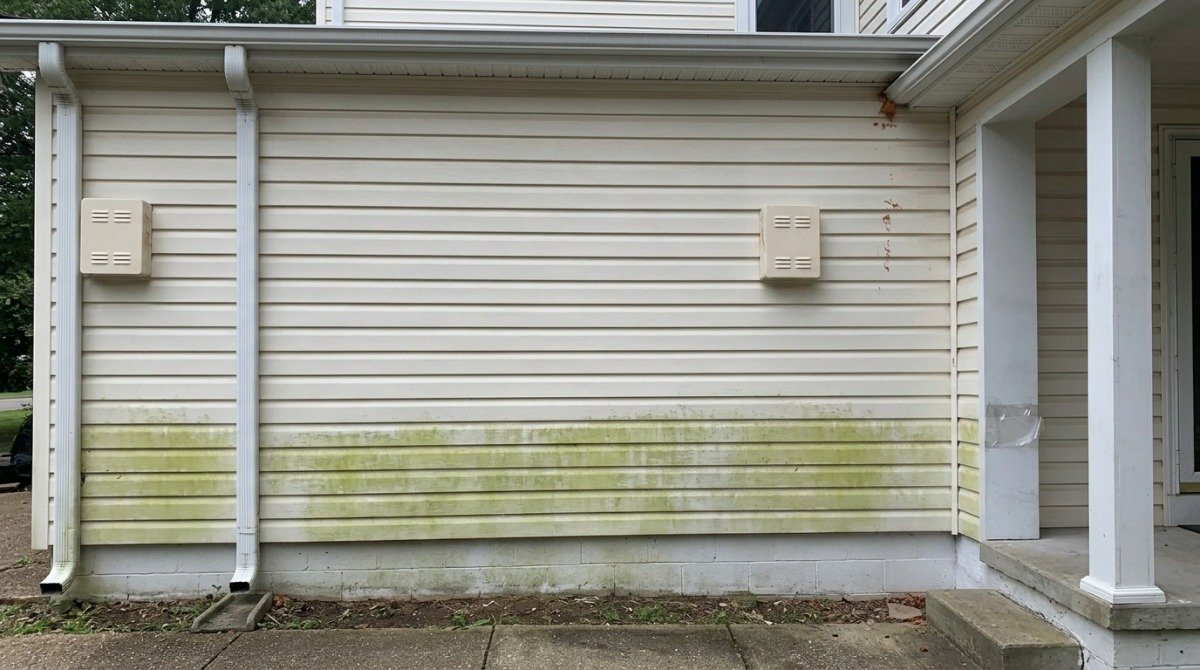
What salt does is leave a hazy film that grabs road grime, exhaust soot and pollen. That is why the road side of a house goes gray so fast.
The real risk is what is attached to the vinyl: aluminum trim, fasteners, light fixtures, hose bibs, dryer vents and the AC unit.
For vinyl siding cleaning, we rinse top to bottom at low pressure. High pressure can push water behind lap joints, and if that has happened, here is what to do when water gets behind your siding.
Aluminum siding, metal trim and painted wood
The Office of Legislative Research report notes that all chloride deicers speed up corrosion. That matters on metal parts of a house.
Many Newington homes from the 1950s through the 1970s still have aluminum siding with chalky, oxidized paint, and salt film adds to it. Careful aluminum siding cleaning helps, and our guide on aluminum siding chalking explains the powder on your hands.
On painted wood and cedar, salt residue holds moisture against the paint at bottom edges and corners. If you plan to repaint, cedar and wood siding cleaning gives the new paint a clean start.
Why are my windows hazy after winter?
Dried brine and road film leave a haze on road facing glass and screens. Spray cleaner often just smears it.
Rinse the salt off with plenty of clean water first, then clean the glass. Take screens out and rinse them on their own.
On homes near busy roads, I usually find the lower front windows and the ones nearest the driveway are the worst.
Metal railings, fences, mailboxes and outdoor equipment
The Pennsylvania Aggregates and Concrete Association notes that deicers can damage steel and iron railings. Front steps near the street take a lot of splash.
Metal fences along the road, mailbox posts and AC condenser fins sit right in the splash and spray zones. Wood and vinyl fences hold the grime too, and fence cleaning in Newington is part of many spring visits.
After a rinse, touch up chipped paint on iron railings so bare metal is not left exposed.
Driveways, walks and steps
Salt on the apron and walks speeds up freeze thaw scaling. Research in the ACI Materials Journal (2017) found calcium and magnesium chlorides can also react with the cement paste itself.
We cover freeze thaw damage and sealing in a separate article on untreated concrete. For now, clean the apron and walks in spring so chlorides do not sit there all summer.
Our pressure washing in Newington uses controlled pressure on concrete. If you have seen stripes from a past cleaning, read about concrete that etches or stripes after washing.
Your car
We do not wash cars, but this is worth a mention. AAA estimated in 2017 that road salt and deicers cost US drivers about $3 billion a year in rust repairs.
AAA advises washing your vehicle often in winter, undercarriage included, with one last undercarriage cleaning in spring.
Shrubs, trees and lawn edges
Salt injury on evergreens usually starts as browning at the needle tips and moves inward, often on the road side only. Dieback and buds that fail to open are common too.
Spray burns foliage. Salt in the soil is taken up by roots, where chloride builds to toxic levels, and sodium packs clay soil tighter (CAES). CAES also notes March salt is thought to do more harm than early winter salt.
If you replant along the road edge, the CAES list helps:
- High tolerance: Norway maple, white oak, honeylocust, Japanese black pine, white spruce, yew
- Sensitive: sugar maple, eastern white pine, Canadian hemlock, dogwood, viburnum, winged euonymus
We are careful around plantings on every job. If another crew hurt yours, here is what to do when a contractor damages your landscaping.
When and how should you rinse road salt off your house in spring?
Timing first, then the steps.
When is it safe to wash in Connecticut?
Wait until the salting season is over and nights stay above freezing, so rinse water does not refreeze on steps. The Hartford area’s last spring freeze usually comes in late April, so late April into May is the usual window.
Plants are the exception. CAES advises rinsing salt off foliage as soon as you can after exposure, and leaching the soil once the ground thaws.
Do not wait until midsummer. The film keeps getting damp and holding grime all spring.
The spring salt rinse, step by step
Here is how to remove road salt from a house, in the order we follow:
- Walk the house and note road facing sides, metal fixtures and damaged paint.
- Pre wet the plants and beds along the road side with plain water.
- Soft wash siding and trim from the top down at low pressure.
- Rinse windows and screens with plenty of clean water before cleaning glass.
- Rinse metal railings, fences, mailbox posts and the AC unit.
- Clean the driveway apron, walks and steps with controlled pressure.
- Give road side beds a long, slow soak to start leaching salt from the soil.
- Rinse the plants again at the end.
Why soft washing instead of blasting the siding?
Salt film is a surface residue. It comes off with the right solution and a thorough rinse, not with force.
High pressure on vinyl lap siding and older painted wood can drive water behind panels and lift paint. As I often say, “The priority on every property is matching the right method to the right surface.”
That is why soft washing in Newington is our default for siding and painted trim. Pressure is for surfaces that can take it, like sound concrete.
How often should houses near busy roads be washed?
General home care guides suggest yearly washing for most homes and twice a year near heavy traffic.
For homes near the Turnpike, a spring salt rinse every year makes sense. For heavy exposure, I also suggest a fall wash so the siding goes into winter clean. Putting it off for years tends to cost more later, which we will cover in a separate article on deferred maintenance.
What we found on a house off the Berlin Turnpike
Back to that cape. The homeowner had already tried the hose and a bottle of window cleaner, and the front still looked dull.
On the walk around, the road side had a gray film from the foundation up past the window sills. The front windows were hazy and the screens were worse. A white crust ran along the driveway apron and the bottom of the garage door.
A metal railing by the front steps had rust starting at the base. The shrubs along the street were brown on the road side and green on the side facing the house.
The back wall looked far cleaner. Same siding, same age, same owner. The only difference was the road.
We soaked the front beds and shrubs with plain water first. Then we soft washed the siding and trim top to bottom at low pressure and rinsed it thoroughly.
Next came the windows and screens, then the railing, mailbox post and AC unit. We cleaned the apron and walk with controlled pressure and rinsed the plantings again.
Before we left, I talked through next year with the homeowner: a spring rinse once nights stay above freezing, a fall wash to start winter clean, and yew or another salt tolerant shrub if they ever replant the street edge.
Which Newington and Hartford area homes get the most road salt?
You can usually place yourself on this list quickly:
- Homes along and just off the Berlin Turnpike in Newington, Wethersfield and Berlin
- Homes on the state roads that cross or feed it, such as Route 175, Route 173, Route 176 and Route 287
- Homes on busy Hartford streets and near Interstate 84 and Interstate 91 ramps
- Houses with a short setback, corner lots that get plow cast from two directions, and homes downwind of a busy road
Many are older capes and ranches with aluminum or vinyl siding, so the film shows quickly. Near the southern end of the Turnpike, we also offer house washing services in Berlin, CT.
Businesses on the Turnpike strip get it worst. Storefronts, sidewalks and entries collect spray and slush all winter, and our commercial exterior cleaning in Newington and Hartford covers flatwork and building washing.
Road salt and your home FAQs
How far does road salt spray travel?
Most plant damage appears within about 30 to 60 feet of a road. Fine spray can travel hundreds of feet, and researchers have found road salt in snow nearly 1,000 feet from roads.
Does road salt damage vinyl siding?
Not chemically. It leaves a film that holds grime and dulls the color, and it is hard on metal parts attached to the house. A spring soft wash removes it.
What does CT DOT put on the roads?
A 23 percent salt brine before storms, and sodium, magnesium and calcium chlorides during storms. Since 2009, its road salt has been pre wetted with magnesium chloride.
Is magnesium chloride worse than rock salt?
It clings and gets damp again in humid air, so residue lingers. For concrete, calcium and magnesium chloride carry more risk than sodium chloride. For metals, results depend on conditions.
When should I wash road salt off my house in Connecticut?
Late April into May, once nights stay above freezing.
Why are my evergreens brown on one side?
Salt spray burns needles on the road facing side, from the tips inward. Symptoms often show in late winter or early spring.
Should I wash road salt off my car?
Yes. AAA recommends regular winter washing including the undercarriage, plus a final undercarriage cleaning in spring.
Can road salt hurt my driveway if I never use ice melt?
Yes. Tires track salt from main roads onto aprons and garage floors, and plows cast salty slush onto the end of the driveway.
Book a spring salt rinse with a local crew
Living near the Turnpike has its conveniences, and a salty house every March is one of the trade offs.
Mr-Suds Power Washing PROs is based at 130 Dewey Ave in Newington, a few minutes from the Turnpike. We soft wash siding and trim, rinse windows and screens, clean aprons and walks, and take care around your plants.
We are licensed, bonded and insured, with a 5.0 rating on Google. Call (860) 263-9031 or reach us through our contact page to book your spring rinse, and ask about 15 percent off your first house cleaning service.