
By Cory Cooper, Mr. Suds Residential Window Cleaning & Power Washing Kingwood, TX
After 20-plus years cleaning homes around Kingwood, there’s one question I hear more than almost any other. I’ll be standing in someone’s driveway, looking at their siding, and they’ll ask: “So is this power washing or pressure washing? And which one does my house actually need?”
It’s a fair question. The two terms get tossed around like they mean the same thing. Sometimes they do. Sometimes they don’t.
And here’s why it matters. Pick the wrong method, and you can crack siding, gouge a deck, or drive water behind your walls. I’ve seen it happen. So let me explain it the way I’d explain it to a neighbor over the fence.
My wife Brooke and I run Mr. Suds together. We’re a small, family-owned shop, and when you book us, it’s the two of us who show up. This guide is the straight answer, built from real homes, real surfaces, and a lot of years holding the wand.
What Is the Difference Between Power Washing and Pressure Washing?
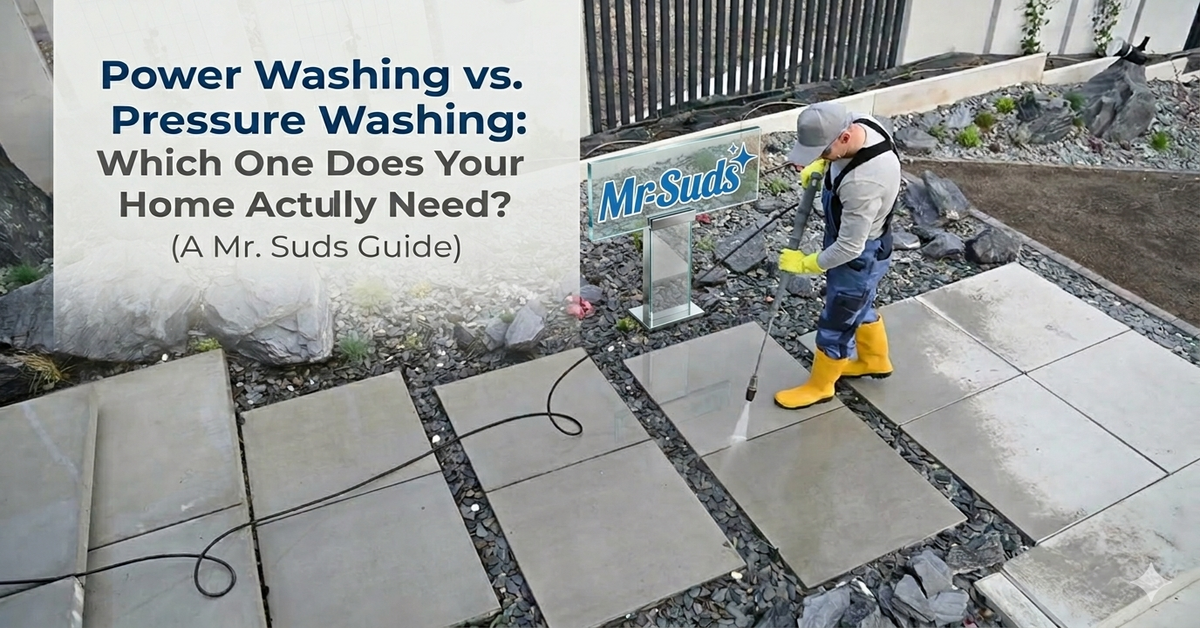
The only real difference is heat. Power washing uses heated water. Pressure washing uses unheated, cold water. Both blast a high-pressure stream from the same kind of machine, with the same pumps and nozzles. For almost every home exterior, the pressure level (PSI) and your technique matter far more than whether the water is hot.
That’s it. That’s the whole secret the industry sometimes makes sound complicated.
Let me break down how each one actually works.
How pressure washing works (cold water + pressure)
Pressure washing forces cold water through a narrow nozzle at high speed. Two numbers control the job.
PSI (pounds per square inch) is the cutting power. GPM (gallons per minute) is the rinsing power, or how much water flows through. You want both working together.
Most home machines run somewhere between 1,300 and 3,000 PSI. That range handles the vast majority of what a house needs.
How power washing works (heat + pressure)
Power washing adds one thing: a heating element that warms the water before it hits the surface.
Hot water acts like a degreaser. It breaks down oily, sticky messes that cold water struggles with. Think grease on a garage floor or gum stuck to a sidewalk.
That heat is genuinely useful on certain jobs. On the average home? It’s rarely the deciding factor. Most of the time it’s a selling point that sounds more impressive than it is.
What “power washing” really means in our world
Here’s the honest truth from the field. Most companies that advertise “power washing” for homes aren’t blasting your siding with scalding water.
The method most homes actually need
We clean with a mix of pressure washing, soft washing, and the right cleaning solutions. I’d guess 9 out of 10 homes we touch never need heated water at all. The detergent and the technique do the work.
So when someone asks me which one their house needs, my real answer is usually neither extreme. It’s the right pressure, the right cleaner, and a careful hand.
Which Is Better Power Washing or Pressure Washing?
Neither one is universally better. It depends on the surface and the type of mess. For everyday home exteriors like siding, decks, fences, and patios, pressure washing or soft washing is safer and more than enough. Power washing’s heated water earns its keep on grease, oil stains, and heavy commercial concrete, not on the average home.
I know that’s not the clean “X beats Y” answer people want. But it’s the truth.
When pressure washing (or soft washing) is the right call
This covers most of what a homeowner deals with:
- Siding with dirt, mildew, or that green algae film
- Fences and wood decks
- Patios, walkways, and pool decks
- Light to moderate mold on shaded surfaces
For these, cold water plus the correct pressure and cleaner gets the job done without the risk.
When power washing’s heat actually matters
Heat shines in a few specific spots:
- Oil-stained garage floors and driveways
- Grease near grills or commercial kitchens
- Chewing gum on concrete
- Big commercial slabs and parking areas
If you own a restaurant pad or a warehouse apron, heat is your friend. For a typical Kingwood home, it’s overkill.
Soft washing: the option most people have never heard of
Soft washing uses low pressure plus a specialized cleaning solution. It’s gentle enough for siding, painted surfaces, and roofs.
Here’s why I love it. It doesn’t just rinse the surface. It kills the mold and algae at the root, so your home stays clean longer.
In our humidity, that matters. A soft wash on siding can hold up far better than a high-pressure blast that only knocks the green off the top.
How Much PSI Do You Actually Need? (The Mr. Suds Cheat Sheet)
This is the part most guides skip, so let me give you the numbers I actually use.
Bookmark this table. It answers the “how much PSI for ” question for almost any surface on your property.
| Surface | Recommended PSI | Best method | Quick note |
| Vinyl / fiber-cement siding | 1,300–1,600 (or soft wash) | Soft wash | Too much pushes water behind panels |
| Wood siding | 1,200–1,500 | Soft wash / low pressure | Follow the grain |
| Concrete driveway / patio | 2,500–3,000 | Pressure wash | Use a surface cleaner for even results |
| Wood deck (hardwood) | 1,200–1,500 | Pressure wash, fan tip | Keep the wand moving |
| Wood deck (cedar / pine) | 500–800 | Low pressure | Soft wood gouges easily |
| Brick (solid mortar) | 1,500–2,000 | Pressure or soft wash | Skip it if the mortar is crumbling |
| Car / vehicle | 1,200–1,900 | Wide tip, low pressure | 2,000 is the ceiling; 3,000 wrecks paint |
| Roof shingles | Under 100 (soft wash only) | Soft wash | Never pressure wash a roof |
Now let me answer the specific questions I get asked all the time.
Is 2000 PSI Enough to Clean a House?
Yes. 2,000 PSI is plenty for most home exteriors, and for delicate siding it’s actually on the high side. We clean most siding between 1,300 and 1,600 PSI, or with a soft wash under 1,000 PSI plus the right cleaner. The detergent does the heavy lifting, not raw pressure.
People assume more pressure equals cleaner. It doesn’t.
More PSI on siding just means more risk. You can crack panels, strip paint, or force water into the wall where mold grows in the dark. That’s the opposite of clean.
I tell folks the same thing every season: let the chemistry do the work. A good cleaner that dwells for a few minutes beats a brutal blast every time.
Is 3000 PSI Enough to Clean Concrete?
Yes. 3,000 PSI is the sweet spot for concrete. Driveways, patios, and sidewalks respond best in the 2,500 to 3,000 PSI range. Below about 1,500 PSI you’ll be out there all day. Above 3,000, you risk etching the surface.
Concrete is the one place where homeowners usually under-power the job. It’s tough, so it can take real pressure.
Why a surface cleaner beats a wand on concrete
Here’s a pro tip that changes everything. Use a flat surface cleaner attachment instead of a wand.
A wand leaves zebra stripes, those uneven lines where you overlapped passes. A surface cleaner spins the spray in an even circle and gives you a clean, streak-free finish. It’s the difference between “looks okay” and “looks new.”
[Image suggestion: Before/after of a striped concrete driveway vs. surface-cleaner finish | Alt: “Concrete driveway before and after pressure washing in North Houston”]
What PSI Is Best for Power Washing a Deck?
Use 1,200–1,500 PSI for hardwood decks and just 500–800 PSI for soft woods like cedar or pine. Always use a wide fan tip, keep the wand moving, and follow the grain of the wood. Too much pressure splinters and “furs” the boards, leaving a fuzzy, damaged surface.
Wood is forgiving when you respect it and unforgiving when you don’t.
The mistakes I see most often are holding the tip too close and parking it in one spot. Both chew up the wood fast.
Keep the nozzle about a foot off the boards. Move steadily, like you’re painting. And if your deck is older or stained, lean toward soft washing instead.
After cleaning, give the wood a day or two to dry before sealing. A clean, dry deck takes sealer beautifully.
Is 2000 PSI Too Much to Wash a Car?
2,000 PSI is right at the upper limit for a car. You can use it with care, but it’s more than you need. The safe range for vehicles is 1,200 to 1,900 PSI.
If you do use 2,000 PSI, technique is everything. Use a wide 25 to 40 degree tip. Stay one to two feet back. Never zoom in on trim, badges, or seals.
Honestly, for a car, I’d dial it down. You’re rinsing, not stripping.
Is 3000 PSI Too Much to Wash a Car?
Yes. 3,000 PSI is too much for a car. It can strip wax and clear coat, chip paint, dent thin panels, and push water past door and window seals. Keep vehicle washing under about 1,900 PSI.
The “never under the hood” rule
One more thing on cars. Don’t spray under the hood with high pressure.
You’ll force water into the engine bay, the electronics, and connectors that were never meant to take a direct blast. That’s an expensive lesson.
Do You Really Need a 4000 PSI Pressure Washer?
No, not for a home. 4,000 PSI is commercial and industrial territory, the kind of pressure used for heavy equipment, parking garages, and graffiti removal. For a house, it’s overkill and genuinely dangerous, to both your property and you. A 2,000 to 3,000 PSI machine handles every residential job.
I get why the big number is tempting. It feels like more is better.
But a 4,000 PSI machine in untrained hands is a wrecking tool. It can carve lines into concrete and tear through wood and siding in a single pass. There’s no home surface that needs it.
How Many PSI Is a Stihl Pressure Washer?
Stihl pressure washers range from about 1,800 PSI on the electric RE 90 up to roughly 2,700 PSI on the gas RB 400 Dirt Boss, with the full lineup spanning around 1,500 to 3,200 PSI. That covers everything a homeowner could need, which is more proof you don’t need a 4,000 PSI monster.
I bring up Stihl because a lot of homeowners recognize the brand. Their gear is solid, and the spec range tells the whole story.
Even the heavy-duty consumer models top out near 3,000 PSI. The manufacturers know what real homes need, and it isn’t a fire hose.
What Should You Never Pressure Wash? (And Where Not to Use One)
Never pressure wash these: roof shingles, windows and glass, electrical panels and meters, AC condenser units, painted or stained surfaces you want to keep, anything with lead paint, the inside of gutters, vehicle engines, outdoor light fixtures, awnings and fabric, crumbling brick mortar, and people, pets, or plants. Each one either gets damaged or creates a safety hazard.
This is the list I wish more homeowners saw before they rented a machine. We’ve been called out plenty of times to fix a DIY job that went sideways, and it’s almost always something on this list.
The “never pressure wash” list, explained
Roofs. High pressure tears shingle granules right off and can void your roof warranty. Roofs get soft washed, never pressure washed.
Windows, glass, and screens. The force cracks glass and blows out the seals around the pane. This is exactly why our window cleaning is a careful, separate process, not a blast.
Electrical panels, meters, and outlets. Water and electricity don’t mix. You can force water into the system and create a real shock hazard.
AC condenser units. The fins bend easily. Bent fins choke airflow and shorten the life of your unit.
Painted or stained wood, and lead paint. High pressure strips finish you wanted to keep. With older homes, lead paint is worse, since the spray turns it into a toxic mist.
Siding at high pressure. I’ll say it again because it’s the most common mistake. Too much PSI drives water behind the panels, and hidden moisture grows hidden mold.
Where you should never aim a pressure washer
It’s not just what you clean. It’s where you stand and where you point it.
- Off a ladder or up on a roof the recoil can knock you off balance
- Straight at windows, cars, or light fixtures
- Up toward your siding’s weep holes
- Anywhere outdoors in freezing temperatures
What Are the Cons of Pressure Washing?
Pressure washing is a great tool. But it’s still a tool with real downsides if it’s used wrong.
- Surface damage to siding, wood, and concrete
- Water forced behind walls, leading to hidden mold
- Injury risk — even 100 PSI can cut skin
- Stripped paint, sealant, and finishes
- Voided warranties on roofs and siding
- Electrical danger near panels and fixtures
- Cleaning runoff that can harm plants
None of this means you should fear the equipment. It just means the person holding it should know what they’re doing. That’s the whole case for hiring a pro, and I’ll get to that next.
DIY vs. Hiring a Pro in Kingwood & North Houston
I’m not here to talk you out of doing it yourself. Sometimes DIY is the right call. Sometimes it isn’t.
When DIY is just fine
If you’re cleaning a small patio, a section of sidewalk, or doing a quick low rinse on a single-story surface, a rental machine is plenty. Go for it.
When it’s worth calling a pro
Call someone when the job gets bigger or riskier:
- Two-story siding you can’t safely reach
- Roofs of any kind
- Heavy mold, algae, or black streaking
- Surfaces you genuinely can’t afford to damage
The North Houston factor
Our climate is its own thing. The humidity, the shade, and all that oak and pine cover grow mold, mildew, and algae fast.
That’s why a quick blast often doesn’t last around here. A proper soft wash kills the growth at the root, so your home stays clean through the season instead of greening up again in a month.
We see the same pattern every year, especially on north-facing walls that never get full sun. By spring, they’re wearing a green coat.
Why it matters who shows up
When you hire Mr. Suds, you’re not getting a rotating crew of strangers. It’s me and Brooke.
We’re family-owned, fully insured, and we’ve been doing this in Kingwood for over 20 years. Same hands, same care, every visit. That’s the part I’m proudest of.
Frequently Asked Questions
What is the difference between power washing and pressure washing? The difference is heat. Power washing uses heated water, while pressure washing uses cold, unheated water. Both use the same high-pressure stream and machines. For most homes, pressure and technique matter far more than water temperature.
Which is better, power washing or pressure washing? Neither is universally better. Pressure washing or soft washing is safer for everyday home surfaces like siding and decks. Power washing’s heat is best for grease, oil, and heavy commercial concrete, not typical residential cleaning.
Is 2000 PSI enough to clean a house? Yes. 2,000 PSI is plenty for most home exteriors and is actually high for delicate siding. We often clean siding at 1,300 to 1,600 PSI, or soft wash it under 1,000 PSI with a quality cleaner doing the real work.
Is 3000 PSI enough to clean concrete? Yes. 3,000 PSI is ideal for concrete driveways, patios, and sidewalks. The best range is 2,500 to 3,000 PSI. Pairing it with a surface cleaner attachment gives an even, streak-free finish.
How many PSI is a Stihl pressure washer? Stihl models range from about 1,800 PSI on the electric RE 90 to roughly 2,700 PSI on the gas RB 400 Dirt Boss, spanning around 1,500 to 3,200 PSI across the lineup. That covers every common home job.
Do you really need a 4000 PSI pressure washer? No. 4,000 PSI is for commercial and industrial work. For any home surface, it’s overkill and risky. A machine in the 2,000 to 3,000 PSI range handles every residential cleaning job safely.
What PSI is best for power washing a deck? Use 1,200 to 1,500 PSI for hardwood decks and 500 to 800 PSI for soft woods like cedar or pine. Use a wide fan tip, follow the grain, and keep the wand moving to avoid splintering the wood.
Is 2000 PSI too much to wash a car? 2,000 PSI is the upper limit for a car. It works with care and a wide tip, but it’s more than needed. The safe range for vehicles is 1,200 to 1,900 PSI.
Is 3000 PSI too much to wash a car? Yes. 3,000 PSI can strip wax and clear coat, chip paint, and push water past seals. Keep vehicle washing under about 1,900 PSI to protect the finish.
What should you never pressure wash? Never pressure wash roof shingles, windows, electrical panels, AC units, painted or lead-painted surfaces, gutters, vehicle engines, light fixtures, fabric awnings, crumbling mortar, or plants and pets. Each gets damaged or becomes a safety hazard.
Where should you not use a pressure washer? Don’t use one from a ladder or roof, aimed at windows or cars, pointed up at siding weep holes, or outdoors in freezing temperatures. These cause injury, damage, or water intrusion.
What are the cons of pressure washing? The main cons are surface damage, water forced behind walls, injury risk, stripped paint, voided warranties, electrical danger, and harmful runoff. Most are avoidable with the right pressure, method, and an experienced hand.
How often should I pressure wash my house in Houston? In our humid climate, most homes benefit from a yearly soft wash, sometimes twice a year for shaded or north-facing walls that grow algae quickly. Concrete and driveways usually do well on a similar yearly schedule.
Do you offer free estimates in Kingwood? Yes. We offer free, no-obligation estimates throughout Kingwood and the North Houston Metro. Just call or text us and tell us what you’re looking at.
Let Mr. Suds Take the Guesswork (and the Risk) Off Your Hands
Here’s the bottom line after 20-plus years. Most homes don’t need scalding water or a 4,000 PSI machine. They need the right pressure, the right cleaner, and someone who knows where not to point the wand.
If you’re still not sure whether your home needs pressure washing, soft washing, or a concrete clean, just tell us what you’re looking at. We’ll give you a straight answer and a free estimate. No pressure, no hard sell.
When you book Mr. Suds, it’s me and Brooke who show up. Family-owned, fully insured, and proud of every house we leave looking new.
Call or text us at (281) 635-4507 or get a free estimate online.
Want to see what we handle? Take a look at our concrete pressure washing, wood pressure washing, and window cleaning services.