
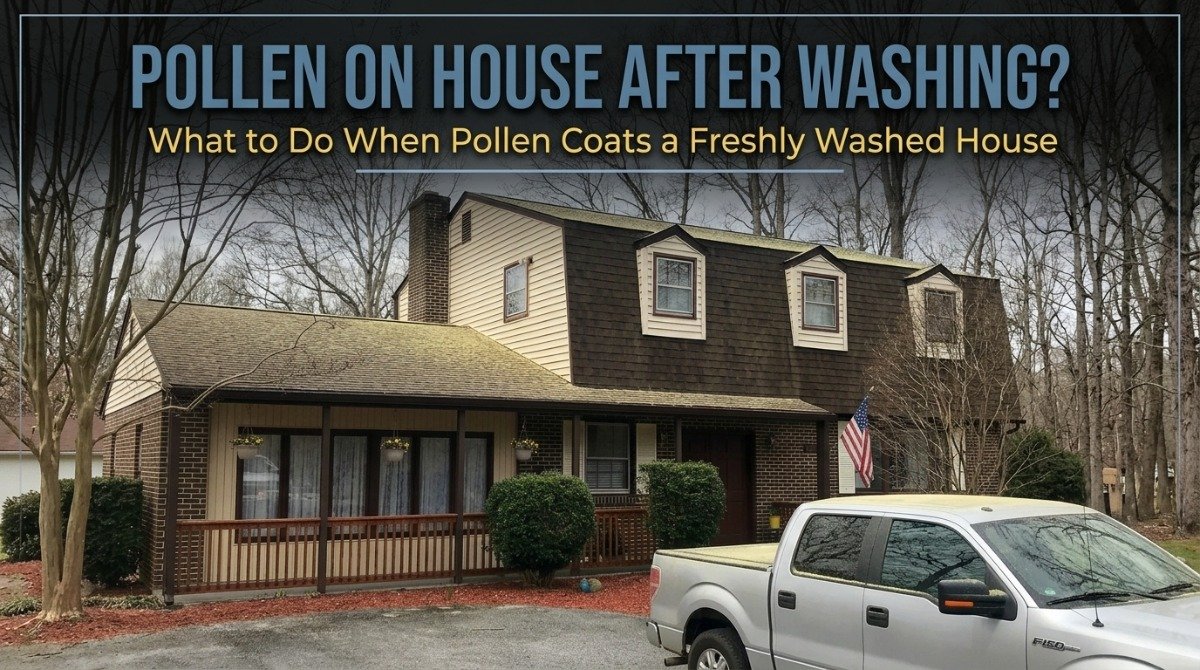
One spring, a couple of weeks after we washed a light gray vinyl cape in Newington, the homeowner texted me a photo. The porch rail had gone yellow. So had the window sills. Under the photo was one line: “Did you guys miss a spot?”
We hadn’t. What they were looking at was pine pollen, and I get some version of that text every May.
If you are dealing with pollen on house after washing, you are in good company, and your money was not wasted. A freshly washed house in Connecticut catches pollen the same way a freshly washed car does.
Below I will walk you through what I told that homeowner. Whether to rinse or wait, whether pollen hurts siding, how to tell it apart from mildew, how to time next year’s wash, and what a fair company should do when you call.
The Short Answer: What to Do With Pollen on a Freshly Washed House
Pollen on a freshly washed house is a new surface deposit, not a failed cleaning. On vinyl or aluminum siding, a gentle garden hose rinse from top to bottom, or the next soaking rain, usually clears it. Skip the pressure washer. Wait until the heavy yellow pine pollen is done before booking any rewash.
Here is the quick version of how I sort these calls:
| What you see | What it usually is | What to do |
| Even yellow dust on siding, sills, porch roof, rails | Pine and tree pollen | Garden hose rinse or wait for rain |
| Yellow film that will not rinse off | Pollen that dried and clung, often in shade | Soft brush and mild soap, or ask us |
| Green or black spots on north walls | Algae or mildew coming back | Call the company that washed it |
| Dark vertical streaks under gutters | Gutter overflow from catkins and pollen sludge | Clean gutters first, then rinse siding |
| Brown worm shaped marks on the driveway | Oak catkins and tannins, not pollen | Often fades; professional treatment if it stays |
Why Does Pollen Show Up Right After a House Wash?
Most homeowners assume a house wash should “keep” for a few months. It does keep. The trouble is timing, and in Connecticut the timing of the yellow stuff surprises a lot of people.
The yellow layer is mostly pine pollen, and it arrives late
The thick yellow dust on your car, deck and siding is almost always pine pollen. Allergy specialists point out that pine grains are large, which is exactly why you can see them sitting on surfaces.
Many of the pollens that actually drive allergies are too small to see. They float. Pine settles.
Pines also run on a different clock than oaks, maples and birches. The University of Maine Cooperative Extension notes that eastern white pine typically produces its pollen cones between May and June. In eastern Massachusetts, local papers describe the yellow coating showing up every June.
Hartford sits a little south of those places. In a typical year, the yellow phase around here lands in late May and runs into early June.
Meanwhile, UConn Health Center allergists have described Connecticut’s tree allergy season as roughly early April to early June, peaking in May. So here is what happens. A wash done in late April or early May looks perfect for a week or two. Then the pines let go.
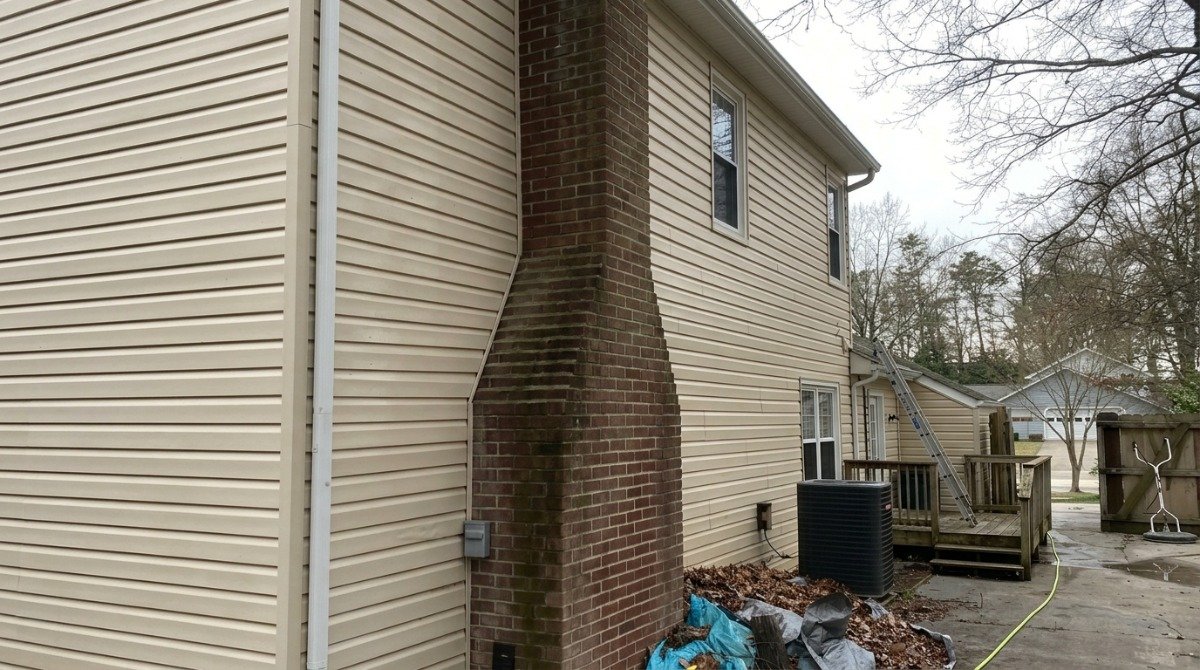
Connecticut is a tree state, so every house gets some
According to the USDA Forest Service, forest covers about 57.8 percent of Connecticut’s land, and oak and hickory make up nearly 70 percent of it. Red maple is the most common tree in the state, and eastern white pine ranks fourth by volume.
Newington and the Hartford suburbs have mature street trees and wooded lot lines. Even a house with no pines in the yard catches drift, because wind carries pine pollen for miles.
Why it looks worse on some parts of the house
On the houses we wash, the yellow shows up first on the sills and the porch rail. That is not a coincidence. Pollen falls straight down and sits on anything flat.
The usual hot spots:
- Window sills and porch rails
- Porch roofs and the top edge of each lap of siding
- Deck boards and outdoor furniture
- Gutters and the ledge above garage doors
Light colors make it more obvious. White, cream and light gray vinyl look yellow fast. Covered porches and soffits never get rained on, so pollen sits there the longest.
Does Pollen Damage Siding, Paint or Windows?
This is the question behind most of the calls I get. People are less upset about the yellow than they are worried about what it is doing to the house.
On vinyl and aluminum, pollen is a surface deposit
I have not seen a manufacturer or university source showing that pollen on its own damages vinyl or aluminum siding. It sits on top. In most cases, water moves it.
Some of it can cling once it dries, especially in shade. Other washing pros describe it as almost a static cling that needs a soft brush to break loose. That is a nuisance, not damage.
The real risk is how you clean it. The Vinyl Siding Institute recommends a soft bristle brush and warns that stiff brushes or abrasive cleaners can change the gloss and leave the siding looking splotchy. That is why our vinyl siding cleaning is done with low pressure, never a stiff scrub.
Painted wood, cedar and older aluminum need more care
Older aluminum siding often has a chalky finish. Scrub pollen off one section hard and you can leave a clean patch that does not match the rest of the wall. We handle aluminum siding cleaning with that chalk in mind.
Cedar shingles and clapboards are soft. High pressure spray can cut or fuzz the wood, which is why cedar and wood siding cleaning calls for a gentle method. Painted trim can lose paint the same way.
As I have said before, Newington homes cover a wide range of ages and building materials, and each surface calls for a slightly different approach. Pollen is no exception.
Can pollen lead to mildew or algae?
I want to be careful here, because a lot of websites state this as fact without anything behind it.
What I can tell you from the field is this. On shaded, damp walls, a film of pollen and dust can sit for weeks. Those are the same walls where algae likes to come back. A light rinse once the yellow phase ends keeps those walls looking clean longer.
Windows, screens and the car
Glass in full sun will streak if you rinse it and let it dry. Rinse windows in the shade or early in the morning.
Screens need their own wipe. A quarter cup or so of all purpose cleaner in half a gallon of warm water, wiped on both sides, then a clean water wipe, does the job.
The car is its own project. A regular car wash handles it.
Is It Pollen, Mildew or Something Else? How to Tell in Two Minutes
When that Newington homeowner sent the photo, I went by the house. The first thing I did was run a finger along the siding under the porch rail. It came away yellow and powdery.
Then I walked to the north side, looked up at the gutters, and checked the driveway. Here is the same check, so you can do it yourself:
- Finger test: Pollen wipes off as a yellow powder or a light yellow smear. Mildew and algae are green, gray or black.
- Location test: Pollen is on every side and heaviest on flat ledges. Algae and mildew favor shaded and north facing walls, in spots and patches.
- Rinse test: Hit a small area with the hose. Pollen moves. Mildew stays put.
- Streak test: Dark vertical lines under gutter seams or corners usually mean the gutters overflowed.
- Driveway marks: Brown, worm shaped marks on concrete are usually oak catkins and the tannins they leave, not pollen. More pressure rarely fixes those.
| Sign | Pollen | Mildew or algae | Gutter overflow | Catkin or tannin stain |
| Color | Yellow to yellow green | Green, gray, black | Dark gray or black lines | Brown or rust |
| Pattern | Even dust, heaviest on ledges | Spots and patches on shaded walls | Vertical streaks under gutters | Shape of fallen catkins |
| Rinses off | Mostly yes | No | Partly | No |
| Timing | Late May into June | Builds over weeks or months | After heavy rain | Mid to late spring |
Catkin stains also land on decks and patios. If they have not faded on their own by midsummer, that is usually a job for deck and patio cleaning with the right cleaning solution, not more pressure.
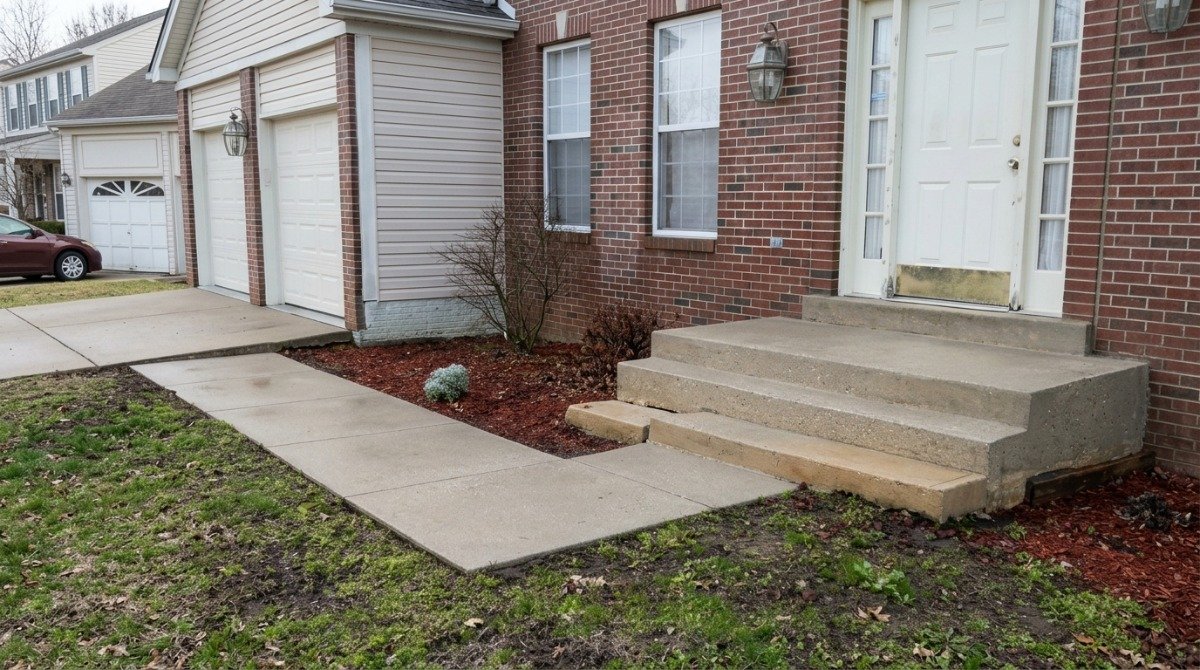
What to Do Right Now: A Safe Homeowner Rinse
You have two good options. Neither one involves renting anything.
Option 1: Wait for a good soaking rain
Honestly, this is often the easiest answer. A steady rain clears most of the pollen off exposed walls.
Just know that while the pines are still shedding, new pollen keeps landing. Rain helps, but only for a few days at a time. Covered porches and soffits will not get rained on at all, so they may need a hand rinse later.
Option 2: A garden hose rinse, done the right way
If you want it gone now, a hose does the job. Here is how I explain it to customers:
- Wait until the heavy yellow fall slows down. Otherwise you will rinse twice.
- Close the windows, move cushions, and wet your plants first so the runoff does not dust them.
- Use a regular garden hose nozzle on a gentle spray. Work from the top of the wall down, so loose pollen flows off.
- Spray straight at the wall or slightly downward. Never aim up under the laps of vinyl or aluminum siding. That pushes water behind it.
- For spots that cling, use a long handled soft bristle car wash brush with mild soap. When you wash with a solution, the Vinyl Siding Institute recommends working from the bottom up to avoid streaks, then rinsing.
- Do the windows last, and do them in the shade.
That is it. No chemicals, no machine.
What not to do
Please do not rent a pressure washer for pollen. It is far more power than the job needs. On vinyl, aluminum, cedar and painted wood, it is the most common way we see homeowners damage their own house.
Forced water behind siding, furred wood and stripped paint all come from the same mistake. The same thing happens on driveways, where a wand held too close leaves etched stripes in the concrete. We are licensed, bonded and insured partly because this kind of work carries real risk when it goes wrong.
A few more things to skip:
- Stiff brushes or abrasive powders on any siding
- Solvents like acetone, lacquer thinner or mineral spirits on vinyl
- Dry sweeping porch floors, which just puts the pollen back in the air
- Climbing a ladder to rinse second story siding
Check the gutters before you rinse
In late spring, oak catkins and wet pollen turn into a paste inside the gutters. Then a heavy rain comes, the gutter overflows, and dark streaks run down a wall that was clean a week ago.
Homeowners often blame the wash for this. Clear the gutters first, then rinse the siding. If the gutters are out of reach, that is something our crew handles with gutter cleaning.
Not sure if it is pollen or something we should look at? Send us a photo. If it is just pollen, we will tell you, and we will tell you how to rinse it without hurting the siding. Mr-Suds Power Washing PROs, Newington, (860) 263-9031.
Should You Have Waited? How to Time a House Wash Around Connecticut Pollen
Short answer: it depends on what you needed the wash for.
The trade off between early spring and late spring
An April wash takes off the winter grime and the algae that built up over the cold months. The house looks great when you want it to. The catch is that it will collect tree pollen, and then the pine shed.
A late spring wash, once the pines slow down, gives you the longest lasting clean look. Around Hartford that usually means June.
Early fall is the other strong window. Average highs at Hartford sit in the mid 70s in September and the low 60s in October, per NOAA normals, and the first frost usually comes around October 20. September and early October work very well.
You will read advice online saying to wash “before pollen season” or in “late March to May.” That timing comes from Georgia and Virginia. It does not fit Connecticut.
When an early wash still makes sense
Sometimes the date matters more than the pollen. Listing photos, a graduation party, a family visit. Or heavy algae on the north wall that you do not want sitting through a humid summer.
In those cases, wash when you need it. Then plan a simple hose rinse after the pine shed. That combination works fine.
A quick look at the Connecticut pollen calendar
Maple and birch release early. Oak runs through May. Pine comes in late, from late May into June, and grasses follow after that. If you book around that order, you get the most out of every wash.
Will the Company Rewash My House If Pollen Comes Back?
This is a fair question, and I would rather answer it plainly than dance around it.
What a wash can and cannot control
A house wash removes what is on the house that day. Nobody can stop pollen from falling next week, any more than a car wash can stop tomorrow’s rain.
What a good company does control is the quality of the cleaning. Missed areas, streaks we left, or algae that was not killed are the company’s responsibility. New pollen is a new deposit. It is not a cleaning failure.
How Mr-Suds handles a pollen callback
If you call us after a wash, we take it seriously. Send a photo or ask us to come by, and we will look at it with you.
If we missed something, that is on us and we come back and make it right. That is what our satisfaction guarantee means. If it is pollen, we will tell you that honestly, show you how to rinse it safely, and help you plan next year’s timing.
Questions to ask before you book next time
- When do you recommend washing a house in my area, and why?
- What does your callback or satisfaction policy cover?
- Do you soft wash vinyl, aluminum and painted surfaces?
If a company books you for the first week of May without ever mentioning pollen, they are not thinking about how your house will look in June.
Practical Example: The Callback That Turned Out to Be Pollen
Back to that light gray cape in Newington.
We had soft washed the siding in spring, along with the front walk. The house had a few white pines toward the back of the lot and oaks along the street. Typical for the neighborhood.
A couple of weeks later came the text and the photo of the yellow porch rail. The homeowner was polite about it, but I could tell they were wondering if they had paid for a half job.
When I got there, the finger test told me most of the story. Yellow powder, every side of the house, heaviest on the sills, the porch roof and the top edge of each lap. The north wall had the same yellow dust and no green coming back. Good sign.
The gutters were the other piece. The front run was packed with catkins and pollen paste, and there was one faint dark streak starting under a seam. Out on the walk, a few brown catkin marks.
None of it was a cleaning problem. So we talked through it.
I showed them how to rinse with the hose on a gentle setting, top to bottom, aiming slightly down. I suggested they wait about a week, until the pine shed slowed, so they would not be rinsing twice. We cleared the front gutter so the streak would not get worse.
They waited, rinsed one evening, and a good rain the following week took care of the rest. The covered porch needed a second wipe. That was it.
For the next year, they decided to keep a spring wash for the algae on the north side and add a quick hose rinse in June. Some customers would rather move the whole wash to June or September. Both work.
My takeaway from that job, and from every May since: the yellow is normal. Every house in Connecticut turns a little yellow in spring. What matters is not panicking and not grabbing the wrong tool.
Pollen Season in Hartford, Newington and Central Connecticut
Hartford has a reputation with allergy sufferers. The city ranked 7th on the Asthma and Allergy Foundation of America’s Allergy Capitals list in 2022, and 60th of 100 in the 2026 report.
The season is also getting longer. Climate Central has reported that Connecticut’s allergy season is about 20 days longer than it was in the 1970s, and the Hartford area growing season has stretched by more than 20 days over five decades.
The houses around here do not help either. Plenty of mid century capes, ranches and colonials with vinyl or aluminum siding, sitting under mature oaks and maples with a few white pines nearby.
We are based at 130 Dewey Ave in Newington and handle house washing in Newington, soft washing in Hartford and pressure washing across Hartford, along with Wethersfield, Rocky Hill, Farmington, Avon and the surrounding towns. Every spring we watch the yellow wave roll through the whole area, street by street.
Our Google rating sits at 5.0, and you can read what homeowners say on our reviews page. A lot of that comes from being straight with people on calls like this.
Frequently Asked Questions
Will rain wash pollen off my house?
Mostly, yes, on exposed walls. A soaking rain moves a lot of it. Covered porches, soffits and areas under deep overhangs stay dusty because rain never reaches them. While the pines are still shedding, new pollen keeps landing, so the cleanest result comes after the shed ends.
Can I use a pressure washer to remove pollen from siding?
There is no need, and it is the riskiest tool you could pick. On vinyl, aluminum, cedar and painted wood, high pressure can force water behind siding, damage wood and strip paint. A garden hose on a gentle spray and a soft brush handle pollen just fine.
Does pollen stain vinyl siding?
In our experience, pollen usually rinses off vinyl. A film that dried on may need a soft bristle brush and mild soap. The Vinyl Siding Institute warns against stiff brushes and abrasive cleaners, because those can dull the finish and leave the siding looking uneven.
How long does the yellow pollen phase last in Connecticut?
The heavy yellow pine shed is fairly short, usually a few weeks from late May into June in the Hartford area. Tree allergy season as a whole runs longer, roughly early April to early June, with oak peaking in May.
Should I wait until after pollen season to have my house washed?
If you want the clean look to last as long as possible, yes. Book after the pine shed, usually June, or in early fall. If you need the house clean for a specific date, wash when you need it and plan a light rinse once the yellow phase ends.
Is the yellow dust what causes my allergies?
Mostly not. The visible yellow dust is mainly pine pollen, and its large grains are less likely to trigger symptoms for most people. The smaller, invisible pollens from oak, birch and grasses do most of the damage to your sinuses.
Is it pollen or mildew coming back?
Pollen is yellow, sits on every side of the house, and rinses off with a hose. Mildew and algae are green, gray or black, grow in patches on shaded walls, and do not rinse off. If you see the second kind soon after a wash, call the company.
Will Mr-Suds come back if pollen lands after my wash?
If we missed a spot or left streaks, yes, we come back and fix it. If it is new pollen, we will tell you honestly and show you how to rinse it safely. Either way, send us a photo or give us a call and we will take a look.
Planning Next Year’s Wash?
If your house turned yellow after a spring wash, you are in good company. It happens all over Hartford County every year.
If you want help timing next year’s wash around the pine shed, or you want us to look at a wall you are not sure about, call us at (860) 263-9031 or request a free quote online.
First time customers in Hartford and the surrounding towns get 15 percent off their first house cleaning service. Mr-Suds Power Washing PROs, 130 Dewey Ave, Newington. Licensed, bonded and insured, with a 5.0 rating on Google.